0:00
Hi, I'm Dustin Abbott and there's a good chance that if I was coming up your drive and I was
0:13
carrying this, you would think I was some kind of traveling salesman. But instead, I'm here to talk
0:18
to you about a product that if you like to shoot things like product photography, maybe food
0:25
photography, even some macro work, this is something that you, like myself, might find
0:31
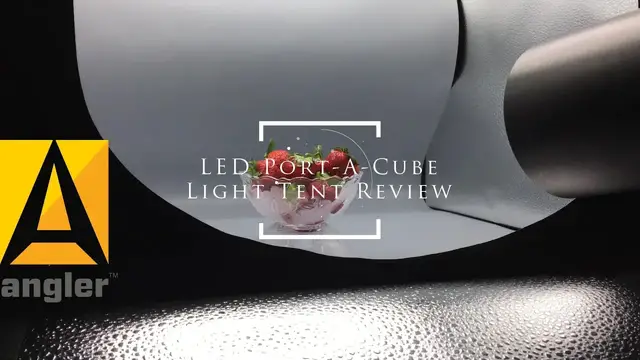
very, very useful. This is from the manufacturer Angler, and this is an LED light tent, portable
0:40
light tent. And so before we jump into that, I'm just going to pull a few of the things out of an
0:45
outside mesh pocket. There is a diffuser here, instruction booklet that came in the box, and then
0:52
there are some electrical components here and so we will just quickly assemble these two things
0:58
and so we're ready to plug it all in when we get it assembled
1:07
Okay and so with those things out of the pocket you have what is you know fairly large in terms
1:13
of going across but it's only about an inch inch and a half thick here and so you have something
1:20
that is actually very easy to store but is surprising how useful that it is. And so through
1:27
the use of Velcro, we'll just start to lay things out here so that we can take a look
1:32
at that. And so we have a few different components that are a main part of the setup here. And
1:38
so there are some panels that we can stand up and we'll just, I'll quickly assemble those
1:47
three together here and then I'll turn it and so you can see a look so all of these have just velcro
1:54
that attaches on the corners easy to set up there and then once you have established that you've got
2:01
a reflective surface inside you've got this kind of cubed shape here there's another component that
2:08
comes as a part of that and if you look inside as I fold this further down right now there is a background that is set up but there is actually a total of four different options that are included There is a white there is a black there is a kind of a
2:26
medium gray that's going to give you a very nice white balance, and then even a green if you're
2:31
wanting to do some chroma key work with it. And so here just for our sample purposes, I'm going to
2:39
pull these others out and I'm just going to take out and then I'll just take out this white here and so all of these are they're actually a fairly
2:53
heavy grade of material they're not a paper but I'm not exactly sure what the material is but it's
2:59
very resistant to both wrinkling and it's certainly pretty much tear proof and so what you do with this
3:06
is that you have on one end of it there are some uh there's velcro that will actually attach
3:14
inside here so i'm just attaching that end and then on this opposite end there's actually a little
3:21
kind of slot for that to be tucked under and once you have tucked all of that in you can then
3:28
bring the top flap up like this and once again you use the velcro to attach up the sides
3:39
and then once you've got all of that assembled you simply rotate everything over like this
3:50
and then once that has been opened up then we can look inside and now we have a very white surface in here in which to put our products on
4:03
to shoot now it gets even more interesting however i'm going to close that back for a moment
4:08
as you remember we do have an actual power plug here and so the cool thing about this there is a
4:16
plug here to tie into for that. And so I simply plug in that. I'm going to plug this into the wall
4:29
Now there actually an actual power switch here And so you can switch it on and off I going to open that back up so you can see inside and then if I switch that on there actually some built LED lighting here that coming
4:42
down from the top that fills that space up with light. Now if you find things a little bit too
4:48
bright there is a diffuser that we saw earlier that you can actually detach inside and so you
4:56
can diffuse that light a little bit but what happens here is you have a couple of different
5:01
shooting position options. And so obviously there is this front flap that opens up quite wide
5:06
On top here, there's also another additional shooting spot that you can shoot down through
5:13
if you're wanting to do top related. And of course you could also tilt this in another direction if
5:18
you so desire. So what I've got here to do today is, and by the way, you can easily, there's
5:26
actually a flap here where I can fold that down to hold that open. Lots of cleverly placed velcro
5:32
things along the way that will allow you to keep things open or closed
5:46
But what I've got to accomplish here today and one of the primary things that I'll use this for
5:51
is when I am shooting lenses. And so what I've got is I've got a couple of different lenses that
5:57
I am wanting to shoot together here. And that's the Sigma 135 f1.8 art along with the Zeiss Milvus
6:05
135 millimeter f2. And so what I will do is I'll put them inside of the light tent and I will get
6:11
some of my product shots that I will use in, you know, my various promotion and reviews. And so
6:21
going to go ahead and take those images and then I'll show you a few of what I produce here using
6:26
just this setup right here. So as you can see these images allow you to really create a very
6:36
in this case I'm going for a high key look where it's a very pure background. You could also put
6:41
them on black and the fact that these are a material that doesn't going to absorb moisture
6:47
means that I can also as I do sometimes I can spray a little mist on that and so I can give a look that to emphasize in this case maybe some weather sealing and so it gives you just a lot of versatility and then of course I could even
7:00
go chroma key if I wanted to put something different in the background go for a black look
7:04
or a low-key type look and so there is a lot of different alternatives and options and then as you
7:10
saw all you have to do when you're done shooting is reverse the whole process store everything
7:15
inside of it and you're back to having something very compact that could be put into a closet
7:21
or in a corner and take up very little space in the real world
7:25
All in all, this is a very, very useful product and I'm very excited for using this moving
7:30
ahead because I do some product photography and also I incorporate a lot of this into
7:35
my actual lens and gear reviews and so it's something that will be very beneficial for me
7:41
great news is that this product from angler you can get it for under a hundred bucks and i'll
7:47
throw a link in the description down below so if you're looking for something like this
7:51
it seems to work very very well employ the diffuser if you want to kind of limit the light source
7:58
but that that does bring me to what i would consider the one kind of weakness here that i
8:04
would the one thing that i would like to see changed or improved and that is that there is
8:09
no kind of slider control, no kind of dimmer for the built-in lighting. And so in some cases
8:15
you may end up with some hot spots if you don't manage your lighting appropriately. And that could
8:21
be more easily avoided, much more usefully than just putting a diffuser on there if the switch
8:26
itself had a dimmer incorporated it. And the fact that these are LEDs should make the dimming aspect
8:32
fairly easy to add on to into the future. But beyond that, if you understand how to use
8:37
aperture and shutter speed, you should be able to eliminate that problem anyway from your everyday
8:42
shooting. And so far, I haven't personally found it to be an issue. I'm Dustin Abbott. Look in the
8:48
description down below if you would like to get a link to looking at this. And of course, if you
8:54
haven't already, you can subscribe or follow me on social media. Thanks for watching. Have a great day