Up next in 10

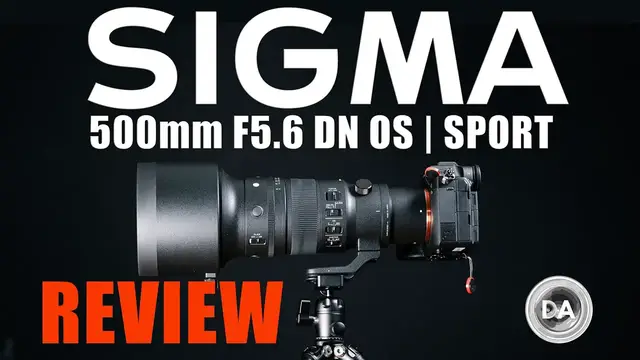
SIGMA 500mm F5.6 DG DN OS | SPORT Review | The Tele We've All Wanted?
Feb 22, 2024

Photographer Dustin Abbott shares a review of the telephoto everyone has been asking for - the Sigma 500mm F5.6 DN OS | SPORT. Is it what we all wanted? | This video is sponsored by Fantom Duffel. Visit https://store.fantomwallet.com and use code DUSTIN20 to get 20% off | Read the Text Review: http://tinyurl.com/500DNreview | Visit the Image Gallery: http://tinyurl.com/500DNPics | Purchase the Sigma 500mm F5.6 DN Sport @ B&H Photo https://bhpho.to/48rLFTp | Adorama https://howl.me/clGotWXcyqF | Amazon https://amzn.to/3wk9wqu | Camera Canada https://shrsl.com/4fe3w | Amazon Canada https://amzn.to/3UMweli | Amazon UK https://amzn.to/48yqmzC | Amazon Germany https://amzn.to/49KYjh1
Check out the DA Merch here: https://bit.ly/TWIMerch | Become a Patron: https://www.patreon.com/dustinabbott | On the Web: http://dustinabbott.net/ | Sign up for my Newsletter: http://bit.ly/1RHvUNp | Instagram: http://bit.ly/DLAinsta | Facebook: http://on.fb.me/1nuUUeH | Flickr: http://bit.ly/1UcnC0B | 500px: http://bit.ly/1Sy2Ngu Follow Craig @ https://www.instagram.com/craigstoffersen/
Want to support this channel? Use these affiliate links to shop at:
B&H Photo: http://bhpho.to/1TA0Xge
Adorama: https://howl.me/cjU0LKdp3LN
Camera Canada: http://bit.ly/DLACameraCan
Sony Canada: https://www.thesonyshop.ca/?ref=abbott
Amazon: https://amzn.to/3HrY64d
Amazon Canada: https://amzn.to/3qG1p18
Ebay: http://bit.ly/DustineBay
Into the AM Clothing: https://bit.ly/intotheAMda and use code DUSTIN10 for 10% off
Make a donation via Paypal: https://www.paypal.com/paypalme/dustinTWI
=============================
Table of Contents:
=============================
0:00 - Intro and Concept
1:05 - Fantom Duffel
Show More Show Less View Video Transcript
0:00
Hi, I'm Dustin Abbott
0:12
This is a lens that, at least on paper, is a lens that I have seen so many people ask
0:17
for over the last five or so years. This is a reasonably priced, about $3,000 US dollars, which is half the price of Sigma's
0:25
previous F4 version of this lens. It's a high-performing, lightweight, 500mm F5.6 prime lens
0:35
The Sigma 500mm F5.6 DN OS sport lens uses basically all of Sigma's latest technologies
0:42
to produce what is a really fantastic telephoto lens. There are a few unfortunate realities that we will detail that are beyond their control
0:52
but if you take those things out of the equation, this is a package that Sigma has really done
0:56
a great job of executing. So is this the lens that you've been waiting for
1:00
Well, let's find out all of my thoughts as we come back right after a word from our sponsor
1:05
Today's episode is brought to you by the Phantom Duffel, a new, unique convertible duffel bag
1:10
that starts as a compact, packable case that easily fits into your luggage or carry-on
1:14
bag, but then converts into a 35L duffel. The exterior is made of 1680D ballistic nylon, which is tough and weatherproof
1:23
The interior has a high-visibility reflective finish that allows you to easily see what's
1:28
inside, even in a dim hotel room. A large foam pouch on the side has a cable pass-through to allow for charging, and the
1:34
removable straps use a Fidlock system to easily and securely connect them
1:39
I've been using it for the gym, and it has room for my water bottle, a change of clothes
1:43
a basketball, my massive shoes, a towel, and a charger for my cell phone
1:47
Visit store.phantomwallet.com to check it out, and use code Dustin20 for 20% off when
1:53
you're ready to check out. So obviously, one of the huge reasons why people are interested in a lens with a long
2:00
focal length, 500mm, and then a slightly smaller maximum aperture of just f5.6, is that the
2:06
size of the lens radically changes. This lens is much shorter and much, much lighter than Sigma's previous 500mm f4 lens
2:16
And just to give you an idea of the weight, it weighs in at 1365g in Sony E-mount version
2:23
There's also a Leica L-mount version. So that's about 48 ounces. To give you some comparisons, Sigma's own 150-600mm sport weighs 2100g, making it 53% heavier
2:36
The Sony 200-600 is about 5g heavier than that, so roughly the same
2:41
Sigma's own 60-600mm sport, which in my opinion is the superior lens, it weighs 2500g
2:48
So it is nearly 60% heavier than what this lens is. So what that means is that if you're someone who's looking for a telephoto lens that you
2:55
can take out and you can use handheld, I would say that most people are going to be capable
3:01
of doing that with this lens. It really is quite lightweight, and it's going to basically hit you with the same kind of
3:07
roughly weight kind of cost that a typical 70-200mm f2.8 lens will
3:13
Which is to say, it's heavy, you'll notice it, but it's certainly manageable even for
3:17
longer periods of time. Likewise, this lens is considerably shorter than the competing telephoto zooms
3:24
You can see here from this shot that it is dwarfed by the Sony 200-600mm lens
3:30
This prime lens from Sigma is 236.6mm or 9.3 inches in length, and that compares to 317mm
3:40
or 12.5 inches for the Sony lens. It is 107.6mm or 4.2 inches in diameter, and you can see it has a fairly large front filter
3:52
thread of 95mm. Now, you'll also note that while there is that flare-out to that large front element
3:58
that lets lots of light in, you'll also see that the actual barrel of the lens itself
4:02
is quite compact. Speaking of that barrel, this lens is made of a combination of different materials, including
4:08
magnesium alloy, and then what Sigma calls TSC, or thermally stable composites, essentially
4:15
high-end engineered plastics. Very nice build quality, and I will note that the lens hood itself is lightweight because
4:21
they have used carbon fiber infused plastics for that. It does have that rubberized contact point at the front, which I think is really great
4:29
for a lot of reasons. Number one, it's going to do a better job of absorbing energy if you happen to bump
4:35
into something accidentally, but also when you have that nice rubberized stable point
4:40
makes it very natural to be able to put the lens, you know, stand it upright like this
4:44
without ever doing any kind of damage to anything. And so, nice execution there
4:49
I'm not really convinced that this whole, you know, having to use a tension knob to
4:53
attach that as opposed to bayonet style is an improvement, but that's what Sigma does
4:57
on their large telephotos. By the way, this lens also does come with a very nice nylon padded case that has a carrying
5:05
strap for it to help you with convenience for that. Now inside the lens, it is thoroughly weather sealed from the gasket to all the various
5:14
rings and switches, buttons along the way. Everything is sealed. This is sports series, which gets Sigma's highest degree of build quality along with
5:23
weather sealing designed to be used outdoors. This is also an extremely feature rich lens
5:30
It has three different function buttons, focus hold buttons at three different positions
5:35
So if you're holding it vertically, different positions, you have one that is, you know
5:38
easy to get to. Also in a first for one of their telephoto lenses, we have an aperture ring here in the
5:44
front and that aperture ring does fall in a good position where it falls easy to hand
5:50
Sigma is really doing a great job with giving you options when it comes to controlling aperture when they're so equipped
5:55
And so we have the option to either click or de-click the aperture here
5:59
We have an iris lock that allow you to either lock in or out of the manual aperture ring
6:04
If you're not a manual aperture ring at all, no problem. Put it in a mode, engage that iris lock and it will stay there
6:10
Likewise, if you don't want to inadvertently pump into auto mode, just keep it locked into
6:16
the manual aperture area. So that's great. The actual manual focus ring is nice and wide, has a little bit of a bevel in it
6:24
It's like ergonomically contoured, falls easily to the hand and has a nice damping to it
6:29
So that is great as well. We have a bank of four switches that comes next
6:35
There's an AF-MF switch, there's a three position focus limiter, and then there that followed
6:40
by an OS control. So you have a mode one, which is your standard mode, mode two, which is kind of panning for
6:46
tracking action. And then below that, we also have a custom button that gives you two different custom options
6:53
Now, here's where the path diverges for Sony and Leica users. For Sony users, there is no lens station that's available or a USB dock that's available
7:05
And so as a byproduct, you are going to have to just stick with the functions that are already assigned to these buttons
7:10
So what they end up being is just two additional modes for the optical stabilizer
7:16
And so what that allows you to do is to have more of a focus on stabilizing the viewfinder
7:21
which by the way, seems to work pretty well for video. I can get the most stable handheld results using that
7:27
And then the C2 position is more of a dynamic to where you basically are only getting stabilization
7:32
at the moment you pull the trigger. You hit the shutter and outside of that, it's allowing you to track maybe more erratic action
7:39
So you have a variety of options there for optical stabilizer. Now on the Leica front, you do have access to a lens station or lens dock
7:50
And so through that, you can assign different values to those custom buttons, a little bit
7:54
more flexibility for Leica users on that front. Now speaking about that optical stabilizer, this is Sigma's OS2, which uses their most
8:02
recent algorithms. It is definitely an improved stabilizer over what we saw in previous lenses
8:08
They first debuted this with the 60-600 sport. And so what I am finding with this is while it's rated for five stops, I was able to get
8:16
I would say, closer to six stops. And you can see in this shot that at just one eighth of a second, I was able to get
8:23
a stable result and I was able to get that maybe about 30, 35% of the time
8:28
And that's six stops at that point. Now again, another diversion is when it comes to the ability to use teleconverters
8:36
L-mount shooters will be able to use the 1.4x and 2x teleconverters from Sigma
8:42
Unfortunately on Sigma, that remains an area that is restricted by Sony
8:46
So at this point, no teleconverter support on something like my camera that I'm using here
8:51
And by the way, no, Sony's own teleconverters don't work. The one final thing to talk about when it comes to the build is that the tripod collar
8:59
and foot here, when it comes to the actual tripod foot, it is ARCA compatible, which
9:05
I love, means I can go right onto a tripod with it. You have a tension knob here that'll allow you to rotate it and you do have clicks at
9:13
the cardinal positions. And so that is great for that. Now when it comes to the actual removability, the collar itself cannot be removed
9:21
The foot from basically this junction on can be removed, though you will have to use the
9:25
included Allen keys to do that. It is not a tool-less operation
9:30
One other thing that you might note is that if you like to carry it by a tripod foot
9:35
there's not a ton of room in between the foot and the barrel of the lens
9:39
It's fairly close. And so that may not work for everyone. Overall, however, this is a beautifully built lens that is just as feature-rich as really
9:46
any of the Sony G Master equivalent lenses. So high marks when it comes to that
9:52
So let's talk autofocus. This has gotten Sigma's newest autofocus system, which they call HLA, which is High
9:59
Response Linear Actuator. So basically a high-powered linear motor. It is very fast and very quiet
10:05
And as you can see here, I was able to make transitions from near to far nice and snappy
10:11
That's all great. The one area where I did notice any kind of slowdown, which is typical of any long telephoto
10:16
like this, is that in some situations, if you're completely defocused, it takes a moment
10:21
to actually get the lens, because you can't see anything and the point of view is, or
10:25
the angle of view is so narrow, it can take a little bit to get kind of to a hard edge
10:29
to where autofocus will engage. So you can mess around for a split second with that
10:34
That's a pretty rare case study, however. For the most part, I found that autofocus was fast, snappy, and delivered very good accuracy
10:43
Now for some reason, Sigma persist in always releasing their new telephotos right in the
10:48
dead of winter, which is difficult for someone like myself because there's not a whole lot
10:52
moving out there when it's extremely cold in Ontario, Canada, where I live
10:58
And so I went out and got skumped on three or four occasions trying to find some birds
11:03
moving around something. And unfortunately, I was unable to do that. And a lot of times I use a dog breeder nearby, and unfortunately she was sick during my review period
11:13
So that did not work out. I did take it to the gym to try to track some pickup basketball
11:19
Now 500 millimeters is too long for basketball court type action. You need more space in that
11:25
It's probably better for more like stadium type sports. And so it's too tight for that
11:30
Even when I was back up against the wall in the field house, probably 35 feet from the
11:35
beginning of the court, and I started someone down near the end, far end of the basketball
11:40
court, they still were just barely... I didn't have enough room to frame both their head and their feet in that shot
11:46
It's just a very long focal length. So it wasn't great for that. And then also F5.6 and that kind of lighting is not fantastic
11:54
Shooting it, ISO 6400 and still only getting like 1 200th of a second, which isn't really
11:59
fast enough. So that's not a great case study for it. However, you can see here that tracking was fairly good
12:06
I did note one dip away, where for about five shots, it..
12:10
Out of the burst of... It was nearly 90 shots in the burst. It swung away for a moment and then came back
12:17
And so I did fine just in shooting other shots. For the most part, my tracking was really good
12:23
I would say that I have a lot of experience with the Sony 200 to 600 millimeter G lens
12:29
which I own. And I would say that I don't think it's still 100% there, but it's very close
12:35
And moving ahead, I think that it'll probably get better still when it comes to that
12:41
The one limitation that is a Sony imposed limitation, like the limitation on teleconverters
12:48
is that on sports cameras like the Alpha 1, which I was using for those tests, I'm limited
12:53
to 15 frames per second, as opposed to the 30 frames per second that the camera is capable of
12:58
And so obviously that's going to be even more dramatic on the new A9 Mark III
13:02
And that's a limitation that Sony has imposed on, unfortunately, all third-party lenses
13:07
Again, not Sigma's fault, but it is a reality that you have to consider
13:11
Now there is no such limitation on Leica L-Mount, but unfortunately there's not really any amazing
13:17
sports cameras on L-Mount. Probably the S5 Mark II at the moment is about as good as it gets
13:23
And so no, the limitation's not there, but neither is there the cameras that can fully
13:28
deliver everything that this lens is capable of. They don't really exist on L-Mount
13:33
Now on the video side of things, I found that video AF was good
13:37
You know, good focus transitions, confident. There is some noticeable focus breathing
13:43
That's in large part due to just being such a long focal length. But again, video AF worked well
13:49
Autofocus system is very, very good. Probably as good as what I've seen from any third-party lens
13:53
I would still say that Sony's top telephotos are just a little bit better
13:58
So how about image quality? I will give you a detailed image quality breakdown and some comparisons in that image
14:05
quality breakdown that comes at the end of the video. You can jump ahead to that if you so desire
14:10
The mark is linked in the description down below. But here's a quick breakdown and overview of that optical formula, 20 elements in 14 groups
14:19
That's three FLD elements, two SLD elements as a part of that makeup
14:24
I found that there was basically zero distortion, nothing that I could measure as far as distortion
14:29
And vignette was incredibly low. It only gave me, I used a plus 25 to correct
14:35
So not even quite, I would say, a full stop of vignette in the corners
14:40
This is one area where it's definitely better than any of the competing zoom lenses
14:44
Typically by 500 millimeters, the zooms have some pincushion distortion and considerably
14:48
more vignette than what you see here. I also found that there was no either longitudinal or lateral chromatic aberrations, no fringing
14:56
that I saw in any of my shots. Really well controlled. And even, for example, in this shot of frost crystals that are formed on something with
15:04
bright light coming right through it, there's just no fringing there. So that is an amazing performance
15:10
And when it comes to sharpness, even at f5.6, it is pretty close to perfect all across the frame
15:16
And you can see the breakdown later on, but it is notably sharper than either the Sigma
15:21
60 to 600, which I think is Sigma's best. And then it's even better than the Sony 200 to 600 millimeter, which is an impressive performance
15:29
Comparing f5.6 to f8, I would say there is the mildest of gains at f8
15:34
After f8, whatever gains might be there are offset by the diffraction that starts on higher
15:39
resolution bodies. I tested for resolution on the a7R Mark V, which is 61 megapixels
15:45
And so after that, I mean, you can go all the way down to f32, but you're going to have
15:50
a remarkably softened image by then due to the effects of diffraction
15:54
So I would say shoot at f8 if you can, and as a kind of a top limit, f11 being your upper
16:01
limit if you're on a high resolution body, but you don't really need to stop down for
16:06
more performance. Basically, almost all performance is available right at f5.6. Now minimum focus distance is not amazing here
16:13
It's 3.2 meters. So that means that our maximum magnification, you can't get particularly close to anything
16:21
and maximum magnification is only 0.17 times. So that is way less than the zoom in particular, Sigma's own 60 to 600 millimeter, which is
16:30
really, really strong at 200 millimeters where you get a maximum magnification of like 0.44
16:36
times or something very high, much higher than this. So don't buy it to be a kind of a long distance macro lens
16:43
That's not its strength. I would say that the bokeh quality is nicer than the equivalent zooms at this focal length
16:49
It's just a little bit smoother and creamier in my opinion, and it's certainly capable
16:53
of producing some really beautiful looking images with very nice color, great contrast
16:58
lots of detail. It's fantastic optically. It even has good flare resistance
17:03
So the amount of times that you're pointing this at the sun or some kind of bright light
17:07
are probably going to be more rare because again, angle of view is so narrow, but at
17:11
the same time, it does really perform well. Really there's nothing to complain about
17:15
There isn't really any flaw that I can point to. It's a very, very strong lens optically
17:21
So in conclusion, this is a near flawless lens in its actual performance
17:25
I would say that the Sony teles have just a little bit better of a focus advantage and
17:31
they tend to use, you know, dual, even quad motors to get maximum performance
17:35
So I would say there's just a little bit more there than what we've got here, but this is
17:39
probably going to be good enough for just about anyone and just about any kind of circumstance
17:43
Unfortunately on Sony, it is held back by those two major Sony imposed third-party limitations
17:49
no teleconverters and a lower burst rate. You're not going to be able to get around that
17:54
That's just the reality of the game. Now on L-mount front, it is primarily held back by the fact that this is an amazing lens
18:01
It really doesn't have an amazing sports camera to pair it with on L-mount
18:06
That hopefully will change in the future and that will make this lens a really compelling
18:09
buy there. The final consideration is that this lens is fantastic in its performance and it's a
18:17
little bit better than the best zoom lenses that cover this right now, but it also costs
18:22
about a thousand dollars more than either the 60-600mm from Sport from Sigma or Sony's
18:29
own 200-600mm G lens. And so you're going to have to, you know, decide whether or not that extra bit of performance
18:36
and the more compact size and lighter weight is worth the trade-off and of an additional
18:41
thousand dollars. But I will also say that this is a lens that definitely fills a need and a niche that have
18:49
existed for a long time on both Sony and Leica L-mount fronts
18:53
And this is a lens that people have been asking for. Now we'll see if they're going to go out and buy it
18:59
I'm Dustin Abbott and you'll stay tuned. I can give you the full image quality breakdown, but if you want more information, you can
19:06
find buying links in the description down below and also linkage to both my full text
19:09
review and also to an image gallery if you want to see more from it
19:14
And now without further ado, let's dive into our detailed image quality breakdown
19:26
Okay let's start by taking a look at vignette and distortion. You'll be excused if you don't see much difference between the image on the left and the image
19:33
on the right. You can see that there is so little distortion that I didn't see anything worth correcting
19:39
And vignette is actually so low that I only used a plus 25 to correct for it
19:43
And so there's very moderately less vignette that shows up there. But really there is almost nothing to correct for when it comes to vignette and distortion
19:51
This is an area where it definitely exceeds all of the zoom lenses that cover 500 millimeters
19:56
that I've tested. Now this image really shows how well longitudinal chromatic aberrations are controlled
20:03
That's the fringing before and after the plane of focus. So you can see both before and after plane of focus here
20:09
And we can see that even with these, you know, they're just frost ice crystals that have
20:14
formed with the sun coming very directionally through them. Lots of potential for fringing here and you can just see that there is nothing to be seen
20:22
It's really, really well controlled. Likewise in this image where we would see maybe some lateral chromatic aberrations
20:29
you see this house down near the edge of the frame. Now you can see that there's some heat shimmer that has affected textures, but you don't
20:35
see any fringing. If we move up here, pan through the trees and we look up here near the edges of the
20:40
frame, there's just no lateral chromatic aberrations to be seen. Just lots of great, great detail
20:45
So that's another impressive performance. Now using a 61 megapixel Sony A7R Mark V here looking at f5.6, this is 200% magnification
20:56
and you can see at this very high magnification level. The detail is just incredible in the center of the frame
21:03
Looking at the mid frame, if anything in this zone, I would say it almost looks better
21:07
Extremely, extremely crisp and looking down here into the corner, that sharpness profile
21:11
just carries right into the corner and it's not just that corner
21:15
If I look up at the opposite side, you can see an identical result
21:18
Very well centered, very, very high performing. So to put that in context, now these two comparisons were not shot at the exact same time, but
21:28
under similar conditions. You can see compared to the, right at near 500 millimeters on the 60 to 600 millimeter
21:34
sport, you can see here in the middle of the frame that the prime lens has a clear advantage
21:40
over the zoom lens. You can see in all of these textures, there's just so much more contrast in detail
21:46
Likewise if we move into this zone, that result becomes even more noticeably different
21:51
The prime just looks fairly soft by comparison. Now I think that the prime does, or excuse me, the zoom lens does a fairly good job in
21:58
the corner of the frame, but the prime lens clearly has more contrast in detail either way
22:06
And if you look up here, you can see that the textures are just popping in a way that they don't with the zoom lens
22:11
So a clear win for the 500 millimeter DN over the 60 to 600 millimeter
22:17
Now I have consistently found Sony's own 200 to 600 millimeter to be really better than
22:23
just about anything that I've tested for the zoom lenses. But you can see that this prime lens from Sigma has a clear advantage over it in the
22:31
center of the frame. You'll note also to get equivalent framing, I had to zoom into 518 millimeters
22:36
These were shot at the same time. I had to zoom into 518 millimeters to get equivalent framing
22:42
In the mid-frame, again, a clear advantage for the zoom, or excuse me, for the prime lens
22:47
And then here looking into the corner, you can see once again, the prime has the clear
22:52
advantage and that's true in both corners. So an easy win there for the prime lens
22:57
Now taking that into a real world image, we can see here as we look at the horse, that
23:02
there is just great detail and contrast in all of the fine hairs
23:07
And if you look along the shaggy coat here, right on out, I mean, look how incredibly
23:12
sharp it is even right there. Just a little bit of softening here towards the very edge of the frame, but it's not far off
23:19
That's a fantastic performance. Now if you compare F5.6 on the left to F8 on the right, you can see that truth be told
23:26
there really isn't any kind of noticeable improvement as you stop the lens down a bit
23:33
All things considered, things are more similar than different. So I see you're getting pretty much maximum performance wide open
23:40
There's just not really any kind of advantage I can point to stopping down to F8
23:45
Now from F8 to F11, you can see that diffraction is taking away just a little bit of the contrast
23:50
already, and that's only going to increase as you continue to stop things down
23:55
If we compare F11, which we could already see was a little bit softer than F8, and then
24:00
a little bit softer still from F5.6, and we compare it to the minimum aperture of F32
24:06
you can see here that we have lost a lot due to diffraction
24:10
The lens still looks pretty fantastic at F11, which does bode well for using even a two
24:15
times teleconverter on Leica L-mount. But you can see that if you go beyond that, diffraction on a high resolution body in particular
24:23
is really going to soften image quality. Now as noted before, there's nothing to write home about when it comes to the amount of
24:31
magnification that's available right under 0.17 times. You can see that up close performance is good
24:37
There's no problem there. I have no complaints when it comes to that
24:41
At its worst, the 60-600mm produces this amount of magnification, and at its best, it can
24:46
give you this kind of magnification. So and again, if you go even to 60mm, it gives you this kind of magnification
24:54
So clearly there's much more flexibility when it comes to getting up close and working with
24:58
the 60-600mm zoom lens. This image here I think really shows off how nice the bokeh quality is
25:05
Just really smooth and creamy out of focus background. This shot here, again, it's a little bit further away, but it shows just how nice the background is
25:15
Likewise, in this shot, which is maybe a more typical working distance if you're shooting
25:19
with wildlife. At this point, I was probably about 70 feet away from the horse here
25:26
You can see that even at that distance, it's able to blur out a background really quite nicely
25:31
And even in this shot, where there is a really complicated background that is right beyond
25:37
the horse, you can see that there is a little bit of jitteriness there, but not bad
25:41
And then you look beyond that, and you can see that the background looks really soft and creamy
25:45
So, I would say bokeh quality is definitely going to trump what we're going to see from
25:49
any of the comparative zoom lenses. One final thing we'll look at is flare resistance
25:54
Again, you're not going to be pointing this lens at into a bright light source very often
25:59
but what I saw was a continued holding up of contrast, and in various positions you
26:04
can see there's no weird ghosting artifacts or just big veiling impact
26:10
It holds up, and basically all the metrics that I can test, this lens passes all the
26:14
tests with flying colors. And as always, thanks to those of you who have stuck around to the very end
26:19
Thanks for watching. Have a great day. Let the light in