Up next in 10


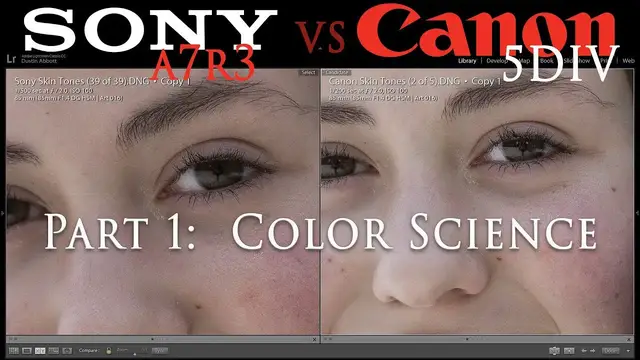
Sony a7R3 vs Canon 5D Mark IV | Part 1: Color Science | Sony's new a7R3 (a7r III) is a hot item, but how does it perform in real world use? Canon is vaunted for it's color science, but is that advantage real? Find out in Part 1 of the a7R3 vs 5DIV showdown.
Visit the Image Gallery: http://bit.ly/Sonya7R3ig
Purchase the a7R III: B&H Photo: https://bhpho.to/2D6ibNO | Amazon: http://amzn.to/2CNxOvH | Amazon.ca: http://amzn.to/2CNYz36 | Amazon UK: http://amzn.to/2CRGvWM
Purchase the 5D Mark IV: B&H Photo: http://bhpho.to/2cLng3e | Amazon: http://amzn.to/2mAJ7MX
Strap of Choice: Peak Design Slide Lite: B&H Photo: https://bhpho.to/2BsubH2 | Amazon: http://amzn.to/2GcxINh | Amazon Canada http://amzn.to/2Fa5Yr7 | Amazon UK: http://amzn.to/2n6ALxC
Want to support this channel? Use these affiliate links to shop at:
B&H Photo: http://bhpho.to/1TA0Xge
Amazon: https://www.amazon.com/shop/dustinabbott
Ebay: http://bit.ly/DustineBay
Make a donation via Paypal: paypal.me/dustinTWI
Get a discount off all Skylum Editing Software (Luminar, Aurora HDR, AirMagic) by using code DUSTINHDR at checkout: http://bit.ly/LuminarDLA
Become a Patron: https://www.patreon.com/dustinabbott | Check me out on: Personal Website: http://dustinabbott.net/ | Sign up for my Newsletter: http://bit.ly/1RHvUNp | Instagram: http://bit.ly/DLAinsta | Google+: http://bit.ly/24PjMzv | Facebook: http://on.fb.me/1nuUUeH | Twitter: http://bit.ly/1RyYxIH | Flickr: http://bit.ly/1UcnC0B | 500px: http://bit.ly/1Sy2Ngu
My filming setup: Sony a7R III: B&H Photo: https://bhpho.to/2D6ibNO or Amazon: http://amzn.to/2CNxOvH | or | Sony a9 @ B&H Photo: https://bhpho.to/2HyWIyt or Amazon: https://amzn.to/2s1vYE0
Tamron 28-75mm F2.8 RXD @B&H Photo: https://bhpho.to/2FA00la or Amazon https://amzn.to/2G2kaEr
Show More Show Less View Video Transcript
0:00
Hi, I'm Dustin Abbott and over the next few weeks I'll be giving you a series of videos
0:11
comparing as I kind of did with the Nikon D850 and the Canon 5D Mark IV. I'll be comparing the
0:18
Canon 5D Mark IV with the new Sony a7R III. And so obviously some of these comparisons are going
0:26
to end up favoring the Sony. Some of them will end up favoring the Canon. And that's, you know
0:30
somewhat the nature of where we are in terms of the market right now in that I don't think that
0:36
there's necessarily a clear leader in all categories, but certainly there's a lot of
0:41
parity across the board. But there are also individual strengths of each camera system and
0:46
each brand. And so today we're going to look at, we're going to start by looking at something that
0:51
a lot of people have been asking me about that has a lot to do with what is perceived as being
0:56
a strength for the Canon system, and that is color science. And when I refer to color science
1:02
I refer to just the way that the camera actually records and renders colors. And so today we're
1:08
going to look at kind of some static comparisons along with a few kind of portrait type comparisons
1:13
so we can take a look at skin tones and we can evaluate whether or not that perception
1:18
about Canon color is in fact accurate, and at the same time, of course, evaluate how Sony is doing
1:25
here with the new a7R III. So let's jump in, let's look at some images, see what we discover
1:31
Okay, so we're going to take a look at the color science out of both the Sony here on the left
1:38
and then the Canon 5D Mark IV on the right, a7R III on the left. There's a lot that is made over
1:44
Canon's color science and how it is superior. And so what I've done here is I've used the same lens
1:51
on both cameras. I've used the Sigma MC11 adapter on the Sony. I've used the Zeiss Milvis 135mm F2
1:59
I use this lens because it is, number one, it's one of the best lenses out there, period
2:05
but also because Zeiss does an incredible job of giving a color neutral lens. And so I think it's
2:12
a great frame of reference. And so as you can see, what I've first done is just allowed both
2:17
cameras to pick their auto white balance for this image. And so as a result, we have an image that
2:24
really is not terribly far off. But what we do see here in the, you know, kind of metallic tones
2:30
of this vintage camera body is we see that there is just a slight bit more of a green cast to the
2:39
Sony image, while the Canon image is, you know, I think it's more neutral in my opinion
2:48
It's not, you know, some people say, oh, Canon just skews red, but I'm not seeing necessarily
2:52
a skewing towards red here. I'm seeing really a more accurate metallic tone, whereas the Sony has
3:00
just a little bit of a green cast to it. Now, if we look at over here at some of these colors that
3:07
are rendered here. Of course, having the ability to look at the original
3:12
I can tell you that the colors out of the Canon are maybe just a little bit more accurate because there isn any kind of cast to it Now if we were to look at the neutral area here kind of the defocused area you know
3:28
for whatever reason, although they're exposed the same, it seems like the Sony image may be
3:33
just a hair brighter, so the black area looks a little bit blacker. Let's take a look also at this
3:38
area here, and once again what we can see just looking over at this area is that there's just
3:44
a little bit more of a neutral color rendition out of the Canon. Now where things got interesting
3:49
is when I set a custom white balance in both cameras and on both of them because I knew the
3:55
color temperature of the lights that I used, I used a Kelvin setting of 5300 for both cameras
4:02
and so as you can see even with both of them having a Kelvin value set into them, kind of a
4:08
custom white balance, you can see that there's definitely a difference and whereas the Canon of
4:13
course is more consistent with what we originally saw in color the the Sony color is actually assumed
4:21
even more of a kind of a green tint to it and that kind of interested me because I would have
4:28
thought that they would actually have been closer with the custom white balance set in there but
4:34
that is not the case if anything I think that Sony did a pretty fair job of allowing those
4:40
kind of coming back to neutral with the auto white balance. Now, if we look here, just looking at this
4:47
at a kind of a brighter level, you can see that on Mario's face here that the skin tones just are
4:54
as a result, they're just a little bit cleaner looking and some of that has to do with the tint
5:00
there. And we can also see that some of these colors just look a, they're not necessarily
5:06
oversaturated, it's a little bit more about accuracy, I would say. And there is similar
5:13
saturation levels, but the end result isn't quite the same. So is it possible to get basically
5:21
Canon colors out of a Sony body? Well, I did just a little bit of tweaking here in Lightroom
5:26
trying to find as close a balance as I could. And a lot of that involved adding kind of more
5:33
magenta tint into the Sony and also lowering the black level a little bit to match the contrast
5:43
punch out of the Canon. And I think that here we've got a pretty close result here. If not
5:51
identical, it's certainly, I think, very, very close. And so I think that the answer is yes
5:57
you can get equivalent color, but it may take a little bit more work to achieve that
6:04
So what about faces? I used the Sigma 85mm f1.4 Art on both of them, a very good portrait lens
6:13
And so as you can see under similar conditions shooting outside here, you definitely get a
6:18
different look to the skin tones on both of them. In terms of the basic color cast
6:23
It's not the same. And in here, it's hard for me to describe this
6:29
but there's definitely, it probably more that green cast that is there Whereas the Canon skin tones as you can see they a little bit paler yes but I think that they also a little bit more neutral in terms of the color
6:45
And so as you can see, I mean, both of them, you know, both results look good
6:51
And if you weren't looking at them side by side, you know, you wouldn't necessarily say one is better
6:56
than the other, but there certainly is a difference. So if I equalize color balance here as much as possible
7:04
to see how our result evens out. We can see that, you know, in both cases
7:09
it's still not quite all things being equal here. And just, there's just a little bit more of a tent there
7:18
And we've seen that just changing the white balance doesn't necessarily do the trick on the Sony
7:23
You need to infuse a little bit more magenta into it for one thing, to help to offset
7:29
some of that green cast or bias. Now, in this case, I purposely entered in
7:33
a cooler white balance for this setting. And so, kind of an overcast day
7:39
and I went with kind of more of a daylight type. And so in this case, that actually produces a cooler result
7:45
And so what we can see is that if we look at the two of them side by side
7:51
the funny thing is, is that in some ways, the Sony has actually skewed a bit cooler
7:57
than what the Canon has. And so that's kind of interesting considering our previous result. And if we look at the kind of skin tones here, there's definitely
8:07
more of a, you know, kind of a magenta or cooler cast here to the Sony. And so in this case
8:15
we still haven't really nailed, you know, good skin tones per se. We've actually ended up with
8:21
an overly cool result compared to the more neutral result from the Canon. So if we take that exact
8:27
same image now and we you know we kind of warm it back up um since the raw files we can do that
8:33
what we see is that we you can see now that there's that kind of magenta magenta cast that was there
8:40
to the sony has remained of course even as you've brought that up and so uh you know again it's it's
8:48
it's different um they're not quite the same and this may be a taste thing i suspect those of you
8:53
that shoot Nikon will look at the Sony skin tones and they'll look, you know, maybe basically right
8:58
to you because I found that the a7R III and the D850 were closer in terms of this than what the
9:04
Canon was. If you're, you know, a familiar Canon shooter, you may look at that and say, that's
9:10
better, that's more accurate. And so certainly the results are different. And by the way, yes
9:16
the exposure values, for those of you that try to say it's going to be exposure value
9:20
The exposure values weren't identical, but I have equalized the histograms on both of them
9:26
And so it's minor enough that this hasn't impacted the image. And so it's more about the difference in the actual color science than it is basically regarding any kind of exposure variation here
9:40
So as you can see, at least in my perception, is that I think that Canon still has the advantage, particularly when it comes to skin tones
9:49
And I think although I use the ogy a green kind of tension in some ways it almost a bit of a yellow bias in skin tones that makes them not just feel warmer per se but in some ways the areas that should be skin toned kind of skew
10:10
a little bit yellow. Now, again, as I mentioned in the comparison video while we're looking at
10:16
the photos, that I think that in a vacuum, I don't think that you would notice that so much
10:22
Let's just say you're out. I mean, by the way, I have no dog in this fight
10:27
I own the 5D Mark IV. I've got my order in for the beginning of February for an A7R III
10:33
And so I'm not out trying to bash either system. My plan is to shoot both of these cameras and both of these systems side by side
10:41
And so I don't think that I have a bias, although I'm sure that there will be some of you that will accuse me of having one
10:47
but I just think that if you were out and you were shooting, and I intend to be shooting portraits
10:53
with the a7R III, I love IAF, I think it'll do great for that, but I think that if I were to
10:59
just take images as I have here, you know, equal things out with the lens choices, and so it just
11:04
comes down to the way that each camera interprets the color of a given scene, I do still favor
11:10
Canon's color science, and I think that in this case we've seen once again that Canon's reputation
11:15
for really doing skin tones very well is justified here. And so I think that there are ways, obviously, in post-processing
11:25
or even in the way that you use kind of custom color profiles
11:30
or custom white balances, maybe I should say, as a part of the shooting process, that you can get fantastic color
11:36
out of this Sony a7R III. And as we're going to see as we continue in this series
11:40
there are obviously some tremendous sensor advantages that do exist for the Sony when compared to the Canon
11:46
But in this first segment and in this first evaluation, I think that Canon still comes away with a win
11:52
for having really good, really accurate color that I find that in post-processing gives you a little bit more versatility
12:00
because if you're starting off with a good and balanced color science
12:04
it allows you to then kind of go and play with that color without things skewing as much as we saw when we went with the cooler image
12:11
and we warmed it up, for example. And so, anyway, just something to bear in mind
12:17
if you're evaluating systems and if you're a portrait photographer, for example
12:22
or someone where color science is going to be very important for you
12:27
that's certainly something to bear in mind as you're evaluating these systems
12:31
I'm Dustin Abbott, and as I've mentioned, stay tuned because I will have a lot more coverage
12:35
coming from the Sony a7R III, a camera that I'm really enjoying in a lot of ways
12:40
and so stay tuned for that. You can also see an image gallery from the a7r3 where I've got lots
12:46
of photos from a lot of different applications, APS-C mode, adapted lenses, native lenses, the
12:52
you know 24-105mm f4g which I just released a first look beginning of the review at, all of
13:00
those things so stay tuned for those things and there'll be a lot more coverage coming your way
13:05
If you haven't already please click that subscribe button. Thanks for watching. Have a great day
#Reference