Up next in 10


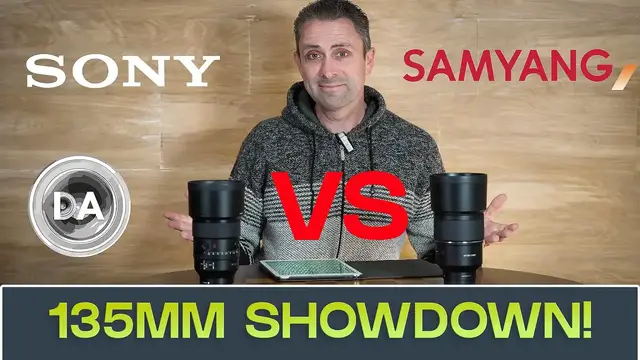
Photographer Dustin Abbott shares a head to head comparison between the might Sony 135mm F1.8 G Master and the upstart Samyang AF 135mm F1.8...at half the price! | This video is sponsored by Fantom Wallet. Visit https://store.fantomwallet.com and use code DUSTIN15 to get 15% off
Read the Samyang Review: https://bit.ly/AF135da | Watch the Review: https://bit.ly/AF135Def | Visit the Image Gallery: https://bit.ly/AF135pics | Purchase the Samyang AF 135mm F1.8 @ B&H Photo https://bhpho.to/3AH4wdy | Amazon https://amzn.to/3VaMVV9 | Amazon Canada https://amzn.to/3F613Jn | Amazon UK https://amzn.to/3gDIHpX
Read the Sony Review: https://bit.ly/135GMText | Watch the Review: https://bit.ly/135GMlongterm | Visit the Image Gallery: https://bit.ly/135mmGMig | Purchase the Sony 135mm F1.8 G Master @ B&H Photo https://bhpho.to/349RGEE | Amazon https://amzn.to/3aLBhc0 | Camera Canada https://shrsl.com/3uos3 | Amazon Canada https://amzn.to/2JJY2ks | Amazon UK https://amzn.to/2UHvRZT | Ebay ebay.to/135GMdla
Check out the DA Merch here: https://bit.ly/TWIMerch | Become a Patron: https://www.patreon.com/dustinabbott | On the Web: http://dustinabbott.net/ | Sign up for my Newsletter: http://bit.ly/1RHvUNp | Instagram: http://bit.ly/DLAinsta | Facebook: http://on.fb.me/1nuUUeH | Flickr: http://bit.ly/1UcnC0B | 500px: http://bit.ly/1Sy2Ngu Follow Craig @ https://www.instagram.com/craigstoffersen/
Want to support this channel? Use these affiliate links to shop at:
B&H Photo: http://bhpho.to/1TA0Xge
Camera Canada: http://bit.ly/DLACameraCan
Amazon: https://amzn.to/3HrY64d
Amazon Canada: https://amzn.to/3qG1p18
Ebay: http://bit.ly/DustineBay
Make a donation via Paypal: https://www.paypal.com/paypalme/dustinTWI
=============================
Table of Contents:
=============================
0:00 - Intro to lenses
Show More Show Less View Video Transcript
0:00
Hi, I'm Dustin Abbott and I'm here for another one of my Versus episodes, one that I have
0:15
had a lot of requests to do ever since this lens got released earlier in the year. And
0:20
unfortunately, it took me quite a long time to get one. That has been rectified now and
0:24
as you've probably seen at this point, I've got a series of reviews centered around the
0:28
Samyang AF 135mm f1.8. This is a very high quality telephoto prime for Sony E-mount and of course
0:38
it is placed up against one of what I consider to be one of the very best lenses on Sony period and
0:45
as far as their non-super telephoto primes I consider this and the 50mm f1.2 to be kind of
0:51
the upper echelon at this point. And so my question to be answered here today is can this
0:57
lens that costs less than a thousand dollars compete with one of Sony's absolute best. And I'm
1:03
going to do my best to answer that question, also to maybe give you a little bit of feedback as to
1:07
which lens you should consider based on your actual performance needs. We'll break all of that down
1:13
in reasons to buy the Samyang, followed by reasons to buy the Sony. And then if you want a deeper
1:17
dive, I'm going to have an IQ breakdown at the end where we take a deeper dive into that actual
1:23
performance. So stay tuned for that if you're interested. First, however, a word from our
1:27
sponsor. Today's episode is brought to you by Phantom Wallet, the minimalist modern wallet
1:33
that is now even better with the new Phantom X that is crafted from aluminum right here in Canada
1:38
It is 22% smaller and 35% lighter while still making it easy to access your cards and money
1:45
when you need them thanks to their unique fanning mechanism. You could even customize your wallet
1:50
due to its modular design with accessories like a money clip, cash holder, ID display
1:56
and even Chipolo and AirTag tracking integration. Visit store.phantomwallet.com to check out their unique sizes, styles, and finishes
2:04
that span from aluminum to wood to carbon fiber. And use code DUSTIN15 for 15% off when you're ready to check out
2:15
So let's talk about reasons to buy the Samyang. In many ways, there's a lot of similarities between these lenses, but there are a few
2:22
distinctions that I want to highlight here. First of all, the big one is the price. The MSRP for
2:29
the Samyang is $999, though at the moment I do note that it is available for $899, making it a
2:37
tremendous value and probably the best bang for buck optically that you're going to find on the
2:42
Sony platform for under $1,000. The Sony is more expensive at right under $2,100 US dollars
2:50
though I have recently seen the price as low as around $2,000. And so either way, you're talking
2:56
about at least $1,000 difference between the two lenses. At the moment, that price difference is
3:01
more like $1,200. That's a pretty huge advantage when you consider how much you could purchase with
3:06
that additional $1,200. The Samyang also is slightly lighter. It weighs in at 772 grams or
3:13
27 ounces versus 950 grams or 33 and a half ounces for the GM. Now I will note the Samyang isn't
3:21
smaller, but it is a little less dense. And so it is the easier lens to carry along
3:27
Another advantage comes on the optic side, whereas we'll see in more detail later
3:31
the Samyang sports slightly less distortion, basically no distortion, and very, very little vignette
3:38
A surprisingly low amount for a large aperture lens like this. The Sony is actually also quite good, but it is not quite as good in either metric as what the Samyang is
3:48
I also felt, both in my test where I looked for it in detail, and then also as a general impression
3:54
that the Samyang had slightly softer bokeh. and defocus regions were just a little bit creamier, a little fewer hard edges. And we'll
4:02
try to break that down a little bit more in the optical comparison. I also found that it did have
4:07
slightly nicer bokeh geometry. And what I mean by that is that it has more circular shapes across
4:13
more of the frame with less of a deformation towards cat eye or lemon shape when compared
4:18
to the G Master lens. It also has a little bit better edge performance, something that is born
4:23
out in the MTFs and then also in my real world test. And that as you move closer to the edge of
4:29
the frame there a slight but real advantage for the Samyang there Also finally the Samyang has some specific features for astrophotography that allow you to get accurate focus even in the night where it a little more difficult to do that sometimes And then also it
4:47
has a very, very high performance in terms of low coma. And so it gives it a little bit of an
4:51
advantage when it comes to that. So let's talk about reasons to buy the Sony instead. To me
4:57
the top reason to buy the Sony instead is when it comes to autofocus speed. Samyang has a single
5:03
linear motor, whereas the 135 G Master has dual XD linear motors. And XD, to break that down
5:11
essentially means that they have their higher torque motors. And as a byproduct of that
5:16
there is definitely a difference in autofocus speed and confidence, as you can see here
5:21
Also, an advantage for the Sony is that, kind of along the same vein, that because it's a first
5:26
party lens and a high performing one at that, if you're shooting with one of Sony's sports related
5:31
cameras, you're going to be able to unlock their full burst rate. And so with my Sony Alpha One
5:36
that means 30 frames per second. On a A9 or A9 Mark II, that means 20 frames per second
5:41
Whereas third-party lenses like the Samyang are going to be capped at 15 frames per second. Now
5:45
if you're not shooting with the sports body, that's not a big deal. If you don't shoot sports, maybe it's not a big deal. But this is a lens that very much could be used in some sporting
5:53
situations as a sideline lens, or, you know, for that matter, maybe performance arts. And it is a
6:00
top-notch autofocus performer. It also has higher grade build materials. While the Samyang is not bad
6:07
made at all, I actually find it to be quite nice, the GM lenses are Sony's best. And so they just
6:12
have a higher grade of materials. And also I will note that even when it comes to weather sealing
6:17
there are 10 seal points in the G Master, while there are seven seal points in the Samyang
6:23
Hopefully both would provide enough, but if you're concerned about weather sealing
6:27
the GM is just at another level. It also has a dedicated aperture ring that does give you the
6:33
option of de-clicking it. Now you can turn the manual focus ring into an aperture ring via the
6:39
custom mode here on the side of the Samyang, but it doesn't give you the visual representation
6:44
of what a dedicated aperture ring does in that you can just visually look at it and know what
6:49
aperture you're at. Whereas with the Samyang, you're going to have to look inside the camera and you don't have the de-click option that you do with the G Master lens
6:56
I will note that while again it's a slight advantage, but an advantage nonetheless
7:01
the G Master sports a very slightly higher level of magnification. It is 0.25 times versus 0.24 times
7:09
and I also felt that the G Master performance was every bit as good, if not a hair better up close
7:15
making it a very useful lens, particularly if you add like extension tubes as a pseudo-macro type lens
7:22
The GM also has very slightly more center sharpness and pop there in terms of contrast
7:27
And so in many ways, that could be the most important place to have that extra little bit
7:32
as compared to the Samyang, which wins out on the edges, which are often less important in a telephoto type lens
7:38
Finally, just as a matter of practicality, the GM is going to have full first party support on every level from profiles to
7:46
you know, Samyang does do firmware updates and all of that. But obviously a Sony lens is going to get Sony support
7:53
And it's also going to have a higher level of resale value as well, because it is a premium product from a premium brand
8:00
So what's not really all that different is when it comes to eye detection and portrait sharpness
8:05
something I know that a lot of people would be interested in. And we'll dive into that more in our IQ breakdown
8:10
But as you can see from these series of shots, I had my wife, who's not a photographer
8:15
take these shots just using IAF in camera on the Sony Alpha 1
8:18
and just taking a series of shots just to test how well the IAF worked in focusing and how great
8:25
sharpness it delivered. And as you can see, there is very little difference between the Samyang and
8:29
the Sony results. And so that's something that both lenses do exceptionally well, but not
8:35
necessarily a whole lot one being better than the other. So at the end of the day, which one should
8:40
you buy? Well, the Samyang is very clear the bargain choice. And as we're going to see even
8:45
further, it gives up very little in optical performance. And frankly, it doesn't really
8:49
give up a whole lot in features either. If you're looking for a high value lens at the 135 millimeter
8:55
focal length, the Samyang is an easy winner. I think the GM is the lens of choice. If you want
9:01
the most demanding autofocus, be it for sports or performing arts, or maybe even just as a portrait
9:07
photographer, you trust a first party lens more. And I do think you get a little bit more when it
9:11
comes to autofocus even you know overall autofocus consistency the GM is exceptionally good And so as a by of that if you are the most demanding of users and you want the very best then I think the G Master is the lens of choice still
9:27
But I think for very many people, you're going to experience quite little difference between the two if you're looking at the more budget option as well
9:36
I'm Dustin Abbott, and if you want to stay tuned for the image quality breakdown, you can stay tuned for that
9:41
And if not, however, there are links to my full text reviews and video reviews in the description down below
9:47
Also buying links if you'd like to purchase those. And of course, if you want to have more information, let's dive into the image quality breakdown
9:54
Okay, let's start by taking a deeper dive into this comparison here that we briefly saw in passing
10:00
So this really is about a couple of things before we've been looking at the focus accuracy
10:05
And so as you can see, both of these are very well focused. And then also it's looking about at the, you know, kind of contrast and performance for skin textures
10:14
So, I mean, quite obviously, both of these lenses are going to reveal probably more skin flaws and blemishes than what your typical person is going to want to deal with
10:23
So I wouldn't be too concerned about that. I would say that I think ever so slightly, there's a little bit more contrast for the G Master
10:31
Though, as you can see, if you didn't, you know, have them side by side, you really wouldn't see much of a difference
10:37
As far as in the hair here, I do think a little bit more detail for the G Master, but again, very, very close
10:46
And as you can see also, skin tones aren't identical, but there's not really anything that is radically different either
10:53
And so color balance, not really a factor here that I can tell either
10:58
Now we mentioned bokeh geometry. We'll detail at that just a little bit
11:02
And so here you can see with the Samyang, this is F1.8, then F2
11:07
then F2.8, then F4. And so as far as the basic geometry all across the frame
11:14
that is really good as we're going to see a little bit better for the Samyang. However, we're also going to see if we move to the G Master
11:20
which you can see here, the G Master has a little bit more deformation towards the edges
11:25
than what the Samyang did. But we can also see as we stop it down
11:29
that the aperture blades do a slightly better job of keeping a circular shape as well
11:34
So a little bit of give and take there. I think this more apples to apples comparison helps to illustrate that point even better
11:42
And so here we've got a fixed location off of a tripod. And so you can see that both of them are focused in the same spot
11:48
But if we look over here at the bokeh, you can see that both of them do eventually get towards a cat eye or lemon shape towards the edge
11:55
But where we have an advantage is, for example, here, quite circular with the GM already deformed
12:01
and then in this area right here samyang is very circular whereas the gm already has some
12:06
deformation and so that's kind of a big deal i think particularly for some people in that you're
12:12
going to get just a little bit rounder bokeh circles out of the samyang now we'll look at a
12:17
couple of other bokeh related things this is just more about the kind of transition area so again
12:22
you can see they're both focused in the same area as we look towards the um the transition area now
12:28
I made a minor mistake in that I must have bumped the aperture ring and it was at F2 rather than F1.8
12:33
That gives a very slight advantage to the GM, but I don't think enough here to make a significant difference
12:38
So if we look at here, it's just a little bit softer than what it is on the GM
12:42
As I look along this and as I look at the kind of textures on this, I see just a little bit more softness
12:48
Also up here, just a little fewer kind of edges that are there
12:53
Here's another example here. And, you know, while I don't see a major difference in this particular image, I see the geometry thing favors the samming on the left a little bit
13:04
As we move out of this kind of defocused area and then we look towards over this area, both of them are nice and creamy
13:10
And I don't know that one stands out to me more than the other. Now, this example here is a little bit interesting in that, again, obviously both set up in the same situation, exact same settings
13:19
There was some sun coming through the window that was highlighting this from the back
13:23
You can see actually that the GM has done a little bit of veiling here in the corner, whereas the Samyang has actually shown up a little bit better contrast
13:31
And so this also gives us a look at any kind of longitudinal chromatic aberrations
13:37
I think that there is a tiny bit of a blue-green fringing on the Samyang, very, very little
13:43
And I think that maybe the GM is just a little bit more neutral in that regard
13:48
And so maybe a slight win for the G Master there. As we look towards the kind of defocused areas here I do think that the Samyang is a little bit creamier and softer and just a little bit more edging for the G Now if we talk about these things for portrait work I did find that as far as my triggers went
14:06
that the two didn't trigger identically. And so we have identical settings, but
14:11
there's just a little bit more flash power for whatever reason that came out using the G Master
14:16
And so what we're more looking at is just kind of the defocused background. And in these cases
14:21
I think that both of them show a nice transition towards defocus
14:24
Likewise, in this shot where we have both some foreground and then some background bokeh
14:29
If you look at just the kind of the dock that's in the background and the water beyond
14:34
and then at the surface of the water, you can just see there's a little bit more edging
14:39
in the transition area for the G Master, whereas the Samyang is just ever so slightly softer
14:45
Again, I don't think this is a major thing at all, but it is worth considering that there
14:50
is a very minor, I believe, bokeh advantage in both geometry and then softness for the Samyang
14:55
Now, I mentioned the vignette and distortion. So if we look at the GM, nothing significant here
14:59
You can see a little bit of pincushion distortion and a little bit of vignette. Neither is extreme
15:04
Now, if we do a manual rather than a profile correction, we can see that there's just a minus
15:09
one to correct that pincushion distortion. You're probably not even going to want to bother with
15:13
that and a plus 35 to correct for the vignette. If we jump over to the Samyang, the Samyang required
15:19
no correction. It basically has so low of distortion that if you tried to correct something
15:23
you would create more distortion than you would correct. And then it has a little bit lower
15:27
vignette, a plus 28. That's a plus seven difference, not significant, but again, in both metrics
15:33
just a tiny advantage for Sam being there. All right. Our major showdown here, and that comes
15:38
to sharpness and contrast. This is a 50 megapixel image and it is shot, or I'm going to show it to
15:44
at 200% magnification. So here is where, as mentioned before, I think that the GM shows a little bit more contrast
15:50
in the center of the frame. Just a little bit more pop there. You can see slightly more of the moir pattern
15:55
that comes from really intense sharpness and contrast. A little bit in the text
16:00
you can see a minor difference there. And even down here, just a very slight advantage for the GM
16:05
In the midframe, that advantage is, it's largely gone. They're about the same
16:10
Down here in the corner, it is actually the Samyang that gives us a little bit stronger performance
16:16
You can just see a little bit more detail and contrast here towards the edge of the frame
16:22
Now if we stop them both down to f2.8, we can see that now the contrast has really, really bloomed for the Samyang
16:29
and it is now every bit as contrasty in the center of the frame. In the text popping, arguably the Samyang is a hair better
16:36
In this mid-frame performance, I think a little bit more contrast than what the GM shows and down here in the corner
16:43
Both of them are really, really good in the edge of the frame, but you can just see like from this text
16:47
there's a little bit more contrast and performance out of the Samyang. We pop over here to the left side
16:53
We can see that they both look very, very good. We'll take a look here as well, a couple of other spots
17:00
I very slightly think that there's a little bit more contrast for the G Master there
17:04
If we look up in the upper corner here, we can see that they both look very good
17:10
but maybe just a hair better on the Samyang with a little bit more contrast that reaches right out to the edge of the frame
17:16
We'll do one final comparison at F5.6. And so we can see here in the center of the frame, both of them are exceptional
17:24
If anything, I would maybe give the GM the very slightest of edges
17:28
It's incredibly close. In the mid-frame, the Samyang is just a little bit better, though
17:33
I mean, frankly, I mean, it's splitting hairs. They're both really, really brilliant
17:36
down here in the corner. They are both, you know, just fantastic. I mean, both of them just kind of
17:42
popping right off the page. And so, I mean, frankly, the performance all around is just
17:47
really, really exceptional. No matter where you look, everything is just fantastic across the
17:53
frame for really for both of these lenses. They are exceptionally strong. So as you can see
17:58
these are both incredibly high performing lenses. And frankly, you're going to be very happy with
18:03
what you get from either one of these lenses when it comes to their optical performance
18:07
So at the end of the day, there are other considerations here, but hopefully I've given you enough information to help you make an informed decision as to which lens is going
18:14
to work best for you. I'm Dustin Abbott, and if you'll look in the description down below
18:18
as mentioned, linkage to the full suite of reviews on these, buying links, also linkage
18:23
to follow myself or Craig on social media to become a patron, to get channel merchandise
18:27
Please like and subscribe. Thanks for watching. Have a great day, and let the light in