Up next in 10

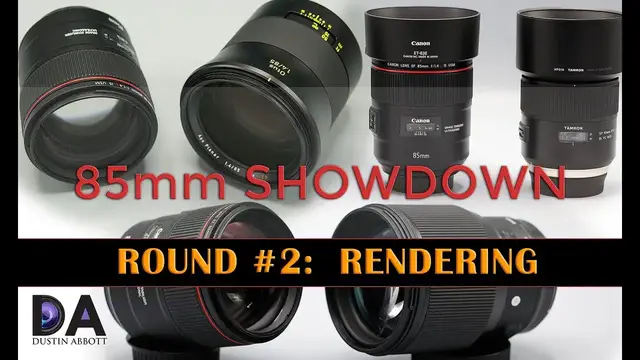
85mm Showdown: Canon | Sigma | Tamron | Zeiss | Part 2: Rendering
Jul 26, 2023

85mm Showdown: Canon 85mm f/1.4L IS vs Sigma 85mm f/1.4 ART vs Tamron 85mm f/1.8 VC vs Zeiss Otus 1.4 | Photographer Dustin Abbott gives a detailed breakdown of the rendering from each lens, including chromatic aberrations, bokeh quality, facial rendering, actual focal length, contrast, and more... More images here: http://bit.ly/canon85LISig
Purchase the Canon 85mm f/1.4L IS: B&H Photo: https://bhpho.to/2kdkFUU Amazon: http://amzn.to/2i4ZtMU | Amazon Canada: http://amzn.to/2ng6LCH | Amazon UK: http://amzn.to/2Bxqpgu | Ebay: http://bit.ly/Canon85LIS
Purchase the Sigma 85mm f/1.4 ART: B&H Photo: https://bhpho.to/2D2zwpu | Amazon: http://amzn.to/2DFrxjo | Amazon Canada: http://amzn.to/2Br4QxL | Amazon UK: http://amzn.to/2BGNRvP
Purchase the Zeiss Otus 85mm f/1.4: B&H: https://bhpho.to/2BXTOA1 | Amazon: http://amzn.to/2BYrv4f
Purchase the Tamron 85mm f/1.8 VC: B&H:
https://bhpho.to/2fUnWXD | Amazon: http://amzn.to/2BoOgCw
Want to support this channel? Use these affiliate links to shop at:
B&H Photo: http://bhpho.to/1TA0Xge
Amazon: https://www.amazon.com/shop/dustinabbott
Ebay: http://bit.ly/DustineBay
Make a donation via Paypal: paypal.me/dustinTWI
Get a discount off all Skylum Editing Software (Luminar, Aurora HDR, AirMagic) by using code DUSTINHDR at checkout: http://bit.ly/LuminarDLA
Show More Show Less View Video Transcript
0:00
Hi, I'm Dustin Abbott and I'm here today to give you part two of my 85mm showdown
0:14
And so I have been comparing a number of the most recent 85mm options and including in those is the class leader
0:24
the Zeiss Otis 85mm f1.4 along with the new Canon 85mm f1.4 LIS, the Sigma 85mm f1.4 ART
0:35
and the Tamron 85mm f1.8 VC lens. And so in our first episode we looked mostly at resolution
0:44
and how each one of these lenses resolved, but made the point at the end in the wrap-up that
0:50
But in a portrait focal length, which all of these lenses are, resolution isn't always the most important metric for evaluation
1:00
And so today we're going to look at some other things that may come into play, whether you are a portrait or if you happen to be like an event shooter
1:08
Say you shoot weddings or other events and you want the 85mm focal length because it's a versatile focal length, particularly on full frame
1:16
It also, of course, delivers some nice shallow depth of field and gives you some unique shots that zoom lenses aren't going to give you to the same degree
1:25
And so today we're going to look at a few other things. We're going to take a look at the chromatic aberration and how that impacts contrast
1:31
And then we're also going to take a look at that contrast from another perspective
1:37
We'll look at the focal length and how all of these are 85mm lenses, but how there is some slight variation that comes in their actual focal length
1:45
We'll take a look at the bokeh quality. We'll look at facial rendering and allow you to evaluate
1:51
which of these looks best to you. Light transmission, all of those things which are
1:56
you know, perhaps important in making a decision if you're evaluating between one of these four
2:00
lenses. I'll give you an idea of how they play out in the real world. In the wrap-up, I'll also
2:06
talk about two other options that I don't have in this particular comparison that you might want
2:12
to consider as well. Now I'm going to kind of show you in terms of the order of kind of best to worst
2:18
here when it comes to, when it comes at least to the chromatic aberration that leads to the absolute
2:24
contrast. This is all going to be a comparison at f2 just to standardize here. You know, you can see
2:30
of course that the, once again, the Tamron frame's a little bit tighter. It's got a little bit more
2:35
magnification and it is also a you know it's it's it's longer compared to the other lenses and so
2:42
but you can see that here at f2 the the otis performance is perfect in the chromatic aberration
2:48
department there just isn't anything there you have a very very slight bit of purple fringing
2:54
from the the tamron and it's not pronounced in any way but if you'll look in kind of the you know the
3:01
the weakest areas or the most suspect areas, you'll see just a little bit of purple. Whereas
3:07
on the Otis, you see perfection and, um, you know, also no green fringing there. That being said
3:14
we do see here that the Otis has got, you know, the most, the busiest inner circle
3:19
some of that onion bokeh. The, um, the Tamron has a pretty nice, even inner circle. Only downside
3:25
is that it's inner line is a little bit more pronounced than what the Otis does. You can also
3:30
see however that it is producing you know it's similar aperture it's producing a bigger bokeh
3:36
circle and that is in part well well it's it's because it has a longer uh you know it's it's a
3:42
longer focal length by comparison now finally with the um the comparison between the the sigma
3:49
and the canon here and you can see um looking at this image that um first of all once again the
3:56
Sigma is framing quite loose by comparison and the Canon is a little bit closer. So I think it's
4:02
probably second to the Tamron lens with the following after that, the Zeiss, and then the
4:10
Sigma as being the shortest of the bunch. And in terms of the chromatic aberration and thus
4:16
you know, the hit on contrast by F2, wide open these lenses are, they both have quite a bit of
4:21
CA, although there's more on the Canon. Stop down here to F2, you can see just the faintest edges
4:26
left on the Sigma, kind of like the Tamron, maybe just a hair more, whereas you can still see some
4:33
of the purple fringing. And looking up into this area right here, which is kind of the hardest area
4:38
you can see kind of like the Tamron that there's just a little bit left on the Sigma lens. There's
4:43
still a fair bit left on the Canon lens, and that's what's robbing it of some contrast compared
4:51
and here. And if you look at the Sigma result, this is the exact same shutter speed, same lighting
4:56
The Sigma result, yes, it's not as bright. The Canon's delivering the brightest image
5:01
but there's also not as much contrast kind of in this area here. Now, for those that are
5:06
interested in comparison to the Otis, you can see that the Otis frame is just a little bit
5:10
tighter than what the Sigma does. Looking here, you can see that, you know, the Otis is completely
5:17
neutral and kind of like with the Tamron. There's just a little bit of purple there on the Sigma and
5:22
just looking at these other spots, kind of same story. Both of these lenses deliver the busiest
5:28
inner circle here, but the difference being is that it looks a little bit more ring-shaped
5:34
you know, kind of onion bokeh shaped in the Otis than it does in the Sigma. But you also see that
5:40
once again here, the shortness of the Sigma means that it's not producing as big and soft
5:45
of bokeh circles as what even the Otis is here. But you can see that the, in terms of that kind of onion
5:52
bokeh look that these are the most similar looking of the lenses Now comparing the Tamron and the Canon the Tamron of course is framing tighter but the advantage of the larger maximum aperture and the kind of brightness light transmission of
6:09
the Canon, it gives it a bit of an advantage here also in that the bokeh circles are nice and big
6:16
actually bigger even than the Tamron. And so, and in terms of busyness here, you can see that
6:22
these two look they look pretty similar but the inner circle is just a little bit softer ignore
6:27
the kind of the dust spots here that are that's not really that's not really the issue here but
6:32
you see the general busyness here is just a little less pronounced on the Canon and this inner line
6:36
is a little softer and so that tells you who's going to give you the nicest bokeh quality out
6:42
of these I would say it's going to be Canon Tamron Sigma and then Otis in terms of these kinds of
6:49
highlights. Now, in this case, we'll kind of go reverse order. The two that deliver kind of the
6:54
most chromatic aberration here are the Canon and the Sigma. You can see both of them actually
7:01
deliver quite a bit of purple fringing on this end of things. And so you can see how the actual
7:06
contrast in the text looks. And frankly, it's pretty close between these. After the plane of
7:11
focus, what I think the biggest kind of shortcoming in my mind of the Canon lenses is the green
7:17
fringing, which as you can see is definitely more pronounced here than it is here. And so thus the
7:23
area of contrast is smaller in terms of a plane of focus on the Canon than it is on the Sigma lens
7:31
Now the Tamron and the Otis are the strongest in this category. However, the Otis of course is
7:37
the best corrected with basically no purple fringing there. Whereas you can definitely see
7:43
there is some of the purple fringing on the Tamron. However, you know, while the Otis
7:48
it transitions to just, you know, it's, you can see that the colors are focused very, very similarly
7:55
This is the only apricomatic lens of the bunch. And so you can definitely see the quality of it
8:00
there. Tamron, what you don't really see is any of the green fringing here as you go out of focus
8:07
And so, you know, it does quite well. And as a result, it, you know, both of these lenses deliver
8:12
the strongest contrast with the Otis of course being the absolute best. So this is the flare test
8:18
We're going to do it f2 again standardizing for all of these. This is starting with the
8:23
Sigma lens here. So you can see a little bit of you know some loss of contrast and you can see
8:29
that there is some purple and green fringing there in terms of the the veiling section. That just
8:34
gives you an idea of how that looks. Moving on to the Otis lens and so you can see again there's a
8:41
little bit of veiling at the epicenter there. However, if we look up here, you can see perfect
8:46
correction. There's no fringing there. Thus, our contrast on our subject is better than it was on
8:52
the Sigma. Now on the Tamron, you can see again, here is your kind of veiling epicenter looking at
9:00
our subject here. Not really in the purple fringing and very little of the green fringing
9:05
there is a hair there and so contrast holds up pretty well here and you know flare resistance
9:11
is is helped along by that finally on the canon lens we see that there's just a little bit more
9:18
of a flare pattern there you can definitely see there's a little bit of purple fringing here and
9:23
definitely some green fringing beyond and those you know do rob contrast somewhat there in the
9:29
epicenter so comparing the uh the two most similar i think performances here come from the tamron
9:34
and the Zeiss lens. And so if we look kind of here
9:39
we'd see there's a little bit more of a veiling taking place
9:42
on the Otis lens right in that area, a little less on the Tamron
9:47
However, the most, in this case, I would say that the contrast
9:53
when you move off of that immediate epicenter there, because there's no chromatic aberration
9:58
that's the most neutral performance that's coming off of the Otis lens
10:03
And so those are your kind of two best performers on that test. Now if we stop all these down to f11
10:09
You see that the cannon is Pretty affected here by some ghosting patterns and some prismatic haze coming off there
10:16
It really doesn't really like this test all that much now in terms of you know this area here
10:22
You can also see that there's a veiling artifact that is, you know causing a loss of contrast there as well
10:30
So, I mean, the Canon does not like the sun in the frame
10:33
or in this case, a very bright flashlight. Also, just take a look at the shape of the aperture blades
10:38
Now, if we compare the Tamron here with the Canon, we can see that there's definitely less veiling that's taking place
10:46
Both of them are, you know, showing some ghosting artifacts. The Tamron is a little less pronounced
10:52
And if we look kind of in this area, you know, there's less destruction to the images taking place
10:57
and obviously a different kind of prismatic. The Tamron goes a little bit more purple
11:02
The Canon obviously goes a little bit more green. And as you can see, that's going to influence your shadow colors there
11:08
And so, again, it's probably a taste thing. In terms of chromatic aberration, neither one of them are suffering anything here
11:14
You can definitely see there's a little bit more contrast hold up on the Tamron. Now, if we compare the Otis and the Sigma lens
11:22
we can definitely see that the Sigma lens outside of the Canon likes flair the least
11:28
You can see a pretty pronounced kind of ghosting pattern here. This kind of thing for some people though has artistic value
11:36
So whether it does or not for you, that's a matter of taste
11:40
What both of these lenses do, you can see that the Otis
11:44
it doesn't hardly show any of the ghosting patterns other than a very localized thing here
11:49
Whereas the Sigma is showing more, you can see aperture blade ghost effects that are there
11:55
you can also see them kind of carrying out you know in a successive range The Sigma and the Tamron deliver and I compare them in just a second to me the most pleasing kind of sunburst effects
12:08
Now looking at our, you know, kind of area here, there's a little bit of veiling taking place on the Otis
12:16
I would say that the Otis is probably delivering the most maybe artistic veiling though
12:21
and it's not strongly pronounced. And so, again, the Sigma and the Canon are delivering on the green side
12:30
And then the Tamron and the Otis are delivering kind of more on the purple side
12:37
In terms of contrast here, you know, unsurprisingly, the contrast for the Zeiss is the strongest there
12:44
Now, here, just very quickly, you see that the two sunbursts from the Tamron and the Sigma are actually the closest
12:52
in terms of that basic starring pattern. There's a lot of similarities between the two of them
12:58
Obviously less ghosting, though, coming off of the Tamron than it is off the Sigma
13:03
Our final test here, again, at F2 to standardize, is just taking a look at rendering of faces and skin tones
13:11
And so you can see here that the Sigma and the Zeiss
13:16
are the two that we have here. Sigma is just a slightly, red is a little bit more accentuated in this. If we look towards the eye area, we see that the
13:28
Otis micro contrast and then rendering of fine details is unparalleled. Now, again
13:35
in this situation, that may be a pro or that may be a con in terms of skin texture. You see lots
13:42
and lots of skin texture through the Otis lens. And so again, that may not be people's favorite
13:48
quality for portrait work. However, if you're shooting models or those that have very flawless
13:55
skin or images that are going to be blown up very, very large, I mean, this is an amazing amount of
14:01
micro contrast on the face. Now, looking at the quality of the bokeh beyond that, that's another
14:07
thing to consider. Very even circles for the Sigma. And as far as the Zeiss goes, they're also even
14:15
across the frame, there's just a little bit more of a non-agonal shape from the aperture blades that
14:20
is showing there. And so, and you know, both of them, you can see a little bit of busyness
14:25
but you can definitely see that more onion bokeh quality pronounced on the Otis lens
14:31
All right. So here we see the difference between the Canon and the Tamron. And in this case
14:39
the Canon actually exposed a little bit brighter. And I would say it's actually slightly
14:43
overexposed. And that's unfortunately, that's the way that it happened. And so the Canon actually
14:49
has done a really nice job in this particular comparison. There's a lot of detail there
14:55
And I don't know if it's because of being slightly underexposed and the eyelashes
14:59
there's a little less, to me, there's a little less contrast there. It could be a difference in
15:03
focus here as well. But we also see that there is a little bit more contrast on the Tamron in the
15:10
skin tones. And so in some cases that, again, you know, that's either a pro or a con depending on
15:16
what you're trying to accomplish here. But I also wanted to show you just kind of the rendering of
15:21
the planes of the face. Some people that are really into portraits, that's something that you
15:26
want to see. There's a difference in the rendering on that. Now, in terms of the defocused highlights
15:32
you can see that in many ways the Tamron delivers the most deformed here at F2. And part of that
15:38
has to do with the fact that it's only stopped down one third of a stop while the other lenses
15:42
are stopped down a full stop and so as a result it doesn't fare as well in that kind of comparison
15:48
in terms of the actual smoothness of the bokeh highlights you can see that the canon is just a
15:54
little bit softer it is the best bokeh lens of the bunch now again just to quickly compare the
16:00
Otis with the Tamron. Just line up those that you haven't seen. Now the Canon with the Otis here
16:09
and so you can see a difference, and you'll definitely see a difference between the Otis
16:13
and the Canon in terms of the micro contrast on skin textures. Again, you know, good or bad
16:21
depending on what you're trying to accomplish. Then finally, looking at the difference in the
16:25
shape of the face from the Sigma and the Tamron here. And so just so you can see all of them put
16:31
together. So as we can see, there are strengths and weaknesses to all of these lenses. We noted
16:37
in our first episode that the Zeiss Otis has the best resolution. It has the strongest contrast
16:44
It is the most well-corrected of all the lenses. And so it handles all the different aberrations
16:49
the best of the bunch, and delivers an incredibly neutral performance, fantastic color rendition and I think quite a special quality because of that amazing punch
16:59
that it has to images. But at the same time the Otis that micro contrast for portrait photographers
17:07
those that aren't shooting you know basically professional models or if you're not shooting
17:11
for big blow-up sizes that incredible amount of contrast and resolution may be too much and you
17:17
may find that in post-processing as a portrait photographer you're having to do a lot of facial
17:22
softening because too many pores and too many facial flaws are evident. And so again, it's
17:28
different strokes for different folks there. We saw that with the Sigma lens, it is the shortest
17:34
of the bunch. And so as a result, it doesn't deliver quite as soft backgrounds as the others
17:40
But at the same time, the Sigma is kind of delivering in some ways the best performance
17:47
kind of across the board in terms of it has resolution that's not quite as good
17:52
as the Otis but very very good it has good contrast though not quite as high as that of the Otis the bokeh quality is a little bit busier than the Canon and even the Tamron but not as busy as what the Otis bokeh quality is
18:10
And at the same time, we saw a good color rendition and, you know, some good things to
18:15
consider as a part of that. The Canon lens delivers the brightest image of the bunch
18:22
And so it has the best light transmission. And you combine that with the IS, and it is your absolute, it's a low-light monster in that sense
18:31
And so if you're an event shooter, the Canon is a really compelling choice
18:35
because it's going to give you perhaps the best bokeh rendering, I think the best bokeh quality of the four lenses that we've considered here
18:44
But it also gives you amazing light transmission along with a great IS system
18:49
that allows you to handhold in lower light situations, lower shutter speeds
18:55
And so it's going to give you an advantage if you're shooting events
18:59
And so I think that that's probably your top choice if you're an event shooter. The Tamron, it's amazing how well it hangs with all these lenses
19:07
considering the fact that it is the smallest, the lightest, and by far the cheapest lens here of the bunch
19:14
And it costs under $800. and the Otis, you know, at the other extreme costs $4,500
19:21
I mean, so it's amazing how well the Tamron does considering that limitation
19:26
And so in some ways it is, again, it's a very versatile lens. However, if you're a studio portrait photographer
19:33
I think that the Tamron, in my feeling, it delivers the least appealing rendering of skin
19:40
It's just, when you compare them all side by side, I find that skin looks a little bit more sallow by comparison than it does with the others
19:49
Now, I've used it effectively as a portrait lens, and it can do a very good job. But if you are just choosing a lens right now, I think that if you're a studio photographer
19:58
the Sigma may be the best choice of the bunch. And so if you are a commercial fashion model photographer and you've got the money, go for the Otis
20:09
It's incredible. If you are a studio photographer, go with the Sigma because it's slightly shorter focal length
20:17
and a little less compressed backgrounds. It's not such a big deal in a studio setting
20:21
It does really good, I think, with facial quality, skin tones. If you are an event or an outdoor portrait photographer, I think the Canon is a great option
20:34
It has stability, it has beautiful bokeh rendering, and it's going to give you very nice subject isolation
20:40
The Tamron, I think, is the all-around most versatile performer. If you're not really any of those things, you're just looking for an 85mm lens that pretty much does everything well
20:50
And at a great price, I think the Tamron is a fantastic option
20:53
It really has no glaring weaknesses other than having a smaller maximum aperture and a little bit more vignette
21:00
But, you know, in most situations, that's not really a huge deal
21:03
It's also the longest lens of the bunch. And so it kind of makes up for its smaller maximum aperture by a little bit longer focal length that helps with the compression to put it right there in the hunt with the other lenses
21:15
So hopefully in this 85mm showdown that gives you an idea of those four lenses
21:20
A few other lenses of course to consider is that if you don't need super fast autofocus, the 85mm F1.2L from Canon is still a very viable choice
21:33
It has a very bright maximum aperture, a little bit more chromatic aberration than these, a little less sharpness
21:39
but it has gorgeous rendering that is tested and proven at this point
21:43
What it does lack compared to a number of these options is it doesn't have weather sealing
21:48
and so that could be a factor for you. Another lens that doesn't have weather sealing and doesn't have, it also doesn't have autofocus
21:57
but has incredible rendering that I think is just as good, if not better, than the Canon 85L Mark II
22:04
Plus, it's a bit sharper and has a little bit better contrast. It's the new Samyang slash Rokinon XP 85mm f1.2
22:13
And I honestly think of all these lenses that I've reviewed, it actually has my favorite rendering of all of them
22:19
But again, it has some limitations. It has a good price tag. It has a very bright maximum aperture
22:25
but of course, you know, it is manual focus only, so that's a challenge. And a final option that's
22:30
manual focus only also, but does have weather sealing and an incredible build and a more
22:36
reasonable price tag than the Otis is the Zeiss Milvus 85mm f1.4. It is probably the best of all
22:44
these lenses in the absolute corner performance. It's not quite as sharp as the Otis in the center
22:49
of the frame, but it does have a little bit better edge sharpness, and it doesn't have the onion
22:56
bokeh kind of quality that the Otis has. It's a little less corrected in some areas, has a little
23:02
bit more vignette than the Otis. It's kind of some give and take, but it is an amazing rendering lens
23:07
and certainly is well worth consideration if you don't mind manual focus. Those in my mind
23:13
and realize I'm coming from a Canon shooter's perspective, I've obviously not considered
23:17
because I've never tested either a Sony or a Nikon option here
23:22
But if you are a Canon shooter, these, I think, represent your best choices
23:27
And hopefully that can help you in making this decision. I'm Dustin Abbott. If you look in the description down below, I'll throw a linkage to all of these lenses
23:35
And of course, if you look at my website, you will find my reviews of almost all of these lenses that I've mentioned here
23:41
and maybe get a little more information there. You can also find them if you search here on my YouTube channel
23:47
you can find video reviews of basically all of those lenses as well. If you haven't already, please click that subscribe button
23:53
And thanks for watching. Have a great day
#Hobbies & Leisure