0:00
Hi, I'm Dustin Abbott and I'm here today to give you a quick kind of off the cuff
0:16
more my real world feedback from using these two high end mirrorless cameras that take a
0:22
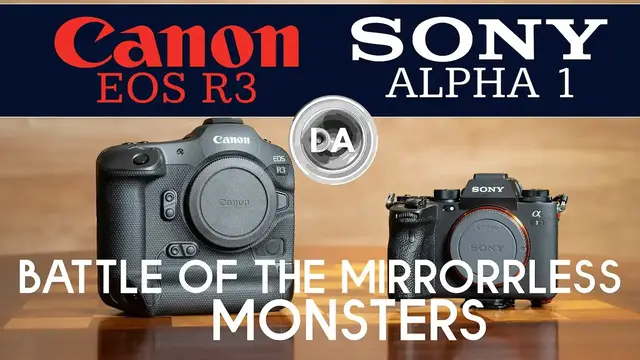
very different approach to kind of sports and general purpose photography. And one of those is the Sony. The first released was a Sony Alpha 1 here, 30 frames per second, a price point of about $6,500 US dollars
0:35
And then the more recent is the Canon EOS R3 with the obviously larger integrated vertical grip style body
0:43
It retails surprisingly for cheaper at $6,000. And so today is just kind of my quick feedback on using both of these cameras to give you just a little bit of thoughts
0:54
many people have not had an opportunity to use two such expensive cameras that have a very
0:58
different approach to this. And so I just wanted to give you some real world feedback, maybe help
1:03
you to make an informed decision if you're choosing between a brand new system and wanting
1:07
to know which route to go. So first of all, obviously on a price point, if you want to feel
1:12
like you're getting more camera for your money, I think that the R3 wins on that front and that
1:17
it's obviously a much larger camera and it is the cheaper of the two. I will point out, however
1:22
that not everyone is looking for the larger vertical integrated grip. For those of you that
1:27
are, there are certain advantages to this, the redundant controls, larger battery capacity. Those
1:33
things can be extremely useful and obviously more room for both physical controls and perhaps more
1:38
advanced weather sealing as a by-product of having a little more real estate in the body
1:43
The Alpha 1, however, gives the advantage of, I would call it stealth, and that this is a camera
1:49
that is much easier to bring along, to store, and in many cases to use in a greater variety of
1:56
situations. It certainly gives me more options for how I'm going to pack it or how I'm going to carry
2:01
it in a carry solution. And if you're going to use a camera all day long, this is going to be the
2:07
much simpler way to do that. So it really comes down to a priority. But as I said, two different
2:12
approaches Also a very different approach is the fact that while both of them do 30 frames per second in their burst rates very very impressive 12 frames per second in the mechanical shutter on
2:24
the R3, and then on the Alpha 1, I believe it is 10 frames per second in the mechanical shutter
2:31
And so, but the mechanical shutter in both these cameras, in many ways, is an afterthought. They
2:35
have both gotten incredibly good with the electronic shutter. So most of the downsides
2:39
that used to be associated with an electronic shutter just are not really relevant here
2:44
I will note on the electronic shutter front, while you can go up to, I believe
2:49
1 32 thousandth of a second with the Alpha 1, you can actually go up a stop higher
2:54
to 1 64 thousandth of a stop with the electronic shutter here
2:58
Both of them do a very good job with anti-flicker technology. All of that works, and even flash sync
3:04
up to 1 180th of a second with both of them using the electronic shutter
3:08
So again, very little reason to not use the electronic shutter. However, the Alpha 1 is pushing more than double the resolution
3:17
50 megapixels versus the 24 megapixels in the sensor. And when I compared the sensor
3:23
the sensors, I should say, in a variety of different settings, be it high ISO performance
3:29
or dynamic range, there's some give and take in both of them. I would say that the R3 serves as
3:35
a slightly better high ISO performer, though not by a large margin, surprisingly. Whereas the
3:42
dynamic range is roughly similar between the two, but maybe a slight edge and a few metrics for
3:50
the Alpha 1. Both of them are really impressive sensors, but I would say that the Alpha 1 is the
3:57
more impressive sensor for the simple reason that the resolution is so much higher. And so the fact
4:01
that it's able to be competitive while having so much more resolution is a really impressive job by
4:07
Sony on this front. Both of them have amazing autofocus systems and have an amazing job
4:12
tracking. I will say, having used them right back to back, that I slightly favor the R3's tracking
4:19
Not because it necessarily achieved a better performance, but more so because I felt like
4:25
the visual process was a little bit more engaging in the viewfinder I felt a little more connected to the subject using the R3 Though I will say that the Alpha 1 is also amazing It almost both of them feel basically like cheating
4:39
They are so good in that regard. Now, as far as buffer depth, obviously with this particular camera, the R3
4:47
and a lower resolution point, you get deeper buffers. You get 540 JPEGs versus 400 JPEGs, 150 full RAWs
4:56
but 420 of the compact raw or the kind of lossless compressed raw
5:04
whereas in this case, you get 238 of those same compressed lossless raws here
5:11
And so a little bit deeper buffer depth on the R3 versus the Alpha 1
5:16
though again, the Alpha 1 is fairly impressive because it's pushing so much more resolution
5:22
so many more megabytes through the pipeline there. But obviously both of them are really, really impressive
5:28
I do think that the R3 was a little bit more responsive in flushing the buffers
5:32
The Alpha 1 is good. The R3 is even better in that regard. As far as the actual sensor goes, though the metrics are close
5:40
I would slightly favor the higher resolution for the Alpha 1 for a couple of reasons
5:45
First of all, you have much more options in deeply cropping. And so if you're not taking much of a hit when it comes to tracking
5:51
and of course the burst rate is the same, then it means that you have final images that are a little bit more flexible in what you do with them
6:00
You have more cropping room or if you want to shoot an APS-C mode this has a very useful
6:05
APS-C mode in in the crop whereas your APS-C mode here only yields a resolution of about I believe
6:14
9.3 megapixels versus I believe 22 megapixels on the Alpha 1. That's obviously more useful
6:21
for APS-C. That's a usable amount of resolution that's almost as much as the native resolution
6:26
of this camera. So for that reason, I do slightly favor the Alpha 1. I will also say that at this
6:32
point in time, this is subject to change, I prefer Sony's ecosystem for the amount, quantity of
6:38
lenses at variety of different price points. And that's largely due to having so many good third
6:44
and I have found that recently the Sony G lenses are every bit as good as what coming out in the high L series on Canon but almost always smaller and cheaper on the Sony front versus the Canon front
7:00
And of course, then you add in all those excellent third-party lenses from Sigma and Tamron, Samyang, and more
7:06
whereas you have very little of that on Canon. Right now, as an overall user for myself, I prefer this camera
7:13
Even though there's a few things I definitely prefer on the Canon, One of those is the very angle LCD screen, much higher resolution
7:21
I believe this one is, it's well over four, let's see, it's 4.15 million pixels
7:26
Whereas the tilt only screen on the Alpha 1 is a pathetic 1.44 million pixels
7:33
And of course the Canon also has its eye control AF technology, which is really, really cool
7:39
Though the resolution is a little bit higher in the viewfinder of the Alpha 1. And bottom line is that there's give and take in both fronts
7:46
And I think that both cameras are going to give you delightful sports performance for tracking
7:52
It really kind of depends on which one of these body styles approaches that you prefer
7:57
and whether or not it's about high resolution or a little bit better high ISO performance
8:02
and maybe a more manageable file size, which you certainly get with EOS R3
8:07
At this stage, we live in somewhat of a golden age for mirrorless to where we are getting cameras
8:11
that really are not just good for mirrorless cameras, but I think in both of these cases
8:16
these are probably amongst the best cameras that their respective brands has ever produced, bar none
8:22
That's a pretty great option to live in. So if you've got deep pockets, 6,500 bucks or 6,000 bucks
8:28
you'll find that both of these cameras are very likely to delight. I'm Dustin Abbott
8:33
And if you look in the description down below, you can find linkage to my full reviews of either camera
8:37
and buying links for either camera if you want to check that out. and beyond that of course there is linkage to check out our new channel Let the Light In TV
8:45
and to buy merch for this channel there's also linkage there to follow myself or Craig on social
8:51
media to become a patron and of course if you haven't already please click that subscribe
8:55
button right here on YouTube thanks for watching have a great day and let the light in