Up next in 10

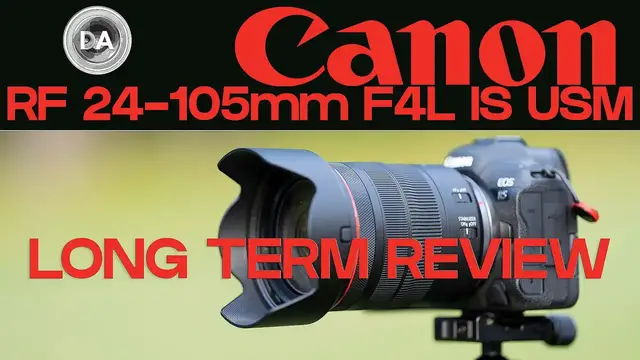
Canon RF 24-105mm F4L IS | Long Term Review on Canon EOS R5
Jul 16, 2023

Photographer Dustin Abbott shares a his long term review of the Canon RF 24-105mm F4L IS - this time on the higher resolution Canon EOS R5. Is this still the essential lens for Canon's RF system? | This video is sponsored by Fantom Wallet. Visit https://store.fantomwallet.com and use code DUSTIN15 to get 15% off | Visit https://bit.ly/lethelightinTV for the new channel | Read the text review: http://bit.ly/RF24_105LISda | Visit the Image Galleries: http://bit.ly/RF24105ig
Purchase the Canon RF 24-105mm f/4L IS USM @ B&H Photo https://bhpho.to/2qCEghi | Amazon https://amzn.to/2qAY1FY | Amazon Canada https://amzn.to/2PNIYqH | Amazon UK https://amzn.to/2Qx3yJ2 | Amazon Germany https://amzn.to/2zGY8nT | Ebay http://bit.ly/RF24105L
Purchase a Canon EOS R5 @ B&H Photo https://bhpho.to/3iMH18x | Amazon https://amzn.to/33L3D53 | Camera Canada https://shrsl.com/2jqth | Amazon Canada https://amzn.to/3iEo6wE | Amazon UK https://amzn.to/3jLHol4 | Amazon Germany https://amzn.to/3nxaE1h | Ebay http://bit.ly/EOSR5dla
Purchase a Canon EOS R6 @ B&H Photo https://bhpho.to/3dCt9g3 | Amazon https://amzn.to/3o0T4Tm | Camera Canada https://shrsl.com/2k730 | Amazon Canada https://amzn.to/3424pLc | Amazon UK https://amzn.to/2H9e6yj | Amazon Germany https://amzn.to/2T0BkJJ | Ebay http://bit.ly/EOSR6dla
Check out the DA Merch here: https://bit.ly/TWIMerch | Become a Patron: https://www.patreon.com/dustinabbott | On the Web: http://dustinabbott.net/ | Sign up for my Newsletter: http://bit.ly/1RHvUNp | Instagram: http://bit.ly/DLAinsta | Facebook: http://on.fb.me/1nuUUeH | Flickr: http://bit.ly/1UcnC0B | 500px: http://bit.ly/1Sy2Ngu Follow Craig @ https://www.instagram.com/craigstoffersen/
Want to support this channel? Use these affiliate links to shop at:
B&H Photo: http://bhpho.to/1TA0Xge
Camera Canada: http://bit.ly/DLACameraCan
Ebay: http://bit.ly/DustineBay
Make a donation via Paypal: https://www.paypal.com/paypalme/dustinTWI
=============================
Table of Contents:
=============================
0:00 - Intro
Show More Show Less View Video Transcript
0:00
Hi, I'm Dustin Abbott and I'm here today to give you another in my series of long-term reviews
0:16
And this is of the lens that actually was the first lens that I reviewed when Canon released
0:21
its new Canon RF mount and its first full-frame mirrorless camera, the original Canon EOS R
0:27
And that is the Canon RF 24-105mm F4L IS USM lens. This lens, this particular focal length, has always been an important one for Canon's more kind of professional grade, we'll call it a kit lens
0:45
So it's not a kit lens in the traditional sense of being an inexpensive lens that tends to be bundled with cameras
0:50
In this case, it's a more premium lens that happens to be bundled with some of Canon's better cameras
0:56
And as such, it is one of the most popular lenses in the L series, if not the most popular
1:02
And it's a lens that a lot of people are going to have some experience with. And at this stage, even though now Canon's RF system is much more fleshed out
1:10
we've seen a number of different lenses and cameras released along the way
1:15
I think it remains one of the most important lenses for those that are looking for a general purpose type lens
1:22
Unfortunately, at this point here in 2022, halfway through the year, we continue to see that Canon is a fairly close platform
1:30
and that there are very, very limited third-party offerings, which means that there are a lot of very expensive Canon lenses
1:37
and only so many that fall into that kind of medium category
1:42
Canon has kind of two-tiered at this point to where there are a fair number of expensive lenses with an RF mount
1:48
There are a fair number of inexpensive lenses, more consumer-grade lenses with an RF mount
1:55
but very few in that middle space that I've often found gets populated by manufacturers like Sigma and Tamron
2:02
Because Sigma and Tamron aren't players in that space, and we're talking in the, let's say, $8-to-$1,200 range
2:09
where you're getting into a very good lens, if it's a third-party lens
2:13
that is competitive with a lens that might retail more between $1,800 to $2,000 from a first party
2:21
Because we don't have any of those, there's still a really big hole that a lens like the 24-105mm F4L
2:28
is going to fill that very few other lenses do. Initially, I passed on the EOS R after some Canon firmware updates
2:39
I bought an EOS R and then when the R5 came out, which is the current main Canon camera that I'm
2:46
shooting with, when that came out, it really satisfied a lot of what I was looking for in a
2:50
Canon camera. When I did the original EOS R review and reviewed the 24-105, a lot of my expectations
2:58
were going to be in the RF mount lenses, which I felt like had the potential to just be better
3:03
than the previous Canon lenses and to improve on them in any number of ways
3:08
you know, optically, in size, you know, all of these things. To many degrees, that has not played out the way that I thought
3:17
in large part, I think, because Canon has remained a closed system
3:21
And so I was really impressed because when this lens came out, because I felt like it was a lens that was pretty much better in every metric
3:30
compared to its EF counterpart. and it was a little bit smaller. It's about 10 millimeters shorter. It was lighter by about 100
3:38
grams and on top of that it offered up just better performance, better autofocus performance
3:45
It added on the control ring and that extra measure of control. The image stabilizer was a
3:50
little bit better and optically it was also a little bit better. And so basically improvements
3:56
across the board and really not you know a bump in price. Now at this point almost all Canon Lendez
4:01
have raised in price, including this lens, which now retails for $1299. And so in some ways
4:07
it's almost risen out of my kind of benchmark that I'm talking about. Though frankly, I think
4:11
it still probably deserves to be in that $1099, maybe $1199 range. And, you know, just Canon
4:18
market values have driven it a little bit out of that. But this is a lens that remains an essential
4:24
lens because there really are very few quality general purpose options on the Canon RF mount at
4:30
this point. And so after not having one for a long time, I wanted to add it for when I travel
4:38
when I just want a walk around lens that covers a variety of focal lengths that can, a jack of all
4:43
trades type lens. And so I repurchased one months ago after lamenting that I didn't have it on a
4:49
trip. And I have been shooting with it since that point. And so I wanted to give you an updated
4:53
kind of perspective on a lens like this, which is now close to four years old, and also an updated
4:59
perspective on how it handles a higher resolution body like the EOS R5. Today's episode is brought
5:06
to you by Phantom Wallet, the minimalist modern wallet that is now even better with the new Phantom
5:11
X that is crafted from aluminum right here in Canada. It is 22% smaller and 35% lighter
5:18
while still making it easy to access your cards and money when you need them
5:22
thanks to their unique fanning mechanism. You could even customize your wallet due to its
5:27
modular design with accessories like a money clip, cash holder, ID display, and even Chipolo
5:33
and AirTag tracking integration. Visit store.phantomwallet.com to check out their unique sizes, styles, and finishes that span from aluminum to wood to carbon fiber, and use
5:45
code DUSTIN15 for 15% off when you're ready to check out. And so, I'm not going to recap everything. At this stage, you're probably pretty familiar
5:56
with the overall build and design of the lens. It is a very functional lens that has the L series
6:03
this was kind of the L series blueprint that has been replicated in many ways since that point
6:08
And the zoom ring is nice and smooth. It's got the finish that we've come to expect
6:13
that seems to be holding up very well so far. As far as the features on the lens
6:18
it has got an AF-MF switch. It has got an on and off for the image stabilization
6:22
And it has a zoom lock, though I will note this is a lens that Rula does not suffer from zoom creep very much
6:28
And the way that it's designed, particularly with the zoom ring, I find that it's very rare
6:32
that there's any kind of rubbing on that that's going to cause a lens creep
6:37
Already earlier today, I did a hike, not long, but probably about four kilometers
6:42
you know, a couple of miles. And, you know, over the course of that time, I never engaged the zoom lock
6:47
I never noticed it extending at all for any reason. And so that's something it does well
6:51
The control ring we're familiar with at this point, As we are familiar with the fact that L lenses they come with a few more features including weather sealing and a lens hood and so far I had no problem with this copy or the original one that I reviewed in getting any kind
7:08
of dust or moisture inside. It holds up quite nicely. The basic specs are that the lens is
7:14
about 700 grams in weight. That's about one and a half pounds. It is 83 and a half millimeters in
7:20
diameter, a little over 170 millimeters in length. That's about 3.3 inches by about four and a quarter
7:27
inches. It has a 77 millimeter front filter thread. It has nine rounded aperture blades
7:33
a minimum focus distance of 45 centimeters, which is about a foot and a half. And it has a maximum
7:39
magnification of 0.24 times. Now I will note when we get to our image quality breakdown that while
7:46
that magnification figure is useful. The lens isn't as good optically up close as what it is
7:51
at a little bit further distances, and we'll break that down a little bit more as we go
7:56
This lens continues to have really what I would say is one of the best, if not the best
8:02
autofocus systems that I have seen on any of the RF mount lenses. Certainly better than some lenses
8:07
that are even more expensive than what it is. Autofocus is basically very close to instantaneous
8:14
it is very quiet in operation and I've just had no problems with autofocus whether it is for
8:21
video purposes or it is for stills. It just gets the job done without any kind of fuss
8:27
IAF works fine and so I've used it in a variety of situations for event work, for portrait work
8:34
and I will note that on the event front you know the nice thing is with a lens like this 105
8:39
millimeters is not really enough reach for a lot of event type settings but if you're shooting on a
8:45
body like the R5 the ability to switch over into the crop factor and apply that 1.6 times crop
8:51
APS-C crop it still gives you a reasonable amount of resolution and if your concern is more just
8:57
getting framing that you want in camera you can always crop in post. What I find in an event type
9:02
setting I'm going to have a high volume of photos very likely and I don't want to have to go in and
9:08
crop and compose in post. I want to get what I want for the most part in camera and have it ready
9:13
to either turn over to the client or share it with whomever I'm there to take photos for
9:19
I want to get something quick and fast. And so the ability to quickly change over into APS-C mode
9:24
and get reach that is going to extend me out to where I'm going to be more in the 170 millimeter
9:30
ish range means that it's certainly very, very useful in getting better framing. And as you can
9:36
see in this shot here, I still have a nice amount of resolution and detail, even though I've shot at
9:40
105 millimeters and with that 1.6 times crop to get the framing that I wanted in camera. And so
9:46
autofocus has worked well in those situations and just does a really effective job. Same is true for
9:53
the image stabilization system, which is rated at five stops. If you're shooting on a body that has
9:58
in-body image stabilization, like my R5, then you get a little bit more of a boost, another stop or
10:05
So, though, again, I find that there is a practical limit. And frankly, I very rarely see, even in a combo situation like this, anything much better than about that five-stop limit
10:16
Because practically, you get down really low. And unless you have, like, ninja steady hands, very likely you're going to see some motion blur
10:23
And with a higher resolution body, like the 45 megapixels of the R5, motion blur shows up pretty clearly, particularly if you're looking at a pixel level
10:32
And so, you know, but the image stabilizer, it does a great job
10:36
It's, you know, good for a lot of different applications. And so I'm certainly glad to have it
10:42
And having image stabilization does help to offset the limits of having a maximum aperture of F4
10:48
Though these days, I will say for F4 lenses, Canon has some very good F4 lenses
10:53
The 70-200mm F4 is also a really good lens. and I think that in many ways there's more tolerance for a maximum aperture of f4 for the
11:03
simple reason that Canon's cameras tend to perform quite well at high ISO, particularly if you're
11:08
shooting with the lower resolution bodies like the R6 or the R3. And even on the R5, you're able
11:16
to shoot at 12,800, for example, without a huge amount of penalty. And as a byproduct of that
11:21
it is an option to raise the ISO and still get decent results depending on what you're shooting
11:27
4. And so as a byproduct of that, I think that the effectiveness of F4 lenses is in some ways
11:33
better. Though, you know, as always, I'm going to be spoiled because I have a lot of, you know
11:38
very fast glass. And so I do miss a larger maximum aperture. And sometimes I'm surprised at what ISO
11:43
I have to be shooting at to get the shutter speeds that I'm looking for. That's the byproduct of an
11:49
F4 aperture. Though I will note that it does seem to perform quite similarly throughout the zoom
11:53
range. When I did my formal test, I got basically identical exposure throughout the zoom range
11:58
at f4, which is good. It just tells me that Canon is doing an effective job of maintaining light
12:04
transmission throughout the zoom range. So that's obviously a positive. Let's break down that image
12:09
quality and see if it holds up on a higher resolution body like the R5. So the first thing
12:14
that really has to be observed with a lens like this is the flexibility of the focal length. And
12:19
And you can see at 24mm we have a very wide angle of view
12:23
And then at 105mm we have a nice tight telephoto framing that is radically different than what you see at the beginning of the focal range
12:31
So obviously that's going to be very useful. And that longer focal length does play into the assessment of the optical performance of the lens
12:40
Now this lens is not exempt from having some chromatic aberrations, particularly of the lateral kind
12:46
so we can see where it should just be black and white transition. You can see that there is some color fringing on either side of those high contrast areas
12:53
and that's true at 24 millimeters, and it's also true at 105 millimeters
13:00
Now, the good news is that this is the easy kind to correct. It's typically a one-click, and it will remove most of it
13:07
and of course, it will be corrected in camera for JPEGs and video
13:12
Now, longitudinal chromatic aberrations are not as bad, And you can see here that while everything is not, you know, flawless here as far as going towards any kind of fringing, going towards a defocused area, I'm just not really seeing it there
13:26
It looks quite good. And even if we look at this shot of the early morning grasses here, you can see, you know, this is a high contrast situation
13:34
So you are going to see it in some of these scenarios. And you can see little bits of fringing here and there
13:42
but as you begin to look at the transition on the bokeh circles towards defocus you can see that
13:48
overall really they're pretty neutral there's very little fringing and just a little bit in
13:53
this zone but overall I would say that a pretty strong performance now with zoom lenses that go as wide as 24 millimeters it not uncommon to see various types of distortion as a part of the optical performance In this case I actually think the Canon has done a reasonably good job
14:08
You can see that there certainly is some barrel distortion at 24mm, but it's by no means excessive
14:14
I did a manual correction here of this result, and I only needed a plus 5, though as you can see, it's a little bit non-linear, just a little bit of that mustache pattern
14:23
so if I corrected completely for the center bulge it would raise up the corners and so you can't get
14:28
a perfect correction that way. Vignette also is in the you know high moderate amount at a plus 63 to
14:35
correct for it and but again it is correctable. The actual standard profile as you can see does
14:41
a better job of correcting there and eliminating that mustache type pattern so at the end of the
14:46
day it's probably not all that big a deal. If we go through to the end of the zoom range at 105
14:51
millimeters what we can see is that there is some pin cushion distortion that is here now
14:56
also some vignette that is it's not so much concentrated in the corners it's more a enveloping
15:02
vignette that comes towards the center of the frame i manually corrected with a minus seven
15:07
here and as you can see it's nice and linear so that cleaned up fine and about a similar amount
15:13
of vignette and again pulling the midpoint all the way over you can also just use the standard
15:18
correction profile which you know cleans everything up nice as well so my original review of the 24 to
15:24
105 was done on the 30 megapixel eos r and so obviously this is the first time that i've tested
15:30
it on the higher resolution 45 megapixel r5 and so i was interested to see how it handled that
15:37
transition i was you know quite pleased with the optical performance on the eos r and so you know
15:42
we have essentially a 50% increase of resolution here and so I was interested to see how it held
15:49
up but as you can already see looking at a 200% magnification at various points in the frame this
15:55
lens really is holding up quite quite nicely at 24 millimeters and it's giving really excellent
16:00
sharpness all across the frame I think you can agree that's something that we would all be pleased
16:06
with in terms of performance and it's also giving us a nice centered performance in all the different
16:12
corners stopping down to f5.6 which is going to be on the right doesn't really show any kind of
16:20
improvement that I can see it seems like we're getting most of our performance wide open in the
16:26
corners I would say there's slightly better contrast and you know and a little stronger
16:31
performance right out here to the edge of the frame but that is really about the limit so you're
16:35
not going to see a tremendous advantage when you stop down particularly if you don't have the
16:40
advantage of looking at the two aperture side by side as we're doing here. Stopping on down to f8
16:46
doesn't really introduce any kind of noticeable improvement over f5.6 and on a higher resolution
16:52
body you know you're getting close to the peak again I think right here in the corner you may
16:57
see the slightest bit of advantage but anything beyond f8 as we're going to see is going to have
17:03
a diminishing returns actually a loss of sharpness overall. Our minimum aperture is f22
17:09
throughout this zoom range, so maximum aperture of F4, minimum of F22
17:14
But as you can see, diffraction really robs a lot of contrast out of that
17:19
and just kind of the clarity of the textures. So everything looks like it's a little bit hazy and, you know
17:25
like Vaseline smear over the top of things. And so a byproduct of that is I would avoid these smaller apertures
17:31
anything beyond F11 were at all possible. So at 35 millimeters, next marked point on the zoom range
17:38
we can see that wide open, I would say it looks even better in the center of the frame at F4
17:44
Again, I don't see really an improvement in stopping down in the center of the frame
17:49
And at the mid frame, it looks a little bit better looking really crisp there
17:53
And F5.6 in particular looks really fantastic in the corner. And so continuing that strong performance there
18:01
Now at 50mm, F4 on the left side, F5.6 on the right
18:05
We can see if we go into that 200% magnification to the center of the frame
18:09
Not quite as sharp as what we saw at 35mm wide open, but still looking quite good
18:16
And in this case, it's probably the first time that I can actually see a bit of an improvement stopping down for the center of the frame
18:23
Here in the mid frame, F4 looks good, but not exceptional. F5.6 is looking better
18:29
And if we pan on down to the bottom right corner, you can see that it definitely has an uptick in contrast and performance if you stop down to f5.6
18:40
Now at 70mm, f4 on the left, looking a little bit sharper than 50mm in the center of the frame
18:47
But again, we do see an improvement at f5.6 in terms of the general contrast
18:52
Again, it's looking better in the mid-frame than what we saw previously
18:56
but I would say it's looking excellent at f5.6. We go down to the corner, and again, better than 50mm across the frame
19:04
and better when stopped down to f5.6, but already quite good even at f4
19:08
though contrast does pick up when you stop it down. Now at 85mm, and again f4 on the left
19:16
and again, looking strong in the center of the frame, and better still when stopped down to f5.6
19:22
Mid-frame looking good and a little bit better when stopped down and then down in the corners
19:28
Again, a very consistent performance with f5.6 looking better in the corner of the frame
19:35
as has been the case throughout the zoom range. So finally, critically, we arrive at 105mm
19:41
and so we can see that in the center of the frame, while there is some evidence of that fringing that is causing a little bit of loss of contrast
19:49
It still looks fairly good, not as strong as the best parts of the zoom range
19:54
And stopping down, again, it looks a little bit better in terms of contrast
19:58
You can tell that the resolution isn't quite as high. Now, mid-frame actually looks quite good, and at f5.6, it looks pretty excellent
20:07
Down here in the corners, however, at f4, this is the softest that we have seen
20:11
and even stopping down I would say that it's not quite as good at f5.6 as what we saw at
20:18
wide open apertures throughout other points in the zoom range. Stopping on down to f8 only produces
20:24
a mild improvement in contrast and never quite the resolution that we saw earlier on and so our weak
20:30
points tend to be the telephoto end at 105 millimeters with a little bit of a dip not
20:36
significant at 50 millimeters as well. Overall, however, quite strong throughout the zoom range
20:42
So unfortunately, the downside of that weakness at 105 millimeters relative to the rest of the
20:48
zoom range is that that's where you're going to get your strongest magnification. And magnification
20:52
here really is quite good at a 0 or 24 times magnification So that part is good but you can see that we really have fairly low contrast up close wide open And so as a byproduct of that it will diminish somewhat the up close performance
21:11
Now I saw that when I used some extension tubes to try to get a higher degree of magnification
21:16
But what I did here is that I stopped on down to F8, and obviously it really helped to improve that contrast
21:24
And so in some situations, that's going to be an option. and here for example again on the extension tubes this is at f um at f4 and so you can see if we zoom
21:35
in that the contrast is not amazing but what is quite amazing is the bokeh quality and here i you
21:42
know moved on to zoom to a further subject and you can see that you know detail and contrast is not
21:47
really off the charts but the overall image you know looks pretty impressive due to the nice creamy
21:52
bokeh. I would say that in general, bokeh is a strength for the lens, particularly for a zoom
21:58
lens like this. And it's not going to match the best primes, obviously, but everything looks quite
22:04
soft there. And one of the advantages maybe of having a little bit less contrast at 105 millimeters
22:10
is that it does produce a nice bokeh quality. And so, you know, in this case, I would say that
22:16
the resolution and contrast is enough to make the image work. And then the nice creamy bokeh
22:23
you know, really helps to make the image work. Likewise here, you know, this really looks quite
22:28
good for this kind of shot if you look at it at a global level. But again, if you look in up close
22:35
you know, there's the detail there, but the contrast is not exceptional. What's interesting
22:39
however, is that if you step a little bit further back, it really does help the overall contrast
22:45
And so in this image right here, which again, the bokeh looks really quite nice here
22:50
But if we zoom into a pixel level, the detail actually looks really fantastic
22:54
That's a really strong performance right there. And so unfortunately, it's really it's the up close performance that is kind of compromised
23:02
Another image here where, again, the colors look really nice and rich
23:06
And if you look at the plane of focus, which is here on the left side, even though this is composed fairly close to the edge of the frame
23:13
you can see that the performance really is quite strong and the end result is a beautiful image
23:19
In this case, we're a little bit closer, so let's see how our subject holds up
23:24
In this case, because we're not quite at a macro level or the minimum focus distance
23:28
it looks a little bit better with contrast being a little bit stronger. And so there is kind of your key
23:34
If you're willing to accept a little bit less magnification, the trade-off is that you're going to get better contrast at 105 millimeters
23:41
I wanted to share this image because it's shot at f8 and just to show you how that the bokeh circles are staying really nice and circular
23:50
So the aperture is doing a good job of maintaining a circular shape even when stopped down two full stops to f8 here
23:57
Now a fairly typical strength I find for Canon's better lenses and of course Canon's sensors is really good color with good saturation levels but without a tend towards garishness
24:08
garishness. And so here, I think that you can see that colors overall, they're deeply saturated
24:15
but they look very, very natural. And that is a strength for the lens. So obviously
24:19
an application for this lens is going to be to use it for portraits. And you can see here
24:24
we've got good focus on the eye and looks good. I mean, it's not off the charts sharp here
24:31
but the overall look of the image is nice. The bokeh quality is nice. Stepping back to more of
24:36
a full-length type portrait. Again, good focus and detail on the eyes, and even though here
24:42
there's more of the bokeh that's in what you would call the transition zone, where it tends to be a
24:47
little bit more jittery, there is some outlining there, but in general I think that the quality of
24:52
the image is pretty good, with a fairly good three-dimensional effect on our subject, even
24:58
though this is just using available light. Now, this lens can pick up some flare artifacts in
25:04
certain situations. And so you can see here wide open, a little bit of a ghosting pattern there
25:10
not terrible, but certainly there. And when stopped down, it becomes a little bit more
25:14
pronounced with a little more impact there. And so just be careful in your composition
25:19
where you put the sun in the frame. So outside of a few of the typical flaws of lenses that go from
25:25
you know, fairly wide to telephoto range, I think that the image quality holds up fairly good here
25:31
certainly for just kind of the standard everyday use when I'm not pixel peeping
25:37
As long as I'm not shooting really, really up close where sometimes I see that lack of contrast
25:42
I actually feel like images look quite good and contrast looks good. Images have nice pop to them
25:47
And of course, Canon does do a really good job with color and their L series lenses tend to be uniformly quite good
25:53
in color rendition and color neutrality. And so I think that that's definitely true of this lens
25:58
making it a very useful lens because again, it is a jack of all trades. It allows you to do pretty much everything and do it all reasonably
26:06
well. I wouldn't want this to be my only lens because I'm a spoiled brat, but if you did have
26:12
to have just one lens, you know, there's a reason why Canon sells this lens in kit with, you know
26:18
some of their bodies because it's a lens that allows you to, just with that one lens, do a large
26:25
variety of different photography purposes and holds up quite well in the process. So at the end
26:30
of the day, while I hate to see a price of legacy lenses, and this is not a legacy lens at this
26:36
point, but it's not a new lens. It's four years old at this point. I hate to see that price point
26:40
creep up as we've seen across the board with Canon lenses, but that's the reality of the day in which
26:45
we live. And so its price point at about $1,300 is a little bit higher than what I'd like. However
26:51
I will say that it's a lens that has held up well and obviously still does the job even on higher
26:56
resolution bodies. And so if you need a jack of all trade lens for your Canon RF mount body
27:02
I don't really know that there is a better choice. The, you know, the top alternative is going to be
27:07
something like the 24 to 70 millimeter F2 LIS, which is a very good lens. It's also significantly
27:16
more expensive. And there's always going to be that challenge of, do I prefer the faster maximum
27:21
aperture or the bigger zoom range? And ultimately that's a question that you and your wallet
27:26
are going to have to answer. I'm Dustin Abbott. If you look in the description down below
27:31
you can find linkage to my original text review of the lens in the image gallery there
27:36
There's also buying links if you'd like to purchase one for yourself. And of course, beyond that
27:40
linkage to follow myself or Craig on social media to check out our collaborative channel
27:44
Let the Light In TV. You can get channel merchandise, become a patron
27:48
and of course, if you haven't already, please click that subscribe button right here on YouTube
27:52
Thanks for watching. Have a great day and let the light in
#Camera & Photo Equipment