0:10
Hi, I'm Dustin Abbott and I'm here today
0:12
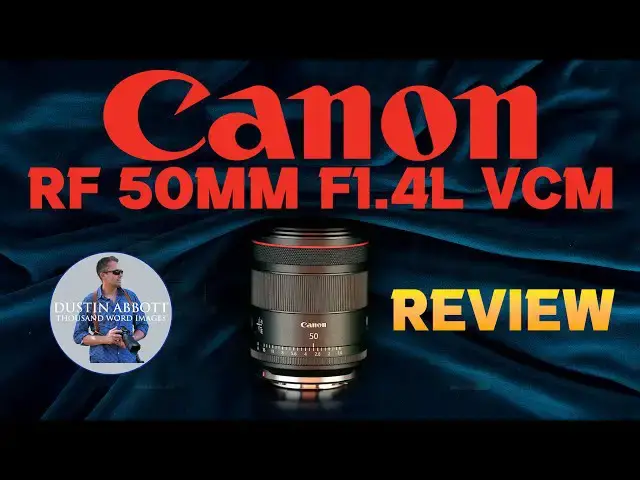
to give you my review of the Canon
0:18
VCM lens. Now, I reviewed the 35mm lens
0:22
from the series VCM lens in the past and
0:25
that lens I I gave it somewhat of a
0:28
mixed review. For one thing, I loved the
0:30
Canon EF 35mm f1.4 L Mark II. It was one
0:34
of my favorite Canon primes from the
0:36
previous generation. And so, in some
0:38
ways, I was kind of underwhelmed by the
0:40
new lens, how much correction that it
0:42
needed, and that it didn't seem to have
0:44
quite the character of the previous
0:45
generation lens. In this case, however,
0:48
I am overall happier with this lens. And
0:51
while maybe 50 millimeters is a little
0:53
bit easier to engineer, this is a good
0:55
kind of mid-level option compared to the
0:59
50mm f1.2 L, which is one of the
1:01
earliest RF lenses. And while I think
1:04
that that lens has really amazing uh
1:06
rendering, uh you know, there's
1:08
obviously some areas where it could be
1:10
improved, particularly when it comes to
1:11
the autofocus. And so in this case,
1:13
you've got a lens that cost you about
1:14
$1,50 less in terms of the MSRP, putting
1:18
it at about $1,450, competing right in
1:21
the same space as say Sony's 50mm f1.4
1:25
GM. And so this is a lens I think that
1:28
is going to be probably an appealing
1:30
option for a lot of people that just
1:31
don't want to spend all the way up to
1:32
the f1.2 or carry it around because this
1:35
lens is not quite half the weight, but
1:37
only a little bit over uh about 60% of
1:40
the total weight of the other lens. And
1:42
so there's a lot of things that make it
1:43
appealing. And of course, the VCM
1:45
autofocus is very fast, very quiet, and
1:48
this is going to be a better lens for
1:50
video than the other lenses. So today,
1:52
we're going to dive in and take a look
1:54
at it. I do want to thank Canon Canada
1:56
for sending me a loaner of this lens. As
1:59
always, however, this is a completely
2:01
independent review, and no one has had
2:03
any input on my findings here, and no
2:05
one will see it before you do. Let's
2:08
dive in. Let's take a look. All right,
2:10
let's talk build and handling for a
2:11
moment. Starting with taking a look at
2:12
the price. MSRP here is $1,549.
2:16
It's currently available for $100 less
2:18
than that. But that MSRP is $1,50 less
2:23
than the 50mm f1.2 L. And so it's not an
2:27
inexpensive lens currently at $1,450,
2:30
but at least it's more reasonable than
2:32
looking at spending $2,600 for a 50mm
2:36
prime. Size also is much more moderate
2:39
relative to the 50mm f1.2 L. It's 76.2
2:43
millimeters in diameter or 3 in, leaving
2:47
you a 67 millimeter front filter thread
2:49
up front, which is very common and
2:50
shared across lots of lenses. Length
2:55
mm. Anything under 100 millime I
2:57
consider to be a moderate or mediumsiz
3:00
lens at most. That's 3.9 in. And it
3:02
weighs in at 580 g or 20.8 8 oz. To give
3:07
a little bit of context, the 50mm f1.2 L
3:10
weighs in at 950 g. And so we're talking
3:14
about nearly 400 g more, which is a lot.
3:17
Now, this lens is ever so slightly
3:19
bigger and heavier than the Sony 50mm
3:22
f1.4 G Master lens, but it's it's in the
3:26
same ballpark. And certainly, of course,
3:29
you know, this lens has to accommodate
3:30
for a little bit larger mount diameter
3:33
than what the Sony or the Sony lens
3:35
does. As an L series lens, this is
3:38
thoroughly weather sealed, flooring
3:40
coating on the exposed outer elements.
3:43
It has got a weather sealing gasket at
3:45
the lens mount and then seal points
3:46
throughout the lens itself at the the
3:48
rings and the switches. So, all of that
3:50
is great. We do have an aperture ring
3:53
here and it there's not an option for it
3:56
to have clicks. It is always a
3:58
decllicked aperture ring. However, we do
4:00
have an aperture iris lock that allows
4:02
you to either lock in or out of the
4:04
aperture ring. Now, on the R six Mark
4:07
III that I've been primarily testing it
4:09
on, I'm able to use that aperture ring
4:12
even in stills mode, not just on video,
4:14
but unfortunately on my R5, even after
4:17
the most recent firmware updates to that
4:19
camera, uh I still can only use that
4:22
aperture ring when shooting video, not
4:24
for stills. It's that's the weirdest
4:26
thing that I've never encountered before
4:27
on any other lenses. But anyway, it's
4:30
there's some kind of technology thing
4:32
there for Canon that causes that
4:34
roadblock. And so, just be aware for
4:36
some of you, if you're using an older uh
4:38
camera body like I am, it means that
4:41
you're going to find that that aperture
4:42
ring does nothing when you're in stills
4:44
mode and it only works during video
4:45
mode. However, we do have an aperture
4:48
iris of 11 blades and so it can maintain
4:51
a pretty circular shape and you are able
4:53
in video mode to do nice smooth aperture
4:56
racks and so that is very useful as you
4:59
can see here. Other features include
5:01
outside of that iris lock and the
5:03
aperture ring include an AFMF switch on
5:05
the side and then a custom button always
5:08
welcome. And then of course we have C
5:10
Canon standard control ring at the front
5:12
that can be assigned a whatever value
5:14
that you want to assign it from the
5:16
camera within itself. That is clicked by
5:18
the way. Go figure. And then there is
5:21
the manual focus ring which I actually
5:23
really like. It's got a nice damping.
5:26
The VCM motor is nicely responsive. So,
5:29
it gives you a nice manual focus
5:30
emulation. Minimum focus distance here
5:32
is 40 cm with a magnification level of
5:36
0.15 times, which is enough to be
5:39
useful. Nothing exceptional, but useful.
5:41
And so, overall, I think that this is a
5:44
nice mediumsiz package that should work
5:47
for a lot of people. So, let's talk
5:49
autofocus. The VCM here refers to a
5:51
voice coil motor. And this is Canon's
5:55
kind of most recent technology that they
5:57
are using in autofocus, particularly in
6:00
what is an ever growing series of prime
6:02
lenses here. VCM motors are some of my
6:05
favorites because they are extremely
6:08
quiet. They tend to have plenty of
6:09
thrust for a lens like this to be able
6:12
to get very fast, very quiet, and very
6:15
accurate autofocus. And they also are
6:17
very very good for video work. And so
6:20
this is very much a hybrid lens. This
6:22
whole series I think is in Canon's mind
6:25
is designed for equally for use on video
6:28
as what it is on the stills side of
6:30
thing. And so autofocus motor here is
6:32
very quick and very quiet in operation.
6:35
And so this is an autofocus motor that
6:36
works very well with a hybrid camera
6:38
like the R six Mark III that I'm filming
6:41
on at the moment. I found that in all
6:43
the various situations that I shot that
6:45
I was able to get quick effective
6:46
autofocus. There was basically no drama
6:48
at all with autofocus. And so whether I
6:51
was shooting in a uh event type setting
6:53
in a church or whether I was shooting
6:55
shots of the animals out shooting the
6:57
nature shots that I like to shoot you
6:59
shooting in low light situations, it
7:01
didn't really matter. Autofocus was
7:03
pretty much instantaneous
7:05
there. Every now and then, as I always
7:07
see on all systems, sometimes the focus
7:10
system doesn't immediately want to grab
7:12
on a foreground object. It wants to stay
7:14
at the background instead. But all you
7:16
got to do is basically, you know, point
7:18
or manually focus back into the rough
7:20
zone that you want and then autofocus
7:22
will, you know, kind of get the hint and
7:23
it will lock on to what you want. And
7:25
again, that's something that's pretty
7:27
universal across all different camera
7:28
systems. And so, in general, I'm very
7:30
happy with autofocus and what we get out
7:32
of the lens. So, how about video AF?
7:35
Well, I had to actually reshoot this
7:37
scene because uh Nala interrupted my
7:40
outdoor recording and I didn't realize
7:42
that after she jumped into the scene,
7:44
the focus never really got consistently
7:46
back to me. She's stole the show yet
7:49
again and using it for video work.
7:51
Hello, Anala. What are you doing, you
7:56
You showing off for the audience. This
7:58
lens has a VCM focus motor and voice
8:00
coil motors are really particularly good
8:02
for video work. You can see here that as
8:06
I approach the camera, it is really,
8:08
really responsive. Not only in keeping
8:09
up with me, even shooting at f1.4, but
8:11
if I duck out of the scene, it is like
8:14
instantly to the background and
8:15
instantly back to me. There's just
8:16
really no hesitation there. And so, it's
8:18
a very reliable uh focus motor if you're
8:21
wanting that kind of accuracy to, you
8:23
know, be able to get a subject and to
8:26
continue to track it. And so, it's very,
8:27
very effective for that. In terms of
8:29
focus pools, again, it's got good
8:31
confidence there in terms of going back
8:33
and forth. And so, no real hesitations
8:35
there. I mean, this is a a lens that
8:37
really is designed around hybrid video
8:39
work. And you can tell by its
8:42
performance and and so I have no
8:44
hesitations in recommending this focus
8:46
motor for video work. Okay, let's start
8:49
by taking a look at vignette and
8:50
distortion. Distortion is not bad. A
8:53
very mild amount of pin cushion
8:54
distortion. I used a minus two to
8:57
correct it. Nice and clean. No problem
8:59
there. Vignette is another story. You
9:01
can see that there is a massive amount
9:03
of vignette here. And that is definitely
9:05
one of the areas where Canon, I think,
9:08
is overly reliant on having such good
9:11
electronic correction profiles available
9:13
to them. So, they're just a little bit
9:15
lazy sometimes with correcting these
9:17
type of things optically. I basically
9:19
had to max out the sliders here for
9:21
vignette to get rid of that. And so, it
9:24
is a good solid four stops of vignette.
9:28
very very heavy. There's also some
9:30
fringing on this lens. You can see on
9:31
the test chart, definitely a little bit
9:33
of magenta, but more noticeably some
9:35
kind of green fringing after the plane
9:37
of focus. I did notice it out in some
9:39
real world shots. For example, here you
9:42
can see that all of the specular
9:44
highlights definitely have some of that
9:45
green fringing around them, which I
9:47
don't love. Then when I shoot my dad's
9:50
old SLR, you can definitely see some
9:52
fringing showing up on any of the shiny
9:56
edges there. and also a little bit here
9:58
in the actual text. As we look at the
10:00
specular highlights, there is a mild
10:02
amount of fringing there, but not too
10:04
bad. However, we do see that they are
10:07
pretty busy. That's an unfortunate
10:09
reality that uh you know, kind of almost
10:12
some onion type bokeh in there. Now,
10:14
here's the geometry as we stop down here
10:16
at f2. So, you know, getting nice and
10:18
circular other than in the corners. 11
10:20
aperture blades here. And then as we
10:22
stop on to f2.8, they're very circular
10:25
all across the frame. However, they
10:27
definitely are still quite busy. So,
10:30
that part is unfortunate. If they're
10:32
really bright like this, you don't see
10:34
that so much. And so, you know, I I like
10:37
the look of this image generally. You
10:39
can see there's a little bit of that
10:40
lemon or cat eye shape, but generally
10:42
not too bad here. But, I mean,
10:44
obviously, there's going to be that
10:45
factor in the lens, as we're going to
10:47
see, is nice and sharp. Good contrast.
10:49
Lateral style chromatic aberrations are
10:51
not bad. There's a tiny bit here at the
10:53
edge, but like for the most part, the
10:55
transitions from black to white look
10:57
excellent. And so this is on a 45
10:59
megapixel uh EOS R5 in the center of the
11:02
frame. We can see that sharpness and
11:04
contrast is good. Not like
11:07
mind-blowingly good, but good. Mid-frame
11:09
is looking really, really nice. A nice
11:11
consistent profile there. And as we look
11:13
up here towards the corner, you can see
11:15
that here it's good, but it's getting
11:16
softer towards the edge. And looking
11:19
down into this corner, similar kind of
11:21
story there. For some real world
11:23
perspective here at f1.4 out at
11:25
infinity, you can see perfectly good
11:27
amount of detail and contrast there. I'm
11:30
happy with that. And this shot here is
11:32
also at f1.4. And you can see good
11:35
detail and contrast here. And and right
11:36
off to the edge of the frame, I still
11:38
find everything's looking acceptably
11:40
good. Over here, we're kind of
11:42
diminished by depth of field a little
11:44
bit. And so that's not really relevant.
11:46
But here where we have within the depth
11:48
of field, it looks fine. The shot of
11:50
Nala at f1.4 looks great. Great detail,
11:54
great contrast. Nothing to complain
11:56
about with that. And I would say that
11:58
the overall rendering in this shot is
12:00
fine. I don't see any issues like with
12:02
fringing, for example. Might be a tiny
12:04
bit in the whiskers there, but it's not
12:06
anything meaningful. Maybe a tiny bit in
12:08
this edge, but I don't think anyone's
12:10
going to be too put off by that. Okay.
12:11
If we stop down to f1.8, eight. We can
12:13
see that there is a little bit more
12:15
sharpness and contrast there. Not by any
12:18
kind of meaningful margin, but just a
12:19
little bit better. Likewise here,
12:21
looking a little bit better. And if we
12:23
look up into the corner, it's not really
12:26
a radical difference, though. You can
12:27
see that sharpness profile extending
12:29
just a little bit from f1.8 to f2.
12:32
Again, it's just a tiny improvement, but
12:35
we'll see a little bit more of a
12:36
meaningful improvement from f2 to f2.8
12:39
here. Looking down into this corner, you
12:41
can see that now we're getting into
12:43
quite good range here in the corner. And
12:46
by f4, we're approaching excellent. And
12:49
by f5.6, I think we've probably peaked
12:51
as far as consistency across the frame.
12:54
At f11, we see that sharpness is still
12:56
staying at a pretty nice level.
12:59
Defraction is starting to cause a little
13:00
bit of issue by f-16, but not to a
13:03
terrible extent. It's just not as crisp
13:05
as what it would be at f11. and an f11 a
13:08
little slightly bit less crisp than f8.
13:11
Here's a look at that maximum
13:12
magnification 0.15 times. And if we take
13:15
a look here, you can see that the amount
13:18
of sharpness there is fairly good.
13:20
Contrast isn't like wow good, but
13:23
overall it's plenty of detail there to
13:25
use for up close shots. This shot for
13:27
example with you know this kind of shiny
13:30
metallic surface, you can see good
13:31
contrast and detail even at f1.4 there.
13:34
So perfectly usable for that.
13:36
Boat quality is generally good and you
13:39
know in optimal situations this is what
13:41
I would consider an optimal situation
13:42
and it's helped by the fact that there's
13:44
a bit of fog here makes everything nice
13:46
and soft. It looks great in this shot.
13:49
It's a little bit less advantageous but
13:51
still we've got a good level of contrast
13:54
on the subject and a fairly nicely
13:56
defocused background. No real hard
13:58
edges. Colors here look great and you
14:02
know that's kind of what I would expect.
14:04
And yeah, I was shooting in somewhat
14:06
dreary conditions, but sometimes those
14:07
can produce very nice uh images. I also
14:11
found that as I kind of panned up and
14:13
down into the sun coming through with
14:15
window light here, the lens was fairly
14:17
flareist and didn't really give me any
14:20
kind of major issues with that. So
14:22
overall, a fairly strong optical
14:24
performance. Not perfect, a little more
14:26
vignette than what I would like, a
14:27
little bit more fringing than what I
14:28
would like, but still it's a lens that
14:30
produces greatl looking results. So,
14:33
what's my conclusion? Well, you've
14:34
probably picked up as a part of this
14:36
review that I like this lens better than
14:38
what I did the 35mm f1.4 LVCM. I feel
14:42
like there are less compromises in the
14:44
optical design. And while it's not a
14:46
flawless performer optically, I think
14:49
that it is nice and strong. It is
14:51
competitive with similar lenses from
14:53
other brands. And I feel like this is a
14:56
a really solid hybrid option. I love the
14:58
VCM focus motor. I love in general the I
15:03
would say the handling of the lens. So
15:04
I'm I'm less delighted that if you have
15:06
an older camera body like my R5 that you
15:10
actually aren't able to use that
15:12
aperture ring in uh photo mode, only in
15:15
video mode. So that's that's just a bit
15:17
of an annoyance because it's something
15:18
I've never seen before from any other
15:20
brand in any other situation. But if you
15:23
have one of the newer camera bodies from
15:25
Canon, obviously that is a non-factor
15:28
and you can use the aperture ring in
15:29
photo mode. And so, you know, that makes
15:31
it a little bit more of a versatile
15:33
lens. I wouldn't say that this is a
15:36
better lens than what equivalent lenses.
15:38
I would still say that I having owned
15:41
the Sony 50mm f1.4 GM for a long time, I
15:45
would say that I still like that lens
15:46
better, but I also think that this is a
15:49
really strong lens. And frankly, uh,
15:51
there isn't really any kind of EF analog
15:54
for this lens because in the previous
15:55
generation, the 50mm f1.4 was really
15:59
more of a consumer-grade lens.
16:01
Obviously, this is a much higher level
16:02
and it's a much more expensive lens. But
16:05
I'm really glad that this lens exists
16:07
because the jump between spending under
16:10
$200 for the 50mm f1.8 8 SDM and then
16:14
spending all the way up to oh about 2600
16:19
$2,700 for the RF50mm f1.2L.
16:23
That's a big big gap. And so I'm glad to
16:26
have this mid-tier option particularly
16:28
for those that want to do both photo and
16:30
video work. And so I think it is a very
16:33
solid option for that. And considering
16:34
unfortunately that we don't really have
16:36
any third-party alternatives, this is
16:39
probably the best 50 millimeter f1.4
16:41
four option that you've got. If you want
16:44
more information, you can check out my
16:45
uh text review that is linked in the
16:47
description down below. There's some
16:48
buying links there as well. As always,
16:51
thanks for watching. Have a great day
16:53
and let the light in.