Up next in 10

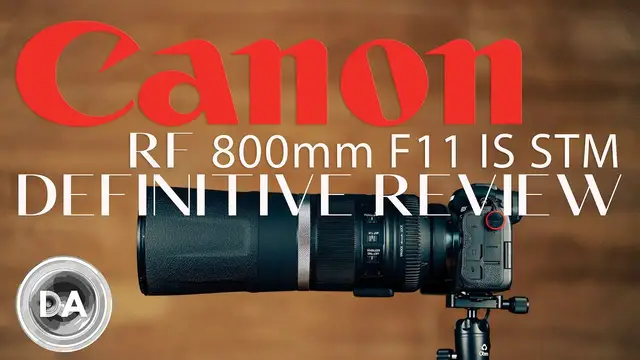
Canon RF 800mm F11 IS STM | Definitive Review
Jul 18, 2023

Photographer Dustin Abbott shares a thorough review of the odd Canon RF 600mm F11 IS STM lens - the lightest and cheapest way to get to 600mm! | Video Sponsored by Ridge Wallet: https://www.ridge.com/DUSTIN Use Code “DUSTIN” for 10% off your order | Read the Text Review: https://bit.ly/RF800review | Visit the Image Gallery: https://bit.ly/RF800pics | Purchase a Canon RF 800mm F11 IS @ B&H Photo https://bhpho.to/3D6y19u | Amazon https://amzn.to/3AU9LWr | Camera Canada https://shrsl.com/34ij8 | Amazon Canada https://amzn.to/2WaUv8k | Amazon UK https://amzn.to/3z6EZca
Purchase a Canon RF 600mm F11 IS @ B&H Photo https://bhpho.to/3j2niF4 | Amazon https://amzn.to/3swaIkG | Camera Canada https://shrsl.com/34ij6 | Amazon Canada https://amzn.to/3z85vlM | Amazon UK https://amzn.to/3y1AbDS
Check out the DA Merch here: https://bit.ly/TWIMerch
Purchase a Canon EOS R6 @ B&H Photo https://bhpho.to/3dCt9g3 | Amazon https://amzn.to/3o0T4Tm | Camera Canada https://shrsl.com/2k730 | Amazon Canada https://amzn.to/3424pLc | Amazon UK https://amzn.to/2H9e6yj | Amazon Germany https://amzn.to/2T0BkJJ | Ebay http://bit.ly/EOSR6dla
Purchase a Canon EOS R5 @ B&H Photo https://bhpho.to/3iMH18x | Amazon https://amzn.to/33L3D53 | Camera Canada https://shrsl.com/2jqth | Amazon Canada https://amzn.to/3iEo6wE | Amazon UK https://amzn.to/3jLHol4 | Amazon Germany https://amzn.to/3nxaE1h | Ebay http://bit.ly/EOSR5dla
=============================
Table of Contents:
=============================
0:00 - Intro
2:52 - Build and Design
10:23 - Autofocus Performance
15:53 Image Quality Breakdown
23:49 Conclusion
---------------------------------------------------------
Show More Show Less View Video Transcript
0:00
Hi, I'm Dustin Abbott and I'm here to give you my definitive review of the Canon RF 800mm F11
0:17
and this is an IS or image stabilized and it has an SDM or a stepping focus motor
0:24
This lens of course joins the 600mm that I reviewed a week ago
0:29
as being amongst the most unique lenses on the new Canon RF full-frame mirrorless platform
0:36
In that they, number one, are much smaller and lightweight and cheaper
0:41
than most prime lenses that reach this kind of focal length. But beyond that, they also have a really, really odd aperture, maximum aperture of f11
0:52
And it's not just a maximum aperture of f11, it is an aperture of f11
0:57
More on that in just a moment. And so these lenses, there's some different elements, design elements as a part of them
1:06
and they're really quite unlike anything that I've reviewed on anything previously in the past
1:11
Some for good, some for ill, as we'll see as a part of this review
1:15
But what is certain is that this lens, I think even more than the 600mm
1:20
is an enticing proposition if your goal is just to get as much reach as possible
1:26
There are very few lenses that reach out to 800mm and certainly very few of them that give you good image quality, as we're going to see this lens does, and at such an inexpensive price
1:38
In this case, we're looking at around $900 US dollars. So, to get 800mm of reach in an autofocusing, image-stabilized lens is pretty impressive
1:48
And we'll discuss a little bit more how we get there during this review here today
1:53
But first, a word from our sponsor. today's episode is brought to you by Ridge the wallet redefined give your aching rear a break
2:01
and ditch that bulky old wallet full of stuff you don't need and move to a sleek aluminum titanium
2:06
carbon fiber or even their new 18 karat gold Ridge wallet it takes up a little more room than a
2:12
credit card has RFID blocking technology to protect your valuable information and comes with a
2:18
lifetime warranty. Visit ridge.com forward slash Dustin and use code Dustin to get 10
2:24
off your order along with free shipping worldwide. So this comes out as a larger lens than what the
2:33
600 millimeter did as we took a look at recently and even though it is definitely larger and it is
2:39
heavier it still is an incredibly lightweight and relatively compact tool for this kind of reach
2:45
So let's break down the build and the design of the lens and give you more information, give you a closer look at it
2:51
Let's dive in and take a look. So we're going to go hands-on with this very, very unique lens
2:56
It stands with the 600mm F11 lens as the only lenses like this that I've ever seen this kind of design language with
3:05
And so there are some serious quirks that are a part of this design. And that starts when you power the camera on
3:10
the first thing you're going to see is a notification to set the lens to the shooting position
3:16
So you actually can't use the lens until first you release this locking position here
3:21
You extend the lens out a fair distance, 10 or 11 centimeters, and then you lock it back in place
3:29
And only then will you see the actual traditional focus screen appear
3:33
except for it's not quite like what your custom is seeing in that there is a rather small
3:38
by comparison to when you're accustomed to having the whole frame available
3:42
a fairly small box that is there. Because of the maximum aperture of F11, autofocus is limited here
3:49
And so you don't have all focus points available. You're just able to focus within the center point
3:54
And for those of us that have gotten spoiled and used to being able to track all across the frame
3:58
I did not enjoy going back to a more limiting experience like that
4:03
But the quirks don't end there. If you look inside here, you're going to see that there are no aperture blades
4:09
And you say, well, sure, you never see the aperture blades when the aperture is fully open
4:13
True, but in this case, there are no aperture blades showing because there are no aperture blades
4:19
This is a fixed F11 lens, which means that not only can you not open the aperture wider than F11
4:25
you can't close it down further than that, which means that every shot taken with this lens will be shot with an aperture of F11
4:32
And so that obviously really limits what you can do creatively in that you can't stop the lens down further to increase depth of field
4:41
And so you're going to have to use this lens basically in a very prescribed kind of way because that's the only way that it functions
4:48
Just another part of the quirkiness of this particular lens. Now in its retracted position, this is a very compact lens for an 800mm lens
4:58
It's not compact in absolute sense and certainly feels significantly larger than what does the 600 millimeter
5:05
But in this case, we have nearly 102 millimeters of diameter to the lens, giving us a fairly large 95 millimeter filter thread up front
5:14
And the overall length of the lens is about 352 millimeters. And so it is a fairly long lens, about 90 millimeters longer than what is the 600 millimeter
5:26
You'll note that at the front of this lens, there's an extended section that has a very different texture
5:31
In this case, it's a rubberized surface. That's where you're going to be holding the lens a lot
5:35
And it feels more like a camera body or even like a pair of binoculars in terms of finish
5:41
In some ways, this lens looks a little bit like a long binocular because of that, you know, unique type of finish
5:48
Not included here is a lens hood. Canon persist in its non L-series lenses of not including lens hoods, which seems really odd to
5:57
not have an included lens hood in a lens like this. Also, there is no kind of weather sealing
6:02
included as well, and somewhat unique to a lens like this. Although there is an attachment point
6:08
for a tripod foot, it doesn't actually come with a tripod foot, which is the reason why you'll see
6:14
that I am having to have a rather precarious balance with my little tabletop tripod of mounting
6:20
this on the camera and then having all of that weight out in front. And I've taken care
6:25
of that by making sure that I have a leg underneath here that is supporting that weight as it
6:30
would like to tip forward. And so if you're going to use a tripod foot, you're going to
6:35
have to use a third party one and provide it yourself Just another one of the quirks that are a part of this Now as far as other aspects of Linn design it a little bit more traditional We have Canon control ring which is you know we become accustomed to on RF
6:50
lenses. It has a diamond pattern here as we've always seen, but it's a different finish in that
6:55
a little bit more of a chrome type finish. The focus ring is nice and wide. It's ribbed and
7:02
rubberized. It has a little bit less damping, at least in the two copies I have here, a little less
7:07
damping them what does the 600 millimeter. I slightly prefer the feeling of the 600 millimeter
7:13
as it feels a little bit more definite. That could be a copy specific thing. There are three different
7:18
switches here, including a focus limiter, two position, full, and then 20 meters to infinity
7:26
Now that's kind of a long distance. You know, 20 meters is starting you at nearly 70 feet away
7:30
And so it's kind of an odd starting position for that. But that also betrays the fact that this
7:36
lens really is not designed for close focus at all. It can only focus as close as six meters
7:42
which is nearly 20 feet. And so you're not going to be able to get close with this lens. And it has
7:47
a very low, like the 600 millimeter, magnification of 0.14 times. And so this is not a lens that's
7:54
going to double as a macro lens in any way, shape, or form. Overall, the weight here is 1,260 grams
8:01
which is obviously very lightweight for an 800 millimeter lens. In fact, that's lighter than
8:06
most of your traditional 70 to 200 millimeter f2.8 zoom lenses. And so it is definitely a
8:12
lightweight lens. In the middle here, you have an AF-MF switch, switching between the stepping motor
8:18
and then manual focus. And then on the bottom, you have a basic on and off switch for the image
8:25
stabilizer. So no different stabilizer modes, but just that one on and off switch. You're going to
8:30
have to rely on the lens to be smart enough to handle whatever situation you're in, even if
8:35
you're panning. Now, I will say on a positive note that the image stabilizer here works very
8:41
effectively, particularly for such a long focal length, and it's very, very appreciated because
8:46
with a minimum or a maximum aperture and minimum aperture of f11, it means that in most lighting
8:52
conditions, it's going to be hard for you to get a fast enough shutter speed to really stop action
8:57
And so if you're shooting an unmoving subject, you can rely a little bit more on that and keep your ISO low
9:04
Otherwise, you're going to have to crank that ISO because no image stabilizer is going to stop the actual movement of your subject
9:11
And so you have to, the only way to accomplish that is to get that shutter speed up fast, which is hard to do here with a maximum aperture of F11
9:20
So just one of the quirks in operation of this lens. So certainly a very unique kind of lens design, not going to be for everyone, not going to be for most people
9:30
And yet this lens is popular because it gives you a tremendous amount of reach for a quite inexpensive price of right under $900 US dollars
9:38
In some ways, I feel a little more open to accepting some of the quirks and flaws of this particular lens
9:44
simply because unlike the 600mm, at 600mm there's quite a number of options of getting you there
9:51
It doesn't mean that they're necessarily better, but they are different options. Bottom line is you still get to 600mm
9:57
That's really not true when you talk about an 800mm lens. There just are very, very few lenses that are going to get you there
10:04
And often to get there, you're having to involve something like a teleconverter, which has its own downsides
10:10
And so there are some quirks here, obviously, but I'm willing to embrace those a little bit more fully on an 800mm lens
10:17
just because of the other uniqueness of that amount of reach in a lens that is really, at the end of the day, still quite usable
10:24
That usability extends on to the stepping motor because while stepping motor doesn't represent the top tier of autofocus performance
10:32
on a Canon RF mount, their kind of better system is their Nano USM
10:38
And a Nano USM gives you just a little bit more speed, and particularly when used in kind of an array of multiple nano USM motors
10:47
it really delivers some really great autofocus results. Often STM is not quite on that level
10:52
though I will say that the STM motor employed on this in a 600mm lens
10:57
they are amongst the better ones on Canon lenses. First of all, there is a very good amount of quietness
11:04
There's not a lot of focus sound. And even if I were to focus with the lens near my ear
11:09
I hear only the faintest little clicking sound inside, which is almost inaudible
11:16
And so there's very little focus noise. Focus speed is generally fairly good, though obviously there are some limitations on a lens like this
11:24
in that if you're trying to go from close to distant, the reality is that it doesn't really focus all that close
11:32
And so in this case, your closest focus point is 20 feet away or 6 meters
11:38
and so that means that you know it's not so much up close to infinity it's less
11:43
less far to infinity and so at the end of the day I do find that focus is fairly good
11:49
The biggest place that I am going to miss more focus speed is actually during initial acquisition
11:54
say with birds in flight. Obviously this is a really long focal length and it's not like a
12:00
zoom lens where you get to kind of acquire subject and then zoom in closer to it. You're
12:05
always at 800 millimeters. And so that does make that initial contact of an object that's already
12:10
in motion, it's challenging and it's going to require some effort, particularly since, as we
12:14
have already seen, you're not working with the full sensor's worth of focus there. You have more
12:19
of a center box. And so that does introduce some additional challenges into this. That being said
12:25
I was actually really pleasantly surprised at how good focus was for, for example, bird in flight
12:32
And so if I were to, once I had acquired focus, I could track, even though it takes a lot more work with a long, very narrow angle of view and not having the full sensor to work with, with some effort I could track this seagull in flight, for example
12:49
And as you can see, though, you know, it's some weaving up and down, either the birds doing that or maybe I'm doing that
12:55
You can see that consistently the eye was in focus. Even more so, let's run that clep back again, but now zoomed in a fair bit
13:03
And you can see that with great rapidity, we are keeping a good constant accuracy on the eye of the seagull in flight
13:11
So I was really impressed by that in performance. I'm also impressed by the R5 body that I was using in that it doesn't actually have a dedicated bird
13:20
IAF mode like my Sony Alpha 1 does but it seems to do equally good in tracking eyes nonetheless And so I could certainly see it lock on and track during flight and just really deliver very good results in that
13:34
setting. So I was very impressed with that. And so of course, if you're able to capture the bird
13:38
in flight, capturing, you know, for example, these birds that are still are just hopping around
13:43
you know, easy peasy, no problem at all with autofocus there. So at the end of the day
13:47
I think that there are some good marks to be given here on the autofocus front. It's not the
13:52
fastest lens out there and you know compared to the high-end telephoto primes but at the end of
13:59
the day I think you're going to get a better result here than you are with most say teleconverter
14:04
combinations which is going to be your most likely way of reaching out to 800 millimeters
14:08
so I don't think that you're losing much there now my major caveat that I do have to give here
14:13
is you have to remember this is always f11 your the sensor is never going to get more light than
14:18
f11. So that means that shooting in the middle of the day, I'm able to, you know, I have to shoot
14:25
at higher ISO than what I would like, you know, even, you know, mid afternoon, if I want to stop
14:30
action of a bird in flight, I'm going to have to shoot ISO 1600, 3200, at least to achieve that
14:37
But if you're working at the margins at all and lower light conditions, this lens is probably
14:43
going to give you some frustration. So that could be, you know, very early morning for shooting
14:47
wildlife and so, you know, sun's just rising and there's still, you know, kind of maybe misty
14:52
conditions or that's just kind of dim, your autofocus speed is going to drop. And it's going
14:57
to drop because there's a minimal amount of light that's able to get through the lens to the sensor
15:02
Likewise, you know, at late evening or in lower light or stadium conditions where the lighting's
15:07
not very good, you're going to have frustrations. This is not a true, you know, replacement for an
15:12
you know, an f4 or an f5.6 lens and those kinds of situations. And so you have to be realistic
15:18
about the kind of scenarios where this lens is going to thrive and where it's not going to
15:23
and use it to its strengths. And I think if you use it to your strengths, you are going to be
15:27
quite satisfied with the performance. The same I think is going to be true in many ways when we
15:32
talk about the image quality performance. There are some oddity lenses out there, you know, for
15:38
example, like mirror lenses that can give you very long reach in a fairly compact body, but often
15:44
the image quality is really mediocre. As we're going to see in just a moment, this lens is far
15:50
better than mediocre in that performance. Let's dive in. Let's take a look. So first of all, you
15:55
can see that I'm zoomed much further into my chart than what I usually am, and that's because
16:00
at 800 millimeters, you need a lot of room to frame that whole chart, room that I don't have
16:06
So what we can see here is there is just a mild amount of a pin cushion distortion
16:12
You can see these lines squeezing down just a little bit and a bit of vignette in the corners
16:17
though nothing here is very extreme. So here's a manual correction of that
16:21
So first of all, I've taken off the profile corrections. Very mild amount of distortion, a minus two, and then a plus 50 for the vignette
16:29
Nothing that is significant. And most of the time, this is what you'll actually see right here
16:34
because the standard profile in camera or in software will automatically detect and add that
16:40
And so you don't actually see either the vignette or the distortion, though frankly, neither one is that big of a deal
16:46
I found, like the 600mm, that I was impressed with chromatic aberration control
16:51
And so when it comes to longitudinal chromatic aberrations, it will exhibit before and after the plane of focus as fringing
17:00
You can see that on these white high contrast little wildflowers, that there is not really any evidence of any kind of fringing after that
17:09
And so it is well controlled here. And even in these kind of transition areas here
17:14
we can see that chromatic aberrations are well controlled, no fringing to be seen
17:19
Likewise, I don't see any lateral chromatic aberration near the edge of the frame
17:24
Lab will show up on either side of black and white transitions like this
17:28
and you can see there really just isn't any evidence of that taking place here
17:32
So our sharpness tests are done on the 45-megapixel Canon EOS R5
17:38
and so in this case, I have used a... Obviously, I always use a steady tripod
17:42
I usually use a 2-second countdown. In this case, I went to a 10-second
17:47
just because there's a little bit more chance of there being vibration that lingers
17:51
and a lens like this that, as we've already seen, doesn't necessarily balance the best
17:55
because I don't have a tripod foot for it. Nonetheless, I think I've got very representative sharpness results
18:02
and you can see that in the center of the frame, even at 200%, this is a very sharp lens, and we can see good contrast, good detail
18:09
no problem reading any of the letters that are here on the headband on this bill
18:15
And so, you know, very impressive there. If we move off towards the side on this Canadian bill
18:20
you can see that, again, there's lots of good information there. You can see lots of the weave and textures on the bill itself
18:27
So very impressive. And while I don't have the whole bill to work from, we can see working right down here into the corner
18:33
there is a fairly good profile that reaches right out into the very edge of the frame with good detail and contrast there as well
18:41
So I actually recomposed. And so we would have a chance to really examine further the corner performance
18:48
And so here you see that, again, it's just a really strong look
18:52
you can see that there's great detail that really wasn't much different than what we saw in the mid-frame edge
18:58
And that goes right out to the extreme edge here. Maybe not quite as much contrast right here at the edge, but still a very good amount
19:06
So as noted previously, the maximum magnification figure is not super high here
19:11
but you can see that it's a fairly flat plane of focus with good detail across here
19:16
And if I zoom into a pixel level, I feel like the contrast is ever so slightly reduced, not quite as good as what we saw at a more standard viewing level
19:27
But overall, this is still a fairly good result. And again, looking off towards the edge of the frame, it's a very usable amount of detail, just a little bit reduced contrast at the minimum focus distance
19:38
So of course, lenses like this are really great for shooting the moon
19:42
In this case, this is a handheld shot, so you could get even better detail if you were in more optimal conditions
19:49
There were coming through, this is either a blood moon that was coming through or it could just be atmospheric conditions at the time
19:57
But this is as it was in terms of color. But you can see as we look towards the edge, there's great big bits of contrast in the crater that is shown there
20:04
and so I mean obviously a really fun lens for shooting up at the moon because you get such a nice high degree of magnification Now the quality of the bokeh can be impressive mostly because 800 millimeters is an extremely
20:19
long focal length. And so, as we can see here, even, you know, with an aperture of f11
20:26
all behind it is completely blurred out. Very, very nice. Here, you know, we've got a little bit
20:31
that's in that transition area. And so, there's a little bit of distracting lines, but overall
20:36
You know, very nice and soft as far as the bokeh. And then taking a look at this image where you have more varying layers
20:44
And so this is just actually on a beach. And so it's very interesting what you can do with the compression with a long focal length like this
20:51
That, you know, the beach seems to be like a wall behind the seagull here
20:57
But in fact, it's just the angle. And it just goes to show you can really get unique looking images at 800 millimeters
21:04
and so here you can see at a one-to-one pixel level that there's nice detail in the feathers
21:09
around the eye here eye detect has worked very well colors are nice here again another seagull
21:16
you can see that once again eye detect is just really really effective nailing it and good detail
21:23
in the feathers everything looks quite nice and these are real world results you know so you know
21:28
this is more indicative of what you can actually get and again i think that's a very good performance
21:33
on a 45 megapixel sensor there. So I'm impressed with that. I was also impressed in this image
21:40
Now I've kind of color toned to taste here. And again, you can see that the focus
21:47
and the degree is good. You know, it's a little bit more of a look that's been put on here
21:52
but it's kind of working on the fact that ISO is a little bit higher. And so I've gone with a higher contrast look
21:57
because it just gives some punch to the image. I found that in all of my sequences here
22:03
of birds in flight, I was really impressed by how much detail there was on the eye, how
22:09
good a job the lens did, along with the focus system of the R5, of just always keeping that
22:15
bird's eye in focus. And even though there isn't an engaged or active bird AF mode like we see on the new
22:22
Sony Alpha 1, you really don't see the difference because it does such a great job in this application
22:28
Now, a couple of final observations. As I point out, and I like to point out on all of these long telephoto reviews, because it's a phenomena that will really throw people
22:37
When you're shooting over areas where there's different thermal deposits, you know, for example, here over water
22:43
And on this particular day, it was a hot day. It was kind of, it was humid
22:48
And of course, the water was cooler than the, you know, the temperature of the air
22:52
That creates these thermal pockets that really do kind of distort and diminish the amount of sharpness
22:59
And so it's not a matter of the lens being softer. It's just the reality of physics on those days
23:05
And if you shoot in other conditions that are a little bit more optimal
23:09
you'll see here that the detail obviously looks better in this particular image
23:14
And so on the subject, it looks good here. But you'll notice that even beyond the kayaker
23:19
there's obviously some different thermal deposits. And you get this almost painterly kind of look that is in large part just a distortion
23:27
You see here it looks like rough brush strokes, and that is an atmospheric distortion that is caused by those different thermal deposits
23:35
And so don't be too frustrated if your images aren't as sharp as what you like under those conditions
23:40
because even if you had a $10,000 lens, it wouldn't be radically different because of physics, which you have no control over
23:49
So that image quality evaluation obviously is a little simpler than usual
23:52
When you only have one focal length and one aperture to evaluate, it really does take a lot of the variables out of the equation
23:59
But, you know, in that controlled environment, I'm really impressed with the kind of image quality that I'm getting
24:05
That's really good resolution, and, you know, for that kind of reach, that's great results
24:10
As I mentioned in the 600mm lens, though, you do have to temper that with some realities, real-world realities
24:16
and that is that if you have a moving subject, for example, and you have to get that ISO up
24:21
it means that you're not going to get the peak performance out of your camera
24:25
It means that there's going to be probably a little bit more noise
24:29
that textures aren't going to be quite as pronounced, and maybe you have less dynamic range to work with in your images
24:37
because of shooting at higher ISO values. That's part and parcel with a lens with an aperture of f11
24:43
and you're going to have to take that into consideration. That being said, though, this is a legitimate lens
24:48
that can produce legitimately good images. Again, if you use it at its strength
24:53
And that's really where I come down on these lenses. I think that for a certain kind of photographer
24:58
these are great additions to the Canon RF lineup in that it enables those without deep pockets
25:05
to get some truly amazing reach. But whether you're going to be satisfied
25:10
or dissatisfied with this lens, in large part is going to come down
25:14
to how realistic your expectations are of it and the situations, environments that you can use it in
25:21
This is the lens that has no weather sealing. And so it's not going to be as good in places that are very sandy or moist
25:29
That's going to be an issue there. If you're shooting in anything other than optimal lighting conditions
25:34
you're going to have some frustrations. And so you have to appreciate this lens for what it is
25:38
And I know some of you, this is the kind of lens that you keep in your car for those moments of opportunity when you need to reach that distant subject
25:47
And you can throw this on and it gets the job done for you. And so I think that there are certain photographers
25:53
that are really going to love this lens and appreciate the fact that it unlocks a type of photography
25:57
for them that would be otherwise unreachable. And so to Canon, I say, you know
26:03
kudos for taking a bit of a risk with lenses like this
26:07
And I think that for the right people, they are something that has value, just not for everyone
26:12
I'm Dustin Abbott. And if you look in the description down below, you can find links to my full text review
26:17
There's also linkage there to the image gallery. so you can check out some of the photos that I've taken with this combination
26:23
There are some buying links there if you'd like to purchase one for yourself. Also, Lincoln's to purchase my merchandise, to sign up for my newsletter
26:31
to follow either Craig or I on social media. And also, of course, you can sign up to become a patron to help to support this channel
26:40
And if you haven't already, please click that subscribe button right here on YouTube
26:43
Thanks for watching. Have a great day. And let the light in