0:00
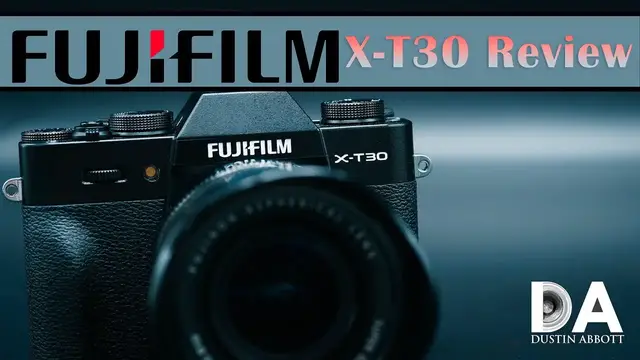
Hi, I'm Dustin Abbott and I'm here today to give you my final verdict on the new Fuji X-T30
0:11
This is an APS-C mirrorless camera with a 26 megapixel X-Trans sensor
0:17
And it is, as you can see, it's a really compact body
0:21
And so this is a camera that is well suited for those of you that are looking for a travel option
0:27
or you just like a compact form factor. You know, there's varying opinions on kind of the role of mirrorless
0:35
And I think that as mirrorless kind of becomes a little bit more mainstream
0:40
we're starting to see that there is a kind of a spectrum of approaches to doing mirrorless
0:46
where, you know, some companies are, you know, they're kind of bridging the gap
0:50
to where they're making smaller, really compact bodies for those that are looking for
0:54
kind of that aspect of mirrorless. And frankly, I would say that APS-C is probably, you know
1:01
APS-C and maybe micro four-thirds are the way to go when it comes to wanting really, really compact
1:06
You know, you move into full frame cameras and while Sony has managed to produce, for example
1:12
some full frame mirrorless cameras that are, you know, reasonably smallest in terms of the camera
1:17
bodies themselves, when you start talking about full frame lenses, that kind of small and light
1:24
goes out the window. And so I think that in many ways, the APS-C mirrorless space is probably the
1:31
most attractive if that is your priority set. Now, I would recommend that you take a look at my
1:37
overview video that takes you on a tour of the features and the performance of the camera. And
1:44
if you look at this episode, it fills in a lot of the details, how it compares to their
1:49
little bit more upscale model that's a little bit bigger in size. That's the Fuji X-T3
1:56
It's also bigger in price, and it's a little bit bigger when it comes to performance. And
2:01
I really delineate in that video where they cut and where they retained the internal aspects and
2:09
some of the performance of the X-T3. Suffice it to say, however, that they have positioned the
2:13
XT30 to be competitive with cameras like Sony's, you know, A6000 series. And like the new A6400
2:23
for example, which is priced at about the same point, $899 in the U.S. market for either this or
2:29
the A6400. Both of them are cameras that do a lot of things really well. However, neither of them
2:36
include in-body image stabilization. And neither one of them, you know, have quite as deep a
2:43
performance for sports you know we're talking about buffer depth for example as what you know
2:48
their more upscale brethren in their lineup have but what you do have here is a lot of the xt3's
2:56
performance in terms of the autofocus and the sensor arguably maybe some of the most important
3:01
aspects of camera design and you got those house in a much smaller body now in terms of the basic weight here we talking about a body that weighs only 383 grams and that including the battery and the memory inside And so obviously that the camera body
3:19
itself is a lot lighter than the majority of the lenses that I actually review. And so it's a very
3:25
very light body. And of course, there's a number of really compact Fuji lenses, particularly in
3:31
primes, that will allow you to have a really compact combination if that's a priority for you
3:36
That actually undercuts the X-T3, which is 539 grams, so 150 grams or so
3:44
And so it's at least 25% lighter in that circumstance, more like 30% lighter
3:51
And so certainly advantageous if that's your priority. Fuji is really great about physical controls
3:56
And while there are fewer physical controls on this as, say, the maybe X-T3
4:03
It may also be a little less overwhelming for those of you that just find the sheer volume of physical controls to be a little bit overwhelming
4:12
Fuji is somewhere in between Canon and Sony when it comes to their touchscreen performance
4:17
On a positive note, Fuji has functionality that Sony does not. In that it's a little bit, you can navigate, for example, the quick menu using the touchscreen
4:27
and it's a little bit more reactive when it comes to selecting a focus point and even touch to shutter
4:36
which is something that Sony has only started including like with the a6400, most recent model
4:42
But now, of course, Canon is still a little bit better in that their whole menu system can be navigated using the touchscreen
4:49
Their touchscreens are a little snappier, a little bit more reactive than what Fuji's are
4:54
But I consider that to be a positive note. One physical thing that I will highlight is that this tilting screen here is not quite as robust as that on the X-T3
5:06
mostly because it only moves on two axes, and the X-T3s allows you to also rotate on the third axes
5:14
That helps you when shooting in a portrait or vertical mode, and so that's something that the X-T30 does not have
5:22
It also doesn't have the same degree of weather sealing, so it's a little bit less robust a camera
5:28
However, it does, as I noted, have the really excellent autofocus system that is inherent in the X-T3
5:36
And so we're talking about 2.16 million phase detect AF point, which of course becomes a useless number in some ways, you know, when you get up to that kind of level
5:47
what's maybe a little bit more recognizable is that there are 425 selectable autofocus points
5:53
that basically cover almost the entire sensor. And so what that means is that you have good autofocus pretty well anywhere on the sensor
6:01
So I find that these Fuji models would be pretty good for tracking. And so that's certainly a plus
6:08
There's a lot of versatility, obviously, on where you focus. Autofocus accuracy is very good with them
6:14
and so I have really no complaints about the autofocus system when it comes to video AF I find that video AF is not quite as good as what either Canon or Sony are and that mostly because I find that when doing focus pulls it not quite as smooth in some cases as what I see on Canon or Sony
6:36
a little bit more of a stepping action sometimes, and also I'm more likely to see a little bit of a little pulse
6:42
For example, if I'm doing a pull from one subject to another subject at another distance
6:48
I'm more likely to see as I pull to the secondary subject, just a little, you know, split second pulse before it settles
6:55
And so in that area, I would say that Fuji is still not quite as sophisticated as what Sony or Canon are
7:02
But in terms of autofocus for stills photography, it's a really fantastic focus system
7:07
And there's a lot that I really like. On the video front, there's a lot of good things that are going on for video performance
7:15
Of course, no in-body image stabilization, so that's something you might miss
7:19
For that reason, I have tested it using the very popular 18-55mm f2.8-4 lens that has OIS, or optical image stabilization
7:30
That obviously helps a lot with footage like this where I'm hand-holding
7:34
All the footage that you're looking at at the moment is footage that I have taken by hand using that lens combination
7:41
And so, obviously lenses that have image stabilization become more important unless you're using a motorized gimbal or shooting off of a tripod
7:50
And so there is a lot of video functionality that is baked into this camera
7:55
It does include 4K recording, but it's capped at 30 frames per second, which is competitive with Sony, but the X-T3 allows you 60 frames per second
8:03
Also in terms of the internal recording, it is only 8-bit internal as opposed to 10-bit internal recording on the X-T3
8:11
So maybe not as sophisticated, but at the same time, Fuji does have a lot of really great options for tweaking your performance when it comes to your video work
8:23
And so you've got just a lot of options when it comes to different kind of film simulations that you have there
8:32
and so Fuji's colors are recognized as being quite good. What they also include is the F-Log options
8:41
and so of course that gives you the ability to shoot in log
8:45
to have a better dynamic range, to have footage that's better for grading
8:49
but at the same time you can also tweak the footage to give you a look that you like out of camera as well
8:54
and so a lot of good things going on there. Like the X-T3, they do have some expanded dynamic range modes
9:00
that I detailed in a second episode where we took a look and comparing specifically against Sony
9:05
when it comes to sensor aspects, things like high ISO performance, dynamic range, color fidelity, things like that
9:13
And so if you didn't catch that episode, I'd recommend that you take a look at it because it might help you to decide
9:18
between a couple of camera systems. But in those expanded dynamic range modes
9:22
you have the option, for example, if you're shooting at ISO 640, you can go into what they call a DR400
9:29
And basically what that does is it kind of splits the sensor readout to where it preserves the shadows from the higher ISO setting so it gives you more exposure and shadows but it preserves the
9:41
highlights from the base ISO, which is ISO 160. What that does is it preserves more highlight
9:46
information and gives you a broader dynamic range. Now, I found that Sony actually had a better base
9:53
isodynamic range, you know, by a stop or so compared to Fuji. However, if you use, you know
10:00
that kind of trick, and obviously there are a few limitations to that, but if you use that
10:06
I actually found I could get a little bit better preservation of highlights using Fuji in that
10:12
So, I mean, both sensors really have a lot of good things going on. I found that ISO performance up
10:17
to about 12,800 was pretty good, and in some cases a little bit better than what Sony's was
10:23
You're also getting the benefit of two extra megapixels of resolution, 26 versus 24
10:30
Going into the higher and expanded ISO settings, I found that Sony was a little bit better
10:35
starting at 25,600. And so both of them, some strengths and weaknesses, both of them very
10:41
very competent. And that kind of brings me to a conclusion. If you're trying to decide between
10:46
these two models, I'd really recommend that you don't just look at the camera itself
10:50
Look at the system that you want to buy into. Sony is a little bit more open source, meaning that you have more third-party support in terms
10:58
of lenses and accessories. So you have maybe a little bit broader range to draw from
11:03
At the same time, nobody has a more complete APS-C system than what Fuji does
11:09
And yeah, a lot of that is first-party. And so, you know, you're kind of dealing with first-party lenses for the most part
11:16
and first party prices. And so some of their lenses can get pricey
11:20
but they do have a really broad range of really great prime lenses that are moderately priced
11:27
and really perform very well. They also have a lineup of APS-C specific lenses
11:34
that are more professional grade than what any competing system does with weather sealing, higher end optics
11:42
nicer build quality. And so, I mean, that's certainly something to consider
11:47
And so you just need to weigh out what works best for you. I'm Dustin Abbott
11:50
And if you look in the description down below, you can find linkage to my full written review
11:55
That's a great resource if you want to follow up on more information there. There's linkage to an image gallery
12:00
so you can look at more photos that I've taken with the X-T30
12:04
the 18-55, along with some other lenses, and kind of give you a sense of the kind of images that you can produce with the camera
12:11
There's also buying links if you'd like to purchase one for yourself. And of course, beyond there, there's my typical links where you can follow me on social media
12:19
including now on Instagram. You can sign up for my newsletter or become a patron and get advanced screenings of upcoming content
12:27
And of course, if you haven't already, please click that subscribe button right here on YouTube
12:32
Thanks for watching. Have a great day. Thank you