Up next in 10

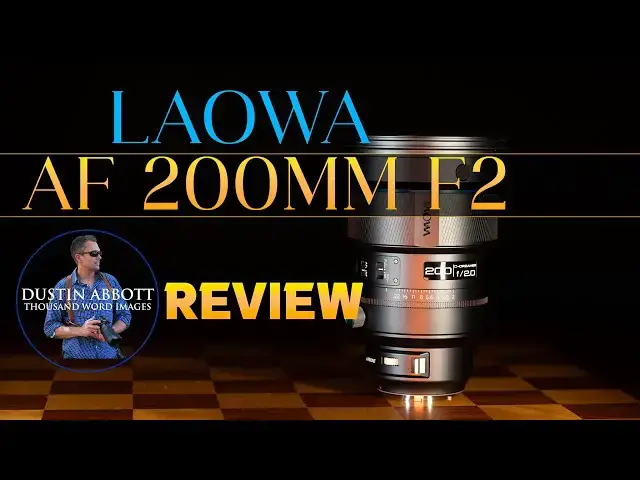
Laowa AF 200mm F2 Review | A Budget Super-Telephoto?
Dec 19, 2025

Photographer Dustin Abbott shares a deep dive review of the Laowa AF 200mm F2 super telephoto prime for Sony FE, Nikon Z, and Canon EF | Read the text review on dustinabbott.net: | Purchase the Laowa 200mm F2 @ B&H Photo https://tinyurl.com/BuyLaowa200mm | Adorama https://prf.hn/l/rdEp4qg/ | Amazon https://amzn.to/4qjjK1k | Amazon Canada https://amzn.to/4pIs6zr | Amazon UK https://amzn.to/4p5Q0Ut | Amazon Germany https://amzn.to/44yAo4r
Check out the DA Merch here: https://bit.ly/TWIMerch | Become a Patron: https://www.patreon.com/dustinabbott | On the Web: http://dustinabbott.net/ | Sign up for my Newsletter: http://bit.ly/1RHvUNp | Instagram: http://bit.ly/DLAinsta | Facebook: http://on.fb.me/1nuUUeH | Flickr: http://bit.ly/1UcnC0B | 500px: http://bit.ly/1Sy2Ngu Follow Craig @ https://www.instagram.com/craigstoffersen/
Want to support this channel? Use these affiliate links to shop at:
B&H Photo: http://bhpho.to/1TA0Xge
Adorama: https://howl.link/nt4zdz1goa7ql
Camera Canada: http://bit.ly/DLACameraCan
Sony Canada: https://www.thesonyshop.ca/?ref=abbott
Amazon: https://amzn.to/3HrY64d
Amazon Canada: https://amzn.to/3qG1p18
Ebay: http://bit.ly/DustineBay
Into the AM Clothing: https://bit.ly/intotheAMda and use code DUSTIN10 for 10% off
Fioboc Clothing: https://tinyurl.com/FiobocDA20 and us code DUSTIN20 for 20% off
Make a donation via Paypal: https://www.paypal.com/paypalme/dustinTWI
=============================
Table of Contents:
=============================
Show More Show Less View Video Transcript
0:10
Hi, I'm Dustin Abbott and I'm here today
0:12
to give you a review of an interesting
0:15
lens. Now, over the last 10 years, we
0:17
have seen almost no 200 millimeter F2
0:20
releases. And over that time, the only
0:22
200 millimeter F2 lens that I've
0:24
reviewed is actually one from Fuji for
0:26
their APS Xmount system. And so on APS-C
0:30
that means that it is going to behave
0:32
really more like a 300mm f/2.8. That is
0:35
an extraordinarily extraordinary lens
0:36
that I really liked. But you know it
0:38
also cost north of $6,000.
0:41
So it was a surprise to see Sigma
0:44
earlier this year be the first on Sony
0:46
and Lmount to release a 200 millimeter
0:48
f2 with their sport series lens. And it
0:51
was a really impressive lens and quite a
0:54
bargain at around uh $3,300.
0:57
But far more shocking is when Chinese
1:00
manufacturer LAA announced that they
1:02
were going to release their own 200
1:03
millm F2. This obviously is well outside
1:06
the scope of what LA has done in the
1:08
past. They've primarily been known for
1:09
wide-angle lenses and also for some
1:12
unique macro lenses. They have started
1:15
to do autofocus but only within the last
1:17
couple of years and only on wide angle
1:19
lenses. And so engineering autofocus for
1:23
a wide-angle lens where most things are
1:24
in focus most of the time is a very
1:27
different reality than engineering a 200
1:29
millm f2 where depth of field is
1:31
incredibly shallow. So LAA has
1:33
definitely upped their game in what
1:35
they're going after here. Have they
1:36
managed to pull it off? Well, that's
1:38
what we're going to explore here today.
1:40
One thing we know for certain is that
1:41
this lens is a tremendous value. It is
1:43
the first sub $2,000 200 millimeter f2
1:47
autofocus lens. And while it is barely
1:50
sub 2000, it is there. And so that makes
1:53
it an intriguing option for those of you
1:55
that really want the look of a 200 millm
1:57
f2 lens, but don't necessarily have the
1:59
budget to afford a much more expensive
2:02
one. So today, we're going to explore
2:04
whether or not this is the lens that you
2:05
should consider. First of all, I do want
2:08
to disclose that this lens was loan to
2:10
me by LAA for this review. It will be
2:12
going back to them at the end of the
2:13
review, and they have had zero input in
2:16
this review. My findings are my own.
2:18
This is a completely independent review.
2:20
Let's jump in and take a look. So, this
2:22
lens will be available in Sony E-mount,
2:25
which I'm testing here, Nikon Zmount,
2:27
and then interestingly, Canon EFmount,
2:29
which while that's a DSLR era mount, it
2:32
is very easy to adapt to a lot of
2:34
different platforms. The one difference
2:36
is that the EF mount will not have this
2:38
filter holder. Uh, again, that's because
2:40
it has to have a different kind of
2:43
flange distance because it's going onto
2:45
a camera with a mirror. So, let's start
2:48
by taking a look at that filter holder.
2:50
We have the ability to use 43mm filters
2:55
uh in this filter holder. And so, that
2:56
allows you to avoid dealing with the big
2:59
105 mm filters that would need to go up
3:02
front. And what's more, you can actually
3:05
rotate those filters. It does come with
3:07
a UV filter. They're probably just part
3:09
of the optical path, but you can rotate
3:11
that filter if you had a circular
3:12
polarizer or a variable ND filter there.
3:15
And by the way, you can get a kit of an
3:18
ND8, an ND64, ND1000, and a circular
3:22
polarizer a kit for just $60 from LAA.
3:25
And so that's really quite a great price
3:27
for that. Now, this lens, unlike the
3:30
Sigma that was released this year, does
3:32
not have built-in lens base optical
3:34
stabilization. So, you're going to have
3:35
to rely upon whatever is in your camera.
3:38
That could be a a potential factor for
3:40
some people if your camera is not so
3:42
equipped. As mentioned up front, the big
3:45
filter threads here are 105 mm. And like
3:49
is often the case with lens hoods for
3:51
lenses with big diameter like that, this
3:53
lens hood relies on a tension clip here
3:56
rather than bayonetting on. I will note
3:59
that the finish on this hood is clearly
4:02
going to be prone to marking. You can
4:03
see it's already marked up. I don't know
4:05
how much traffic this loner has had
4:07
already, but the fact that it's already
4:09
showing a lot of marks isn't necessarily
4:11
encouraging about the finish that's
4:13
going to go on there. The lens hood
4:15
itself is relatively lightweight, as
4:18
we'll see in just a moment, but one
4:20
thing I do miss from it is that it
4:22
doesn't have the actual rubberized front
4:24
edge because often you're going to want
4:26
to set it like this. And I like it
4:28
better when there's that kind of soft
4:29
touch approach there. As far as the
4:33
actual size and weight here, the lens is
4:35
118 millimeters in diameter and 174.8
4:41
mm long. So basically 175 millime. And
4:46
by my own weights, it weighs in if with
4:49
the tripod foot removed, it weighs in
4:51
grams or 3.92 lbs. If you add the foot
4:54
back on, it is 1881 g. Then if you add
4:58
the hood in there, it's a total of 1997
5:02
gram. So basically 2 kg with the hood
5:05
attached there. So it's not lightweight
5:07
because everything here is made of
5:09
metal. And we've got this unique finish
5:11
that is LA. It's kind of between a blue
5:13
and a purple color. And so it's unique.
5:16
It's polarizing. Some people like it,
5:18
some people don't. As noted, the actual
5:21
tripod foot is removable. You loosen
5:24
this tension knob. And then there's a
5:25
button here that allows you to easily
5:27
slide it off. You can see that it does
5:29
have the it's got the Arca-Swiss cutout
5:31
and so it can go right onto a tripod. So
5:34
that is very welcome always.
5:38
Over here we have a tension knob that
5:40
allows you to freely rotate that. And
5:43
there are light detents. You can feel a
5:45
little click at the 90° positions all
5:48
the way around. And so uh I always
5:50
appreciate that because it makes it
5:52
easier to line things up perfectly.
5:55
We do have a manual aperture ring here
5:58
and so you can have it a choice of
6:00
having clicks at 1/3 stop to tense.
6:02
There is a dclick option and so that you
6:05
can rack through it smoothly to do
6:07
aperture racking. A little bit more
6:09
weight than maybe what I would like
6:11
sometimes on that but it moves smoothly
6:13
enough. Here on the side we have a focus
6:16
limiter. It's just two positions and so
6:17
you can eliminate short focus and just
6:19
go from 5 m out. Minimum focus is 1 and
6:22
a half meters. So you're basically
6:23
eliminating from 1 and a half to 5 m,
6:26
but that makes sure you're not doing any
6:28
kind of close racks. AFMF switches here.
6:31
And then we have a customer or function
6:32
button. What's interesting, however, is
6:34
that those custom buttons are repeated
6:36
all four positions here at the front.
6:39
Now, these are not all independent. They
6:40
all do the same thing, and you program
6:42
that function from within the camera
6:44
itself. There is no iris lock here, and
6:47
the Aperture Iris has nine rather than
6:50
more blades. You can see what that looks
6:52
like and also see that unfortunately you
6:54
start to see the shape of those blades
6:56
pretty quickly. Manual focus ring moves
6:59
nicely. Kind of a unique thing for LA is
7:02
the fact that they've got this ridge on
7:04
the side. So even though it can, you
7:06
know, rotate endlessly, it does give you
7:09
at least the feeling of some defined
7:11
positions because you've got these
7:12
ridges on the side. So I actually don't
7:14
mind that design. Although it does mean
7:16
that this kind of LA flattened part
7:19
could end up anywhere. And so if you
7:20
kind of if you're kind of like a little
7:22
OCD about everything lining up properly,
7:24
that may drive you a bit crazy. Minimum
7:27
focus distance as mentioned is 1.5 m and
7:30
you have a maximum magnification of 0.15
7:33
times at that point. There is a weather
7:35
sealing gasket here at the rear and some
7:37
gaskets inside along with a coating on
7:39
the front element to help with weather
7:42
resistance. Overall, it is a nice
7:44
looking, nicely made lens. you know,
7:47
relatively compact for a 200 millimeter
7:49
f2, but certainly not overly lightweight
7:52
because of that all metal construction.
7:54
All right, let's talk autofocus. Now, in
7:57
this case, LAA doesn't actually, at
7:59
least as far as what I've seen, actually
8:00
disclose what type of focus motor we've
8:02
got going here. I suspect it is an STM
8:05
type focus motor. And in this case,
8:08
unfortunately, I feel like it's maybe a
8:10
little underpowered for the task, the
8:13
kind of herculean task that a lens like
8:15
this has to take on. When it comes to
8:17
focus speed back and forth, just in like
8:19
my standard test, the focus speed is
8:21
really not too bad. You can see that it
8:23
moves back and forth, not with the speed
8:25
that we saw from the Sigma 200mm f2, but
8:28
moving back and forth with a reasonable
8:31
pace here. So, no major concern there.
8:33
And when it came to shooting things like
8:36
an event setting in a church, I shot
8:38
with it and I got well well focused
8:39
results, good accuracy there. Likewise,
8:42
in a portrait session, all of my results
8:44
were pretty much flawless. The challenge
8:46
is going to be that if you try to take
8:48
on any kind of fast action where the
8:50
focus system is just not quite reactive
8:53
enough to give you consistent keeper
8:55
rates. And uh and so I would say that in
8:58
those situations, if you want to shoot
9:00
sports or something with with fastmoving
9:02
action, I think that you would probably
9:04
be better served with the Sigma lens. At
9:06
the same time, if you are a portrait
9:08
photographer, a wedding photographer, I
9:10
think that this lens is going to serve
9:12
your needs just fine. And I just think
9:14
you need to be realistic about how
9:15
you're going to use the lens. And at
9:17
least for stills, that will help to
9:18
determine whether or not the LAA is
9:20
going to work for you. Now on the other
9:23
side of the equation when we talk about
9:24
video once again here I feel like the
9:27
biggest challenge is in the reactiveness
9:29
of the focus motor you can see here
9:31
where I used my hand to kind of force
9:33
focus changes back and forth that what
9:36
ends up happening there is that there is
9:38
a bit of some focus racking sometimes in
9:41
the wrong direction and it seems like it
9:43
takes a few seconds for inertia to build
9:44
up before focus moves where you want it
9:47
to go and so it's not probably reactive
9:50
enough for again for active type video.
9:54
At the same time, when I just kind of,
9:55
you know, moved approaching the camera,
9:58
as you can see here, it seemed to stay
10:00
up with my face, no problem. When I
10:02
ducked out of frame or stepped out of
10:04
frame, it picked me up with fairly good
10:06
quickness picking me back up. And so, I
10:08
don't have any major concerns on that
10:09
front. And I've been filming all these
10:11
outdoor segments with the lens. And
10:12
you've probably noticed that focus is
10:14
fine, even if contrast, as we're
10:17
shooting these kind of close-up shots
10:18
that are kind of the nature of a 200
10:20
millimeter f2. You can see that at f2,
10:22
you know, contrast isn't off the charts,
10:24
but as far as what the focus is doing,
10:26
it seems to be doing okay in this kind
10:28
of situation. And so, again, my
10:30
conclusion on autofocus generally,
10:31
whether it be stills or video, is that
10:34
if you are realistic about what the
10:37
limits of this lens are going to be, I
10:39
think that you're going to be fine. If
10:40
you try to use it for fast action and
10:42
sports, you're going to get some good
10:44
greatl looking shots, but you're also
10:45
going to get a number that are not going
10:47
to be well focused, that aren't going to
10:49
be keepers. And so at the end of the
10:51
day, it's your choice to make. It
10:52
obviously is way cheaper than any other
10:54
200mm f2 option. And so if the autofocus
10:57
is good enough for you, then go for it.
10:59
All right, let's start by taking a look
11:01
at the optical design. Here we have 11
11:03
elements in nine groups, including a
11:06
couple of extra low dispersion elements,
11:08
one of these anomalous dispersion
11:10
elements, and one ultra high refractive
11:12
index element. The MTF chart suggests a
11:15
very sharp lens starting over 90% here.
11:18
And you can see dropping really a grand
11:21
total of no more than 10 percentage
11:23
points towards the corners. But does it
11:25
hold up to that in real life? Well,
11:27
that's what we're going to find out.
11:28
Now, when it comes to vignette and
11:30
distortion, there is the tiniest amount
11:31
of pin cushion distortion. Just a minus
11:33
one over here to manually correct for
11:35
that. Little bit of vignette in the
11:36
corners. I used about a plus 23 to clean
11:39
that up. So, under a stop, no issues
11:41
there at all. Likewise, longitudinal
11:43
style chromatic aberrations that show up
11:45
as fringing us using magenta before and
11:47
green or blue after. You can see that
11:50
there is just very very minor amounts.
11:52
And if we take a look at a
11:53
three-dimensional subject and we zoom
11:55
way in there, you can see that there is
11:57
just the tiniest amount of fringing even
11:59
at a 200% magnification. Very little
12:02
around specular highlights and so no
12:04
real issues there. On the note of those
12:07
specular highlights, you can see that
12:09
there is the typical cat eye or lemon
12:11
shape here in the corners. The overall
12:13
circles are relatively clean. No major
12:16
issue there. We can see as you start to
12:18
stop the lens down, however, at f2.8,
12:20
you probably get the most consistent
12:21
roundness, but you can already start to
12:23
see the shape of those nine straight
12:25
aperture blades. And by f4, again,
12:27
they're a little bit more pronounced.
12:29
Lal style chromatic aberrations, not
12:31
really an issue at all. I don't really
12:33
see hardly anything in these transitions
12:35
from black to white near the edge of the
12:37
frame. Now, when it comes to resolution
12:39
and contrast is where I have my first
12:42
disappointment here. Shooting at f2,
12:45
this is a 61 megapixel Sony A7R Mark II,
12:48
200% magnification. Way I do these
12:50
tests, you can see that there is
12:52
resolution there as the MTF suggest.
12:55
However, contrast is quite low and so
12:57
there isn't really any pop to the image
12:59
there. As I move into the mid-frame,
13:01
again, I'm just a bit disappointed,
13:03
underwhelmed by what I see. And as I pan
13:06
down towards the corners here, again,
13:08
there's there's a decent amount of
13:10
resolution going into those corners, but
13:12
contrast is really quite low. And up
13:14
here, I'm just I'm underwhelmed by that.
13:17
I'm particularly underwhelmed if I go
13:18
back and compare to my Sigma 200 millm
13:21
f2 results where you can see a dramatic
13:24
difference at f2 in the center of the
13:25
frame. A very dramatic difference in the
13:29
mid-frame result and even into the
13:31
corners there is a pretty dramatically
13:34
different result. And that's true on any
13:36
of the corners that we look. We see
13:38
somewhat of a dual nature in this lens
13:40
between f2 and then f2.8. Here are
13:43
portrait shots taken within just a few
13:45
seconds of each other. You can see the
13:47
f2 result has that kind of soft low
13:49
contrast look a little bit dreamy as
13:51
we've talked about. Whereas f2.8 is kind
13:54
of that modern sharp crisp looking
13:56
result. And so it really it's just that
13:59
one stop of stop down that allows you to
14:02
get that extra boost of resolution. If
14:04
we go back and compare to the Sigma,
14:06
both lenses at f2.8, eight, we can see
14:08
that the LAA is more competitive, but
14:11
obviously still not quite at the same
14:13
level as the Sigma lens. That becomes
14:16
more obvious in the mid-frame and
14:18
certainly into the corners where the
14:20
Sigma shows really great consistency
14:22
across the frame, which the LA MTF
14:24
suggested it should as well, but that's
14:26
not actually what I found. If we stop
14:28
the lens on down, we get a little bit
14:29
more in the center of the frame at f4,
14:32
but as we stop on further, we don't
14:34
really see it in the center of the
14:35
frame. If anything, there's a mild
14:36
regression there. But what we do start
14:38
to see is more consistency into the
14:41
mid-frame result, which you can see on
14:43
both sides here. But then probably at f8
14:47
is where we're finally starting to get
14:49
what I would consider to be a good, if
14:51
not great center performance. Now, by
14:53
f11, you're going to start to see some
14:55
softening due to the effects of
14:57
defraction. By f-22, which the which is
14:59
the minimum aperture, you can see that
15:01
has become much more pronounced. Now, as
15:03
we saw earlier, our minimum focus
15:05
distance and thus is 1.5 meters. Maximum
15:07
magnification is 0.15 times. I will say,
15:11
however, that up close, it actually
15:13
looks almost a little bit better than
15:14
what it did in my typical test results.
15:17
And so, I have no problem with this.
15:19
Could use maybe a little bit more
15:20
contrast, but really the detail there is
15:22
pretty nice up close. Now, the real
15:24
strength of a lens like this is when it
15:26
comes to the bokeh quality. So, on the
15:28
right, I have the f/2.8 result, you
15:30
know, shot in the same setting. You can
15:32
see that this area back here just gets
15:34
considerably busier looking than what
15:36
the f2 result is. And it's that, you
15:39
know, very shallow depth of field that
15:40
makes f uh two f or 200 millm f2 lenses
15:44
so special. Of course, you know, your
15:46
trade-off is you're going to get more
15:47
contrast at f2.8, but at f2, you're
15:51
getting that more shallow depth of
15:52
field. The shot at f2, I think, shows
15:54
off a lot of the great qualities here.
15:56
The background is really nicely softly
15:59
diffused here. And you know, there's a
16:01
good enough amount of detail and
16:03
contrast for this shot to work while
16:05
having that beautiful background. When
16:06
it comes to portrait shots, as we've
16:08
already seen, it's got a look at f2. And
16:11
that look is a little bit more dreamy.
16:13
Again, you can see that the detail is
16:14
there, but the contrast really isn't.
16:17
And it's when you start to shoot at f2.8
16:20
that you start to get that contrast
16:22
that's, you know, maybe you don't want
16:23
the contrast. Maybe you don't want to
16:25
see all the pores or whatever. But here
16:27
we can see that it is definitely now up
16:30
to f4. Looking really fantastic here at
16:33
f4 with lots of detail and contrast. Now
16:36
when it comes to flare resistance, I
16:39
started off here with the flashlight
16:40
because of just not great conditions
16:42
outside. You can see that at certain
16:45
angles there definitely are some
16:46
reflections, some flashing, a bit of
16:48
ghosting. And here in an uh outside shot
16:52
as I pan up, you can just see that there
16:54
definitely are some flare related
16:56
issues. So again, it's not quite as
16:58
strong as the Sigma when it comes to
17:00
flare resistance either. Coatings not
17:02
quite on that same level. So my
17:04
conclusion is this. This is a kind of an
17:07
interesting lens that leaves me a little
17:10
conflicted about it because I think on
17:12
one hand it really is a remarkably
17:14
capable lens. I love the rear filter
17:16
holder. I like the fact that they've
17:18
made a robust design here with a nice
17:20
feature set. I love the fact that you
17:22
can get a 200 millimeter f2 with decent
17:24
autofocus for under $2,000.
17:27
At the same time, however, I'm left
17:29
wondering where the value is for those
17:32
that want to shoot at f2, but really
17:35
need to stop down to f2.8 to get the
17:38
kind of sharpness that most of us would
17:39
be looking for in a lens like this. And
17:42
that means that it doesn't necessarily
17:44
offer a tremendous, you know, advantage
17:46
over a 70 to 200 millm f2.8 zoom, for
17:49
example. And that I think is where the
17:51
weakness, at least in my opinion, really
17:53
lies here. On top of that, the fact that
17:55
the autofocus is fine for portrait work,
17:58
but not necessarily fine for sports work
18:01
means that this is a lens that probably
18:02
is going to work best for someone who is
18:05
looking for that unique 200mm f2 look uh
18:09
while shooting portraits and doesn't
18:11
mind a slightly dreamy quality to the
18:13
rendering because outside of that, I
18:15
think that this is a really sound lens
18:17
optically. handles distortion and
18:19
vignette and fringing really well and so
18:22
it produces nicel looking results. They
18:25
just don't necessarily hold up with the
18:26
kind of pixel peeping that myself as a
18:29
you know a professional lens reviewer is
18:31
going to be doing. And if your mileage
18:33
varies on that and you're more
18:35
interested in the overall look and
18:36
aesthetic of images rather than the
18:39
technical details, then the LAA
18:41
definitely offers up a really
18:42
interesting value proposition. Never
18:45
before have we seen a 200 millm f2 lens
18:47
with autofocus for this kind of price.
18:49
And that's going to make it very
18:50
compelling for the right kind of
18:53
photographer. And if you aren't that
18:54
right kind of photographer that I've
18:56
described, maybe consider the Sigma
18:58
200mm f2 sport instead. If you want more
19:01
information, you can check out the link
19:03
in the description to my full review
19:05
article on this that dives into any
19:07
everything with depth. There's also some
19:09
buying links there if you'd like to
19:10
purchase. As always, thanks for
19:12
watching. Have a great day and let the
19:14
light in.
#Science