0:00
Hi, I'm Dustin Abbott, and I'm here today to review a very new lens from Korean maker Samyang slash Rokinon
0:16
and that is their new SP line, which stands for special performance
0:20
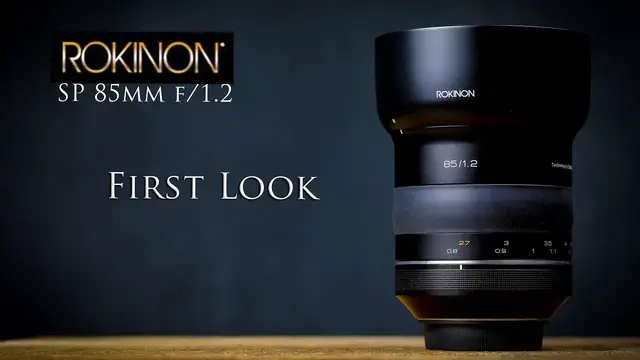
This is an 85 millimeter F1.2 lens. And so over the years, I've reviewed a number of lenses from Samian
0:29
Rokinon, and if you're not familiar with the kind of relationship there, it's drawn an allusion
0:36
to another major Korean manufacturer. It's very similar to the relationship like between
0:41
Hyundai and Kia, and that often there are, you know, there's shared manufacturing and often
0:49
it comes down to kind of packaging. In this case, it's even more true in that there really isn't
0:54
any difference in any of the components. It's really about branding. And for whatever reason
0:58
Samyang slash Rokinon. They may have a little bit different to coat of paint, but it's basically the exact lens
1:05
And that's very obvious here, like on the side of the barrel and on the box, it says technology by
1:10
Samyang Optics. I also noted that included in this new SP or Super Performance line, it comes with a lens pouch
1:20
that is much like Canon's L series lenses, and on the side of it, it just says Samyang
1:25
It hasn't been rebranded at all for Rokinon. And so this lens is a, it's a departure for them in that over the years, while they've always been manual focus lenses
1:38
they have, you know, kind of occupied the lower bracket in terms of the build quality
1:43
It's always been about the bargain with them. And so my experience has been that, you know, they have a build quality that's nowhere near Zeiss
1:50
but often optically they compete fairly well. And so obviously, Sam Yang-Rokinon is
1:58
decided to take that a step further here, and they're going to go after the build quality as well
2:04
And this is a very Zeiss-Milvis-type lens. It is an all-aluminum barrel, and it has a lens hood that
2:14
kind of flows into, you can tell that the lens has been designed for the lens hood to be
2:19
mounted there. It's a metal lens hood, and it's just, it's very much like having a, I mean
2:25
This feels very much like the Zeiss-Milvis 85-millimeter F-1.4 lens. But of course, Samying has won up Zeiss a little bit here
2:37
by going a little bit wider with the aperture to F-1.2, which makes this along with Canon one of the very rare F aperture at 85 lenses So this is a beautifully built lens and like Zeiss You going to hear that repeated quite a few times like the Milvis Lime
2:57
It has got a rubberized texture focus ring that feels very beautifully damped
3:02
It feels a lot like a Zeiss lens in operation. Like Zeiss, it has that very long focus throw that allows you to get a lot of precision there
3:14
and everything is, you know, is stamped in a nice bright way
3:19
In fact, they even have that kind of bright offset color. In this case, it's kind of a bright yellow slash orange
3:26
It, you know, reminds me a little bit of the Otis approach. And so overall, this is a beautifully, beautifully built lens
3:33
You know, the one kind of area that I see that it differs from the Milvis line is that it does have
3:40
I don't see any kind of weather ceiling here. And so there's not any kind of
3:44
ring or gasket here at the end. But one thing that I do note that I think is really important to me
3:51
is that as I watch the movement of the rear element in the back
3:56
at no part, even with it, extended all the way forward, am I seeing to the inside of the lens
4:03
And so it is nicely sealed there in the back as far as dust kind of getting in there
4:10
I'm always happy to see that. It just seems like a good engineering approach to me
4:14
Now, one thing that is unique for this lens is that unlike any previous Samying or Rokinon lens that I've used
4:22
rather than having a manual aperture ring, the aperture is fully electronically controlled
4:28
And so in operation, this lens is just like a Zeiss lens
4:34
You control the aperture from the camera body, which, you know, the advantage of that is it allows you to step up in, you know, kind of one-third steps
4:42
just like you can with any other lens. On top of that, it also does have the focus confirm chip built into there
4:51
And so when you do achieve correct focus, it will light up the appropriate focus point
4:56
and give you a beep to indicate focus. And so, yes, an operation, this is very much like a Zeiss lens
5:04
Now, I'm going to find out if it optically is like a Zice lens
5:08
But, you know, my experience in the past has been very positive optically with
5:12
is. Let's take a look at a few of the other specs for this. If you look up front, you'll note that
5:19
it's kind of a unique design. The inner barrel moves forward with the front element. It'll move
5:26
forward and back, but never past the inner edge. And so here you have room to mount a filter
5:33
along the front And this is now the third lens that I have seen at an 85 millimeter focal length that has an 86 millimeter front filter thread Unfortunately that is still pretty uncommon
5:47
So I saw it first on the Zeiss Otis 85 millimeter F1.4, the new Sigma Art series, 85 millimeter F1.4
5:55
and now this lens, all with that very large 86 millimeter front filter
6:01
Now, those filters are a fair bit expensive you're going to find, and they're also just not all that common
6:07
However, as more lenses kind of broached that larger size, you may see a little bit more filters being made
6:14
And of course, whenever there are more filters on the market, the price should come down a little bit
6:19
It has a nine-bladed aperture diaphragm, and so we'll see how well it keeps the circular shape as things are stopped down
6:29
As a part of the design, it has one spherical element. It has two high refractive index elements, you know, all designed
6:37
to increase, you know, clarity and contrast. And so I'll run it through all of my typical test
6:44
to see how it does when it comes to chromatic aberrations and flare resistance and all of those kinds of things
6:50
It has their own brand and ultra multi-coding for minimizing ghosting and flare
6:55
We'll see how well that it works. There's been a redesign here for this super performance
7:00
sorry, special performance series. SP is also a Tamron branding. And so there's been some reworking done to the front lens cap, which is now a center-pinch design and just with an overall new design
7:15
And like Zeiss has done with air caps, even the rear cap has been redesigned to just be a little bit more elegant looking overall
7:24
Now, this is a very squat lens, as you can see. It reminds me a lot of the Milvis 85 millimeter, except for the Milvis, of course, has a, a
7:35
smaller, kind of more typical 77 millimeter front filter thread on it. But it is, it's fairly
7:42
hefty. It's a thousand and fifty grams. Now, that is lighter than, you know, Otis, Milvis or
7:48
New Sigma art series. But it is, it's, of course, heavier than, say, the cannon. And that is because
7:55
of course, instead of engineered plastics, you've got an aluminum body, you've got a lot of glass
8:00
in there. This is a, you know, it's a pretty serious lens here. Overall, the diameter
8:05
of it is 3.66 inches or 93 millimeters, and it's 3.87 inches long, so almost as, you know, as
8:14
wide as it is long, that's 98.4 millimeters. So, you know, physically it's a very different
8:22
design than the new Sigma Art which is very very long It considerably longer than this lens It a little bit heavier but this lens is quite squat Now one thing I did note when I did the Milvis review is that I found that there wasn hardly any clearance here between my fingers and the and that on a cannon mount because there no aperture ring between the lens barrel and the grip
8:45
And that's somewhat similar here, although there is a little bit more room, so I'm not actually brushing up against it at any point
8:52
And so 10 elements in seven groups, it can focus down to 2.6
8:58
two feet, that's 80 centimeters, and it has a 0.13 times maximum magnification. So, you know
9:08
slightly better than average. The best in the group is the Tamron with a 0.14 times magnification
9:16
No 85 millimeter lens that I am aware of is really, you know, fantastic in terms of
9:21
magnification or reproduction. But that will allow you to frame, you know, nice and tight for, say
9:27
headshots, which is really kind of the primary purpose for a lens like this. So overall
9:33
beautifully made lens, very Zeiss-like, beautiful build quality, focus action is very good. Now
9:41
it's about determining whether the optics live up to it. But if the optics are fantastic here
9:48
this is a pretty serious contender to those that are considering, for example, a Zeiss Milvis
9:53
and that once again, Samying Rokinon has managed to do it at a pretty fantastic price
10:01
Now, nothing near like their previous 85 millimeter F1.4, which was kind of a plastic fantastic
10:07
You know, and it was, you can often get that below 300 bucks in the U.S. market
10:12
This is coming to market at a price point of $999, but when you look at the build of it
10:18
and if it is optically holds up as I expect that it will, that is, you know, basically
10:23
cutting half off of the price of the Zeiss Milvis lens. So that makes it a pretty compelling option
10:31
And so follow along here. If you look down in the linkage below, I'll have started up an
10:36
image gallery and I'll be shooting with this over the next few weeks, adding photos, you know
10:43
pretty much on a daily basis as I tested out in various circumstances. So keep checking back to
10:48
that image gallery and to get a sense of how this is performing optically. And I'll check back in with
10:53
you in a future episode to break down the image quality and how the optics hold up in this package
10:59
But a very interesting option for those of you that aren't afraid of manually focusing
11:03
I'm Dustin Abbott, and you can follow me in social media down below or sign up for my newsletter
11:09
And if you haven't already, please click that subscribe button. Thanks for watching