Up next in 10

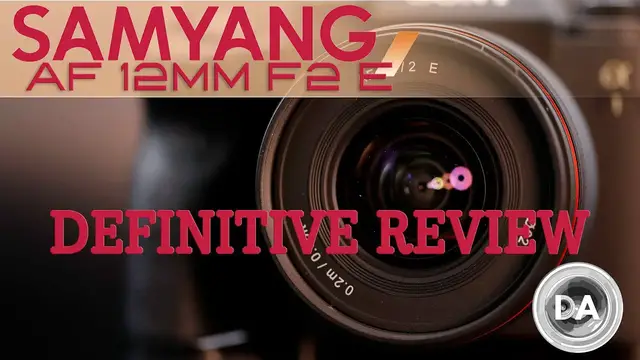
Samyang AF 12mm F2 (APS-C) Definitive Review | 4K
Jul 17, 2023

Photographer Dustin Abbott shares a thorough, real world review of the new Samyang (Rokinon) AF 12mm F2 for Sony E-mount (APS-C) mirrorless cameras. | This video is sponsored by Fantom Wallet. Visit https://fantomwallet.com/ and use code DUSTIN15 to get 15% off | Read the text review: https://bit.ly/AF12Review | Visit the Image Gallery: https://bit.ly/AF12Images | Purchase the Samyang AF 12mm F2 @ B&H Photo https://bhpho.to/3wj0K78 | Amazon https://amzn.to/3v3xQaH | Amazon Canada https://amzn.to/3bBu40E | Amazon UK https://amzn.to/2S9dNZG | Amazon https://amzn.to/3eZSDX4
Check out the DA Merch here: https://bit.ly/TWIMerch
=============================
Table of Contents:
=============================
0:00 - Intro
1:13 - Brief comparison to Viltrox 24mm
2:37 - Build & Handling
7:29 - Focus Action
13:10 Image Quality Breakdown
27:39 Conclusion and Pricing
---------------------------------------------------------
Purchase the Sony a6400 @ B&H Photo https://bhpho.to/2JqJ8Cv | Amazon https://amzn.to/2TOff3W | Amazon Canada https://amzn.to/2Ogeiv5 | Amazon UK https://amzn.to/2CrtO2t | Amazon Germany https://amzn.to/2HvxRyS | Ebay
Want to support this channel? Use these affiliate links to shop at:
B&H Photo: http://bhpho.to/1TA0Xge
Camera Canada: http://bit.ly/DLACameraCan
Show More Show Less View Video Transcript
0:00
Hi, I'm Dustin Abbott and I'm here today to do my definitive review of the new Samyang
0:14
also sold as Rokinon 12mm F2 lens, and this is for Sony APS-C E-mount. I'm really actually happy
0:24
to see Samyang starting to develop for APS-C with their autofocus lineup of lenses as Sony APS-C
0:32
shooters, like most APS-C shooters outside of maybe Fuji, often end up overlooked as a lot of the
0:39
development energy and resources go into developing for full frame. So it's great to see them covering
0:44
this and giving us a lens that I think will end up being quite a popular one because it has a great
0:51
angle of view, 12 millimeters, translates to about 18 millimeters full frame equivalent with Sony's
0:57
1.5 times crop factor. And so that is obviously a very useful focal length for a lot of different
1:04
situations, be it shooting landscapes, you know, city and street for architecture, various other
1:11
applications, a lot of the wide angle things. And frankly, there's not a lot of wide angle options
1:17
on Sony's platform for APS-C, and certainly not a lot to combine both a wide angle of view
1:23
with a wide maximum aperture of f2. So it has a lot of extra usability. The original 12mm f2 NCS
1:34
manual focus lens I reviewed back in 2014, and that has been actually one of my more popular
1:40
reviews over time because despite it being manual focus, it really intrigued a lot of people
1:45
It's relatively inexpensive, or was, about $399. It was compact and light, and of course
1:52
it had good image quality and that great angle of view that a few lenses could match
1:58
Fast forward to 2021, and we have got an updated version of that lens that now has autofocus
2:03
a new exterior design, and a mostly recycled optical formula relative to that other lens
2:10
And the great news is, is the price point is still $399. Now today we're going to do the definitive review and so we're going to dive into a lot of great detail
2:19
including a deep dive into the image quality but if you want a quicker overview you can check out the standard review instead
2:25
I'm going to start by thanking our sponsor of today's episode which is Phantom Wallet and they've been a great partner
2:33
Today's episode is brought to you by Phantom Wallet the minimalist, modern wallet that sets you free from a bulky traditional wallet
2:40
while also making it easy to access your cards and money when you need them thanks to their unique
2:46
fanning mechanism visit phantomwallet.com to check out their unique sizes styles and finishes
2:53
that span from aluminum to wood to carbon fiber you can even customize your wallet with new
2:59
accessories like a money clip cash holder id display and even the chipolo tracking integration
3:07
if you're the kind of person who loses their wallet. Use code DUSTIN15 for 15% off when you're ready to check out
3:16
So let's start by diving in and looking at the build and the handling of this particular lens
3:21
The first thing to notice is that the lens does come with a nice pouch and also comes with a lens hood
3:26
which are very welcome at this price point of right under $400 US dollars
3:31
The lens has a pinch cap at the front. The lens hood itself, while it looks fixed, it is actually a removable lens hood, which is certainly very welcome
3:42
Though the downside here is that the lens does not actually reverse for storage
3:47
It doesn't quite fit because there's an area at the front that comes down in diameter, and so it doesn't fit for reversing
3:55
So that's an unfortunate side effect. We do have a 62mm front filter thread up front, and so the lens hood removable does mean that you have more flexibility when using filters, even if you need to use a step-up ring to a more common filter size
4:08
There is a weather sealing gasket at the lens mount, and there is some sealing inside, according to Samyang
4:15
We have a metal lens mount, primarily engineered plastics in the barrel, but nicely made
4:20
Now, there's been a red ring on Samyang lenses for quite a long time
4:24
They may have stolen that from Canon. In this case, they call it the hidden red ring
4:29
As you can see, it's a little bit different a look, and it works for them
4:33
The main thing on the lens barrel is the manual focus ring, and it has, in this case, a new diamond type pattern that has a nice texture to it
4:43
The ring itself moves nicely. There are no other switches or features on the lens barrel, but that is par for the course in this particular lens class
4:51
The lens itself is right over 59 millimeters in length, 2.3 inches, and it is 70 millimeters in diameter
4:59
That is actually a little bit less than the old manual focus lens, though this lens has a very different lens profile than that one
5:06
which had a more slender barrel that flared out at the front filter threads where it had a larger 67 millimeter front filter thread
5:14
This lens is a little bit more squat, and so its diameter is more consistent, even if it overall is slightly narrower
5:21
They've managed to keep the weight at only 213 grams, which is really fantastic
5:26
7.5 ounces, which makes this lens really highly portable. They've upped the amount of diaphragm blades up to 7 from 6
5:35
which is very welcome here in that the sunburst effect is better
5:40
and you also have more circular shapes when the lens is stopped down in the bokeh
5:45
Our minimum focus distance is 19 centimeters or about 7.5 inches and we have a fairly low reproduction rate magnification of right around 0.10 times
5:58
Overall, the lens is nicely made and the addition of weather sealing sets it above other competitors in this particular class of lens
6:06
In many ways, we have been somewhat fortunate for APS-C shooters in 2021
6:10
as this is the second lens released along with the Tamron 17-70mm f2.8
6:15
that actually gives us a little bit more upscale lens in that we have both, you know, autofocus
6:22
quality autofocus and build, but we also have some weather sealing here
6:26
and that certainly is a very welcome addition there So I really hope that this is the first of many such lenses to come from Samyang because there a lot of holes that could be filled with quality lenses on APS platforms
6:40
So how about that autofocus? We're going to dive in and take a closer look at how it holds up as well
6:46
So let's talk about autofocus. I'm filming right now on the lens mounted on my Sony Alpha 1 in APS-C Super 35 mode
6:54
But anyway, it gives you an idea of how it does for tracking my face in a still segment like this
7:00
This lens is further evidence of the growing maturation of Samyang as an autofocus lens maker
7:06
You know, for many years, they were manual focus only. And the predecessor of this lens that came out in 2013, 2014, in that range
7:13
it obviously was manual focus only. And at the time, that was true of all Samyang lenses
7:18
It's only really within the last four or five years that they've started to produce autofocus. And they've really come a long way
7:24
And they've done that by employing what I think is pretty much the best option on mirrorless lenses these days
7:30
and that is linear STM motors. Linear motors work a little bit differently in that typically on either side of the focusing group or element
7:39
whatever the case is, that the focus motors are there. And so the movement, rather than a twisting like what it was before, ring-type USM
7:49
instead what you've got is these motors that just drive quickly back and forth. This is really effective for a couple of reasons. First of all, it helps with the development of
7:57
movement. There's no kind of spooling up energy, but rather it moves it very quickly forward
8:03
But because of it having essentially on either side, we're front and back, what you end up with
8:09
is it also decelerates really quickly. So it builds up the kinetic energy quickly on the front end
8:14
It also decelerates quickly. What that does is it eliminates the kind of pulsing at the end
8:20
the kind of settling that we would sometimes see in a ring type USM or something similar
8:25
focus in the past. And so the advantage of that is you get really fast autofocus, and in this case
8:32
focus is essentially instantaneous. You have extremely quiet operation, just the nature of
8:38
the focus motor allows it to be really, really quiet, and you end up with very high degree of
8:43
accuracy because of the nature of autofocus systems in mirrorless cameras. And so for example
8:48
if we look at my focus pull test, we will see that there is basically no sound at all
8:53
nor any kind of settling or abnormalities in the focus pull process and video at all. Let's take a
9:00
look. So you can see nothing to complain about there. Focus transitions, they are smooth, quiet
9:16
accurate. And that's been my experience when shooting in general. So, for example, in this
9:22
secondary test where I'm approaching the camera, you can see that focus just tracks along with me
9:27
and as I move in close, it continues to stay reliably on me as I move away. In all of those
9:33
cases, it's doing an effective job of tracking my face, tracking my eye as I get closer. Now
9:39
one of the things you may have also noticed as a part of that test is that until I get really
9:43
close to the camera, the nature of the focal length, in this case 12 millimeters or about
9:50
a 18 millimeter full frame equivalent, means that if you get even at the distance where
9:55
I am right now, which is a little over a meter, about a meter and a half away from the camera
10:00
very quickly, you know, a lot of things are in focus. Depth of field is already great
10:04
It's only when you get really close that the focus system in that sense is really challenged
10:09
to produce accurate results on a singular thing. It's true of all wide angle lenses and I have found that even when I get very close to subjects
10:16
however, autofocus continues to be accurate and reliable. And so there's really nothing to complain about with autofocus on this front
10:25
It just gets the job done and as a byproduct of that, this will be a very effective lens
10:30
for using for video. On a gimbal, for example, it's a great focal length for that
10:35
But also it is so short and compact, it means that there is no impeding of the camera if
10:41
If you're wanting to do 360 degree rotations of one kind or another, inception mode, as
10:47
it's sometimes called, things like that, it will allow you to do all of those things very
10:50
effectively without any kind of limiting principle of either weight or also of size
10:55
It would also make a nice vlogging lens if you're an APS-C shooter for the simple reason
11:00
again of the focal length that it's wide, it allows you to get a lot in the shot, have
11:06
the camera not too far away, but without incredible amounts of distortion. and so there's a lot of reasons to advocate for this
11:13
And so to sum up, I'm really actually kind of happy that we're getting this lens now
11:18
A lot of people love the manual focus version of the lens but anything manual focus is going to be limiting
11:23
Not everybody wants to invest in one. So being able to get an autofocus version
11:27
that has mature autofocus, which I believe is what we're getting here
11:31
is just doubly great. And so kudos to Sam Yang for continuing to mature
11:37
as an autofocus making lens company. I'm really delighted to see Samyang really starting to nail
11:43
autofocus and I think they've reached a place now to where if they're not on par with you know
11:49
first party Sony lenses and I don't think that they're quite quite there at the same time I don't
11:54
think that they're all that far off now and so bottom line is there's not really a big penalty
11:58
for going with this lens as opposed to a native Sony lens I don't think when it comes to the
12:03
autofocus. How about the actual image quality itself? As I noted, this is a largely recycled
12:09
optical formula, but it is one that was very, very good at the time relative to the competition
12:15
of 2013-2014. Wide-angle lenses have gotten better since that point, so fortunately it was
12:22
very good to begin with because now it is good and as we'll see it still holds up quite well
12:27
although maybe not as exceptional as, say, I recently reviewed the Samyang 24mm f1.8 for full frame that was really exceptional
12:36
This one isn't quite at that high bar, but as we'll see, it's a very, very good lens optically
12:41
So one of the first questions that I often get about any kind of APS-C lens is how well it will work on a full frame camera for some reason
12:49
So this is the natural angle of view in the APS-C crop factor on a Sony Alpha 1
12:57
Now if I were to go into full mode you can see the hard mechanical vignette that is here and that this is just not a lens that covers the full frame image circle If I were to crop in on that image however to where there a little bit of vignette left that I could correct for
13:14
but I've mostly cropped out the mechanical portion, you can see that the framing is just a little bit wider than what we saw in APS-C mode
13:23
And so, you know, for example, this is considerably further into the frame and there's just a little bit more room
13:30
So I would say, and looking at the overall resolution, there is about a four megapixel difference
13:38
And so, you know, our crop factor is going to play out at something more closer to 1.4 times, you know, maybe slightly over rather than 1.5 times
13:48
Point being is that this really is a lens that is designed for use on APS-C
13:53
and yes you can get incrementally wider but not enough to you know really consider buying this
13:59
lens intentionally for aps-c you'd be better off buying the 18 millimeter f2.8 so let's talk about
14:06
distortion and vignette you can see that there is a mild amount of barrel distortion good news is
14:12
is that it is very linear and so you can see on the right here which i've done as a manual correction
14:18
that it corrects out accurately. Now, interesting here, I noticed that if I used the correction
14:24
profile for the older lens, even though it's supposed to be the same optical design and I can
14:30
see looking at the diagrams, it basically is. It does behave a little bit differently when it comes
14:34
to distortion in that that profile actually overcorrects and creates some noticeable pin
14:39
cushion distortion. So a little bit less distortion here. As far as the vignette goes, there is a
14:45
fairly significant amount of vignette, about two and a half stops in the corners, and it took me a
14:51
plus 63 and moving the midpoint all the way over to zero to eliminate it. You can see there's just
14:58
a slight bit of maybe some discoloration in the area where the vignette was. It's something that
15:04
I often see with certain lenses. So as far as aberrations go, when it comes to longitudinal
15:10
Plitudinal chromatic aberration, which exhibit before and after the plane of focus
15:14
There is a bit of that. We can see a little bit of purple fringing before, though not significant
15:19
A little bit more of the green fringing after the plane of focus. It's more likely this, I think, that you'll see in real-world situations
15:27
And you will mostly see it, as we can see from this real-world shot, as some, you know
15:32
outlining green fringing around bokeh circles. You can see a little bit of it here, a little bit of purple, a little bit of kind of a green-blue
15:40
after the plane of focus it is not terribly pronounced here and so unlikely to be a major
15:47
issue in real world use now the biggest downside of the previous lens was that it had fairly strong
15:54
lateral chromatic aberration i think it's actually been toned down a little bit here you can see a
15:59
bit of fringing on either side there you can see it around the writing here but it's not you know
16:06
overly obvious. There is some of it there, however. So let's take a look at our resolution
16:11
and contrast. And so we are looking at the test chart here. Now I'm actually using the APS-C mode
16:18
on the Sony Alpha 1, so it's 21 megapixels of resolution. I actually don't have a Sony APS-C
16:24
body at the moment. I do hope to rectify that in the future, but I've been using APS-C mode on the
16:31
a7r mark 3 we actually have three extra megapixels of resolution on the alpha one so as we can see
16:38
here the wide open contrast is fairly good detail is good but not exceptional you can see that
16:47
there's just a little bit of mushiness to some of the textures here we can see it f2.8 contrast
16:53
has improved and a little bit crisper detail is there moving to the midpoint it is good again but
16:59
not exceptional and mildly better at f2.8. More significant improvement in the corner but first
17:07
of all let's examine the fact that resolution is not bad. Here you can see it's falling off as you
17:12
get towards the edge of the frame. Contrast in the corner is quite a bit softer however and at f2.8
17:19
we start to see an improvement in the right direction. Here's a real world shot at f3.2
17:25
And so just looking at real world detail, you can see that detail and contrast looks really good here in the area that is in focus
17:34
And so, I mean, I would think that most people would be happy with that under the circumstance here
17:40
And so you can see as long as we're in the plane of focus, there's some softening in the extreme corner
17:44
But overall, it looks fairly good here. From f2.8 to f4, we see an uptick in overall contrast
17:52
resolution and textures are a little bit crisper. Mid-frame is just looking a little bit better
17:58
sharper overall. And down in the corner, we see that contrast is improving and we're starting to
18:04
get a little bit better detail out closer to the edge of the frame. You can even see here in the
18:09
you know, black and white lines that they're just a little bit better defined at F4. A real world
18:15
shot at F4 shows that if we zoom in here and look at all the various textures here on the side of
18:21
the barn you can see that you know detail looks quite good in these and again it's only in the
18:26
very extreme corner that we see a little bit of softening left over things are better again at f
18:32
5.6 and we can see that here in the corner at f8 things are just a little bit better though in the
18:39
middle of the frame there's not really much of a difference to see between f5.6 and f8 i consider
18:45
this to be kind of the top notch area for most you know for overall sharpness and i would say f5.6
18:52
is pretty close to the peak at f8 f8 it's basically holding its own but it's not getting any better
18:58
many landscape images don't really involve like the extreme corners being significant as you can
19:05
see here and so it's really more about how sharp the lens is across to the you know the mid mid
19:12
frame area and you can see that it holds up pretty well in this shot there. At f11 and beyond we start
19:19
to see a little bit of softening due to diffraction. Minimum aperture is f22 and we can see that it
19:25
looks somewhat similar to what it did at f2 in that it doesn look too bad but you can just see that contrast has backed off a bit again and so it just not as crisp as it got at the sweet spot of the resolution cycle This is f5 out in the real world and you can see that at 100 magnification the center portion looks really great
19:47
and even as we go up into this tree it looks quite good and again it's that little fraction at the end that softens
19:53
but overall the image is nice and crisp. Here's another perspective looking up, and so we can see if we zoom in here to a pixel level that our detail, you know, basically everywhere that really significantly matters looks quite good
20:07
And, you know, a strong performance there. Another real-world shot here, and you can see once again detail is looking, you know, good overall
20:16
I mean, it's not a lot of trace of, you know, for example, up here of the lateral chromatic aberrations
20:21
I think it's you know producing a nice looking image shifting and looking and another perspective detailer on the bridge looks
20:29
quite good and off to the edge of the frame you know detail is still holding up so this is going to be a useful amount of
20:34
sharpness for anyone. I'll also note in this shot that really features a lot of you know important lines here
20:40
that the low amount of distortion is helpful here there's nothing been
20:44
corrected here and so you can see that there's no obvious bulge that's distorting these lines and you know kind of robbing away
20:51
the impetus of the shot and you know detail here looks quite you know great and it's from this kind
20:57
of unique perspective here now as noted previously our minimum focus distance and maximum magnification
21:03
is nothing to write home about i will point out though that we have a fairly flat plane of focus
21:09
you can see it fades off towards the edge but over most of it here it's flat and also we've got a good
21:15
amount of detail and contrast here. So that helps us with real world shots here where detail looks
21:22
nice and crisp. And if we back off, so again, that's not a huge amount of magnification. However
21:27
it does help that it renders nicely at that focus distance. Another shot here, and this actually
21:34
shows stop down to f2.8 that we're retaining a fairly circular shape in these blossoms here
21:43
you can see a little deformation towards the edge, but, you know, looking pretty good overall
21:48
In the nicer months of the year, I love to get this kind of shot early in the morning because
21:52
this kind of uniquely shows us bokeh circles and highlights. So you can see, you know, them start
21:58
to deform towards the edge, extreme edge. In the center of the frame, everything really looks quite
22:02
nice. And as we move up into this zone, you know, the bokeh is actually fairly soft in this situation
22:08
not bad for a wide angle lens. Now it often depends on the ratio and what's in the background
22:14
and so here we have some stuff in the transition zone that looks a little bit busy you know the
22:19
overall background at the distance looks good but this zone busy same kind of thing here that you
22:24
can see some busyness here if you shift over and look here everything is nice and soft and you know
22:29
that's the challenge in that a lens like this allows for more transition zone area depending
22:35
on the shot. So it may or may not be a factor. Flare resistance seems to be improved a bit from
22:40
the original. And so we can see some, you know, minuscule ghosting artifacts here. It's not free
22:46
from flare artifacts, but nothing is overly pronounced. And as you see, when you stop down
22:52
there is, you know, they're a little bit more defined, but they don't look destructive. It's
22:57
none of it is ugly. And so I didn't find it too bad actually. And I will also note that this is a
23:03
vastly improved sunburst or sun star effect and you know for example here in another shot you can
23:09
see that it comes through the trees nicely that was something that was really a downside of the
23:14
first generation lens now samyang marks markets this as being an astrophotography lens it's one
23:20
i've recommended for astro for aps-c shooters in the past and here's the reason why even at f2
23:26
you can see star points are really nice and crisp here and even if you move off towards the edge
23:31
You can see a little bit of coma effect. You know, they're at the beginning of little wings forming, but it's quite well controlled overall
23:41
And so as a byproduct, if you look at the image across the frame, you know, the star points have the appearance overall of looking quite circular
23:50
And so, you know, that really helps. And, of course, having a larger maximum aperture of f2 is going to give it an advantage over any kind of zoom lens
23:58
So well worth considering if you're looking for an inexpensive Astro lens for APS-C
24:04
And so at the end of the day, we see that this lens, as I've said earlier on, is going to be a very welcome addition
24:10
I love the fact that it is nice and compact. It's got a beautiful new build and a unique design that is going to be uniquely Samyang
24:18
It's somewhat understated, not a lot of bold badging, but it's a really great looking lens and it looks great mounted on the camera
24:26
and more importantly it really delivers. The autofocus is great, the image quality is very good
24:32
and so there's a lot of lens here and the price point has not changed. Originally when the manual
24:39
focus lens came to market in late 2013 it cost $399. Fast forward here eight years later this
24:48
lens it cost $399. So you're adding a lot of extra value in there with great autofocus
24:55
weather ceiling, an updated build and design. You know, that's a lot of bang for not any
25:00
additional buck. And so in the end of the day, I think that makes this a winner. And if a lot of
25:06
people were interested in this lens as a manual focus version before, I think they'll be even more
25:11
so interested in a lens today that has auto focus and good auto focus to boot. I'm Dustin Abbott
25:18
And if you look in the description down below, you can find linkage to my full text review
25:21
also linkage there to an image gallery if you want to check out photos beyond that there are
25:26
some buying links if you want to purchase one for yourself there is information there where you can
25:31
purchase some of the let the light in merch lens logo merch that you know looks great if you're
25:37
into photography which i hope if you're watching this you are and beyond that there's linkage to
25:42
follow me on social media to become a patron sign up for my newsletter that comes out every thursday
25:46
and of course if you haven't already please click that subscribe button right here on youtube
25:50
Be sure to ring that bell so you get notified when new content drops. Thanks for watching
25:55
Have a great day and let the light in