Up next in 10


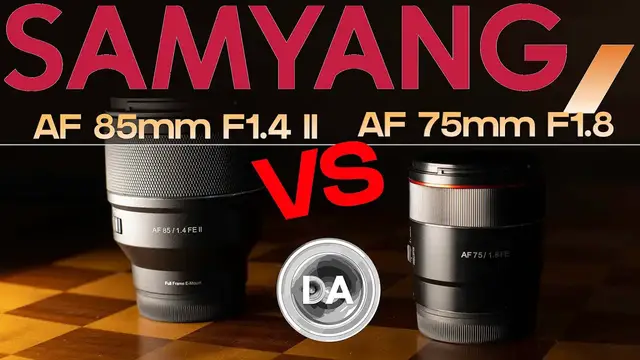
By popular request, Photographer Dustin Abbott shares a comparison/versus episode between the new new Samyang (also sold as Rokinon) AF 85mm 1.4 Series II prime lens for Sony FE and their high performing compact AF 75mm F1.8. Which is the better buy? | This video is sponsored by Fantom Wallet. Visit https://store.fantomwallet.com and use code DUSTIN15 to get 15% off
Read the 85mm Text Review: https://bit.ly/AF85IIda | Visit the Image Gallery: https://bit.ly/AF85IIphotos | Purchase the Samyang AF 85mm F1.4 II @ B&H Photo https://bhpho.to/3SKhmze | Amazon https://amzn.to/3FsaiEE | Amazon Canada https://amzn.to/3U75PuU | Amazon UK https://amzn.to/3zMBGcT | Amazon Germany https://amzn.to/3FmAnEY
Read the 75mm Text Review: https://bit.ly/AF75Review | Visit the Image Gallery: https://bit.ly/AF75IGda | Purchase the Samyang AF 75mm F1.8 @ B&H Photo https://bit.ly/SamAF75mm| Amazon https://amzn.to/2VxyxKb | Amazon Canada https://amzn.to/3eIWOV2 | Amazon UK https://amzn.to/3bwOp5f | Amazon Germany https://amzn.to/3cKta02 | Ebay https://bit.ly/SamAF75mm
Check out the DA Merch here: https://bit.ly/TWIMerch | Become a Patron: https://www.patreon.com/dustinabbott | On the Web: http://dustinabbott.net/ | Sign up for my Newsletter: http://bit.ly/1RHvUNp | Instagram: http://bit.ly/DLAinsta | Facebook: http://on.fb.me/1nuUUeH | Flickr: http://bit.ly/1UcnC0B | 500px: http://bit.ly/1Sy2Ngu Follow Craig @ https://www.instagram.com/craigstoffersen/
Want to support this channel? Use these affiliate links to shop at:
B&H Photo: http://bhpho.to/1TA0Xge
Camera Canada: http://bit.ly/DLACameraCan
Amazon: https://amzn.to/3HrY64d
Amazon Canada: https://amzn.to/3qG1p18
Ebay: http://bit.ly/DustineBay
Make a donation via Paypal: https://www.paypal.com/paypalme/dustinTWI
=============================
Table of Contents:
=============================
0:00 - Two types of lenses
2:45 - Reasons to buy the 75mm
Show More Show Less View Video Transcript
0:00
Hi, I'm Dustin Abbott and I'm here today to give you another one of my Versus episodes
0:16
Now this is a done by popular demand. When I did the review of the new Samyang AF 85mm f1.4 Series 2 lens
0:25
a number of you have written requesting that I do one of my comparisons and versus videos versus
0:31
a lens that you all know that I am quite fond of. I did a couple of reviews of this including a
0:37
long-term review after several years of use and that is the Samyang AF 75mm f1.8. So two different
0:45
lineups really. This 75mm is part of what Samyang calls their tiny series and so while they are
0:51
full frame and highly functional lenses. They're really designed more around a theme of being
0:56
lightweight, very portable, and with a slightly smaller maximum aperture. Whereas this 85 millimeter
1:02
f1.4 series two lens is part of more a part of what I would call Samyang's maybe professional
1:08
grade lenses that have a obviously larger maximum aperture. They're less concerned. I still think
1:15
that they do a pretty good job of keeping them, you know, lightweight and smaller, but they're
1:20
more concerned with a higher grade of construction and quality optical performance, competitive
1:25
optical performance with what really is more higher tier lenses. And so two different kind
1:30
of types of lenses, but there's not, in theory, not a radical difference in price. Though as we're
1:36
going to see, that price gap is larger because of some market pressures and sales on this particular
1:42
lens. We'll dive into that in just a moment. So just to give you a quick idea of what we're doing here today. I'm going to give you some reasons to buy the 75 millimeter. I'm going to give you some
1:50
reasons to buy the 85 millimeter. I'll give you a quick conclusion. And then I'm going to follow
1:54
that with a detailed optical breakdown. For those of you that want the big picture, you can linger at
2:00
the end and you can get my kind of deep dive into the optical comparison between the two to help you
2:05
to make a further decision. First of all, however, a word from our sponsor. Today's episode is brought
2:11
to you by Phantom Wallet, the minimalist modern wallet that is now even better
2:15
with the new Phantom X that is crafted from aluminum right here
2:19
in Canada. It is 22% smaller and 35% lighter while still making it easy to access
2:25
your cards and money when you need them thanks to their unique fanning mechanism
2:30
You could even customize your wallet due to its modular design with accessories like a money clip, cash holder
2:36
ID display, and even Chipolo and AirTag tracking integration. Visit store.phantomwallet.com to check out their unique sizes, styles, and finishes that span from aluminum to wood to carbon fiber
2:49
And use code DUSTIN15 for 15% off when you're ready to check out
2:56
So let's start by talking about some reasons to buy this little 75mm F1.8
3:02
You can see my definitive long-term review of it here if you want more information on it in particular
3:07
But one of the first and most obvious reasons to prefer the 75mm over the new 85mm Series 2 is price
3:15
The MSRP on the 75mm is only $399, but it has been at kind of a real-world price point of under $300 for the last at least six months or so
3:28
And so as a byproduct of that, that compares to the MSRP of $799 for the 85mm lens, which is a really, really great price for an 85mm f1.4 lens
3:40
But obviously, comparatively, you're talking about less than half of what you're paying here
3:46
And so, or I should say that this costs less than half of what the 85mm does
3:51
And so if you're looking at the value proposition, it's really hard to argue against the 75mm
3:56
Quite obviously, if portability is a factor, we've got a huge size disparity here
4:01
This little 75mm lens is only 65mm in diameter, giving you a 58mm front filter thread, only 69mm in length
4:10
That's about 2.5 inches by about 2.75 inches in length. And that compares to what we have at 83 millimeters with a 72 millimeter front filter thread and nearly 100 millimeters in length or about 3 inches by 3 inches So a pretty radical difference there That also goes over to
4:31
the differences in the weight. 230 grams or right over eight ounces for the 75 millimeter versus
4:38
509 grams or about 18 ounces for the 85 millimeter. Again, relatively speaking, that is lightweight for
4:45
an 85 millimeter f1.4, but if you're comparing the two, this little guy is less than half of the
4:51
weight and so much easier to bring along. It also is a little bit higher performing when it comes to
4:57
minimum focus distance and maximum magnification. Now this isn't a huge win here, but there is a win
5:02
there. You can focus down as close as 69 centimeters, giving you a magnification of 0.13 times
5:09
whereas you can only focus as closely as 85 centimeters with the 85 millimeter lens, giving
5:14
you a slightly lower 0.12 times magnification. I also noted that at wide apertures, the 75mm
5:22
exhibited fewer chromatic aberrations. It's actually quite a well-corrected lens, and you
5:28
can see more of that if you stay tuned for the optical breakdown later. We'll also find during
5:33
that optical breakdown that at wide apertures, it gives a slightly better center performance
5:38
and it's not until starting to stop down that the 85mm catches up and then surpasses in some
5:44
ways once you get into smaller apertures. So there are some very clear reasons to buy the 75mm lens
5:51
So let's talk about reasons to buy the 85mm. Well first of all you're obviously talking about a
5:56
completely different level of build quality. If you hold the two lenses in the hands this comes
6:00
across as being a plastic fantastic which it is. 85mm feels like a more professional grade lens
6:07
It comes also with more features including a focus hold button, much better materials in the
6:13
construction, a much nicer focus ring and the materials that go into that. This 85 millimeter
6:19
lens also has a thorough weather ceiling. And so if you're going to shoot in adverse weather
6:23
conditions, that might be a significant factor in the favor of the larger 85 millimeter lens
6:30
Obviously, F1.4 gives you a lot more light gathering capabilities than F1.8 does. That's
6:36
about two thirds of a stop, which means you're in low light situations. You're going to get a
6:40
little bit better focus because the sensor gets more light to work with, but also it's going to
6:45
enable you to get higher shutter speeds, which means you might be able to keep the ISO down
6:49
So that can be a significant factor if you tend to shoot in lower light settings. Also as a byproduct
6:54
of starting off with a larger maximum aperture, you end up with larger and softer bokeh. And that
7:01
includes when you match up both the distance to the subject in terms of the framing, and also when
7:07
you're using an equivalent aperture. It's kind of a quirk that I have found, but it remains true that
7:11
lenses that have a larger maximum aperture, they continue to generate larger and softer bokeh
7:16
even when you equalize the settings out with a lens that has a smaller maximum aperture. And so
7:22
bokeh quality is going to be one advantage for the 85 millimeter lens. I also noted that not only
7:28
is the focus ring material nicer, but also the focus action. Manual focus action is better. And
7:34
And so if you like to do any kind of manual focus, either for video focus pulls or maybe just as a part of your shooting process
7:42
you're going to prefer the manual focus action on the 85mm lens
7:46
I also found that while I thought going into this that maybe the autofocus would be slightly better on this
7:53
since they use equivalent type focus systems and this has smaller elements to drive
7:58
but the newer technology in the new series 2 lens enables it to be as you can see ever so
8:04
slightly faster and more confident in focus again it's not a big win here but there is a minor win
8:10
there nonetheless we'll also find during our optical breakdown that there is more consistent
8:15
sharpness in terms of sharpness extending all the way out to the edge of the frame there is also
8:19
more sharpness available on tap as you stop the lens down so we'll call that a more consistent
8:25
optical performance and sharpness that is achievable there. And so in the quick synopsis
8:31
before we dive into the deeper optical breakdown, and for those of you that don't want to stick
8:36
around to the end here my conclusion Which one should you buy Well it really comes down to what your set of priorities are Do you value portability or are you looking for a higher grade of build Both of these are very sharp lenses and I don think that
8:50
there's too many situations where you can't get images out of either of them that wouldn't impress
8:54
either yourself or a client. But I did note that the 85mm does offer just a little bit more nuanced
9:00
performance, a little bit more consistent performance. So if you're just looking at wide
9:04
open performance. 75 millimeter more than holds its own, except for out in the corners. Both of
9:11
these are relatively good value for what they are, but in many ways, I think that maybe the 75
9:16
millimeter F1 point is very possibly the best bang for the buck lens there is on the Sony platform
9:22
right now. You're getting a lot of optical performance for under $300, and that is pretty
9:27
mind-blowing. In many ways, I certainly would choose this lens optically and price-wise over
9:33
a lens like the Sony 85mm f1.8. It just offers up just so much value there. So at the end of the day
9:40
it really comes down to what your own set of shooting priorities are. But it's really intriguing
9:44
that Samyang is giving us this kind of choice in terms of how we want to approach photography
9:51
And while these aren't exactly the same in terms of focal length, they behave similarly enough that
9:56
I think you can do largely the same things with both lenses. So at the end of the day, the choice
10:00
is yours, but hopefully you have a little bit more information to equip you in making that choice
10:05
If you want even more information, stay tuned now for the optical breakdown
10:09
Okay, for these series of comparisons, we will have the 85mm on the right, the 75mm on the left
10:16
So as you can see, looking at both of these lenses when it comes to vignette and distortion
10:21
there's really not a lot of offensive from either one. There's a slight bit more distortion on the
10:29
75mm a little bit more vignette on the 85mm. There is a software correction profile available
10:35
for both lenses, but here just to do a manual correction so you can see how much is needed for
10:40
correcting, I dialed in a plus 2 for the distortion and a plus 46 for the vignette on the 75mm
10:49
Now for the 85mm I needed a little bit less distortion, only to minus 1, you really could
10:53
leave it uncorrected, and just a little bit more vignette correction, a plus 53. Truth of matter
10:59
is that neither of these are really offensive in this regard and are better than most competitors
11:04
Now, while in theory, the 75 millimeter has slightly better magnification, as you can see in real world performance, it's not enough to make a significant difference
11:14
Now, that being said, the 75 millimeter does offer a little bit more contrast wide open
11:20
than the 85 millimeter does up close. Of course, if you stop the 85 millimeter down to f1.8, that advantage goes away
11:28
And we would find that there's a little bit more contrast for the 85mm then
11:34
Now I did find that the 85mm does suffer from a little bit more chromatic aberrations
11:39
Particularly the longitudinal variety. As you can see in these wide open shots
11:44
Both of them are suffering from some color fringing on this kind of torture test
11:49
Highly reflective surface. But you can see that there's some purple fringing
11:53
There is a little bit more of the green fringing on the 85mm
11:59
And so our actual area of focus is right around here. And you can just see there's a little bit more fringing there
12:05
And more noticeably, if we go towards the bokeh, 75mm is pretty neutral there, whereas the 85mm is showing a little bit of fringing
12:14
Now, one advantage of an f1.4 lens versus an f1.8 lens is the fact that it is able to produce larger and softer bokeh
12:22
And so as we can see looking at these circles, there's more of a defined inner line on the 75mm, whereas on the 85mm it is softer
12:31
And obviously the size is larger and softer for the 85mm. Now interestingly, that's true even if we go to f1.8 on the 85mm
12:42
And so as you can see, the size of the Bokeh circle still favors the f1.4 lens
12:48
And that true even if we go right down to f2 whereas you can see that the size of the bokeh circles is still larger and overall softer than what we see on the 75mm lens Now if we take a look at a real world comparison here with bokeh we can see a few of these different things that we talked about on display here And so we align those up Now at
13:12
f1.8 versus f1.4, I think there's a little bit more real world contrast on the 75 millimeter lens
13:18
but we can also see looking beyond that a few other factors I want to point out. And so first
13:23
of all, we can see once again, it is quite neutral in this out of focus area, whereas there's a little
13:28
bit of green fringing there. We can also see the reality that the size of this bokeh circle is much
13:34
larger and softer on the 85mm lens. Now if we compare both lenses at f1.8 we can see that this
13:41
remains true. I've done my best to equalize the distance and so it's not favoring the focal length
13:47
So you can see that on the subject our resolution contrast is roughly the same. But looking over here
13:52
at the Bokeh circle, it does definitely favor the larger f1.4 lens
13:59
Many of the tiny series lenses like the 75mm are really surprisingly good optically
14:04
Here we are on a 50MP body at 200% magnification, and we can see that if we compare the center
14:10
of the frame, and then this is f1.8 versus f1.4, I'll show you the equal apertures in
14:15
just a moment. We can see that wide open, the 75mm in the center of the frame is actually sharper and
14:21
with higher contrast. If we move to the mid-frame, there is still a tiny bit of advantage for the 75mm, but they are much more similar
14:29
The 85mm is very clearly better at the edge at F1.4, delivering a little bit more consistent sharpness across the frame
14:37
Now, if we compare both of them at F1.8, we look into the center of the frame
14:42
we can see that I would still probably give in the center of the frame a slight edge to the 75mm
14:48
and in the mid-frame things look pretty similar, not really much of an advantage for either one
14:54
Obviously there was already an advantage in the corner at f1.4 for the 85mm
14:58
and obviously that's going to remain the case here. We look over at the mid-frame on this side
15:03
On this side I would say I do favor the 85mm at f1.8
15:07
just again once a little bit more consistently sharp. We stop them both down to f2
15:12
Now we see that the center advantage is largely gone for the 75mm at this stage
15:17
85 millimeter is really starting to stretch its legs and it's looking really really crisp here
15:22
in the mid frame you know again both of them look really good not really an advantage for either one
15:28
and in the corner we already saw an advantage and that advantage has not disappeared yet
15:32
looking over here at the other side at the mid frame again it looks a little bit better on the
15:37
85 millimeter just a slightly more consistent performance and a little bit better pop now by
15:42
f 2.8 both these lenses are brilliantly sharp but the you know the larger lens is showing just a
15:48
little bit more advantage you can see that the contrast is a little bit more intense now here
15:52
at f 2.8 looking at the mid frame you know they both look really really good on this side on the
15:58
mid frame starting to look a little bit better in the corners on the 75 millimeters yet still
16:03
pretty soft when you get to the extreme edge whereas the 85 millimeter now is basically
16:08
perfectly sharp across the frame. Look over on this side as well. You can see just a really
16:12
noticeable difference there in terms of contrast and detail. And back up here once again, we can
16:19
see just definitely more pop for the bigger 85mm lens. If we move on to f5.6, we can see that
16:28
again, both really, really sharp, but the 85mm is the sharper one. And you can just see it in some
16:35
of the nuance, the depth of contrast that is there in the mid-frame
16:39
They both look pretty brilliant, but the 85mm is just a little bit better
16:43
Now we can see that in the corners, the 75mm is getting better, but it's still nowhere
16:48
near the level that we see on the 85mm. And again, we can verify that looking at both sides of the image, where it just definitely
16:57
looks crisper with the 85mm lens. up here in this other corner, we can see again, the 85 millimeter is just the stronger of the two
17:06
So in conclusion, if you want more information, there's link to both reviews down in the description
17:11
below. There's buying links there. And of course, please like, and subscribe
17:15
Thanks for watching. Have a great day and let the light in