Up next in 10


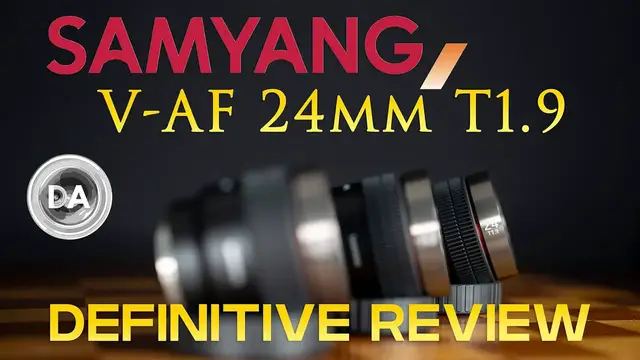
Photographer Dustin Abbott shares a definitive video review of the Samyang (Rokinon) V-AF 24mm T1.9 hybrid lens for both photography and cinematography. | Join the Viltrox Global Photo Contest at https://www.viltrox.com/newsinfo/5614944.html | Read the Text Review: https://bit.ly/VAF24mmDA | Visit the Image Gallery: | https://bit.ly/VAF24pics
Purchase the Samyang V-AF 24mm T1.9 @ B&H Photo https://bhpho.to/40SBC6f | Adorama https://howl.me/cjs34l8WJ31 | Amazon https://amzn.to/42ZRfdT | Amazon Canada https://amzn.to/40zmwD3 | Amazon UK https://amzn.to/3zrdCLU | Amazon Germany https://amzn.to/3m4nAQf | Ebay https://ebay.us/Tp3ZuD
Purchase the Samyang V-AF 35mm T1.9 @ B&H Photo https://bhpho.to/3MdI3g7 | Adorama https://howl.me/cjs37R0rXwC | Amazon https://amzn.to/3nCEq9s | Amazon Canada https://amzn.to/3lXS9He | Amazon UK https://amzn.to/3m0AAqa | Amazon Germany https://amzn.to/3GcE6oi | Ebay https://ebay.us/Tp3ZuD
Purchase the Samyang V-AF 75mm T1.9 @ B&H Photo https://bhpho.to/42Y9LU4 | Adorama https://howl.me/cjs39NQVhO2 | https://amzn.to/3JVxLP2 | Amazon Canada https://amzn.to/40BppTI | Amazon UK https://amzn.to/3K6i4EP | Amazon Germany https://amzn.to/3K157fr | Ebay https://ebay.us/Tp3ZuD
Purchase the Samyang Lens Station @ B&H Photo https://bhpho.to/3Tu7SKy | Adorama https://howl.me/cjs4a2QNHvd | Amazon https://amzn.to/3KqHfDn | Amazon Canada https://amzn.to/42WlYsu | Amazon UK https://amzn.to/3KtCRDO | https://amzn.to/3M4HTHY | Ebay https://ebay.us/onVcG1
Check out the DA Merch here: https://bit.ly/TWIMerch | Become a Patron: https://www.patreon.com/dustinabbott | On the Web: http://dustinabbott.net/ | Sign up for my Newsletter: http://bit.ly/1RHvUNp | Instagram: http://bit.ly/DLAinsta | Facebook: http://on.fb.me/1nuUUeH | Flickr: http://bit.ly/1UcnC0B | 500px: http://bit.ly/1Sy2Ngu Follow Craig @ https://www.instagram.com/craigstoffersen/
Want to support this channel? Use these affiliate links to shop at:
B&H Photo: http://bhpho.to/1TA0Xge
Camera Canada: http://bit.ly/DLACameraCan
Amazon: https://amzn.to/3HrY64d
Amazon Canada: https://amzn.to/3qG1p18
Ebay: http://bit.ly/DustineBay
Make a donation via Paypal: https://www.paypal.com/paypalme/dustinTWI
Show More Show Less View Video Transcript
0:00
Hi, I'm Dustin Abbott. The Samyang VAF series are new hybrid lenses that recognize that many
0:15
modern cameras and photographers split time between photos and video. So these lenses combine
0:21
popular cine features with typical photography features like autofocus and the results are a lot
0:27
of fun. You can find my review of the whole series and how the lenses work together by watching this
0:33
video. Today, however, we will be doing the first individual review of the series and taking a look
0:38
at the Samyang or Rokinon VAF 24mm T1.9, right after a word from our sponsor. Are you ready to
0:46
use that gear and show off your skills? Viltrox is sponsoring a global photo contest with more than
0:52
$15,000 worth of prizes with one catch. Photos must be shot with a Viltrox lens. A panelist of
0:59
judges from around the world, including my friend Christopher Frost, will select the winners. The
1:04
contest runs from April 10th to June 10th, and you can upload your submissions to the link in
1:08
the description below. First prize comes with over $4,000 worth of gear, including a Fujifilm X-T5
1:15
and a Viltrox AF 13mm f1.4 lens with subsequent prizes loaded with lenses, tripods, lights, swag
1:24
and gift cards. There is no cost to enter so get snapping, upload your best work
1:29
and win big prizes in the Viltrox Global Photo Contest. So you may have noticed that as compared
1:35
to the tiny series 24mm f1.8 which a lot of the same DNA from this lens is in this new VAAF lens
1:43
you may have noted that the photography lens is designated by its aperture, f1.8
1:48
whereas the cine lenses are designated by their T-stop or their light transmission stop
1:55
So if f1.8, which is the same here, it's the same maximum aperture
1:59
but as always, as light passes through the aperture and then through the glass elements
2:04
that make up the optical design, a little bit of that light transmission is lost
2:08
And so in this case, it goes from the aperture size of f1.8 to the transmission rating of 1.9
2:15
which is actually quite efficient. It means that there hasn't been a lot of loss of light in the glass elements itself. Now, as you can see, all of these lenses are
2:23
completely standardized in that it doesn't matter whether you're looking at the 24mm
2:28
the 35mm, the 75mm, or the upcoming 45mm and then 20mm T1.9 lenses. They all are going to be
2:37
identical in size, which is 72.2 millimeters in diameter with a 58 millimeter filter size
2:45
also 2.8 inches in length. So almost identical in length and diameter. And they weigh in at 280
2:51
grams or 9.6 ounces. Now, while it's true that these lenses are a little bit larger than the
2:57
tiny series lenses that they replace, also a little bit heavier, they still, in an absolute
3:03
sense are very compact and very lightweight and the build quality has dramatically improved here
3:09
That is up to and including a metal accessory ring on the front that has actually has electronic
3:15
contacts and the bayonet style mount that is there at the front and that is for custom accessories
3:21
that will come exclusively for the VAF series. So far only one thing has been released one accessory
3:26
and that is this manual focus accessory. I break down that a little bit more in the overall series
3:32
review that I referenced earlier. So this manual focus adapter gives you two things that the stock
3:37
lens does not have. The first of those is hard stops. Hard stops both at infinity and then also
3:43
at minimum focus distance. Something you just can't achieve in a focus by wire manual focus ring
3:48
The other thing that it gives you is a consistent distance scale and distance markings which helps
3:54
you of course with focus pulls to have very repeatable results. Now I will note that in the
3:59
actual manual focus ring itself. It has 300 degrees of rotation. It also is linear, and so that means
4:05
that it's not speed specific, and so you can do a fast pull, you can do a slow pull, and you're going
4:10
to end up at the same point. However, without any kind of markings to kind of pull back to, whereas
4:16
the manual focus adapter does give you that, so it certainly adds a little bit of value there
4:21
Returning to the actual design of the lenses itself, however, there's a few other features
4:25
that are significant. First of all, there is a tally lamp, both at the left-hand side and then at the front of the lens
4:31
that allows you to monitor recording status either from the side or the front which I have found very very handy And because I have these lenses displayed I been using them a lot to record these segments and not being able to see that tally lamp I missing it already because it just that
4:45
constant confirmation. You can know that video recording is taking place. There is a custom
4:50
switch. Basically the custom switch changes the behavior of the ring. So I've got it set up that
4:54
in the first custom mode, it is the ring works as an aperture ring. And then if you go into the
5:00
second mode, it automatically goes into manual focus mode and obviously the ring is going to
5:04
function as a manual focus. And so it kind of gives me the equivalent of having an AF-MF switch
5:10
Samyang has designed the manual aperture control to where it behaves differently whether you are in
5:15
photo, as you can see here, with a little bit more in terms of some visible stepping. And then if I
5:22
switch the camera into video mode, we can see that the aperture control is smoother and with less
5:30
visible stepping as a part of the design. Also note that it's not as good as a dedicated cine
5:37
lens when it comes to actual aperture racking, which refers to closing down or opening up the
5:44
aperture during a video shot. And so that more, the depth of field either increases or decreases
5:50
making more or less in focus. But you can see that it's not perfectly smooth in that process
5:55
due to that little bit of lag in the focus by wire nature
5:59
But overall, this actually handles really, really well for a lens of this type
6:04
It also has the focus hold button that can be programmed to different functionalities
6:09
Now, I will note that a lot of the custom nature of these lenses, it can be customized if you use the Samyang Lens Station
6:15
and then their free lens manager software. Right now, the Lens Station can be had for about $40
6:21
I highly recommend getting it. It allows you to do firmware updates and also, of course, to tweak the behavior of the lenses itself
6:28
Included in this design, constant across all of them, is that there are six weather sealing points
6:33
which make this a fairly thoroughly weather-sealed lens. Obviously, very handy for shooting in various inclement conditions
6:40
As we've already seen, the Aputure Iris has nine rounded Aputure blades
6:44
and focus is powered by linear focus motor. Now, in the case of the 24mm, the minimum focus distance is 19cm
6:53
which gives you a maximum magnification, a quite high magnification of 0.21 times
6:58
Certainly very useful. And it's not a completely flat plane of focus because you're focusing fairly close with a wide-angle lens
7:05
but certainly very useful for different kinds of application. Also, of the series, at least what's been reported at this point
7:13
the 24mm shows the least amount of focus breathing at less than a percent, 0.7%
7:19
So that means that there is almost no focus breathing, as you can see here
7:23
And that's going to be obviously very, very useful for video acquisition
7:28
So talking about video here for a moment. First of all, the actual focus pulls are really, really smooth with this lens
7:35
If you have ever done manual focus pulls with a typical autofocus lens, it's often not all that fun
7:43
Autofocus, the actual focus rings tend to not be all that well damped
7:48
and maybe they move too quickly for doing smooth focus pulls. I really like this
7:53
As long as I'm not trying to rack from minimum to infinity, obviously 300 degrees of rotation
7:58
that is several full breaking of the wrist type rotations if you're just doing it by hand
8:03
But for a more typical distance, say within a frame of nine meters, around 10 feet
8:08
it's quite perfect. And so it allows you to have really precise control over that
8:13
And I find that whether I'm doing a fast or a slow pull, that it really, really works very, very nicely
8:19
Also, when you're doing autofocus pulls, autofocus pulls are not too aggressive
8:24
in that it's not like jumping back and forth, but rather it is tuned nicely
8:28
to where you still have a rather cinematic feel of pulling from one point to another, as you can see here
8:34
Obviously, these lenses work really, really well on gimbals for a couple of reasons
8:38
They're lightweight, and so that always helps. But the other thing that really helps
8:43
is not only are they all constant in their size, they're also constant in their balance point which is quite a clever little engineering feat
8:50
what it means is that you can hot swap these lenses and never have to worry about rebalancing
8:55
on a gimbal and so i found that you know doing actual gimbal work that it functions smoothly
9:00
autofocus worked well in that situation and of course many times you'll you'll want to shoot a
9:04
manual focus as well depending on what you're trying to accomplish and it works just everything
9:09
just works really really well now samyang also touts these as working well on a larger drone i don have anything of that size to mount them on but again some of the same principles would be true in that when it comes to the balance and the overall lightweight only 280 grams of these lenses So let talk about the
9:25
optics of the 24 millimeter T1.9 today. One of the first things that's really important about
9:32
this lens and then all of the lenses in this series is that they all are designed to have
9:37
consistent color and all subscribe to Samyang's CCI index. And so that there is a constant color
9:43
output, which really allows you to mix and match footage very, very nicely. It's important as a
9:47
series, but I also just found that in general, colors were really, really nice out of this lens
9:52
very neutral, but with a nice feel to them. I also noted that there was a good kind of cinematic
9:59
look to when, you know, light is hitting the lens, I call it lens flare or even flare resistance
10:06
but it's not completely resistant. But what it does show is something that is quite cinematic in feel
10:11
Also, if you have the lens stopped down, the sunburst effect is quite nice as well
10:16
Now, you will note from this focus pool, returning to this for a moment, you can see a bit of chromatic aberration as you go back and forth
10:23
The primary aberrations you're going to see are some green fringing and bokeh highlights
10:27
It's nothing that's ruinous, but at the same time, just note that there is going to be a bit of it there
10:32
Now, with a wide-angle lens, you know, bokeh is maybe of a secondary consideration
10:37
in that you're rarely going to have things completely defocused in the background
10:41
But I will note that the bokeh quality for a 24mm lens is fairly good here
10:46
Not as good maybe as what you might get with an f1.4 lens or a cine equivalent of that
10:51
but quite good for a lens with a maximum aperture of f1.8
10:56
Now, we're going to dive in briefly to a little segment where I'll give you a look at the sharpness, the contrast, the distortion, things like that
11:03
that are a little easily, more easily measured by looking at a test chart and in still form
11:08
So let's dive in and let's take a look at that. So we'll start by taking a look at vignette and
11:11
distortion. Now for a wide angle lens, the amount of distortion is not particularly high. It's also
11:18
not a hundred percent linear. However, you can see after my manual correction, there is just the
11:22
mildest amount of a wave or mustache type pattern there. I used only a plus three to correct for the
11:29
distortion and then a plus 65 so about two and a quarter stops of vignette in the corner. Neither
11:37
is really particularly severe and so obviously not all that hard to correct. Now I do my test of
11:43
full frame lenses on Sony on the Sony Alpha 1 which is a 50 megapixel body. I'm showing you these
11:48
results at 200% magnification to highlight strengths and weaknesses very clearly. So at
11:54
200% magnification, we can see in the center of the frame, this is a very sharp lens. It's delivering
11:59
very good contrast, very high amount of detail. The midframe is also quite good, not as good as
12:05
the center, but a fairly mild drop. And then if we look down towards the corner, there is more of a
12:11
drop in the corner, though you can see that even on the left side of my final build down here in
12:16
the corner. Things are still looking pretty good, and then there's kind of a steady progression to
12:20
where it's dropping off towards the extreme corner. So through a lot of the frame, up to including
12:25
this zone here, sharpness is still really quite good. Taking a look at a real-world scene here at
12:31
night, F1.8, so landscape-type image, we can see that there is plenty of detail throughout the frame
12:38
Even the corners don't look bad here, and we can see that if we look in the sweet spot here
12:42
even though obviously a higher ISO value at night and an overcast type night
12:47
you can see that the detail everywhere that we look is really quite good
12:51
And again, this is on a 50 megapixel sensor. Likewise here, this is shot through a window, so a little bit of degradation that comes from that
12:59
But even at f1.8, we can see that there's plenty of detail across the frame
13:03
and a nice amount of detail even drawing off into the distance
13:07
Now if we compare f1.8 and f2, we see that there really isn't a huge difference
13:12
There are some lenses that take a real leap forward with just that minor bit of stop down
13:16
In this case, however, I would say the results look largely the same, just a touch more contrast
13:22
but nothing significant. There's a little bit more improvement from f2 to f2.8, but it's between f2.8 and f4 that
13:30
we really see a huge improvement. You can see looking at f2.8 on the left here in the corners and then f4 on the right, how
13:37
significant an improvement we have had in terms of overall performance. And so now anywhere we look in the frame, things are extremely sharp
13:45
We can go over here on this side. You can see just the detail is just popping off the page there down to this zone and scrolling over here You can just see all the detail in the hair and the eyes and the texture of the bill that is showing up just really really strong by that point that means that images taken at landscape apertures like this are going to
14:04
deliver a lot of detail and you can see that's the case that as we look in the frame there is a lot
14:09
of detail great texture information that's captured so just a really strong optical performance when
14:15
stop down. As I saw when I reviewed the stills version of this lens, this is a lens that controls
14:20
coma quite well. And so you can see here off to the corner, we're not seeing any kind of smear
14:25
So this makes this a really intriguing lens for using at night. You can see here that even though
14:30
there's a little bit of smear there because it was so misty down near Niagara Falls, you can see
14:35
that the lens produces really cinematic looking images and the color really pops here at night
14:41
And so you have a great combination of contrast, detail, and then great color, which allows both video footage and then also stills to look really fantastic
14:51
This is a very nice optical performance. I'm having a blast with this VAF series
14:57
I've always been a fan of the Tiny series, so maybe I'm a little bit biased to begin with
15:01
But this takes it all to a whole other level. We have much better quality when it comes to the build
15:07
There's better features. There's more mature autofocus. There's the consistent color and the standardized sizes
15:13
making these all really, really easy to work with. And the fact that they do such a great job of kind of straddling both worlds
15:20
and that they are genuinely fun to use as cine style lenses
15:24
but they also work just as well as the tiny series when it comes to functioning as photography specific or autofocus lenses
15:32
And so it's really great to be able to have both of those in one package, rather than having to have a separate set of lenses for doing video
15:38
and a separate set of lenses for doing photography, these hybrid lenses really allow you to do both
15:43
quite well with relatively few compromises. I think the only question to be answered by you
15:48
as an individual consumer is whether or not it's worth the additional money to you
15:54
I've always looked at the Tiny Series as being a great value. Now, of course, they were kind of
15:58
plastic fantastics in that the build quality was never exceptional, though the 24mm as the last one
16:05
in the series. It was the best of the bunch, but in no way does the build quality compare to that
16:10
of the VAF series. But at the same time, you can get this lens for $400, no more than that
16:17
whereas you're going to be looking at $650 to $700 in that range, depending on the retailer
16:23
when it comes to purchasing the VAF version of the lens. So the question is, is it worth that
16:28
additional money? I would say that the answer is yes, under certain conditions. Number one is if
16:34
you really plan on doing a lot of video work that you really are a hybrid shooter, it is worth the
16:39
extra money because there's just a lot of things that this lens does really well for video that
16:44
this lens doesn't. The other way I would say that it really kind of helps to show its value is if
16:49
you plan to buy multiple lenses in this series and being able to have some of those kind of
16:54
standardized features, not only just in the feature set of the lens itself, but also in the optical
16:59
performance when it comes to color and autofocus, the overall feel and the rotation of the
17:04
ring. If you're going to do that, then this series makes a whole lot more sense
17:08
They are a better value looked at as cine lenses than they are as just purely photography lenses
17:13
That's because they really aren't designed to just be pure photography lenses. And so if those
17:18
scenarios that I've just described apply to you, then obviously this 24 millimeter is going to be
17:24
a really, really popular lens. It's a great focal length for vlogging, for use on a gimbal. It's
17:31
going to be one of the best focal lengths if you actually happen to want to use it on a drone
17:35
Obviously, that focal length is also going to be incredibly useful for video itself. And on Sony
17:40
which these are designed for, you can have the full frame 24 millimeter angle of view. But of
17:44
course, if you're shooting in Super 35 or APS-C mode, you're going to come into a focal length
17:51
that is very similar to the very popular 35 millimeter focal length. So obviously, that is
17:55
going to prove useful for a whole lot of different applications. If you want more information about
18:00
this you can check out the description below where you'll find links to my full text review
18:05
also linkage there to my image gallery from the lens also there are some buying links there if
18:09
you'd like to purchase one for yourself and as always the typical links to follow myself or
18:13
Craig on social media to become a patron or to get channel merchandise if you haven't already
18:18
please like and subscribe thanks for watching have a great day and let the light in
18:30
Thank you
#Hobbies & Leisure