0:00
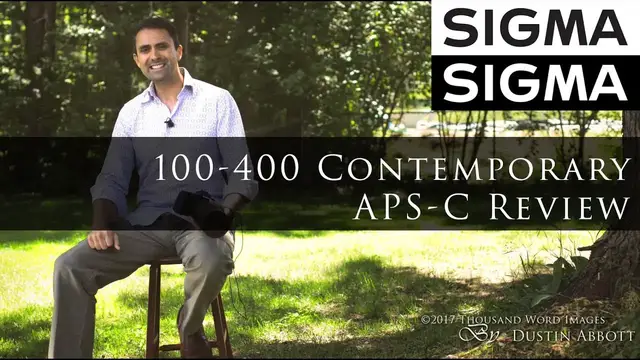
Hi, I'm Dustin Abbott and I'm here today to give you my APS-C or crop sensor review
0:24
of the Sigma 100-400mm. This is f5-6.3. It is DG, which means it's compatible with full frame
0:33
but of course it works just fine on APS-C also. And it has their optical stabilizer
0:38
their HSM or hypersonic motor for focusing, and of course it is from their contemporary line
0:45
Now, if you haven't watched my playlist already as I covered this lens on full frame
0:51
I'd recommend that you do so to get all of the details. And I've covered the build quality already in that episode, in one episode
0:58
In another, I looked at the image quality on full frame. And then in my final review, I covered the autofocus performance
1:06
So I'm not going to repeat all of those things here, but rather I'm going to kind of focus
1:10
on how the lens makes that transition to APS-C. So if you're shooting on like I am, I'm using a Canon 80D for this review
1:19
Canon's crop factor is 1.6 times, which gives this lens an equivalent focal length of 160 to 640
1:28
millimeters, which obviously is a very useful focal range. If you're shooting on Nikon or Sony
1:34
APS-C, they have a crop factor of 1.5 times, which makes this exactly a 150 to 600 millimeter lens
1:43
which is why I think that for many of you that shoot APS-C, you should really strongly consider
1:49
this as an alternative to some of the very popular 150 lenses First of all this is a much much more portable lens Easy to carry around It balances much better on an APS body and it weighs about half as much as the contemporary
2:08
version of the 150-600mm from Sigma and it only weighs about a third as much as the Sport edition
2:15
So as a result, it's just a better fit here on what is often a little bit smaller APS-C bodies
2:22
top of that, of course, while it doesn't have a tripod collar, many of you that are going to use
2:28
this as a handheld lens will find that it just is, it's a much more convenient lens to use. And
2:33
so it's significantly smaller than what the 150 to 600 millimeter lenses are. But at the same time
2:40
it's not hugely bigger than the 70 to 300 lenses. So if you're looking for a little bit more reach
2:46
than what one of those lenses gives you, and you don't want to have to carry around one of the big
2:51
bulky 150 to 600 millimeter lenses, I think that this really will hit a sweet spot for a lot of
2:57
APS-C shooters. And frankly, I find that in most situations, 640 millimeters is plenty of reach for
3:04
me. And so let's take a little bit closer look at this in terms of the image quality. My experience
3:11
says that not every lens makes the transition to APS-C all that well. And while, for example
3:17
my primary full-frame body is a 30-megapixel Canon 5D Mark IV, this Canon 80D body has 24
3:25
megapixels. And so it may seem to be a smaller megapixel count, which it is, of course. But when
3:31
you consider the fact that an APS-C sensor has a much smaller surface area, it means that there is
3:38
a lot of pixels that are packed onto that. So as a result, APS-C sensors tend to actually be a
3:44
little bit more demanding when it comes to actual image quality and a few other factors
3:49
And so I found that some lenses that look fine on full frame they don on APS Fortunately that no problem here I already determined that this lens was very sharp surprisingly sharp on full frame and I was very happy to find that it survived that
4:04
transition to APS-C just fine. In fact, I found the images to be very nicely detailed
4:10
and it continues to have that excellent contrast and resolution, even at wide open apertures
4:18
And that does help to make up for one of the disadvantages of this lens, and that is that
4:23
it has a small maximum aperture across the whole focal range, which means that really for a good
4:28
portion of the focal range, you're actually going to be at f6.3, which isn't, that's what we call a
4:35
slow maximum aperture. And so having great image quality means that you don't have to worry about
4:40
stopping the lens down to get optimum image quality. So that does help. It has a good image
4:45
stabilizer. And so that also helps of course, but note that despite that, this is a lens that is
4:52
going to serve you best when you're shooting in well-lit conditions. And so if you're shooting
4:57
you know, if you're shooting wildlife and you're not shooting at dusk or dawn, it'll do great for
5:02
you. If you're shooting, you know, kind of like your children's soccer matches in either outdoor
5:09
you know, sunlight conditions or very brightly lit stadium type conditions, it'll do okay
5:15
But if you're in more dimly lit conditions, expect the autofocus to balk on you sometimes
5:20
and have a hard time locking on when you don't have an eye contrast area
5:24
The other thing that is pretty important is that I found when I was testing autofocus on this lens
5:30
that while it did great for me in most single shot conditions, other than those very dim conditions
5:36
I didn't find that it tracks nearly as well as what the more expensive options do
5:41
Particularly, I'm talking about the higher end 100 to 400 millimeter lenses that cost two and three times as much
5:47
But for most people that aren dealing with highly demanding very fast moving subjects the autofocus does well enough And I found that I didn see a huge difference between my performance on the 5D Mark IV and then this Canon 80D And so it does do fine for most conditions
6:07
but if you're going to shoot very demanding autofocus situations, you may need to look
6:11
elsewhere. One thing that cannot be argued with is the price to performance ratio here
6:16
At under $800, I consider this lens to be one of the best telephoto values out there
6:24
And I think that Sigma has done a great job in dealing with this lens and packing it with the features that most shooters need while not saddling us with a huge price tag
6:35
And so I give them a huge thumbs up for that. So if you are an APS-C shooter and you're looking for a relatively affordable telephoto lens for your camera
6:45
for under $800 in the U.S. market, you can get this lens
6:50
and I think that you'll find that you'll be very satisfied with the results you're able to get optically out of it
6:55
And if the autofocus will do the trick for you, and let me just say on the note of the autofocus
7:00
I had great accuracy on both camera bodies I tested this on
7:04
I did cite everything and calibrate it using Sigma's USB dock, and if you haven't figured out
7:10
how to do calibration, I have got a playlist here that you should take a look at. But once I got it
7:15
locked in, I got good accuracy, good consistency. It's just not as fast as what I would like it to be
7:22
I'm Dustin Abbott, and if you'll look in the description down below, you can find
7:25
linkage to my full written review, also an image gallery where I have a specific gallery
7:31
included in that that is all APSC shots. Of course, you can also find some buying links there as well
7:38
if you're interested in purchasing one of these for yourself. If you haven't already, click that subscribe button
7:42
Please do so. Thanks for watching. Have a great day