Up next in 10

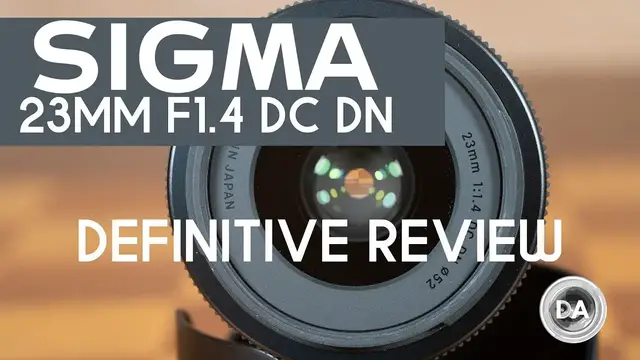
Sigma 23mm F1.4 DC DN C Review | The 35mm F1.4 ART for APS-C?
Jul 15, 2023

Photographer Dustin Abbott shares a deep dive review into the Sigma 23mm F1.4 DC DN C lens for Sony E, Leica L, and Fuji X mounts | This video is sponsored by Ridge Wallet's new Travis Matthew designs. Visit https://ridge.com/dustinabbott and use code "DUSTINABBOTT" for 10% off | Read the Text Review: https://bit.ly/Sim23DNda | Visit the Image Gallery: https://bit.ly/Sig23DNpics | Craig's video review: https://www.youtube.com/watch?v=NTXY_C87DM8 | Purchase the Sigma 23mm F1.4 DN @ B&H Photo https://bhpho.to/3Lgm6Lg | Adorama https://howl.me/cjDG5bKHtoF | Amazon https://amzn.to/3Vjs42H | Camera Canada https://shrsl.com/41nrv | Amazon Canada https://amzn.to/3HqFUdI | Amazon UK https://amzn.to/42bdnRE | Amazon Germany https://amzn.to/44bWk3v
Purchase the Fujifilm X-H2 @ B&H Photo https://bhpho.to/3KAInTC | Adorama https://howl.me/cjyzbiO5lVp | Amazon https://amzn.to/41zMzKl | Camera Canada https://shrsl.com/4128o | Amazon Canada https://amzn.to/40gY4W7 | Amazon UK https://amzn.to/43Grn7a | Amazon Germany https://amzn.to/3L6hwjR
Purchase the Fujifilm X-T5 @ B&H Photo https://bhpho.to/3uJsXFg | Amazon https://amzn.to/3WzxHsZ | Camera Canada https://shrsl.com/3un59 | Amazon Canada https://amzn.to/3v8IiiJ | Amazon UK https://amzn.to/3YEpLs6
Purchase the Viltrox Pro AF 75mm F1.2 @ B&H Photo https://bhpho.to/3PjhRjD | Amazon https://amzn.to/3YD0mz3 | Viltrox https://bit.ly/ProAF75buy (use code DUSTINABBOTT for 10% off) | Amazon Canada https://amzn.to/3v7wai5 | Amazon UK https://amzn.to/3BS3Vrm
Check out the DA Merch here: https://bit.ly/TWIMerch | Become a Patron: https://www.patreon.com/dustinabbott | On the Web: http://dustinabbott.net/ | Sign up for my Newsletter: http://bit.ly/1RHvUNp | Instagram: http://bit.ly/DLAinsta | Facebook: http://on.fb.me/1nuUUeH | Flickr: http://bit.ly/1UcnC0B | 500px: http://bit.ly/1Sy2Ngu Follow Craig @ https://www.instagram.com/craigstoffersen/
Want to support this channel? Use these affiliate links to shop at:
B&H Photo: http://bhpho.to/1TA0Xge
Camera Canada: http://bit.ly/DLACameraCan
Amazon: https://amzn.to/3HrY64d
Amazon Canada: https://amzn.to/3qG1p18
Ebay: http://bit.ly/DustineBay
Make a donation via Paypal: https://www.paypal.com/paypalme/dustinTWI
Show More Show Less View Video Transcript
0:00
Hi, I'm Dustin Abbott, and I'm here to give you my review today of the Sigma 23mm F1.4 DC-DN
0:17
contemporary lens. Now, the 23-millimeter F-1.4 is Sigma's first APSC-specific prime lens in about four years
0:26
Last one that I reviewed was back in 2019, and it was the 56mm F1.4
0:34
And so this joins the 16mm F1.4, 30 millimeter F1.4, and then that 56 millimeter F1.4
0:41
as their current lineup of fast APSC-specific primes with an F1.4 aperture
0:49
Now, this lens comes in a Sony E mount, which I'm testing here, a L-mount, and then some of the other lenses have
0:56
already been released in Fuji X-Mount, which is a recent development. This lens will be coming
1:00
in the summer of this year for Fuji X-Mount. What Sigma is essentially looking at this
1:05
lens as is a miniaturized 35-millimeter F-1.4 art lens for a smaller sensor. 23-millimeter
1:12
roughly corresponds to 35 millimeters. And of course, we've got the F-1.4 aperture, the very high
1:18
optical performance, as we're going to see. And obviously, just in a miniaturized lens with a few
1:23
less features, but designed for that smaller sensor. So the question is, is this lens worth the
1:29
price tag of $550 U.S. dollars? Well, let's find out right after a word from our sponsor
1:35
Today's episode is brought to you by Ridge, the wallet redefined. Ridges RFID protected wallets
1:41
typically employ contemporary finishes like aluminum, titanium, carbon fiber, or even specially
1:46
finishes like 18-carat gold or Damascus steel. But what if your personal style is less Wall Street
1:52
and more California. Ridge has you covered as they have teamed up with Travis Matthew
1:56
a premier lifestyle brand owned by Calloway that takes its inspiration from Southern California
2:02
surf, sand, and sun. Ridge is premiering three limited edition Travis Matthews signature designs
2:09
Ridge wallets hold up to 12 cards, and you can customize them with the included cash strap or money clip
2:14
Visit ridge.com forward slash Dustin Abbott and use code Dustin Abbott to get 10% off your order
2:20
plus free shipping worldwide. So as noted, this is a miniaturized lens, at least relative to the 35mm F1.4, and it is fairly compact here
2:30
It is right under 66 millimeters in diameter with a 52 millimeter front filter thread, and right under 79 millimeters in overall length
2:39
So that's 2.6 inches by 3.1 inches. And it weighs in at 330 grams or 11.6 ounces
2:46
So in an absolute sense, this lens is obviously very compact, and it's fairly light
2:52
easy enough to bring along. Now, let's not to say that there aren't smaller and lighter lenses
2:56
There is a competing lens from Viltrox along with Tokina, 23mm F1.4, very slightly smaller, very
3:04
slightly lighter. And then there is also a Fuji 23mm F1.4. Now, the Fuji's a little bit more
3:10
full feature, a little bit more professional grade and more expensive, and it is very slightly
3:15
larger and heavier. So Sigma kind of strikes the balance in there of kind of a moderate size, where
3:22
it's all reasonable in terms of the size and the weight, the dimensions here. Now, as has been the case with this particular series
3:30
there are very few features here. There is the manual focus ring on the barrel, but that's basically it
3:35
There's no aperture ring. There's no focus hold button. There's no AFMF switch, any of those type things
3:42
And while I lauded the fact with the 56mm F1.4, I went back and read my review
3:48
I lauded the fact that they had added in a weather-sealing gasket
3:51
into the mix. But I will note that over the last four years, the standard has changed. And so even the
3:58
very inexpensive, under $300 lenses from Viltrox and Tokina, they come with an aperture ring. And of course
4:05
the more expensive Fuji, it's more full-featured yet, having, you know, an aperture ring and a little
4:11
bit more thorough weather sealing as a part of the design. So while this standard worked in 2019
4:17
I do think that Sigma is certainly capable of more. And if they're looking at this as being a
4:21
miniaturized version of their 35 millimeter f1.4 art, their art series has become very robust in
4:28
its feature set and competes pretty directly with the Sony Gmaster series. And so I would like to
4:34
see them take things a little bit further. As noted, we do have a weather sealing gasket at the
4:39
lens mount, but no other weather seals inside the lens itself. So outside of having a very nice
4:45
lens hood that, you know, insignia's lens hoods are cut above what I see from a lot of other companies
4:50
It would be the one area where I would say that the build quality exceeds the Fuji, for example
4:55
You basically just have a nice wide manual focus ring. Now, fortunately, this is a well-executed manual focus ring
5:02
It has good precision, and I found when doing manual focus pools that I liked the performance
5:07
I felt like I had a good amount of control, and I could do pulls that, you know, had either speed or move slowly
5:13
but were smooth in operation, and the weight is about right to where you can do it even if you're doing it with a fairly light touch
5:20
but it's not so light that there's zero resistance there. There is a little bit of damping
5:24
and it makes for a more positive experience. Minimum focus distance here is 25 centimeters. It gives
5:30
you right under a 0 times magnification Frankly it felt like magnification was a little bit better than that but that what it says on paper I followed that up from multiple sources and that seems to be the case There are nine rounded aperture blades inside and as you can see here we look at it more detail later on
5:48
but from this quick series, you can see that it does a nice job of retaining a circular shape as you stop the lens down
5:56
So there's not a whole lot going on here in terms of features, but what is here is nicely executed
6:01
There's good materials in the construction. It feels like a quality lens and it handled just fine, particularly that very nice manual focus ring
6:10
Now, autofocus comes via a stepping motor. And once again, this has been Sigma Standard along with this, and they've got a well-executed
6:17
stepping motor that doesn't suffer from things like visible steps or some of the more negative
6:23
things that I've seen with some of the poorer stepping motors in past. This is a very good stepping motor
6:28
It has good focus speed, good focus accuracy. IAF works well, grabs onto the eye and is sticky there, and this footage courtesy of Craig that he shot with it on the A6600 does a very good job of keeping tracked onto the subject even as the subject moves and the camera moves around as well
6:49
Focus speed was also good with focus changes being fairly close to instantaneous and no real concerns there
6:56
I also found in my focus pulls test that the focus pools were confident and smooth
7:02
There is a little bit amount of focus breathing there, but nothing extreme
7:07
I did find that I prefer manual focus pools in the exact same situation
7:12
just because they could be a little bit more cinematic and I had a little bit more control over them
7:17
But overall, the auto focus pulls were good as well. The one area where I have a critique here is really when it comes to my hand test
7:26
that I typically do, that is making a transition from, you know, a subject where I'm putting my
7:30
hand and stopping the camera sensor from seeing my eye and then trying to see that transition back
7:35
I ran the test multiple times because the first time I did it, it just didn't make any kind
7:40
of transition at all. So I did it again, and I held my hand for a much longer time than what I
7:45
typically did. What I found when I actually reviewed the footage is that it had started to make a
7:50
transition, but it hadn't actually completed that. So as you can see, we just kind of get a little
7:54
bit of stuck in between. So for whatever reason, it is starting that transition slower than what I
8:01
would expect. And so the one thing that I would say probably isn't going to be a strength is something
8:06
kind of reactive where focus itself is reacting to a new subject and transitioning towards that
8:12
But outside of that, for photography, my auto focus performance was exceptional. And for video
8:19
I think that everything works fine here as well. So overall, it is a well executed pattern
8:24
that works well either on my A6,400. I also used in an APSC mode on my Alpha 1. And by the way
8:30
I always prefer these lenses on the Alpha 1. You know, for one thing, there's no in-body image stabilization
8:36
in the lens, or in the A6400, no lens stabilization in the lens itself. And so footage is
8:43
I forget how terrible handheld video footage is if you don't have a body stabilization. So I prefer
8:51
the ergonomics and the focus system and definitely the embodied image stabilization of my alpha
8:58
one. But the lens works fine for its intended purpose. And if you happen to have a body like an A6600
9:05
or an A6500 that has image stabilization, it's going to work well. And then obviously there's
9:10
lots of Fuji bodies when it comes to that that have very good image stabilization. And so
9:15
it will thrive in that environment as well. So how about the optics? It's interesting to me now that I've
9:21
spent some time with some of Fuji's 40 megapixel sensors that I recognize that holding up to the 24
9:27
megapixel standard of this A6400 is not really the true test. Unfortunately, it's only out and eMount right
9:33
now and so that's where I'm going to do that test. I certainly would be interested in revisiting some of
9:37
these sigma lenses on the X mount with the 40 megapixel sensor. I suspect that they're going to hold up
9:43
just fine to that resolution level. But let's dive in. Let's take a closer look at the standard of
9:49
performance here. So we can see that this series has long had a very strong MTF performance
9:55
and this 23 millimeter basically slots right under the 56 millimeter as maybe being the second
10:01
best performing in the series. And Sigma points out it's actually even higher resolving than what
10:06
their full frame 35 millimeter F1.4 art is. We'll break down how that plays out in rural world
10:13
performance along with some of my chart test here. So we'll start by taking a look at vignette and
10:18
distortion. As you can see, there is some barrel distortion, kind of the bulge out there, along with
10:22
a moderate amount of vignette. Fortunately, in both cases, both things are quite linear in nature
10:28
and so here's my manual correction, and you can see that I was able to correct it essentially
10:31
perfectly without any kind of wave pattern, mustache pattern left behind. Similarly, for the vignette
10:38
Just to give you those numbers, I used a plus 9 for correction of the distortion, and a plus
10:43
55 for correction of the vignette, moving that all the way over. Now, the plus 55 represents somewhere around two stops of shading in the corners, so nothing too severe here for an F1.4 lens
10:56
Now, on the left, you have my manual correction. On the right, you have the profile correction for raw images in Lightroom
11:03
I actually think that it slightly overcorrects. As you can see it, at least in my test, it's producing a little bit of a pin cushion effect
11:09
so I would back that off just a little bit because I think that it kind of overdoing the correction So let take a look at chromatic aberrations In this case we got a shiny surface here and you can see just the faintest hint of some purple fringing that is there
11:24
Nothing too severe in the out-of-focus area, a very, very slight amount of green fringing there
11:30
Looking at this image where we've got, again, a lot of shiny surfaces here on the front of the stove
11:35
you've got a little bit of fringing there, and very, very mild amounts as you go towards defocus
11:41
nothing too severe there. You can see, however, in this video clip that as we go back and forth
11:48
there is some fringing that shows up along the window frames and even in some of the front surfaces
11:54
And so it really seems to be quite situational. It's not strong or pronounced
11:58
but if you do have to watch out for it in certain situations. Now, when it comes to our lateral chromatic aberrations
12:05
near the edge of the frame, we can see if we look up towards the top of this image
12:09
that they are really, really well controlled. here and here up in these branches this is kind of a hotbed in these transition zones
12:16
and I see next to no fringing there without any kind of correction so a very strong
12:20
performance and by the way I will point out a lot of great detail in that image so
12:25
that transitions us to looking at resolution and contrast here now in this case I
12:30
have only the 24 megapixel Sony a 6400 right now that is the highest resolution
12:36
point in an actual APSC body so obviously this is going to be a harder test on
12:41
something like a Fuji 40 megapixel, you know, be it an XT5 or an XH2
12:48
But, you know, that at this point, Sigma has not yet released that lens and the X mount
12:52
So we've got to test it on what it's available for. So this is not the hardest test that it's going to pass
12:58
I just wanted to offer that caveat. However, looking at 200% magnification here, we can see that in the center of the frame, the image is very sharp
13:05
The mid frame also very sharp. And as we pan down, even at F1.4, we find
13:11
that while there is some drop-off here in the edge, that overall the sharpness is very good
13:16
pretty much across the frame. Now to give you some real-world examples at F-1.4, at 100% magnification, you can see here
13:24
that contrast at normal viewing levels, even at a pixel level, it just looks fantastic
13:28
Great detail, great contrast. Here's another image, which is really quite complex
13:34
There's a lot of very hard edges here, but we can see that there's no bleeding at the edge
13:38
of all these transitions, but even at F1.4, everything is very crisp and detailed
13:43
If I put a person in the frame, you can see that our eye detect is grab focus appropriately
13:49
even at F1.4, and that we have a nice crisp detail there
13:54
Back to the golf course here, and this is, you know, obviously a tough challenge shooting a
13:58
landscape type image at F1.4, and we can see that the focus is going to be somewhere up in this
14:03
area. So as we come back here, obviously our foreground is going to be defocused because of the
14:08
depth of field. But in the areas where there is focus, we can see that it's sharp over here
14:13
on the side. It's sharp in the center of the frame. We've got good resolution of the golfers up there
14:18
That's a really impressive wide open performance. One final example, a little bit higher ISO settings
14:23
and coming indoor. We can see in this shot of Nala detail is really, really crisp. Focus is nailed
14:30
This is a really quality looking image, despite, as you can see, some noise being at a higher ISO setting
14:36
So if we look at F1.4 compared to the stop down to F1.8, we can see that there is a little bit of an uptick in terms of our contrast, and so details are just popping a little bit more
14:48
We can see that in the mid frame, and if we go down here towards the corner, you can just see that the darks are darker and the whites are a little bit brighter, and so that contrast is edging up
14:58
And we're not quite resolved right into that very edge, but we're getting a little bit closer
15:04
From F1.8 to F2, there is a very moderate further improvement. We can also find that if we look at other places in the frame
15:12
off towards this left side and even right up towards the very top
15:16
we can see that our centering performance is good. And so it's not just good on one side of the frame
15:21
but it is good everywhere that we look. Now, from F2 to F2.8, we see a real improvement
15:28
in terms of our detail and contrast in the corners, where everything is now looking quite crisp there
15:33
a really nice looking performance. If we stop on down to landscape-type apertures like F5.6
15:39
we can see that we've got really great detail all across the frame. Again, we'll go to some real-world images to just give you a sense of that
15:46
So at 100% magnification, you can just see that all across this beautiful scene here
15:52
that we have got really, really nice detail being rendered there. Another shot here, you can see that everywhere that I look here
16:00
contrast is just really, really popping. and, you know, the center is sharper than the extreme edge, obviously, but these are both these
16:07
shots are at F4. We can see that detail really is quite good all across the frame, and it's
16:12
rendering a lot of very fine details with good precision. Now, sharpness seems to peak at about F5.6
16:19
and at F8 and smaller, first of all, you have no real improvement, and then as you get towards F11
16:25
and then on to the minimum aperture of F-16, diffraction is going to start to soften that image
16:31
Now, you don't see it as bad here at 100% magnification, but if we look at our customary 200% magnification
16:37
you can see how much diffraction is robbing the contrast in detail
16:40
even compared to wide open. So returning to our minimum focus distance and maximum magnification
16:45
I actually found, for whatever reason, I felt like the magnification level was a little bit higher
16:50
than what the figure represents And in this case you can see that contrast isn quite as intense that it is just a little bit further way but really that a pretty strong performance Detail looks pretty good there
17:01
As far as the bouquet quality, we can see that there is a little bit of deformation towards the edge
17:07
of the frame, but it's not terrible. We more go to an oval shape without going to a true kind of
17:12
cat eye type look. Stopping down to F2, you can see that you're going to now get circular shapes all
17:18
across the frame. And by F2.8, you can see a little bit of the non-agonal shape due to the nine
17:24
aperture blades. But again, the overall impression is everything is still very circular. Now, if there's
17:29
any real optical weakness to this lens is the fact that the bouquet is good, but it's not exceptionally good
17:36
Sometimes in developing really high contrast lenses, it can be also hard to make them soft where
17:42
you need them to be soft. And so obviously we've got great detail on the narrow depth of field
17:47
the line of focus here where the grass of the green and the ball is
17:52
So we look towards the defocused area. It looks fine, but it doesn't look exceptional
17:57
I'll give you a little bit more examples here. So we can see here a little bit more of a medium distance
18:02
that there's just a little bit more outlining than what I would like
18:06
You can just see more things in the background. And again, detail on that is great
18:11
If we jump in really, really close, obviously it does help. But you can still see that there's some more outlining
18:16
And this is about minimum focus distance. And again, I find that to be very, very useful for, you know, obviously really changing up the perspective of these shots
18:25
But the bouquet quality is good, but not great. This image really, you know, it pops to me because I look at the line of detail here and it's just fantastic
18:34
That's really, really strong in terms of the detail. Again, the background is just a little bit busier than what I would like
18:41
Also here, I mean, if you look at the knot, you know, the area of focus, that is just fantastic
18:46
Fantastic. Looking down here, though, there's just a little bit more edges than what I would like in these areas where, you know, it would be the leaves on the forest floor towards a defocus. Now, Boca is subjective, obviously. And so not everyone's going to agree with me, and that's absolutely fine. That's my observation. I'll illustrate that point one more way here, and that is with this shot, which I recreated in less ideal conditions with a full frame 35 millimeter F1.8, which is about what this lens would correspond to
19:16
And so you can see that the framing is very, very similar, but if we look down here in this, anywhere in this area, where it's in the Bocat region, you can just see that there is more outlining there than what there is with this Sam Yang lens, which is probably, you know, somewhat similarly
19:33
You can see that, you know, all throughout this zone, that the Sam Yang is just rendering a little bit softer
19:39
And so while if we look in here, and obviously not the same levels of magnification, I would say that the Sigma is a pretty easy winner in terms of the
19:46
contrast and sharpness compared to the samyang. But we can see that when it comes to the softness
19:51
that's the area where this lens, I think, is maybe slightly balanced towards contrast and detail
19:57
and a little less towards out-of-focus rendering. Now, one final area of strength is when it comes to flare resistance
20:03
which is exceptional for a lens with such a large maximum aperture. You can see here that at a large aperture
20:09
we don't have any kind of ghosting type effects. It looks nice and clean
20:13
We can see here that there's a nice, nice looking sunburst effect and even stop down to f11 we're still not seeing any ghosting artifacts
20:21
not a loss of contrast and you know that nice looking sunburst means that this is a lens that really
20:27
thrives and you point it towards the sun in a way that a lot of lenses might fall apart there
20:32
overall this is a very very strong lens optically and so as you can see that's a really strong optical
20:38
performance yeah i don't necessarily love the bouquet quality but it's not bad either it's just not
20:43
uber creamy. At the same time, this is easily a stronger performance than the
20:50
Viltrox 23mm F1.4. I did find the Viltrox 23mm would be one of the better of that series
20:56
but the Sigma's colors are better. It is sharper. I would say it has nicer bouquet quality
21:01
in general. Of course, it should be. It's almost twice as expensive. At the same time
21:06
it's hard to argue against the value of this as a high-performing 35-millimeter equivalent lens
21:11
The equivalent lens from Fuji that has a little bit more features, but it's also about $350 more
21:19
And so it makes the Sigma look like a value. And I would say that this lens, along with others from this series, particularly the 56mm F1.4, are well-poised and ready for that very high resolution, demanding sensor point of that Fuji X-mount
21:34
So this is an intriguing lens that gives Fuji shooters an alternative at a lower price point
21:39
It gives Sony shooters a little bit higher level performance in an APSC-specific body
21:45
And it's always nice to have high-performing APSC lenses because typically your alternative is that you're using some full-frame equivalent
21:53
The problem with the full-frame equivalent is it's going to be larger and heavier than what it needs to be for your smaller sensors
21:58
So I'm really delighted to see Sigma Return to developing these high-performing compact APSC prime lenses
22:05
I'm Dustin Abbott, and if you look in the description down below, you can find linkage to my full-text review
22:09
There's also an image gallery there if you'd like to check out some photos, buying links there
22:13
if you'd like to purchase one for yourself. As always, there's linkage there to follow myself or Craig on social media, to become a patron
22:19
or to get channel merchandise. If you haven't already, please like and subscribe. Thanks for watching
22:24
Have a great day and let the light in
#Online Media
#Camera & Photo Equipment