Up next in 10

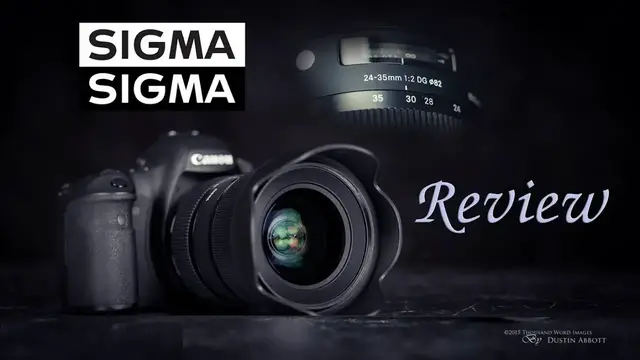
Sigma 24-35mm f/2 DG HSM Art Lens Review
Jul 17, 2023

Photographer/Reviewer Dustin Abbott shares a thorough examination of Sigma's newest lens - the 24-35mm f/2 Art series. This is a unique lens - an f/2 constant aperture zoom lens for full frame bodies. Watch for Dustin's conclusions.
Buy the lens here: http://bhpho.to/1hHMTk4
Read Dustin's review at dustinabbott.net: http://bit.ly/1FcmAb4
Want to support this channel? Use these affiliate links to shop at:
B&H Photo: http://bhpho.to/1TA0Xge
Amazon: https://www.amazon.com/shop/dustinabbott
Ebay: http://bit.ly/DustineBay
Make a donation via Paypal: paypal.me/dustinTWI
Get a discount off all Skylum Editing Software (Luminar, Aurora HDR, AirMagic) by using code DUSTINHDR at checkout: http://bit.ly/LuminarDLA
Become a Patron: https://www.patreon.com/dustinabbott | Check me out on: Personal Website: http://dustinabbott.net/ | Sign up for my Newsletter: http://bit.ly/1RHvUNp | Instagram: http://bit.ly/DLAinsta | Google+: http://bit.ly/24PjMzv | Facebook: http://on.fb.me/1nuUUeH | Twitter: http://bit.ly/1RyYxIH | Flickr: http://bit.ly/1UcnC0B | 500px: http://bit.ly/1Sy2Ngu
My filming setup: Sony a7R III: B&H Photo: https://bhpho.to/2D6ibNO or Amazon: http://amzn.to/2CNxOvH | or | Sony a9 @ B&H Photo: https://bhpho.to/2HyWIyt or Amazon: https://amzn.to/2s1vYE0
Tamron 28-75mm F2.8 RXD @B&H Photo: https://bhpho.to/2FA00la or Amazon https://amzn.to/2G2kaEr
Lights: Rotolight AEOS @B&H Photo https://bhpho.to/2IK7mqV | Genaray Contender @B&H Photo: https://bhpho.to/33HbGNM | and Aputure AL-MW: https://bhpho.to/2N3MtZV
DISCLAIMER: This video and description contains affiliate links, which means that if you click on one of the product links, I’ll receive a small commission. As an Amazon Associate I earn from qualifying purchases.
Show More Show Less View Video Transcript
0:00
Hi, I'm Dustin Abbott and I'm here today to do a review of the newest Sigma lens
0:13
and that is the 24-35mm f2 from the Art Series lens. Not long ago, I did a review of the kind of equivalent lens by Sigma for crop sensor cameras
0:40
the 18-35mm f1.8 Art Series lens, and I noted in that review that I was looking forward to giving
0:46
this lens a spin. Now, this obviously continues to be another unique product for Sigma. It was kind
0:53
of the unspoken rule that any kind of zoom lens had a maximum aperture of f2.8, but Sigma has
1:01
proven that that doesn't have to be the case. That being said, however, this is a zoom lens
1:07
but probably only in what you might call one of the briefest examples of a zoom lens. It starts
1:12
at 24 millimeters and it ends at 35 millimeters. And so if you include both the extreme focal lengths
1:19
of that, it's only 12 millimeters of zoom. And so that means that many zoom lenses and f2.8
1:27
zooms, for example, like this Tamron here, they start at 24 millimeters and they go up to 70
1:32
millimeters. Sigma has something similar along with pretty much every major camera manufacturer
1:39
And so as a result, you're talking about a lens that, as you can see here, is actually a larger
1:46
and heavier lens, over 140 additional grams into the Sigma, and of course it has quite
1:53
a narrow zoom range by comparison. The upside, of course, is that this has something that other full-frame zooms don't, and that
2:00
is an aperture that is a full stop larger than f2.8, and that is f2, which means you
2:07
have a full stop of additional light that comes into this lens, and so that means that
2:12
it's more of a direct competitor in some ways with some of the existing prime lenses. Now that may
2:18
strike you as being a bit curious because Sigma has had a very successful 35 millimeter f1.4 from
2:25
the art series and just a few months back they released a 24 millimeter f1.4 lens and so in a
2:32
sense Sigma has created a direct competitor to those lenses how be it one in a single form factor
2:39
with a zoom and a slightly slower aperture of f2. One way of looking at this is that in one body
2:48
it is a 24 millimeter f2 prime lens, a 28 millimeter f2 prime lens, and a 35 millimeter f2
2:56
prime lens. And if you don't have any prime lenses in those focal lengths, then you have a very
3:03
capable lens as we're going to discover in here in just a moment. That being said, you also have
3:09
much, much smaller and lighter competitors, like, for example, this Canon 35 millimeter F2 lens
3:16
which as you can see, it is about half the overall length. It also weighs about a third
3:23
has a similar maximum aperture of F2. And at the same time, it also adds a very effective image
3:29
stabilizer. And so that's one way to look at it. And then of course, this lens is also going to
3:34
compete for some people with 24 to 70 millimeter f2.8 zooms. And of course now because it goes
3:41
fairly wide you also might be cross shopping against other wide angle lenses. For example like
3:47
this Tamron 15 to 30 millimeter f2.8 lens that also has a very effective image stabilizer
3:54
The reason why I bring all these things up before I jump into the actual review of this is
3:58
to know that I think that this lens faces a bit more of a challenge than the 18-35mm did
4:07
And that is because in crop sensor, which the other lens is a crop sensor specific lens
4:12
in crop sensor territory you have far fewer options and very few really premium lenses that are in a crop specific form factor And this lens of course as a full frame it competes with a whole great range of excellent lenses And so that is what I perceive
4:29
as the challenge. But leaving all that aside, what about this lens itself? Well, I'm happy to say that
4:36
this lens continues the tradition that's already been established with Sigma's art series of
4:41
providing some truly exceptional optics. This lens, in fact, is going to have a sharpness that
4:46
competes with any of the primes that it goes up against, and that sharpness is not just in the
4:51
center of the frame. It extends out to both the extreme corners of the frame and does an excellent
4:57
job there. It has a very, very excellent color rendition. It reminds me a lot of images I took
5:04
out of the Sigma 50mm f1.4 art, which is to say, great. It's got great contrast. It's completely
5:11
usable wide open without any kind of hesitation when it comes to sharpness. And so it's got a lot
5:17
going for it in the optical department. And as far as the blows against it optically, there really are
5:24
very few. It does vignette quite heavily. And I find that although there's not an existing profile
5:31
the lens is too new, I found that I had to use a fairly excessive amount of correction to fully
5:36
eliminate that vignetting and something like a plus 80 mark in Lightroom and plus I that vignetting
5:44
extends enough into the frame that I had to move the midpoint further further into the frame
5:49
and so that is one issue of course that will become much easier to correct once Lightroom
5:56
or Adobe Camera Raw or other similar pieces of software have a standard profile setup for the
6:02
lens. It does have a very minor bit of chromatic aberrations, mostly in the form of a bit of green
6:09
fringing that I noticed, but I only noticed that at wide apertures and furthermore then only
6:16
noticed it really when examining images at a pixel level. And so as far as field use goes
6:21
you're not going to find chromatic aberrations to be an issue. It actually also handles ghosting or
6:28
putting the sun into the frame quite well. It's got just, I noticed just a bit of a little bit of
6:34
ghosting and a few images, but overall contrast holds up. The lens does not veil. It behaves very
6:40
well. And one very nice thing it does when you put the sun into the frame and stop the lens down
6:46
somewhere around 11 is that it creates a really beautiful sunburst or sun star, which may not be
6:53
big deal to you but I find adds that extra bit of just that final touch to a lot of landscape
6:58
images that helps to set them apart. Speaking of landscape images, I wasn't really thinking so much
7:04
a landscape lens when I went into this review but as I begin to use the lens I discovered that it
7:10
really is a fantastic landscape option in a lot of ways. Number one here at the front you have an
7:16
82 millimeter front filter thread and so it can use traditional filters. Now I recognize that 82
7:22
millimeters is on the larger side but the reality is that a good number of lenses have trended in
7:28
that direction in recent years and as a result the cost of 82 millimeter filters has gone down
7:35
and their availability has gone up and so I consider that to be a plus for this lens
7:41
On top of that this lens has remarkably low distortion at 24 millimeters in fact when I
7:46
directly compared it with my Tamron which is amongst the better of the 24 to 70 millimeter
7:52
variants I found that there was noticeably less distortion on the wide end with this lens enough
7:59
so that I find that although I think that these this focal length is actually not quite as wide
8:05
as 24 millimeters it was noticeably less wide than what the Tamron was when I compared them
8:11
side by side as you can see in these images. But I think that because of the very low distortion
8:17
this lens leaves less to correct and thus you might end up with a little bit or as much if not
8:23
more usable image after correction. But as a result of that excellent performance when it comes to
8:31
distortion, this becomes a very appealing landscape lens. And it's not just that. The amazing resolution
8:36
means that if you stop down this lens a bit it is bitingly sharp And as a result it really matches the ongoing trend towards higher and higher resolution bodies and I think that you will find that this lens is able to
8:50
handle for example the resolution of the new Canon 5DSR or bodies that are like that that have
8:59
extremely high resolution. On top of that it also has really excellent color rendition and I found
9:06
that when I shot landscape images with them they just had that extra bit of pop that really sets
9:11
them apart and makes them beautiful. When it comes to the actual field use this is a beautiful lens
9:17
to use. The Art Series lens I've kind of glowed over them and all of the reviews when it comes to
9:22
their build. I think they have a really beautiful design to them. On top of that all of the kind of
9:28
cause or excuse me mechanical parts work really well. The zoom ring on this lens is very nicely
9:34
damped. And so as a result, it has a very precise and definite feel. That same is true for the
9:40
manual focus ring. And it does offer, of course, full-time manual override. The manual focus ring
9:48
is just a little bit less heavily damped. And I find it feels just a hair less precise
9:54
One thing that I will note about the build, and that is that something I don't quite understand
10:00
and that's why there is no attempt at any kind of weather sealing or moisture resistance with this
10:05
series of lenses. They're obviously manufactured and appealed to a lot of professional users
10:11
and there are a number of professionals or discerning amateurs that although weather sealing
10:17
is not a guarantee of anything, they like that bit of reassurance that if they're going to have to
10:22
shoot in slightly adverse conditions, they don't have to worry about their gear being messed up
10:27
But that's been true of all of Sigma's art series lenses to this point
10:33
Now, usually at some point in the review, I have to come to what to me has been Sigma's Achilles heel
10:39
And that is when it comes to autofocus consistency. I'm happy to report that I believe that this lens is a big step in the right direction
10:47
Unlike the 18 to 35 millimeter art, I had no problem in calibrating this lens
10:52
I did require a fair bit of calibration. I believe it was a minus 14 for me, know that this is body specific, minus 14 on the wide
11:01
end and a minus 12 on the telephoto end. That's a fair bit of correction, but that was a very consistently repeatable result
11:10
And of course, if you purchase the Sigma USB dock, it enables you to calibrate a lens even
11:16
further and really fine tune it to your body. And if you're going to use this lens or other Sigma lenses on a consistent and particularly
11:24
on a professional basis, I would recommend that purchase and investing the time to really get the
11:29
most out of your investment with those lenses. But I was also happy to find that overall my focus
11:35
consistency, my focus accuracy was quite good. There were some shots that were missed, of course
11:41
but I found that the misses were more within what I might call the acceptable zone, in which they're
11:46
not perfectly focused, but they're focused well enough that they would pass, they would work for
11:52
most applications and most clients would be happy with them. But other than a few misses like that
11:59
for the most part, my focus accuracy was quite good. That being said, it's still not up on the
12:04
level of like what this 35 millimeter F2i S is. It focuses amazingly accurately and I almost never
12:12
miss with it. So Sigma is not quite there, but I do believe with some time investment with the USB
12:17
doc, you could probably get this lens to where it would function very satisfactorily for you
12:23
And so I'm happy to see what I consider some progress in the right direction for that
12:29
One of the other kind of hangups in the field that I observed is that because this lens is
12:34
wide enough to perhaps compete with some of the wide angle options, I did a bit of work at night
12:41
to determine how the coma would be and how it would function shooting the night sky stars
12:47
And while the Koma performance isn't the worst I've seen by a long shot
12:52
it still isn't perfect. And my new favorite right now for shooting the night sky is actually this Tamron 15-30VC
12:59
And the big reason for that is because its Koma is so nicely controlled This 35 sigma one thing that it does do is that the star points are they not weird shaped in the sense of like UFO or a flying duck
13:18
like I sometimes see, but at the same time, they all tend to elongate a little bit to where it
13:24
almost looks like a longer exposure, you know, 35 to 45 seconds where the stars have started to move
13:31
and are beginning a star trail look. And that's what I kind of see
13:35
In fact, I actually double-checked a few of my exposures to make sure that they were within the kind of acceptable range
13:41
Usually the best range is 25 seconds or less exposure to prevent any kind of movement of the stars
13:47
And most of my exposures were between 13 seconds and 20 seconds
13:52
And so that shouldn't have been an issue, but it's not the fact of the exposure length
13:58
but rather it's kind of a tendency of this lens when stars are in the frame that they tend to just
14:04
extend a little bit. That being said, I took some images that I thought were quite beautiful in that
14:09
setting. And so if you buy this lens, I wouldn't hesitate to use it in those kinds of settings
14:14
Just know that it's perhaps not the top choice. And if you're looking specifically for
14:19
an astrophotography lens, I would recommend that you look elsewhere. In conclusion, there's a lot to love about this lens. The image quality really is exceptional
14:30
It does a beautiful job and I found that to be very consistent across its focal range
14:35
That focal range is narrow, of course, but Sigma has done a great job of calibrating and creating a
14:41
very consistent excellence when it comes to the optical performance. I really like the look of
14:46
the images that came out of this lens and I found that they lended themselves well to processing
14:51
they looked great. Of course the downside is the fact that this is a fairly big and fairly heavy
14:57
lens that has a quite limited focal range and so as a result I wouldn't consider it a great pick for
15:04
travel for example and even though this is a fairly right within kind of the sweet spot for
15:10
street photography it probably isn't going to be the best option for that simply because the lens
15:14
is a little too big and a little too heavy and a little too noticeable. It's not going to be
15:19
discreet if you're into street photography. And so I think that many of you are going to have to
15:24
weigh whether the advantages of this lens, and there certainly are some advantages, outweigh the
15:29
benefits of shooting with a smaller prime lens and kind of zooming with your feet. Of course
15:35
one area that this does come in is if you're a shooter that's working within, say, a limited space
15:42
you shoot in interiors or low light, or you shoot in a studio and you only have so much room to
15:48
step back. A lens like this and that ability to go back to 24 millimeters is certainly very
15:54
advantageous, particularly when you consider that the distortion is quite low on the lens
15:59
And so for some of you that are in that kind of situation, this would be a gorgeous lens to pair
16:04
with a telephoto option to kind of mix things up. And I like having a lens somewhat like this
16:10
to mix things up when I'm shooting portraits just to provide a kind of more of an environmental look
16:17
that gives you a kind of a different appearance than just always doing closer shots with a
16:23
telephoto. And so there's a lot to love about Sigma's newest lens, as long as its basic existence
16:30
being only a very limited zoom range and not quite as fast an aperture as equivalent prime lenses
16:37
If all of those things work okay for you, then I don't think you'll be disappointed at all with
16:42
the lens itself. Its street price is right around $1,000 US. And so while it's not cheap
16:50
when you consider that a lot of the primes that it might compete with or zoom lenses it might
16:55
compete with cost considerably more, and none of them are optically better, then it becomes a pretty
17:01
decent value proposition. And it really kind of falls right within the window that Sigma has
17:06
established for its Art Series lens and their prices. Thanks for watching. I'm Dustin Abbott
17:12
And if you haven't already, please subscribe. A lot of great new reviews and other videos will be coming your way shortly
17:18
Have a great day