0:00
Hi I'm Dustin Abbott and I'm here today to give you the quick review of the new Sigma
0:09
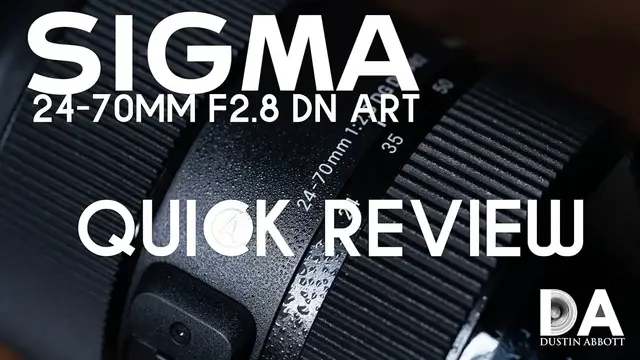
24-70mm f2.8 DN meaning this is designed for mirrorless and it's from their art series. This
0:16
lens is specifically purposely designed for Sony FE where I'm reviewing it also for Leica L
0:23
available there as well. Now if you want to see all of the nitty-gritty the details about the
0:29
performance and the build and the design of the lens, I recommend that you take a look at the
0:32
thorough review, particularly if you're interested in purchasing this lens, it will give you a lot
0:36
more information to help you to make an educated decision. If you just want the overview, however
0:41
this is the review for you today in the quick review. So of this, of course, is a very welcome
0:46
addition to the 14 to 24 millimeter f2.8 art that they've already released, a wide angle
0:53
This gives us the standard zoom, you know, with a wide aperture of f2.8. And the hope is, of course
0:58
that they're going to follow this up with some kind of 70 to 200 variant to give us kind of the
1:03
trinity or trilogy of wide aperture zoom lenses that are kind of the bread and butter for those
1:09
that do either professional work, you know, weddings, events, portrait type work, and also
1:15
those that are looking for just a higher grade of performance even for their, you know, amateur type
1:21
work. And so obviously very welcome and a welcome counterpart to the twice as expensive Sony 24 to
1:28
70 millimeter G Master lens. And when I say twice as expensive, that's literally true. This lens
1:33
comes in to the market at $1,099. That compares to $2,199 for the Sony FE version. And so it is
1:43
half as much and offers almost all of what the GM lens does. When it comes to the build, we have
1:50
a very robust build and design here. It is fractionally longer than what the Sony EF
1:57
equivalent lens was, but it is somewhat lighter, a couple hundred grams lighter. And fortunately
2:03
here it about 50 or 60 grams lighter than the G Master It also is a little bit shorter than the G Master lens 6 or 7 millimeters And so while you not having a huge size savings here
2:14
it is a little bit smaller and a little bit lighter. And that's obviously a helpful thing
2:19
At the same time, it does come with a thorough amount of weather sealing
2:23
gasket at the lens mount, a coating on the front element to help to resist dust and moisture
2:28
It also has about eight different seal points along the various rings, along the switches, and throughout the design
2:39
And so you get a professional grade of build, and it feels pro-grade. It feels definitely a step up from, say, the Tamron 28 to 75 millimeter
2:47
It also has a little bit more in terms of feature set. We have got an AF-MF switch
2:52
We have got the focus hold button. And so far, the two Sigma zooms are the only lens that I've seen outside of also a prime lens that they've released to have the focus hold button, which previously had been just something that I'd seen on Sony branded lenses
3:08
There is also a zoom lock here that while the lens doesn't exhibit zoom creep, you know, in terms of the just, you know, natural forces of it
3:20
I have found, of course, when you're out hiking and maybe you're brushing on that zoom ring that the zoom lock is something that is useful to have
3:28
When it comes to the actual zoom ring here, it works fairly smoothly, a little bit heavy on the damping side, but it works fairly well
3:37
I do find that with a wider lens like this, it terminates in an 82mm front filter thread, so it is wider
3:43
When it's mounted on the camera body, you don't have a lot of room between your knuckles and the actual lens itself
3:50
So, you know, that's kind of one negative I can point to there. The focus spring, it is focused by wire, but it works quite well
3:58
In terms of the autofocus performance, I found autofocus performance to be very good
4:02
and so it focuses quickly, it focuses quietly, and it focuses accurately, particularly when you're using
4:08
things like IAF, either for humans or pets. I got a perfect performance not one missed shot over the course of my review The only focus liability that I ran into is that when trying to shoot up close I found that a lot of times the lens was
4:23
just reluctant to focus closely. And so that is, you know, kind of the area that sometimes
4:29
separates on Sony. I found the best lenses from the lenses that maybe need a firmware update
4:35
and it's in that really close focus capability. And so there were some areas where I just found
4:40
the lens balky to focus where I wanted it to. The Tamron 28-75 was similar when it came out
4:46
There was a firmware update that came that fixed that problem. I see no reason why Sigma couldn't
4:50
do the same here. But overall, my autofocus performance was good. It focused well also
4:56
in low light situations and even in near dark conditions, it locked on quite quickly and
5:02
accurately. And so, you know, definitely more good than bad when it came to that
5:07
When it comes to the image quality performance, image quality is actually really strong
5:12
There is some pronounced barrel distortion at 24 millimeters, and then there are more
5:16
mild levels of pin cushion distortion throughout the rest of the range. There is definitely some vignette that persists throughout the zoom range, so you'll just
5:24
have to watch out for that. Fortunately, it will be corrected in camera for either JPEGs or video
5:30
There's not yet a profile in at least the Dolby products that I use for software for correction
5:36
I'm sure that that will come down the road. Beyond that, it has very, very good performance
5:43
I found when comparing it to the Tamron, which is very popular, that the Tamron had similar levels of performance in the center of the frame
5:51
The Sigma sometimes had a little bit of an edge out at the corner, the periphery of the frame
5:57
At 50 millimeters was the place where the Tamron was strongest versus the Sigma
6:02
The Sigma was stronger at 70 versus 75 millimeters, and that was actually the most noticeable difference
6:09
between the two lenses. The Sigma offered the better performance there. I was consistently impressed with the amount of detail
6:15
I got in images across the frame. Contrast was good. Color performance was good as well
6:20
This is a very strong lens optically The biggest drawback that I found is that it is somewhat flare prone and particularly when panning across the sun there definitely a lot of ghosting artifacts that came through there
6:32
and so that is something that you might want to watch out for. It is the one kind of serious
6:37
liability that I saw with the lens. I view two ways of looking at this lens. Those of you that
6:43
are looking for small and light and don't mind that the Tamron is 28 instead of 24 millimeters
6:49
the Tamron might be a better choice for you because if you're working off of a gimbal
6:53
or your weight matters in your situation, it is several hundred grams heavier and you might
7:00
notice that. It is also much bulkier when it comes to fitting into storage for the simple case that
7:06
it is a wider lens in diameter and the lens hood itself is also considerably wider. And so at the
7:12
end of the day, it's a fairly big footprint right there. But if size is not so much of an issue
7:18
the fact that it does go to 24 millimeters, I would prefer the four extra millimeters on the
7:24
wide end than I do the five millimeters on the long end. And in some situations, you can always
7:30
crop in to get closer. You don't always have the option of stepping back further. And so it is very
7:35
valuable when it comes to that. The second way to look at this, if you're considering a 24 to 70
7:41
millimeter and you're comparing the Sigma to the GM lens, the GM lens, which I have reviewed
7:46
has very few advantages that I can perceive compared to the Sigma, and it's hard to justify
7:52
spending twice as much for it. And so I think Sigma has done a good job of positioning this
7:56
lens where it needs to be to where it is going to be attractive to people when it comes to the
8:02
price to performance ratio. I'm Dustin Abbott, and if you'll look in the description down below
8:07
there is linkage to a full text review if you want to go get more information. Linkage also to
8:11
my image gallery if you want to look at some photos. Beyond that, there is also linkage there
8:16
to follow me on social media, to become a patron, or to sign up for my newsletter. And if you haven't
8:20
already, please click that subscribe button right here on YouTube. Thanks for watching. Have a great day