Up next in 10

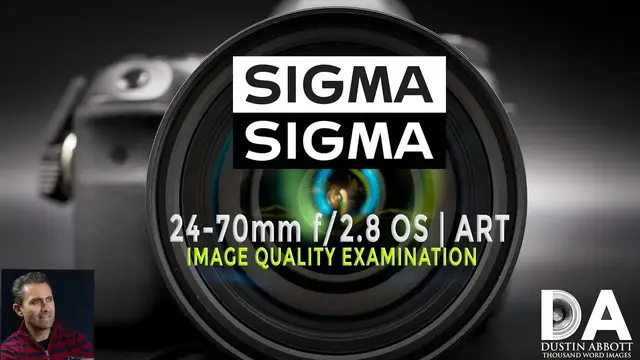
Sigma 24-70mm f/2.8 OS ART | Image Quality Examination | 4K
Jul 25, 2023

Sigma 24-70mm f/2.8 OS ART | Hands On First Look | Photographer Dustin Abbott takes a detailed look at all the different aspects of the image quality from the new Sigma 24-70mm f/2.8 DG OS HSM ART lens. To see more photos, click here: http://bit.ly/2470ARTig
Purchase the Sigma 24-70 ART: https://bhpho.to/2vi7aEV | Amazon: http://amzn.to/2foreSb | Amazon.ca: http://amzn.to/2fndGXk
Want to support this channel? Use these affiliate links to shop at:
B&H Photo: http://bhpho.to/1TA0Xge
Amazon: https://www.amazon.com/shop/dustinabbott
Ebay: http://bit.ly/DustineBay
Make a donation via Paypal: paypal.me/dustinTWI
Get a discount off all Skylum Editing Software (Luminar, Aurora HDR, AirMagic) by using code DUSTINHDR at checkout: http://bit.ly/LuminarDLA
Become a Patron: https://www.patreon.com/dustinabbott | Check me out on: Personal Website: http://dustinabbott.net/ | Sign up for my Newsletter: http://bit.ly/1RHvUNp | Instagram: http://bit.ly/DLAinsta | Google+: http://bit.ly/24PjMzv | Facebook: http://on.fb.me/1nuUUeH | Twitter: http://bit.ly/1RyYxIH | Flickr: http://bit.ly/1UcnC0B | 500px: http://bit.ly/1Sy2Ngu
My filming setup: Sony a7R III: B&H Photo: https://bhpho.to/2D6ibNO or Amazon: http://amzn.to/2CNxOvH | or | Sony a9 @ B&H Photo: https://bhpho.to/2HyWIyt or Amazon: https://amzn.to/2s1vYE0
Tamron 28-75mm F2.8 RXD @B&H Photo: https://bhpho.to/2FA00la or Amazon https://amzn.to/2G2kaEr
Lights: Rotolight AEOS @B&H Photo https://bhpho.to/2IK7mqV | Genaray Contender @B&H Photo: https://bhpho.to/33HbGNM | and Aputure AL-MW: https://bhpho.to/2N3MtZV
DISCLAIMER: This video and description contains affiliate links, which means that if you click on one of the product links, I’ll receive a small commission. As an Amazon Associate I earn from qualifying purchases.
Show More Show Less View Video Transcript
0:00
Hi, I'm Dustin Abbott and I'm here to take a closer look at the new Sigma 24 to 70 millimeter F2.8, DGOS, HSM, and this is from their art series
0:17
Now I can tell from my first look episode that a lot of you are really interested in this lens, which of course is completely what I anticipated
0:25
Sigma's new art series lenses really come with a lot of expectation from people
0:29
because of strong optical performance from them. It usually what comes down to as a very competitive price compared to alternatives
0:39
Today we're going to jump in and we're going to take a closer look at the image quality, the resolution from the lens, but also some of those other metrics
0:46
You know how its color rendering is, how its boca quality is
0:50
We'll take a look even at some things like distortion, flare resistance
0:55
all of the different metrics that are a part of lens performance on the optical level
0:59
And so we're going to jump in and take a look together at some real-world images along with some controlled test here
1:06
Okay, we'll start by taking a look just at sharpness. We're going to look at 24mm, 35 millimeter, 50 millimeter, and 70 millimeter
1:15
And so here at F2.8, wide open, 24 millimeters, we see that our center sharpness is pretty good here
1:23
Textures look fairly crisp and I don't really see a lot of like softness of haze
1:30
Contrast is quite good. As we move out towards the edge of the frame, however, you can see at wide open apertures
1:36
the image quality is degrading quite a bit, and we are much softer in the corners
1:42
compared to the center of the frame here, and particularly here you can see
1:48
And I would say kind of looking at this too, that you can also see some of the barrel distortion pattern there
1:54
and also along the top curve here. But, you know, it's not absolutely
1:59
terrible either look at this line here and it's it's still fairly straight
2:04
one other thing that you can see as a part of this there might be a little bit
2:08
of kind of field curvature or playing a focus and so that may account for
2:14
some of these softness towards the edges if we stop down to F4 so I'll just kind of
2:19
scroll back and forth there you can see that there is a bit of vignette that
2:24
clears up and so look down here F2.8 and then at F4
2:29
You could see that brightening up. In the center, you know, it's maybe a little bit crisper, but roughly the same
2:37
The improvement is really starting to stretch out towards the edges of the frame
2:42
And while it's still not, you know, razor sharp here on the edges
2:45
it's a little bit of less of that, you know, softness, haze that is there
2:50
Stopping on down to F5.6, you can see a, again, this is F4, F5.6
2:57
There's a little bit more vignette lift there. And so now we see center of the frame looks really good
3:04
And as we move out towards the edges, the edges, if not as sharp as the center
3:10
they are reasonably close. And so here is probably approaching at least with a 5D mark four body
3:20
We basically reach as good as we're going to get before the diffraction starts to become a factor
3:24
But let's step on down to F8. I'm going to scroll back and forth, and you'll see there is just a minuscule amount of vignette that is still lifted there from F5.6 to F8
3:36
So here at F8, in the center and across the frame, everything looks pretty good here, I would say
3:44
And so somewhere at F5.6, F8, if you're wanting to shoot landscapes, this is probably your optimal apertures here for that
3:54
here's F11 and at F11 I wouldn't say that you're getting necessarily any more sharpness and now a diffraction is maybe causing just a tiny tiny bit of softness haze back into the equation and so I would say F8 is your best bet now if we move to 35 millimeters F2.8 we're going to find once again that our center sharpness is still
4:23
pretty good and looking out towards the edge. It seems like the edge, you know, is not as sharp
4:31
but it's also, it's certainly not as soft as what F2.8 at 24 millimeters was. So if we look over here at
4:39
the difference between this is 24 millimeters this is 35 millimeters you can see that there is a pretty market improvement in you know edge to edge sharpness at 35 millimeters compared to 24 Now look here like along the edges going from F2 to F4
4:58
You can see that there is a little bit of a vignette lift, but here at 35 millimeters, the vignette is less pronounced anyway
5:05
And so at F4, our edges are now looking quite good. The center looks excellent, of course
5:13
I really like the look right here and out towards this edge also looks good
5:18
Moving to F5.6, I do see, I'm going to toggle back and forth here
5:23
an extremely minute difference in terms of vignette. So vignette at 35 millimeters is really not much of a factor at any aperture
5:32
Certainly not enough to impact you at field use. F5.6, we're seeing a nice crisp result from corner to corner
5:40
And we'll just go down to F8 here. And at F8, you know, it's, I think it's pretty much more the same
5:49
I don't know that I'm seeing more sharpness, but certainly our sharpness is right out to the very edge of the frame
5:54
And so a nice result there. Now, if we move to 50 millimeters here, we are going to take a look at our center once again
6:04
Center is very consistently looking good. And out towards the edge of the frame, you know, the edge is not looking too bad here at 50 millimeters
6:13
In fact, if I put them side by side here at 35 millimeters, which was an improvement over 24 millimeters
6:19
I would say that 50 millimeters is an even further improvement in terms of edge sharpness at wide open at F2.8
6:28
And so you can see there's just a little bit more detail in contrast at 50 millimeters than there was at 35 millimeters
6:34
which of course was significantly better than it was at 24 millimeters
6:39
At 50 millimeters from F2.8 to F4, you see a tiny bit of brightening and then F5.6, just a tiny bit more
6:49
But once again, then yet, not a huge factor here at these focal links
6:55
At F4 here in the center, this is, I think, the best sharpness and contrast that I've seen from the lens
7:01
That's a great looking result there. And also right out towards the edges, you know, looking quite good here at F4
7:08
let's stop down to F5.6 and you can see just a little bit more contrast and resolution that came into those corners
7:17
However, the center remains pretty much equal. You see a little bit more improvement along the edge
7:23
And then F8 doesn't look like it's really making much of a difference
7:31
At 50 millimeters, I would say F4 to F5.6 is your top
7:37
F8 is about the same. no real improvement. So use that more for depth of field than you would for trying to add more
7:44
sharpness. Finally, at 70 millimeters, we can see looking into the center of the frame that our
7:51
center frame once again looks quite good and moving out to the edge. I would say we're a little
7:57
bit of a step back from 50 millimeters in terms of sharpness there, maybe a little bit closer to the 35
8:04
millimeter result and but I would say still better than the 24 millimeter result. Let's take a look
8:10
at vignette here. So if we move up to f4 you can see toggling back and forth. There's a pretty
8:16
significant difference and so unsurprisingly the 24 and 70 millimeter positions are the ones most
8:22
impacted by vignette. Moving up to f5.6 brightens things up a little bit but most of your improvement
8:29
is between f2.8 and f4. Back at f4 here in terms of our
8:34
sharpness. Center sharpness at F4 looks great, good contrast, and looking towards the edge of the
8:40
frame. We still have a bit of a softness towards the edge of the frame. You can just see, you know
8:45
details aren't quite as crisply rendered. There's a little bit of haze there. Stopping down to F5.6
8:53
and at F5.6, you know, still, it still isn't great towards the edges of the frame. And so
9:03
So in the center, things look fine. Finally, at F8 here. And at F8, our result is maybe a bit improved
9:12
but it never gets as crisp as it does at 50 millimeters, at any aperture here at 70 millers
9:19
A center sharpness is excellent, but, you know, a corner sharpness, not so great
9:25
Now, I want to just take a look at more of a landscape type image here. And so this is at F2.8. And we'll just take
9:33
quick look at the details I would say that you rendering plenty of detail there along frame And so right out to the very edge we see that that edge softness that we talked about a bit
9:46
This is at 32 millimeters here. And so not, you know, somewhere in between the improvement at 35 millimeters
9:53
and the weaker 24 millimeter performance out towards the edge. Stopping down to F4, you can see that, you know, VNET really wasn't a huge factor
10:03
change a whole lot. Detail all throughout this area is nice and crisp and now that corner is a
10:09
little bit better and this corner, you know, also looks fine. I would have no issues in using that
10:15
At 5.6, a little tiny uptick in corner brightness and maybe a little uptick here in terms of our
10:23
detail rendered, all of which is good. And now right out to the edge of that frame, that looks good
10:29
on this side also looks good. And finally at F8, no real change in terms of vignette
10:37
And in terms of our detail, we're looking at roughly the same, which, you know, frankly, this is quite good
10:44
And so I would have no issues in using this for a, for landscape purposes
10:49
You stop the lens down, and it does a great job. Now, even at what we perceive as the weakest, you know, in terms of edge performance, 24 millimeter
11:01
but then at 70 millimeters we saw a little bit softer towards the edges. But in terms of what you're going to most likely use this for
11:09
I would say that that is a beautiful amount of detail. But more importantly, I'm really impressed with the rendering from this lens
11:17
Boka quality is really nice and soft here. And here's another shot
11:24
And it shows you, you know, again, the same kind of nice detail
11:27
But look at this, let's look at this crop here. This is 70 millimeters F2.8
11:32
And, you know, fine detail is really actually nicely rendered there. And just the rendering as you go towards defocus, I'm quite impressed with
11:41
This is, I'm not often blown away by boca quality from Sigma art lenses, but this one I really do like
11:51
Now, some of you looking at this image in my gallery, a couple of you said I see some onion-type boca there
11:56
And certainly here, there's a little bit of it. evident, but it's certainly not strongly pronounced, and I've shot a lot of images like this
12:06
with a lot of different lenses, and this really is not, this is not worst case scenario at all to
12:12
me. And in fact, the quality of the boca is really, to me, quite pleasing in terms of the
12:18
highlights. Now, here's kind of stop down, just looking at detail and color rendition
12:24
and again, you know, stop down, just in real-world use, that looks
12:30
you know nice to me I have no I'm very happy to use that as like a traveled type lens
12:36
although it's on the heavier side but you know great color rendition here is a you
12:41
know shot this is around 70 millimeters and so here you can see some areas that
12:45
that trend a little bit towards busyness but overall the rendering there is
12:50
nice and soft and skin textures are certainly good enough and here got my
12:57
self-portrait in her sunglasses But you can see in the plane of focus here that, you know, the detail looks quite good
13:07
And look at the nice soft background and really good color rendition
13:12
And here's my wife getting a self-portrait taking a picture of me
13:16
Again, looking at the background, I find that all to be very pleasing in terms of the rendering
13:23
How about some food? Looking at these tacos, you know, this is kind of just looking at this as a travel lens, you know, general purpose
13:30
Again, it's a great looking image, and at this place, they had homemade ice cream sandwiches
13:37
and as you can see, it looks pretty yummy here in all of the details there
13:41
Here, once again, just kind of a more, just a defocus type look, and this is actually at F4
13:47
but we can see that, you know, everything is rendered nicely here
13:50
And in this image, you know, where there is certainly potential for chromatic aberrations
13:56
I'm not seeing a lot of them, and so C, A.4. is really handled quite well here, you know, just a tiny bit of fringing along these edges
14:05
but not enough to really negatively impact an image. Once again, Boca rendering even at this kind of, you know, not medium distance
14:14
but also not at, you know, near macro type focus distances. So there's nice detail there, but all of this in here that could trend towards, you know
14:22
really busy is it handled quite nicely And as you get a little bit closer here I can see that the the boca performance here is is really quite lovely this is actually APSC here I using it on an
14:35
adapter on a Sony a 6500 body and so as you can see a really nice result here's a look at the sunburst
14:43
which is fine from the image but you will also note that it does have a tendency to produce some
14:49
ghosting and you know a little bit of veiling here the veiling isn't bad but there definitely is a
14:56
ghosting pattern if you get the sun in the frame here's another example here and so you know up in
15:02
this this particular corner it's you know that's so okay there's a little bit of prismatic haze
15:07
but i'm more concerned you know kind of down in this area where you're getting some kind of ghosting
15:13
blobs and so i'm never really a fan of that and trying to clean that up in post back to some
15:19
positives here though. I'm really impressed by the color rendition out of this lens and the basic
15:25
rendering from it. I think that this is an unusually good sigma lens in terms of color rendition
15:34
And this is a straight out of camera image. And I think I raised some of the white levels a little
15:39
bit. And this is a blue hour shot. But I mean, I just really love that color rendition
15:44
And then here, just kind of a family type shot. But you can see, you know
15:49
Nice detail where you want, nice detail, and then a nice transition to defocus
15:56
And the color rendition is what it should be in this kind of shot
16:00
So as you can see, this is a somewhat atypical Sigma Art Series lenses
16:05
many of which have been known for having it very close to
16:09
if not class leading, resolution performance. And sometimes I find that that comes at a cost in some other areas
16:17
You know, maybe they're a little bit clinical in the rendering. with boca quality that is okay but not exceptional
16:22
or sometimes I find the colors to be a little bit flatter
16:26
maybe than what I would like, you know, things like that, not as much contrast as what I would like
16:32
But this is kind of the opposite of all of those things. I find actually that the color rendering is exceptional
16:40
and better I think than any of the 2470 options that I've used previously
16:45
I really like the contrast out of the box, and I find that the boca quality is
16:49
really quite pleasing for a lens like this, a zoom lens like this. I think that it does a great job
16:56
in these various metrics of rendering. It is a little bit flare prone, as you can see, but that's not
17:02
necessarily a typical there either. But of course, where it isn't necessarily exceptional
17:07
it is good, but not exceptional, and that is actually in the resolution. And it is quite strong at
17:13
the 35 and 50 millimeter points, but at 24 millimeters and at 70 millimeters
17:19
it's fine in the middle, but you know a little softer towards the edges of the frame
17:23
and really not exceptional at any aperture on the edges of the frame
17:28
And so it's a different kind of approach and I'll have to tell you that for me personally
17:34
I'm more drawn to this lens than I am of some of the supremely sharp Sigma art options
17:40
And because I find that the overall package, the actual images themselves
17:44
and that's what matters to me, the images themselves look good, Whether I process them or not, they come out of the camera looking really good
17:52
And the thing is that the lens is sharp enough. And I think for most applications, there's plenty of sharpness for most users
18:01
And so I personally applaud the approach that Sigma has taken with this lens myself
18:07
Now, stay posted because in my final review, my final verdict, I'm going to be delving into that a little bit more deeply
18:13
I'll also take a look at a few of the other things, you know, the optical stabilizer
18:18
their auto focus performance and maybe in the fall when I've got more time, I may try to throw
18:24
together and once the Tamron 24 to 70 G2 is actually released in a Canon mount, it's out in
18:29
Nikon but it's delayed in a Canon mount. Once that's actually out, I may try to put together
18:34
more of a head-to-head and maybe get a Canon 24 to 70F 2.8L Mark 2 in there just for another
18:42
variable and throw it all into the mix at that point. In the meantime, you can look down to
18:48
description down below and you can find linkage to my image gallery that I've
18:53
been contributing to along the way you can also of course become one of my
18:57
patrons or follow me on social media and thanks to those of you that have
19:01
become supporters and of course you haven't already please click that subscribe button thanks for watching have a great day