live_tv
Livestream Starting Soon
00
Hours
:
00
Minutes
:
00
Seconds
Up next in 10

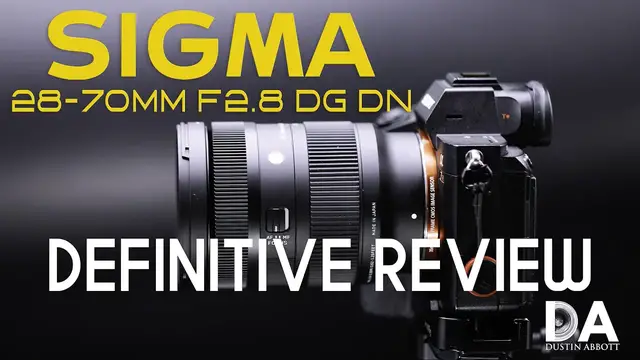
Sigma 28-70mm F2.8 DN Definitive Review | 4K
Jul 16, 2023

Build and Handling 03:26 | Autofocus Performance and Video 09:33 | Image Quality 12:25 | Summation 24:56 | This video is sponsored by Fantom Wallet. Visit https://fantomwallet.com/ and use code DUSTIN15 to get 15% off. | Photographer Dustin Abbott shares a thorough review of the new compact large aperture zoom - the Sigma 28-70mm F2.8 DN | Read the Text Review: http://bit.ly/Sig2870review | Visit the Image Gallery: https://bit.ly/Sig2470DNpics | Purchase the Sigma 28-70mm F2.8 DN @ B&H Photo https://bhpho.to/3bACS67 | Amazon https://amzn.to/3qMBfJ1 | Camera Canada | Amazon Canada https://amzn.to/3buwVaR | Amazon UK https://amzn.to/3kdVmNL | Amazon Germany https://amzn.to/3pPGk1E | Ebay http://bit.ly/Sig2870DN
Check out the DA Merch here: https://bit.ly/TWIMerch
Purchase the Sigma 65mm F2 DG DN @ B&H Photo https://bhpho.to/3qgR8rc | Amazon https://amzn.to/3mny5bu | Camera Canada https://shrsl.com/2olep | Amazon Canada https://amzn.to/2WqKwc8 | Amazon UK https://amzn.to/34oStCV | Amazon Germany https://amzn.to/3r67T8V | Ebay https://bit.ly/Sig65DN
Purchase the Sigma 35mm F2 DG DN @ B&H Photo https://bhpho.to/3qhLx3S | Amazon https://amzn.to/3ltA39P | Camera Canada https://shrsl.com/2nq7t | Amazon Canada https://amzn.to/3lt1two | Amazon UK https://amzn.to/2JC8oGE | Amazon Germany https://amzn.to/2JApwMB | Ebay https://bit.ly/Sig235DN
Purchase a Sony a7C @ B&H Photo https://bhpho.to/323jP0m | Amazon https://amzn.to/34MlE3z | Camera Canada https://shrsl.com/2l7yt | Amazon Canada https://amzn.to/3jGoN93 | Amazon UK https://amzn.to/2JoSnDL | Amazon Germany https://amzn.to/3mFxBy1 | Ebay http://bit.ly/Sonya7C
Purchase the Sony a73 at B&H Photo: https://bhpho.to/2HTcogD | Amazon: http://amzn.to/2GRoG7T | Amazon Canada: https://amzn.to/2KhSaON | Amazon UK: https://amzn.to/2I3NU4D | Ebay: http://bit.ly/a73DA | Amazon.de: https://amzn.to/2Hk7fwq
Sony a9 Camera @ B&H Photo https://bhpho.to/2HyWIyt | Amazon https://amzn.to/2B4NAjh | Camera Canada https://shrsl.com/2ikpx | Amazon Canada https://amzn.to/2peQkbn | Amazon UK https://amzn.to/2M7XPcY | Amazon Germany https://amzn.to/2VHbDOP | Ebay http://bit.ly/Sonyalpha9
Purchase the Sony a7RIV @ B&H Photo https://bhpho.to/2nUgnno | Amazon https://amzn.to/2oGpVD1 | Camera Canada https://shrsl.com/2imqe | Amazon Canada https://amzn.to/2mY8UDW | Amazon UK https://amzn.to/2n9GWF3 | Amazon Germany https://amzn.to/2nXhene | Ebay http://bit.ly/a7RIVda
Want to support this channel? Use these affiliate links to shop at:
B&H Photo: http://bhpho.to/1TA0Xge
Camera Canada: http://bit.ly/DLACameraCan
Ebay: http://bit.ly/DustineBay
Show More Show Less View Video Transcript
0:00
Hi, I'm Dustin Abbott and I'm here today to give you my definitive review of the brand new
0:16
just announced Sigma 28 to 70 millimeter f2.8 DG DN lens. Now this lens is going to be coming in both
0:25
a Sony FE or full-frame E mount, which I'm reviewing here, and then also in a Leica L
0:31
mount. This lens, of course, is a little bit of a surprise to me in that it certainly doesn't seem
0:38
to be a lens of the greatest need, perhaps. And when I look at the lineup, and of course, Sigma
0:44
has been incredibly prolific over the last about two years, and in less than that period of time
0:49
really, they have released 12 brand new designs for Sony E and or Sony FE and then Leica L. And so
0:58
during that timeframe, I don't think that anyone has produced more lenses for them than them for
1:03
this platform. But out of, you know, that growing catalog of lenses, there still are some pretty
1:08
significant holes, I think that many of us would point out. I think that a lot of you are very
1:12
interested in a 50 millimeter F1.4 DN, you know, in the same vein as the 85 millimeter F1.4 we saw
1:19
last year. And I think above all, people are looking for the 70 to 200 millimeter F2.8 DN lens
1:28
which, you know, already we've gotten the 14 to 24 millimeter, we've gotten the 24 to 70 millimeter
1:33
And so it seems like that is the logical completion of the full frame Trinity zoom F2.8 zooms that are
1:41
used by a lot of different professionals. But instead we got a second lens, you know, covering
1:47
the same focal length and so this only goes to 28 millimeters rather than 24 millimeters
1:52
and you know it is cheaper not hugely cheaper as we're going to see and it certainly is much
2:00
more compact and I think maybe that's more where maybe the logic lies in many ways this I think is
2:06
going to be Sigma's more direct answer to the extraordinarily popular Tamron 28 to 75 millimeter
2:12
f2.8 rxd a lens that to this point has been the best-selling lens in the world since its release
2:19
so understandably sigma probably wants a piece of that action and so they have you know kind of
2:25
followed that same philosophy and have made a smaller yet standard zoom which again is where
2:31
i think the greatest asset is there now today we're going to be doing our definitive review
2:35
where we jump into everything in great detail if you want a quicker overview type review check out
2:40
my standard review instead. Today's episode is brought to you by Phantom Wallet, the minimalist
2:47
modern wallet that sets you free from the bulky traditional wallet while also making it easy to
2:52
access your cards and money when you need them, thanks to their unique fanning mechanism. Visit
2:58
phantomwallet.com to check out their unique sizes, styles, and finishes that span from aluminum to
3:05
wood to carbon fiber. You can even customize your wallet with new accessories like a money clip
3:11
cash holder, ID display, and even the Chipolo tracking integration if you're the kind of person
3:18
who loses their wallet. Use code DUSTIN15 for 15% off when you're ready to check out
3:26
So we're going to start by taking a look at the build and the handling, the design of this lens
3:31
and look at what's here, what's not here. Let's jump in and let's take a close look
3:35
So the first thing that stands out, I would say, is how compact this lens is
3:39
And so if you compare it to the Tamron 28-75, which the Tamron is going to be its most logical competitor
3:46
you can see that it is significantly shorter in overall length compared to the Tamron
3:51
The Sigma comes in at 103.5 millimeters, right over 4 inches, whereas the Tamron is 117.8 millimeters 4.64 inches and so it is about 14 millimeters longer
4:05
which obviously is significant so depending on your carrying solution it might actually be a
4:09
difference maker for you you know it might be that this lens attached to your camera fits into a
4:15
small carrying solution whereas the Tamron does not but obviously in many ways I think one of the
4:20
the strongest aspects of this design from Sigma is how compact it is. Now, the diameter is pretty
4:26
much identical, 72.3 millimeters for the Sigma, 73 millimeters for the Tamron. And so, you know
4:33
you're talking less than a millimeter difference. Both of them have a 67 millimeter front filter
4:37
thread, but the shorter length of the Sigma does result in a lighter overall weight. It weighs in
4:43
at 470 grams versus 550 grams for the Tamron. And so, you know, while both of them are lightweight
4:51
for a standard f2.8 zoom, obviously the Sigma is lighter still. That's really significant in
4:58
terms of weight when you compare it to the Sigma 24 to 70 f2.8, which weighs in at 835 grams. And
5:06
so it's a good, I think it's around 73% heavier than what this lens is. And so again, if small
5:11
and light is your priority. This lens is going to fit the bill very well. Now, when it comes to the
5:18
build, I'll say this, the Sigma actually feels a little bit better in hand in terms of, you know
5:23
as far as the feel of the build quality, as you can see, the ribbing on the rings is a little bit
5:28
deeper. I like the feel of the texture of the material a little bit better, but compared to the
5:34
24 to 70 Sigma and to the Tamron, you're missing a more complete weather sealing. What you have is
5:40
just a thin gasket here at the lens mount, but no other internal seals. Whereas the Tamron has
5:46
about six internal seals and a flooring coating up front. The Sigma does come with the lens hood
5:52
And I do prefer Sigma's lens hood say to this Tamron. The Tamron is just a really fairly basic
5:57
piece of plastic. The Sigma here has some texture variation. And of course I do like that ribbed ring
6:03
that does help to give you a natural, you know, kind of texture point for mounting the actual
6:08
lens hood. Now, in this case, there is no locking mechanism on the hood. It's not needed. However
6:14
it bayonets on there really nice, tight, and precise. And so it actually takes quite a bit
6:19
of force to break it loose. So you're not going to have any problem with it inadvertently coming
6:23
loose on you. Compared to the 24 to 70, you are losing out on a few features. This has only an
6:30
AF-MF switch, you know, and it comes under the contemporary brand as opposed to the art brand
6:35
so it has a little bit less there so you're missing the focus hold button there is no
6:40
zoom lock button however i've seen no evidence of zoom creep at all here it's really nicely damped
6:48
and you know only extends about three centimeters so i don't think it'd be that big of a deal
6:51
anyway but the compact nature of the lens and the fact that the zoom ring is back here means that
6:57
it's unlikely you're going to be inadvertently bumping it anyway if you're carrying it like on
7:01
strap and so I don't think you'll actually have a real world problem with it so I don't think that
7:06
that was actually needed as noted the overall zoom action here is really nice and smooth like that a lot likewise the manual focus action is good I think Sigma doing a good job of focus emulation recently with these lenses
7:22
I say emulation because it is focused by wire. There's no direct coupling, and so all the focus is actually done by the motor inside
7:29
There are nine rounded aperture blades, and that's a little bit lower blade count than
7:35
what you see on the 24-70, which has 11 blades. However, it does do a nice job of keeping a circular aperture shape
7:42
as you can see here, even when the lens is stopped down. Now, like the Tamron, this lens sports two different minimum focus distances
7:49
and thus two different magnification values. And so at 28 millimeters, you can focus as closely as 0.19 centimeters
7:58
or meters, I should say, so 19 centimeters. So as you can see, you're probably going to want to remove the lens hood
8:03
if you're trying to get that close. you have to get really, really close to your subject to achieve that. And so, you know
8:10
just as you can see here, it's not always all that practical and you will get a 0.30 times
8:16
magnification there, you know, if you can access that. Then at 70 millimeters, minimum focus
8:21
distance is 38 centimeters. And that's shared with the Tamron, but the Tamron does have an
8:27
extra five millimeters of focal length. And so it gives you a little bit higher 0.25 times
8:32
magnification there. I estimate the Sigma's performance at more like 0.22 or 0.23 times
8:40
somewhere in that range. At the end of the day, I think the biggest advantage of this particular
8:44
lens is the compact size. I mean, you were talking about a full frame standard zoom that pretty much
8:51
fits in your hand. And so I think that's going to be one of the great selling features for those of
8:55
you that want to travel small and light, but still want the flexibility of a standard zoom
9:00
So I think, again, the big takeaway here is that they've really exceeded in making a nicely compact lens
9:07
There's some things that are missing versus the 24 to 70 millimeter. And I think the most notable thing that's missing is going as wide as 24 millimeters, but a few features that we don't see there
9:18
And it is a little bit of a disadvantage compared to the Tamron in that while the perceptive build feels a little bit nicer
9:25
it doesn't have as many professional grade features, most notably when it comes to the weather sealing
9:30
So that's probably the greatest disadvantage. Now, when it comes to the autofocus performance
9:36
Sigma has employed an STM or a stepping focus motor here. And I would say pretty much universally
9:43
Sigma's stepping motors have been very, very good on Sony where I've tested them
9:48
I don't shoot Leica. And so I've tested them on Sony and they have been, you know, roundly excellent
9:53
That's true here as well. We've got a very fast focusing speed
9:58
We've got a very quiet, focusing performance, and in my experience, it has been very accurate
10:06
I had only one situation to where it basically, you know, that kind of stood out to me, where
10:11
it really refused to focus on a closer focused subject, as you can see here, and so I, you
10:16
know, stayed stuck on the background despite my best efforts, and eventually I, you know
10:21
manually focused it to where I wanted to get to get this shot here, but, you know, fortunately
10:26
that was the exception rather than the rule. These days, you hardly need to talk, at least on Sony and Canon, hardly need to talk about
10:34
IAF accuracy because it's pretty much flawless in my experience these days
10:40
There's very few misses, and that was true here. Whether it was a human or an animal subject, I got consistently good tracking of the eye
10:48
and good IAF performance. Likewise, the lens worked fine for me when I shot a devotion episode for my church using
10:57
the lens. It stayed locked on my face, didn't hunt around, and it did a good job as a part of that
11:04
It also, as you're going to see here, is able to do quick, accurate, smooth focus pulls as well
11:11
Let's take a quick look at that. So as you can see, you know, nothing to complain about at all there
11:27
and that's been my experience recently. Sigma's doing a really good job with the focus systems on
11:32
these lenses and of course that is a it's a great relief. I've had I never complain about
11:38
Sigma Focus anymore and it seemed like you know going back a little bit further back with their
11:43
DSLR lenses until kind of the last year or two of DSLR releases it seemed like I was always
11:50
complaining about some aspect of Sigma Focus. That's just no longer an issue anymore so kudos
11:55
to Sigma for really learning that lesson and nailing things on that front. Now there is no
12:01
image stabilization built into the lens itself. That's true of all of its competitors as well
12:07
so I'm certainly not going to dock it for that. You're going to be relying on your in-camera
12:10
image stabilization. My experience is it works just fine. You've got a relatively fast maximum
12:16
aperture and you've got that in-body image stabilization. It does the trick, and I doubt
12:21
that there's a lot that people will be missing on that front. So why don't we talk more specifically
12:27
about the image quality? And I will throw in some comparisons to the Tamron here because I think
12:32
that at the end of the day, that's going to be the two lenses that people are most weighing
12:36
in terms of comparison points. They're very similar in price. And so let's jump in and let's
12:41
take a look at the image quality together. So first of all, here is a look at this zoom range
12:47
So you can go from 28 millimeters to 70 millimeters, and that shows you the difference in your zoom as a part of that
12:55
So while this does have a little more abbreviated zoom range than some competing lenses, it still obviously is going to be very useful
13:02
So taking a look at vignette and distortion here, I'm going to cycle that off so you can see this for a moment
13:07
Well, you can see taking a look at the left, which is the 28-70mm, as you can see that there is unfortunately not completely linear barrel distortion
13:19
And so you can see there's a little bit of dip in here, it bulges out and then dips back, which does make it a little bit harder to correct
13:25
Now, comparing it to the 24-70mm, you can see that the amount of distortion, not only does it have that more complex kind of mustache pattern on the 24-70mm
13:34
but as you can see it's definitely much more pronounced so about a plus 24 if you try to
13:40
correct it here versus about a plus 12 or 13 on the left and so um you know certainly there's less
13:48
distortion at 28 millimeters versus 24 millimeters but it remains a somewhat complex pattern so that
13:54
complexity does make for a little bit more difficult manual correction and so you can see
13:59
after trying to correct that you don't end up with straight lines because of that you know it's
14:04
non-linear distortion pattern. Obviously, you're going to get a better result with a standard
14:07
profile, but for raw files, that doesn't exist yet. You will get it with JPEGs and video in camera
14:14
You can also note here that there is a significant amount of vignette in the corners. I had to use
14:20
a plus 95 and pull the midpoint all the way over to try to correct for it. You can see that it's
14:26
still not completely even And so you know we talking about somewhere between three and a half and four stops of vignette in the corners in particular which is obviously really heavy This is one area where the Tamron definitely wins in that you can
14:39
see that there is a lot less distortion. It's much more linear in fashion, so it's easier to correct
14:46
four, and there's significantly less vignette, about a stop and a half less vignette in the
14:51
corners. And so, you know, a better performance at 28 millimeters when it comes to these metrics
14:57
now at 70 millimeter ish sometimes it didn't quite get there but you can see that there is a
15:04
the ping the distortion has changed to a pin cushion type distortion fortunately this is a
15:10
nice linear distortion and so you can see i had no problem manually correcting for it vignette is
15:15
less heavy it's basically the equivalent of what the tamron is at 28 millimeters and so i would say
15:21
somewhere between two and two and a half stops and pretty easy to correct for so at 28 millimeters
15:27
wide open, obviously that vignette is heavy enough that it's going to be very noticeable either in the
15:32
sky or particularly in a lightly colored foreground like the snow. And so you can see that just
15:38
illuminating the vignette manually does pretty radically transform the look of the image. You
15:43
know, and so some cases you might have a rare occasion where this is desirable, probably not
15:47
many, but, you know, obviously you're going to want to correct for it in most cases to get a
15:54
even more even illumination in the frame. So as you can see here, taking a look at the chart at
15:59
28 millimeters, we can see that, you know, jumping in, we have got fairly good contrast and good
16:05
detail center of the frame. Mid-frame looks really strong. It's holding up very well. And down into
16:11
the corner, the result also looks quite good. Now, if we compare to the Tamron, we see that the Tamron
16:17
is producing a little bit more resolution and a little bit stronger contrast. And you can see
16:22
for example that the the moir pattern here is more defined which shows that you know it's resolving
16:28
a little stronger in the center of the frame they're not a there's not a significant difference
16:34
I think there's the contrast is starting to tilt towards Sigma's favor but if you pop down into
16:40
the corner the Sigma definitely looks stronger in the corner and that tends to be the pattern that
16:45
we see throughout the zoom range is that the Tamron has the advantage in the middle but the
16:49
further you move out on the periphery the more that the Sigma's advantage grows. Now at 28 millimeters
16:54
all it takes is a stop down to f4 for your contrast and detail levels to come up to excellent levels
17:01
and so as you can see we've got really strong performance there. Stopping on down to f5.6
17:07
continues to improve those contrast levels and allows the textures to show up even better as we
17:13
can see. If we compare the Sigma to the Tamron once again we find that both of them look excellent
17:18
in the center of the frame with the Tamron having a bit of a contrast advantage. In the mid frame both
17:24
of them continue to look excellent. I don't know that I would call either one a winner there
17:29
but down in the corner once again I do think that the Sigma retains an advantage even at f5.6
17:35
Now minimum aperture here is f22 and on a higher resolution body like the 42 megapixel a7r3
17:43
that I'm using for these tests I typically don't recommend shooting near minimum aperture and as
17:48
As you can see, it's softer and has less contrast at f22 than even at f2.8
17:54
And that's due to the diffraction that comes from the, you know, the higher resolution and the pixel density of the camera
18:01
Moving on to 35 millimeters, 35 and 50 millimeters are actually really, really similar in performance
18:07
And so you see a very good center of the frame performance that improves in terms of contrast at f4 pretty significantly in the center of the frame
18:17
we see a mid-frame performance that is good to start with and gets even better with a mild stop
18:23
down to f4. And down on the corner, the corners aren't quite as strong as at 28 millimeters
18:29
but we can see stopping down to f4 is enough to really start to improve things. Stopping on down
18:35
to f5.6 or f8 makes them stronger still. So arriving at the end of the focal range at 70
18:41
millimeters, the first thing I want to do is just give you a quick comparison to the
18:45
Tamron here just in terms of the framing and so you can see that the 75 millimeters of the Tamron
18:51
does frame significantly tighter and so you can see areas where the image is clipping off here
18:57
because of that additional five millimeters. So taking a look at resolution and contrast we see
19:02
at f2.8 in particular that things are a little bit softer and lower contrast at 70 millimeters
19:09
versus the other places in the range that we have seen. Stopping down to f4 in the center
19:15
does significantly improve contrast and allow more detail to be shown. Mid-frame is also weaker
19:21
but it does start to improve at f4, though not to the degree that we saw earlier
19:26
in the zoom range. And if we look down into the corner, we can see that the corners are significantly softer
19:32
than what they were at earlier points, even at f4. Stopping down to f5.6 improves things
19:38
though not to the level we saw even at f4 other parts in the zoom range you need to stop on down
19:44
to f8 to start to approach you know kind of maximum corner performance here and even then
19:50
it doesn't ever achieve quite the same level as what we saw earlier on in the zoom range though
19:55
at this point it is you know very competent now if we compare to the tamron once again 70 versus 75
20:02
millimeters the tamron continues to show a little bit better contrast and performance in the center
20:07
of the frame. However, even by the mid frame, there's an obvious advantage for sigma here
20:13
and that advantage continues on into the corners, though it's not as pronounced because the sigma
20:18
is weaker in the corners than what it is at other points, or at least at 70 millimeters
20:22
than it is at other points in the zoom range, as we've seen. With both lenses stopped down to
20:27
f5.6, we see that the mid frame still slightly favors sigma, though it's not as significant at
20:33
this point. And down in the corner, I think the same is true, though it's, you know, there's neither
20:39
one of them looks exceptional. There's some give and take, I would say, in both when it comes to
20:44
the corner performance. Now, both the Tamron and the Sigma, Tamron on the right, Sigma on the left
20:50
have, you know, very strong magnification levels at minimum focus at the wide end, 28 millimeters
20:56
But you can see that the Tamron has a significantly higher amount of magnification, a 0.34
21:03
versus 0.30 times you can also see that the Tamron definitely performs better up close with much
21:10
better contrast and thus detail rendering here up close. The same proves true at 70 versus 75
21:18
millimeters where the Tamron has a noticeably higher levels of magnification and as you can
21:23
see even at a global level it is rendering details with better contrast and you know just mostly
21:30
contrast is more significant. You can see as we zoom in to a pixel level that it's a significant
21:35
improvement with the Tamron over the Sigma here. So here's a real world 28 millimeter
21:41
you know, close to minimum focus. You can see that, you know, on the narrow plane of focus you know detail and contrast is pretty good not exceptional but I mean obviously that a very high degree of magnification And then at 70 millimeters this is a kind of a tough scene
21:57
these waxy leaves with bright window light on them. But in this particular one, contrast is only
22:02
okay at 70 millimeters under these circumstances. Here's another shot that shows how shallow a
22:09
depth of field you can get at 70 millimeters, but we can see looking in at a pixel level that the
22:14
The detail and the contrast is okay at best here, though the bokeh looks really, really smooth and
22:21
creamy. Now, a quick look at that bokeh, we can see that there is a little bit of fringing around
22:26
the bokeh circles, a little bit of just generalized busyness in there, but nothing like an onion
22:32
bokeh, anything that's really distracting. And then as we stop down here at F4, we can see geometry
22:39
starting to look really good. And then on at f5.6, you see a little bit of the aperture shape
22:44
but the general impression here is still nice and round. So the quality of the background blur
22:50
the bokeh and real world scenes, in many ways is going to depend upon the shooting situation
22:55
Here, fairly close to the subject, I think that the background looks quite nice. And here
23:01
I think it looks really nice. And so obviously, if you can get a ratio where the background is
23:05
further away. You can get close to your subject. You can produce really nice creamy bokeh
23:11
In this case, also, I think, good. There's a fair enough distance to the background where
23:16
everything is handled nicely. And a little bit further away like this, I think that contrast and
23:21
detail holds up a little bit better. In this situation, the ratio isn't as favorable, and you
23:27
can see that the background is closer. And in this case, I think it looks a little bit busier and more
23:32
distracting however this is not bad for a standard zoom I think in many situations they're okay but
23:39
they're not you know as exceptional as say an 85 millimeter f1.4 even if you're shooting at 70
23:45
millimeters obviously flare resistance is generally quite good you can see basically no
23:51
ghosting type artifacts you know marring the image even in bright early morning sun a little bit of
23:57
the localized kind of veiling effect at the epicenter of the sun stopped down
24:02
things still continue to look really good. Now, if I zoom in a bit, we can see that at F2.8
24:08
there's a little bit more of this kind of prismatic kind of veiling effect here, zoomed in
24:14
but as we stop down, the flare resistance, instead of getting worse, actually gets better
24:19
Here's a couple of more images, just kind of real-world images. And so this, you can see a little bit of that
24:24
kind of veiling effect here and prismatic coloring, but I don't think it's destructive to the image
24:30
And here, this looks really fantastic, kind of middle of the zoom range, and obviously it's
24:36
highly resistant to flare in this particular shot. We can see too, if we pan across the sun
24:41
wide open here, there's very little ghosting artifacts. Contrast holds up. And then if we
24:47
stop down, we see a similar truth with just a hint more of ghosting artifacts in a few positions
24:53
but overall really nicely done. So overall takeaways from that is that if you're, whether
25:00
the Tamron or the Sigma is the better performance, really is going to depend on what your shooting
25:04
priorities are. And throughout the range, I found fairly consistently that the Tamron was
25:10
a bit better in the center of the frame with the Sigma consistently better at the periphery of the
25:17
frame. And so if you're someone that values a corner sharpness, depending on how you're shooting
25:22
then the Sigma's performance is a little bit better. If you're someone who prioritizes
25:26
center performance, then the Tamron's performance is a little bit better. You know, there's give and
25:31
take across the board. Tamron does have a little bit less distortion, a little bit less vignette
25:36
but, you know, at the same time, you know, there's nothing out of hand here and certainly less on the
25:42
distortion front on the 28-70 than what we saw on the Sigma 24-70mm, which had really strong barrel
25:49
distortion at 24 millimeters. So at the end of the day, I think that we have got a good optical
25:55
performance here, which is, you know, more significant when you consider how compact the
26:00
lens is. This is a lens that is going to be fairly competitive with the Sony 24 to 70 millimeter F2.8
26:07
G Master lens, albeit at a much lower price point and much smaller form factor. And I think that
26:14
that for many people is going to be a great selling point for them and so whether or not
26:20
this lens is a worthy consideration over the 24 to 70 millimeter f2.8 dn if your budget is really
26:28
tight obviously you got some savings here but i would say the bigger reason to consider this lens
26:33
over the existing 24 to 70 is more if you are greatly concerned about size because the 24 to
26:41
70 millimeter is already a very competitively priced lens and in the u.s market it's only 200
26:46
more and that's giving you you know better build quality it's giving you the extra four millimeters
26:52
of width a few extra features you know so there's definitely you know 200 worth of additional
26:58
features there i would say but what really sets this lens apart is the fact that you've got a
27:03
very competent um you know standard zoom that is you know well under 500 grams in weight and
27:09
incredibly compact in terms of length. And so if you're shooting with one of the new, you know
27:14
compact bodies, like, you know, say a Sony a7C, this is a natural fit there. And of course
27:20
I think it also makes a lot of sense on the Leica front as well, if you're a Leica shooter
27:25
So at the end of the day, I do think that this is a good and a competent lens. I just will have to
27:31
see how the market bears out, whether this is a lens that the market was actually looking for
27:36
And maybe it is, and I certainly applaud Sigma for exploring with a lot of their recent lenses
27:41
a complimentary line that is smaller, compact, lighter compared to their larger art series type offerings
27:49
And so I think that they're learning that there are different photographers out there
27:53
and there's a couple of different markets within the overall market of photographers
27:58
and if they learn to tap into both of those, they've just broadened their success rate
28:03
And so kudos to Sigma on that front. I'm Dustin Abbott and if you'll take a look in the description down below you can find linkage to my
28:10
full text review also linkage to an image gallery so you can check out more photos
28:15
beyond that there are also buying links though again with a lens that is just just being announced
28:20
some of those links are going to take a little while to populate and where you can actually see
28:25
content and and purchase or pre-order the lens and I understand that it's going to start shipping
28:30
somewhere in mid-March. And so keep an eye out for that, obviously. You can also find Linkage
28:36
to follow me on social media to become a patron. Sign up for my newsletter that comes out every
28:40
Thursday. There's Linkage there to purchase my merch if you want to get some Let the Light in
28:46
gear. And beyond that, of course, if you haven't already, please click that subscribe button. Be
28:51
sure to click that notification bell so you'll be notified when new content drops. Thanks for
28:55
watching. Have a great day and let the light in
#Photographic & Digital Arts
#Audio Equipment
#Camera & Photo Equipment