live_tv
Livestream Starting Soon
00
Hours
:
00
Minutes
:
00
Seconds
Up next in 10

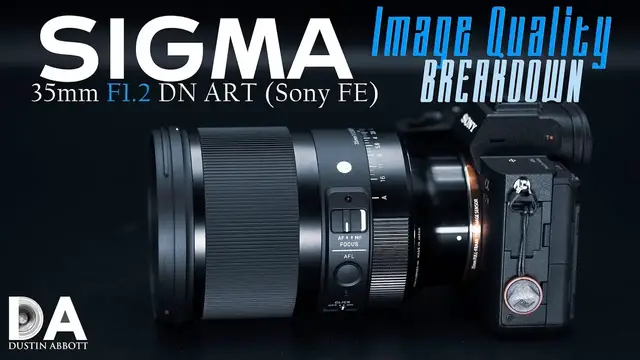
Sigma 35mm F1.2 DN ART: IQ Breakdown | 4K
Jul 24, 2023

Sigma 35mm F1.2 DN ART (Sony FE): IQ Breakdown | Photographer Dustin Abbott carefully examines the image quality from the new Sigma 35mm F1.2 DN ART lens for Sony FE (comparisons to Samyang AF 35mm F1.4 and Canon EF 35mm F1.4L II). This is the first autofocusing F1.2 lens on Sony. | Visit the image gallery: http://bit.ly/Sig35DNimage | Purchase the Sigma 35mm F1.2 DN ART @ B&H Photo https://bhpho.to/2VBzBLi | Amazon https://amzn.to/35tRnVl | Amazon Canada https://amzn.to/317UHSH | Amazon UK https://amzn.to/35xmbEW | Amazon Germany https://amzn.to/2VAbbC5 | Ebay http://bit.ly/Sig35DN
Sony a9 Camera @ B&H Photo https://bhpho.to/2HyWIyt | Amazon https://amzn.to/2B4NAjh | Amazon Canada https://amzn.to/2peQkbn | Amazon UK https://amzn.to/2M7XPcY | Amazon Germany https://amzn.to/2VHbDOP | Ebay http://bit.ly/Sonyalpha9
Purchase the Sony a7RIV @ B&H Photo https://bhpho.to/2nUgnno | Amazon https://amzn.to/2oGpVD1 | Amazon Canada https://amzn.to/2mY8UDW | Amazon UK https://amzn.to/2n9GWF3 | Amazon Germany https://amzn.to/2nXhene | Ebay http://bit.ly/a7RIVda
Want to support this channel? Use these affiliate links to shop at:
B&H Photo: http://bhpho.to/1TA0Xge
Ebay: http://bit.ly/DustineBay
Make a donation via Paypal: paypal.me/dustinTWI
Get a discount off all Skylum Editing Software (Luminar, Aurora HDR, AirMagic) by using code DUSTINHDR at checkout: http://bit.ly/LuminarDLA
Become a Patron: https://www.patreon.com/dustinabbott | Check me out on: Personal Website: http://dustinabbott.net/ | Sign up for my Newsletter: http://bit.ly/1RHvUNp | Instagram: http://bit.ly/DLAinsta | Google+: http://bit.ly/24PjMzv | Facebook: http://on.fb.me/1nuUUeH | Twitter: http://bit.ly/1RyYxIH | Flickr: http://bit.ly/1UcnC0B | 500px: http://bit.ly/1Sy2Ngu
My filming setup: Sony a7R III: B&H Photo: https://bhpho.to/2D6ibNO or Amazon: http://amzn.to/2CNxOvH | or | Sony a9 @ B&H Photo: https://bhpho.to/2HyWIyt or Amazon: https://amzn.to/2s1vYE0
Tamron 28-75mm F2.8 RXD @B&H Photo: https://bhpho.to/2FA00la or Amazon https://amzn.to/2G2kaEr
Lights: Rotolight AEOS @B&H Photo https://bhpho.to/2IK7mqV | Genaray Contender @B&H Photo: https://bhpho.to/33HbGNM | and Aputure AL-MW: https://bhpho.to/2N3MtZV
DISCLAIMER: This video and description contains affiliate links, which means that if you click on one of the product links, I’ll receive a small commission. As an Amazon Associate I earn from qualifying purchases.
Show More Show Less View Video Transcript
0:00
Hi, I'm Dustin Abbott and I'm here today to give you an image quality breakdown from the new Sigma 35mm f1.2
0:13
This is a DN lens, meaning for mirrorless, and it's also from their art series
0:19
In this case, I'm reviewing a copy designed for Sony FE. There's also a Leica L version
0:25
Now if you missed my first look episode, we took a look at the design philosophy of this Brute, the feature set, handling of it all
0:34
I recommend that you take a look at that because this is definitely a premium lens and it comes at a fairly premium price
0:42
Today however, we're going to look a little bit closer at the image quality and compare it to a couple of other maybe alternative lenses
0:50
or lenses that I happen to have on hand that are, you know, benchmarks to compare it to
0:56
This is currently the largest 35mm option on the platform, and so it really needs to deliver in the image quality department to justify that extra bulk, size, and weight
1:08
Fortunately, with only one minor misstep, it definitely does. So we're going to take a deep dive now and take a look at the image quality and the performance from this lens
1:18
Let's take a look. Okay, first of all, we'll take a quick look at distortion and vignette. So at F1.2, now, by the
1:25
way, this is what you're going to see even on a raw file when it's imported, because there is going
1:31
to be an embedded profile that picks up. However, in this case, I've disabled it. And so you can
1:35
actually see vignette and distortion. What we can see is there's definitely some barrel distortion
1:40
that is there. We can also see that it corrects out fine and no kind of linear, no mustache or
1:47
wave pattern that's left behind. Vignette is fairly strongly pronounced, particularly in the corners, but it also moves a fair portion into the frame. And I actually think that the
1:58
standard profile maybe overcorrects in the extreme corners. And I haven't liked the look of its
2:04
correction in some cases when I have actually on kind of real world images. Here on the left side
2:10
is where I have done a manual correction of distortion in vignette. And I'm actually, I like
2:15
that personally better because I don't find it as extreme in the corners. It's kind of more of an
2:20
even illumination across the frame. So if we take a look at our resolution, I've got you something
2:25
different to look at here for a change of pace. And so our focus point is right here on this
2:31
maple log here. So we're comparing F1.2 on the Sigma to F1.4 on the Samyang 35mm F1.4. So first
2:41
a few caveats. The Samyang obviously doesn't have as wide a maximum aperture. It doesn't have as nice
2:46
a build. It has fewer features and its autofocus is not as smooth as that of the Sigma. At the same
2:52
time, it also can be purchased for half of the price. And so it is certainly a consideration
2:59
So what we can see is center of the frame. The Samyang basically is every bit of sharp
3:05
excuse me, the Sigma is every bit as sharp as the Samyang at F1.2. And so a very strong
3:10
performance there in the center of the frame. However, if we look off to the edge of the frame
3:15
there's no question that the Sigma looks better and a better contrast and better resolution in
3:21
the corner. We look down at this corner and the same remains true. And so, um, you know
3:28
the Samyang hangs with it in the center. The Sigma delivers an incredibly even sharpness profile
3:33
If we take that out into the real world, even at F1.2, now your biggest challenge in shooting at
3:39
f1.2 in these kind of conditions is the fact that I've already had to bring down the exposure more
3:45
than a stop to try to balance it here because it lets in so much light. But what we can see is that
3:51
even at f1.2, and this is on the Sony a7R Mark IV, so 61 megapixels, we can see that it is completely
3:58
credible at f1 You know good contrast These things have not bled and fallen apart and so Very very impressive The only flaw I seen here is that there is some purple fringing here in these high contrast white areas that have shown up but outside of
4:16
that, it's pretty much a flawless image for shooting at f1.2. Now here, I actually use the
4:23
A9 because it eliminates some of the headroom issues with shutter speed, and so I actually
4:28
shot this instead of, you know, the maximum of 1 8,000th of a second. This is actually shot at
4:32
1 16,000th of a second. So we've got a clean exposure. Now lower resolution, but what we can
4:38
see as we look at this image, looking towards the distance is that at F1.2, the Sigma has
4:45
no problem resolving the whole sensor of the A9 here. And so, I mean, and if I didn't tell you
4:52
that this was F1.2, I doubt that anyone would guess that this is a landscape shot at F1.2
4:58
In some ways, this is my favorite example here though, because shot only at f1.2, so we have a
5:04
nicely blurred out background. But as we look into our area of focus, we can see that there is
5:10
beautiful sharpness and contrast. I mean, the image, there's nothing that I can really criticize
5:16
there, and that is that f1.2. Very, very impressive. Now, if we can compare f1.2 to f1.4
5:24
What we can see is that the F1.4 image has a little bit better contrast here
5:30
Resolution is not hugely improved, but what you can see is there's a, by comparison, you
5:35
can see the slightest bit of haze on the textures, which are much more crisply delineated at F1.4
5:41
If we look off at this area in the corner, what we can see is the same is true here, although
5:47
it's not as markedly improved. there's more of a contrast kick up in the center of the frame than what there is along the edge of
5:55
the frame. It's there on a mild level, a little bit more noticeable in the center of the frame
6:00
So now for the fun of it at F2, we'll bring in another competitor. This is the Canon EF
6:05
F1.4 L Mark II adapted with the Sigma MC-11. So both of them shot at F2. Center of the frame
6:13
we can see that both of them look really, really great, but I can't say that one looks better than
6:19
the other. In the corner of the frame though there's no question that again the Sigma is more
6:25
consistent across the frame and it definitely looks better than what the Canon does. If we look over on
6:30
this side the difference is a little bit less pronounced on this side but the Sigma doesn't
6:36
really look worse and so its strength is a really even sharpness profile. If you want to know how the
6:42
Sigma or excuse me the Samyang shows up at f2 center of the frame I think there is a slight
6:47
edge for the Sigma, but it's not all that notable. Off at the edge of the frame though, it is very
6:53
noticeable. The Sigma is unquestionably better left side and on the right side as well. Now
6:59
if your intention is to shoot a 35 millimeter lens at more like landscape apertures, you probably
7:05
don't need to spend the extra money for the Sigma. I mean, both of them look great in the center of
7:09
the frame. And now if we look off at the edge of the frame, the Samyang looks basically as good
7:14
as what the Sigma does at f5.6. And so, I mean, its sharpness profile
7:19
stretches on out there. Big advantage for the Sigma is that it is so incredibly sharp across the frame
7:26
at f1.2 and, you know, f1.4, f2, et cetera. Now, another interesting comparison can be found
7:34
as we look at the bokeh. So here's our plane of focus. Both of them look fairly similar
7:38
though the Sigma, I think, has a little advantage when it comes to contrast
7:42
As we're looking at the defocused area, Now, obviously the Sigma has the advantage of that extra one third stop of brightness
7:49
but you can see this area is much busier on the Samyang than what it is on the Sigma
7:55
Also, if we look off into this area, there's no question the Sigma has smoother, softer
8:00
bokeh down in this area here. It's a little bit less busy
8:05
Also, if we look up in this area, we can see that the Samyang has some green outlining
8:10
that just kind of emphasizes the circular shapes of the bokeh, whereas the Sigma just delivers a little bit softer result and also bigger softer bokeh highlights Now if we stop things down both of them to F2 and equal settings we can find
8:27
that in this area, for example, the Sigma does still look softer than what does the Samyang
8:33
Also in this area, it's just a little softer, a little less defined in those areas. And now the
8:39
biggest difference is when it comes to the geometry. Here at F2, we can see it's got nicely
8:44
consistent circular shapes, whereas there's definitely deformation as you move off towards
8:49
the edges of the frame on the Samyang, whereas the Sigma stays nice and soft here. And so
8:56
you know, definitely a strength in those areas. Here's a great example of wide open bokeh. And
9:01
then just how good this lens is, you know, wide open, lots of detail here. I mean, it looks
9:06
fantastic, but then the nice bleed to the defocused area and a, you know, a beautiful background mix
9:13
for a very unique image. Now the Sigma isn't perfect. It does have one significant flaw and
9:19
that is that massive amount of glass is flare prone. And it's not just in extreme situations
9:26
like this where I'm testing for it. I have noted an issue with flare in a variety of images. So in
9:32
this case, you can see there's veiling here. There's kind of a wide kind of a prism effect
9:38
And then there's also a ghosting pattern coming down, stop down. That ghosting pattern becomes
9:43
much more pronounced and it becomes a, what I would call a serious problem here. That's ugly
9:49
and that's not easy to get rid of. In this case, you know, shooting under identical conditions
9:54
what I found is that, you know, the sun is right here. Both of them have a little bit of a
9:58
prismatic effect. The Samyang, a bit more up here, kind of artistic, however. Our bigger problem is
10:05
right here where both of them actually have a ghosting artifact, as you can see, but the Sigmas
10:10
is much more kind of precise and pronounced and thus much more apparent when looking at a global
10:16
level and also harder to kind of deal with or clean up. If we recompose the scene, it becomes
10:23
even more obvious in that there's a pronounced ghosting pattern here that just doesn't exist the
10:29
same way on the Samyang. And, you know, now the Samyang does again have more of that green outlining
10:35
And so the Bokeh region right here looks a little bit better on the Sigma, but it does have the
10:40
this unfortunate ghosting artifact that is kind of hard to get rid of. Now in this scene
10:45
the other thing to notice is that again, you know, there's the ghosting artifact that the
10:50
you know, the Samyang does not have. The other thing, however, is if we look over in this zone
10:55
the Samyang is actually held on to contrast better than what the Sigma does. There's some
11:01
you know, purple fringing. Actually, there's purple fringing on both of them, as you can see
11:04
but contrast on the Samyang is held up a little bit better. So frankly, in this particular
11:10
instance, I actually like the look of the image better from it. Now back to more positives. This
11:16
is actually an interesting lens for shooting the night sky. I mean, for one thing, it's incredibly
11:20
sharp at f1.2 as we've seen. So it's ridiculous. I shot at only ISO 400 and a shutter speed of only
11:27
four seconds to get this shot. As you can see, lots of exposure for the stars. Star points are
11:33
really crisp in the center of the frame. Everything looks good. If we move off to the corner, you can
11:38
see a bit of coma effect. Now I shot this on the A9 and so these would look a little bit more
11:43
obvious on an R3 or an R4 because they would occupy more space but if you're looking at it
11:49
globally the end result is the same and so you know there is there is a little bit of wings
11:55
growing on a few of those but it's not terrible and and so overall I think this is a really
12:00
interesting astro option simply because you can suck in so much light with it. Now IAF worked
12:06
really great with the lens, even at f1.2. I could always grab onto the eye. I shot a lot of portraits
12:13
at f1.2. All of them are nailed. There's no problem with that. Very, very consistent focus
12:19
Only, you know, tiny little flaw I can see is there is just a little bit, you can barely see it
12:24
but just a little bit of purple fringing there from the you know the brightness of the flash that I use to illuminate the scene Another portrait shot here and kind of a similar thing You can see IAF is grabbed Skin textures
12:37
are, there's lots of information to work with there. Color, skin color looks good. Background
12:43
is nice and pleasing. This is actually a wonderful 35 millimeter portrait lens because that wide
12:50
aperture gives you a few more options with how to handle depth of field that other lenses don't
12:56
provide to the same degree. This is shot at a smaller maximum of aperture, I believe f4. And so
13:02
what you can see though is once again, our focus is nailed on the eye and even here, you know
13:09
stop down a bit. Our background is, you know, looks good, looks pleasing. And the end result
13:15
colors look good. It's a nice looking image. This is one that my wife actually shot of me. So this
13:21
is shot on the A9, not as high of resolution, but you can see at F1.2, IAF has nailed lots of
13:29
crispness and resolution, nice cutout effect from the background on the shot. And what is perhaps
13:34
most amazing to me is that finally we have camera and lens combinations where my wife actually has
13:40
gotten me in focus. It's been a little bit of a bone of contention in our marriage over the years
13:45
Now, when shooting at landscape apertures, this is back on the A7R Mark IV. There's obviously
13:51
massive amounts of information and detail there. It's very, very good in this setting. I mean
13:57
as you can see, lots of resolution across the frame, lots of detail there, high contrast
14:04
It's a great looking shot. Finally, let's look at color. On the right side, this is a completely
14:09
flat raw image, other than the fact that I've just changed the profile to the landscape
14:15
profile, and that's the Adobe landscape. On the left, I've just applied a preset
14:19
a standard preset I do for landscape images. But what you can see is a little bit more of a look of
14:25
color. Color looks great here. The image on the left has a little bit more contrast that's been
14:30
added into it. But I just wanted to give you an idea that colors are really nicely rendered here
14:36
And this is shot at f5.6. So as you can see, there's a lot to smile about on the front of the
14:41
Sigma's 35mm F1.2 DNR lenses performance. It does pretty much everything save flare resistance
14:49
really, really well and delivers incredible results even on the most demanding sensor out
14:55
there right now, that of the new A7R Mark IV. And so I'm really, really impressed with the
15:01
performance there. It's a beautiful portrait lens and the very fact that it has such a wide maximum
15:07
aperture and is so perfectly usable at f1.2 means that it gives you some extra creative options when
15:13
it comes to shooting portraits and also the ability to have a surprisingly diffused background
15:19
for what is, you know, a moderately wide focal length. And so I think for those of you that are
15:25
seriously hardcore about portraiture, I think that it might be a strong consideration. I'll be back
15:31
to you with my final verdict on the lens. I'll show you a lot more photos as a part of that. I'll
15:36
I'll also show you more video. I'll give you a closer look at autofocus performance
15:40
and give you a final verdict as to who I think this lens is for
15:44
and maybe who it's not for. And so stay tuned for that. In the meantime, if you look in the description down below
15:49
as always, there is linkage to that image gallery. I've got lots of photos in a variety of situations
15:55
portraits, landscape, night sky, all of that kind of stuff. So take a look at that
16:00
I've also shot with the lens in an event setting. and so I'll give you my findings on that in the final verdict
16:06
So stay tuned for all of that. You can also find Linkage to follow me on social media
16:11
to become a patron and get advanced screenings of upcoming content. You can also sign up for my newsletter
16:17
and stay abreast of everything that's going on, all the reviews, giveaways, and more
16:22
And of course, if you haven't already, please click that subscribe button right here on YouTube
16:26
Thanks for watching. Have a great day. you