Up next in 10

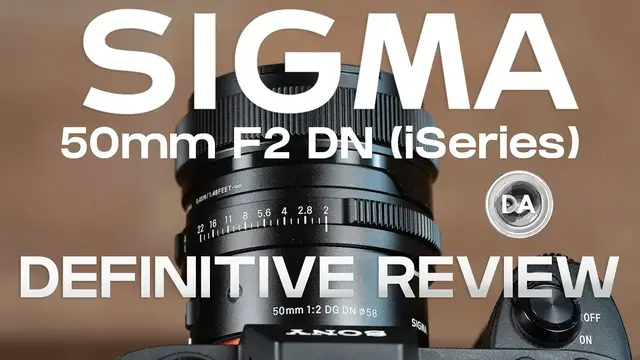
Sigma 50mm F2 DN (iSeries) Definitive Review | Has Sigma Read the Room?
Jul 17, 2023

Photographer Dustin Abbott shares a deep dive definitive review of the Sigma 50mm F2 DG DN | C (iSeries) lens for Sony FE and Leica L. | This video is sponsored by Fantom Wallet. Visit https://store.fantomwallet.com and use code DUSTIN15 to get 15% off | Read the Text Review: https://bit.ly/Sigi50DA | Visit the Image Gallery: https://bit.ly/i50pics | Purchase the Sigma 50mm F2 DN @ B&H Photo https://bhpho.to/3nFJcmq | Adorama https://howl.me/cjuhVxLa8Nl | Amazon https://amzn.to/3zstduQ | Camera Canada https://shrsl.com/40hux| Amazon Canada https://amzn.to/40sXeGB | Amazon UK https://amzn.to/40ztrMh | Amazon Germany https://amzn.to/3GaddkA
Check out the DA Merch here: https://bit.ly/TWIMerch | Become a Patron: https://www.patreon.com/dustinabbott | On the Web: http://dustinabbott.net/ | Sign up for my Newsletter: http://bit.ly/1RHvUNp | Instagram: http://bit.ly/DLAinsta | Facebook: http://on.fb.me/1nuUUeH | Flickr: http://bit.ly/1UcnC0B | 500px: http://bit.ly/1Sy2Ngu Follow Craig @ https://www.instagram.com/craigstoffersen/
Want to support this channel? Use these affiliate links to shop at:
B&H Photo: http://bhpho.to/1TA0Xge
Camera Canada: http://bit.ly/DLACameraCan
Amazon: https://amzn.to/3HrY64d
Amazon Canada: https://amzn.to/3qG1p18
Ebay: http://bit.ly/DustineBay
Make a donation via Paypal: https://www.paypal.com/paypalme/dustinTWI
=============================
Table of Contents:
=============================
0:00 - Intro and Concept
1:00 - Fantom Wallets
1:47 - Build and Design
6:39 - Autofocus
Show More Show Less View Video Transcript
0:00
Hi, I'm Dustin Abbott, and I'm here today to give you my definitive review of the new
0:15
Sigma 50mm F2 DN from their i-series of lenses. Many of you told me that you weren't looking for
0:22
another premium 50mm F1.4 lens when I reviewed the new Sony G Master lens, and you said
0:29
what you wanted was a high-performing compact 50 millimeter f1.8 lens. Well, will f2 work for you
0:38
Sigma is adding to their compact and premium i-series of lenses with the new 50 millimeter f2dn. This is
0:44
coming for both Sony e-mount along with Leica L. So will this new i50, as we'll call it, check all
0:53
the boxes for you and what you're looking for? Well, we'll find out in our definitive review today
0:57
right after a word from our sponsor. Today's episode is brought to you by Phantom Wallet
1:03
the minimalist, modern wallet that is now even better with the new Phantom X that is crafted from aluminum
1:08
right here in Canada. It is 22% smaller and 35% lighter, while still making it easy to access your cards and money
1:16
when you need them, thanks to their unique fanning mechanism. You could even customize your wallet due to its modular design
1:23
with accessories like a money clip, cash holder, ID display, and even Chipolo and AirTag tracking integration
1:30
Visit store.phantomwallet.com to check out their unique sizes, styles, and finishes that span from aluminum to wood to carbon fiber
1:39
And use code DUSTIN15 for 15% off when you're ready to check out
1:46
Let's talk about the build and the handling of this lens. In the big scale of things, this lens is what you would call the medium option
1:56
Obviously, it is larger than a typical 50mm f1.8. I've got a Canon here to step in for a Sony
2:02
It falls in the middle, whereas I have the smallest of the 50mm f1.4 options available
2:09
That's the Samyang AF 50mm f1.4 Series 2 lens. And so you can see that it slots nicely in between those two things
2:17
It is still very, very compact, but don't think it's going to be as small as the typical Nifty 50
2:23
and certainly not as light. It is, however, considerably smaller than Sigma's recent 50mm f1.4D and Art Series lens
2:32
And as Sigma themselves point out, this f2 lens is 37% shorter, it is 50% lighter
2:39
and as a price point, it's about $220 cheaper than the f1.4 Art Series lens
2:45
So how small is that? It's 70mm in both diameter and its length
2:51
and it weighs in, that's 2.8 inches by the way, it weighs in at 345 grams, 12 ounces, and it has a 58
2:59
millimeter front filter size. I will quickly note on that that Sigma has elected to not standardize
3:05
the filter size in the i-series lens. So this filter size is I think only shared with one other
3:10
out of nine or ten lenses and some others have a 62 millimeter, some of them have a 55 millimeter
3:17
airfront filter thread. And so there certainly is, you know, some variance when it comes to this
3:22
particular series. That's either a good thing or a bad thing, depending on your perspective
3:26
You know, the upside of that is that you can design each lens and just kind of let the design
3:31
flow for itself without having to force around a shared size constraint. But of course, it also
3:36
means that you're unlikely to be able to share filters across a number of these lenses. It does
3:43
have an AF-MF switch here on the side, but it doesn't have a focus hold button and really no
3:49
other features outside of an aperture ring and a focus ring on the lens barrel itself. It has a
3:55
gasket here at the lens mount, but no internal seals, which is kind of in the standard for the
4:00
i-series lenses. What is here, however, is really beautifully crafted. I'm hard-pressed to think of
4:07
lenses that are nicer than these current i-series lenses in terms of just the overall design
4:12
aesthetic. There's a lot of really, really great textures. Things feel really good. You can tell
4:18
that these lenses are crafted with some love and care for those that care about the aesthetic
4:23
of that, and that's up to including the lens hood, which is a cut above the lens hoods on
4:28
any of Sigma's other lenses. They're all metal. They're beautifully ribbed. It really kind of
4:33
feels like you've got a separated off focus ring here that happens to be the lens hood
4:37
But as a byproduct, there's a real kind of flow of design here that often I don't see in lens design
4:45
where the lens hood feels like something that's been tacked on, kind of an afterthought
4:51
rather than a part of a comprehensive design. So I really do appreciate Sigma's care in designing these lenses
4:57
The fact that it's all metal does give you an option when it comes to your pinch cap
5:02
You either have the typical pinch cap, or you can use a magnetic cap that is included
5:06
Though I will note, it is hard to dislodge the magnetic cap if you have the lens hood in place
5:11
Those of you that aren't big fans of using the lens hood, you'll probably be more of a fan of using the magnetic cap
5:17
for the simple reason that it pops off nice and easily when you have that exposed like that However the pinch cap is easier to remove when you got the lens hood on because you can pinch in the middle rather than having to reach for the side of it Now as noted the aperture ring and the focus ring both of them move very nicely The aperture
5:36
ring feels really, really good and precise, and the ring itself has a really great feel to it
5:41
I will note that while you can lock it into an automatic mode just by kind of a firm detent there
5:48
there is no de-click option here, and so it's all going to be in one-third stop to tenths as a part of that
5:54
The minimum focus distance here is 45 centimeters, giving us an average, at best, 0.14 times magnification
6:03
which is weaker than the recent ART series lenses, and it falls behind a lens like the Sony 50mm f2.5
6:10
which has a much higher, around 0.21 times. And so not necessarily a strength for the lens, though I will note that up-close performance is very good
6:20
nice flat plane of focus, good contrast, good detail, and so it kind of makes up for things a little bit on that front
6:27
So what's here is really beautifully made. However, I will note that it lacks a few features relative to what has become the standard in the nicer Sony mount lenses
6:39
Autofocus here comes via an STM or a stepping motor, and it has plenty of power for most all applications that I saw
6:48
I saw only some very minor visible steps in my hand test
6:52
You can just see that focus kind of happens in two sections rather than one progressively smooth section
6:57
But for all other applications, I really didn't see any kind of stepping as a part of it
7:02
That can be a weakness for stepping motors. This is one of the better stepping motors that I've seen
7:06
both in speed and power and just overall smoothness. You can see that focus speed is really good here, and focus changes are near instantaneous for photography purposes
7:16
I also saw very good IAF tracking for humans, whether it was in kind of a casual portrait setting or an event setting
7:23
I saw very good IAF on animals as well. One thing that I thought wasn't maybe up to the par of some of these recent higher-end 50mm f1.4 lenses that I've seen
7:34
is that when I tried to track NAL approaching the camera and I turned the burst rate up on my
7:39
a7 IV, I found that there was a back focus for about the first half of the sequence
7:44
and then it pulled up to the right place and it remained constant there. And so maybe not
7:49
as quick in focus acquisition in a tracking situation as some of those better lenses
7:54
I will also note, of course, as a third-party lens, if you're shooting on an a9 series or an
7:59
alpha one, your burst rate is going to be limited at 15 frames per second. That's not just with this
8:04
lens that's with any third party lens. Now, when it comes to other video tracking, when I approached
8:10
the camera, I saw smooth transitions. I didn't see any of those visible steps. I felt like it
8:15
picked up my eye pretty quickly after coming back on frame. Also, when doing focus pulls
8:21
they were very smooth and quiet, though you will see, particularly if you look at the left side on
8:25
the window, that there is some pretty obvious focus breathing. And so if your priority is video focus
8:32
you might want to look at something like the Sony 50mm f2.5G
8:37
because it might be a better video option. It has the ability to de-click the aperture, has dual linear motors
8:43
It is going to be eligible for focus breathing compensation if you have a camera that is so equipped
8:48
And so it just gives you a little bit more flexibility when it comes to video acquisition
8:53
Though for stills and for normal video work, I was perfectly satisfied with what I saw here
8:58
It got the job done. And even if I go back just a little bit
9:02
I would say that this was an exceptional autofocus performance, you know, relative to what I had seen
9:07
previously. So overall, my impressions walking away were very positive. Now, let's talk about
9:13
image quality, because Sigma actually touts that this little 50mm f2 is as strong in the center
9:18
and the midframe wide open as the Art Series lens. Though, as we're going to see on our image quality
9:24
breakdown, there's a little bit more nuance maybe to add to that. Let's dive in and let's take a
9:30
look at the overall optical quality of the lens. So we'll start by taking a look at vignette and
9:35
distortion. So as you can see on the distortion front, there's really not a whole lot to see here
9:40
And so in this area, we're actually much better off than the new 50 millimeter F1.4 DN. There is
9:46
however, a fair amount of vignette. And as you can see, it penetrates quite far into the frame
9:50
which is going to give images a little bit of a heavier look to them if you leave it uncorrected
9:55
Over here on the right, you can see I've done a manual correction here, a pretty straightforward
10:00
plus one to deal with the distortion and a plus 51 to deal with the vignette
10:05
So that's about two stops of vignette. And you can see I've moved the midpoint all the way over to allow that to brighten up
10:11
all the way into the middle of the frame. Now, of course, there is a correction profile that will clear things up, either in camera
10:17
for raw or video or excuse me, for JPEG or video. Raw files will be a correction profile that will come to software, which I have used here
10:24
And you can see here that the image has quite a bit of a heavier feeling prior to that vignette correction
10:32
After the correction, it feels a little bit lighter, a little bit airier than what it does
10:37
So I think in many situations, you'll probably want to correct that vignette. There'll be some situations where it will be flattering
10:43
Now, there is some longitudinal chromatic aberration. We can see here that there a little bit of fringing particularly after the plane of focus here Taking a look from another perspective you can see only a minimal amounts of the magenta fringing but a little bit more pronounced when it comes to the kind of green fringing
11:00
after the plane of focus. You can see in this shot here of congas that on some of these shiny surfaces, you're going
11:08
to see a little of that fringing there. And then you'll see it a little bit when it comes to some of the bokeh highlights, just
11:13
a little bit of outlining there. Nothing too pronounced here, though. now as per usual we're using my sony alpha one 50 megapixels and showing you this at 200
11:24
magnification you can see that there's tons of pop here in the center of the frame great contrast
11:29
wide open you really couldn't ask for much more their midframe looks very good you can also see
11:35
here in this mid area going down to here everything looking really strong and as we go to the corner
11:40
we can see that there is a drop off it's not as sharp towards the edge of the frame however it
11:45
isn't quite as bad as what I thought the MTF suggested. This is really not a terrible performance
11:51
Now we saw that that chart from Sigma showed that wide open, the F2 lens is actually sharper than the F1.4 lens
11:58
at least in the middle through the mid frame. But if you do more of an apples to apples comparison
12:05
you compare them both at F2, we can see that of the two, I would say that I would still give an edge to the Art Series lens
12:11
By F2, it stopped down to where it's a bit sharper. That's even more obvious here in the mid-frame
12:17
which you can just see the Art Series lens just pops there at F2
12:23
We can also see here that it has higher performance. And then down into the corners, you can see that that difference
12:30
in being able to render fine details, look down like in this lattice area here
12:34
you can see that it's just definitely more defined there, much more detail showing up from the Art Series lens
12:41
That's not to take anything away from this F2 lens, because it is extremely sharp
12:45
And so even in this kind of casual, available light shot at F2
12:49
you can see it is just amazingly sharp there on her face
12:53
We can take a look into a more of a landscape type shot or city shot here
12:59
You can see that there is tons of detail here in this shot and that it looks strong even towards the edges of the frame
13:05
In fact, if I compare it to an F5.6 image here, Really the only difference is I see a little bit more contrast from the f5.6 result versus the f2
13:17
But without them side by side, you know, frankly, you would be really hard pressed to tell that difference
13:22
I mean, they both look really, really fantastic. So you've got a lot of optical chops available from wide open on this lens
13:30
And in this case, more of an infinity type landscape. And you can see that there is just great detail all across the frame here
13:37
I don't really see a weak spot as I look across here. I understand that the corners aren't as sharp as what the center is
13:44
but this is not a bad corner performance at all either. And so this is a lens that really is quite impressive in terms of the overall sharpness
13:53
Now, if I compare both of these lenses at f2.8, you can see that in the center, I would give a very mild edge to the Art Series lens
14:03
The same is probably true of the mid-frame. and down into the corners the art series has its biggest advantage though you know frankly both
14:10
lenses look quite good here but if i look at a few other places in the spot yeah i'm going to say
14:15
that there's a little bit more contrast for the art series lens but frankly there's not a significant
14:20
difference between the two optically when i looked at side by side i didn't see a lot of difference
14:25
between f2 and f2.8 on this 50 millimeter f2 lens i saw more of a jump when you stopped on down to
14:31
F4. And as you can see here, contrast has taken a serious bump forward in the center of the frame
14:37
also in the mid frame, showing just higher detail. You can see that there's more detail in this bill
14:43
here. And then down into the corners, we can see now that we're starting to get a really crisp
14:48
looking result in the corners as well. There's a very minor further burst forward at F5.6
14:55
And we can see by F8, you're not really getting any further gains. If anything, I think contrast
15:00
is slightly reducing. So your peak is somewhere around f5.6 on a higher resolution body
15:07
Our minimum aperture here is f22. And as per usual, on a high resolution body, we can
15:14
see that we diffraction is just robbing a lot of the contrast and resolution. So as per usual
15:20
my recommendation is don't go past f11 unless you really, really need to
15:25
So as previously noted, our overall amount of magnification is not particularly high
15:30
but you can see that our performance up close is quite good. Good contrast, good detail there
15:36
If I pop onto a real-world three-dimensional object, you can see it's rendering a lot of fine detail there
15:42
and contrast is holding up quite well, even at very close focus distances
15:47
Now obviously, your ability to compress a background and blur it out at f2
15:52
is not going to be what it is at f1.4. We can see, looking side by side here
15:58
that the quality of the blur is not radically different, but you can just obviously achieve
16:03
a much more of a blurring of a background with a lens with an f1.4 aperture
16:08
like the Art Series lens. Here's a quick look at the geometry. You can see a little bit of that fringing
16:13
that we saw previously There a little bit of a cat eye shape here towards the edge of the frame If you stop down to F2 you get basically all circular shapes all across the frame At F4 that continues to be the case
16:26
We're not really seeing much of the aperture blades yet, though you are starting to see just the beginning of that
16:31
a little bit more of that nonagonal shape. Out in the real world, you can see that up close
16:36
you have the ability to blur out the background quite nicely. Here's a shot now where I've blurred the foreground
16:42
A little bit more outlining here as you get towards a little bit more of a medium distance
16:46
You're not blurring things out quite as much. You know, maybe one of the disadvantages of that smaller aperture there
16:52
Here's another shot of this lock. But again, at close focus distances, you're blurring out a background fairly completely
16:57
And again, I'm very impressed with the up-close performance there, which is really strong
17:02
One final shot here shows just kind of some different edges. You see a little bit of that fringing
17:07
I doubt anything that's going to ruin any shots for you. and as we move towards defocus, it's pretty good
17:12
There is just a little bit more of outlining than what I would like. Overall, however, though, I like the shot
17:18
I like what this lens can do. Now, when it comes to flare resistance, we can see
17:23
you can't really tell because the image has been so resistant to any kind of ghosting or veiling here
17:29
but there's very bright sun that's coming through this window that I've allowed into the frame
17:34
You can see, however, for this shot, though, the contrast has held up perfectly. you can see from the still shot that the sun is in the frame but there's not really any kind of
17:42
negative effect and even when i'm panning across in video you just really don't see at different
17:47
angles any kind of ghosting or veiling if you stop on down you can see that that really continues to
17:54
be the case and this is a very very strong flare resistance now when you're stopped down to f11
18:00
here's a look at what you're going to get as far as the sunburst or sun star effect that is there
18:06
and again even just against a flat blue sky here you can see that there's very little to see in
18:12
terms of any kind of ghosting artifact it's one final shot here that shows how it's holding up
18:17
really quite well again very bright sun coming through the window here in the sauna which is
18:21
otherwise fairly dim inside you can see that there's no nasty artifacts or flare effects that
18:27
are taking place there because this lens has such high contrast i did find that color saturation was
18:32
really strong on it. And so as you can see in this kind of setting, we've got really deeply
18:37
saturated colors. It looks very nice and obviously very, very good detail because this lens has such
18:43
high resolution and contrast. Finally, I did have an opportunity because of a decent night for stars
18:50
to take a look at the coma effect. So you can see that in the center of the frame, star points look
18:54
really very nice. As we move towards the edge of the frame, they do start to become deformed
19:00
There's another cluster of stars up here that you can see a little bit more. Very slight kind of growing of wings there
19:05
But again, it's limited. And so as a byproduct, I would say overall, that's a fairly good effect for controlling coma
19:14
So certainly a lens that if I owned it and I had no, and this was the focal length I wanted
19:19
I wouldn't hesitate to use this for shooting the night sky. Very few optical weaknesses with this lens
19:24
This is a strong performance. And so at the end of the day, you can pretty clearly see that this is a very strong little lens
19:30
and particularly when it comes to the optics, the overall feel and quality of the lens
19:35
the autofocus performance, there is a lot of checks in the positive column for this lens
19:40
and relatively few over in the negative. At the same time, however, this lens does face a lot of very strong competition at its $639 price point
19:51
We've already alluded to the Sony 50mm f2.5G, which is smaller, lighter, and actually less expensive
19:59
Though, I will point it also has two-thirds slower stop maximum aperture
20:04
But, of course, it's also more expensive at the moment than this Samyang lens
20:08
The Samyang is a very good lens that, as you can see, it is physically larger and a little bit heavier
20:14
But, at the same time, it has a faster maximum aperture of f1.4, so a full stop faster
20:21
And of course, there are other options out there as well. And so I think that will be kind of the key issue for Sigma
20:26
is that if they're kind of unique blend of, you know, beautiful design and strong optical performance
20:32
and a, you know, a compact lens, if that is going to be attractive to the right kind of buyer
20:38
On the Leica front, which I always have to consider, even though I'm not a Leica shooter
20:42
I think that this lens makes even more sense. There are fewer options there
20:46
Of course, Sony's e-mount is flooded at this point, but there are fewer options on Leica
20:50
It's a really nice match for some of those smaller bodies that are available there
20:55
And of course, as a price point, it's going to see a little bit more bargain oriented there
20:59
Bottom line is that if you love the concept of the i-series, maybe you have other lenses from the series that you have really liked
21:06
then I think that you'll love this lens. It really does deliver beautifully optically, has great autofocus
21:12
and it has that really charming build and aesthetic to it that makes it a joy to use out in the real world
21:19
I'm Dustin Abbott and if you look in the description down below you can find linkage to my full text review there's also some buying links there if you'd
21:25
like to buy one for yourself link is to follow me or Craig on social media to
21:29
become a patron to get channel merchandise if you haven't already please like and subscribe thanks for watching have a great day and let the
21:37
light in