Up next in 10

Sigma 70-200mm F2.8 OS Sport: First Look | 4K
Jul 26, 2023

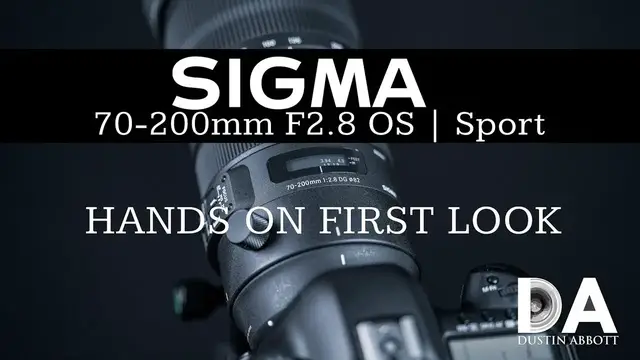
Sigma 70-200mm F2.8 OS Sport: First Look | Sigma has released one of their most important lenses in the last couple of years - the 70-200mm F2.8 Sport. Some of the primes are fascinating to play with, but many reach for a pro-grade zoom when doing serious work. Get the details of the build, handling, and features here along with some first images. See more images in the gallery here: http://bit.ly/70_200SportIG
Purchase the Sigma 70-200mm Sport @ B&H Photo https://bhpho.to/2MRqNNc | Amazon https://amzn.to/2t8hZcu | Amazon Canada https://amzn.to/2TzbafB | Amazon UK https://amzn.to/2UJ6fZT | Amazon Germany https://amzn.to/2TxdEeJ | Ebay http://bit.ly/70_200Sport
Want to support this channel? Use these affiliate links to shop at:
B&H Photo: http://bhpho.to/1TA0Xge
Amazon: https://www.amazon.com/shop/dustinabbott
Ebay: http://bit.ly/DustineBay
Make a donation via Paypal: paypal.me/dustinTWI
Get a discount off all Skylum Editing Software (Luminar, Aurora HDR, AirMagic) by using code DUSTINHDR at checkout: http://bit.ly/LuminarDLA
Become a Patron: https://www.patreon.com/dustinabbott | Check me out on: Personal Website: http://dustinabbott.net/ | Sign up for my Newsletter: http://bit.ly/1RHvUNp | Instagram: http://bit.ly/DLAinsta | Google+: http://bit.ly/24PjMzv | Facebook: http://on.fb.me/1nuUUeH | Twitter: http://bit.ly/1RyYxIH | Flickr: http://bit.ly/1UcnC0B | 500px: http://bit.ly/1Sy2Ngu
My filming setup: Sony a7R III: B&H Photo: https://bhpho.to/2D6ibNO or Amazon: http://amzn.to/2CNxOvH | or | Sony a9 @ B&H Photo: https://bhpho.to/2HyWIyt or Amazon: https://amzn.to/2s1vYE0
Tamron 28-75mm F2.8 RXD @B&H Photo: https://bhpho.to/2FA00la or Amazon https://amzn.to/2G2kaEr
Lights: Rotolight AEOS @B&H Photo https://bhpho.to/2IK7mqV | Genaray Contender @B&H Photo: https://bhpho.to/33HbGNM | and Aputure AL-MW: https://bhpho.to/2N3MtZV
DISCLAIMER: This video and description contains affiliate links, which means that if you click on one of the product links, I’ll receive a small commission. As an Amazon Associate I earn from qualifying purchases.
Show More Show Less View Video Transcript
0:00
Hi, I'm Dustin Abbott and I'm here today to give you a first look at a lens I know a lot of you
0:10
have been really excited about and excited to hear more about and that is Sigma's new 70-200mm f2.8
0:19
and this is in their Sport Series. And so one thing to note about Sport Series lenses is that
0:26
they do have a higher build grade, higher build of weather resistance, and they also typically
0:33
employ some of Sigma's better focus, which of course is incredibly important in a lens like
0:38
a 70-200mm f2.8. Now, I would say outside of a 24-70mm f2.8, the 70-200mm represents one of the
0:50
most important lenses that any manufacturer makes and that is for the simple reason that I think that
0:56
in some ways to me a 70 to 200 as a zoom is even more important than a 24 to 70 for the simple
1:03
reason that while I don't mind replacing a 24 to 70 millimeter with a prime lens often a 35
1:11
millimeter really kind of covers a lot of the same things for me and gives me a little more
1:16
flexibility with maximum aperture and so that's the way that I personally tend to go. However
1:21
a 70 to 200 millimeter stabilized, you know, with OS optical stabilization is a really
1:27
really hard lens to replace with a prime. Mostly because when you get to telephoto focal lengths
1:32
the not having the flexibility of a zoom can be really, really restrictive. And so you end up
1:37
getting a framing that just doesn't quite work. I shot, I remember shooting an early wedding with
1:44
135 millimeter f2 prime the canon 135 f2l and just there being moments in that wedding where
1:54
I just I couldn't get the framing that I wanted you know just the reality of being stuck with that
1:58
one focal length and it was the last wedding that I shot with a prime telephoto lens and I
2:03
you know began shooting with the 70 to 200 so I say that to say I think this is an incredibly
2:08
important lens for Sigma and and in some ways surprisingly it's not got as much hype as what
2:13
I might have expected. But today we're going to dive in. We're going to take a closer look at
2:19
where this lens fits in the lineup. Take a look at the build, the handling. I'm going to give you a
2:24
look at, you know, the fact that it does work with the MC11. Take a look at how it works even with a
2:30
Canon extender and talk about the tripod collar. And of course, its top competitor really, which
2:36
is the Tamron 70 to 200 millimeter F2.8 G2 lens, a lens that has been really, really well received
2:42
does have a few flaws and we'll see how the Sigma compares with that. But also as I move ahead with
2:48
the review series, I will be referencing this lens in particular because when it comes to price
2:53
this is the closest competing lens. Now, the Tamron does have a price advantage. It's priced at $1,299
2:59
in the US market right now. That's a really, really competitive price for such a capable lens. And so
3:06
you know, they do beat Sigma on that front. However, the Sigma is coming to market with an
3:11
MSRP in the US of $1,499, which of course really places it competitively compared to both Canon
3:20
Canon's F2.8 L Mark III runs you about $2,100. And then of course, if you're looking at the
3:27
really comparative Nikon lens, the Nikkor 7200 F2.8 E lens, VR lens runs you almost $2,800
3:38
$100 and so we're talking about a near 50% Price reduction go into the Sigma lens and so of course that I think for Nikon shooters is going to make them even more
3:50
Interested in this lens perhaps even in Canon shooters. So let's dive in and let's take a hands-on look at the lens itself
3:57
Let's start up front actually today and we'll take a look at this lens hood here. So lens hood is
4:02
is made of higher grade plastics. I don't know if they did their carbon fiber reinforced
4:10
plastic, but it does kind of feel like the lens that I recently saw from the 60 to 600 millimeter
4:16
sport lens. They do have this nice rubberized transition area and also a nice grippy place to remove the hood
4:23
And so it's a nicely made hood with one new feature that you can see here, and that is that they have added
4:30
a lock. And so if you're carrying this in a harness or something and you've had issues with lens hoods moving around
4:36
it now has a nice lock that actually is quite a bit nicer than what like Canon's locks are in that kind of position
4:43
So I would say some pluses when it comes to that. Now looking up front, we're gonna see here
4:49
that there is a deviation from the norm. Every 70 to 200 millimeter lens
4:54
that I've previously used, seven or eight of them, have all had a 77 millimeter front filter thread
5:01
So Sigma has bumped things up a little bit bigger here They gone to an 82 millimeter front filter thread i interesting interested in seeing if that pays off in some reduced vignette particularly at 200 millimeters the tamron 70 to 200 millimeter f2 g2 certainly suffers from some vignette at 200
5:20
millimeters so i'm interested in seeing if that's an area of improvement with the sigma
5:24
Now, the actual zoom ring here is furthest away from the actual, you know, the camera itself
5:33
So just so you know that position, this zooms here in the Canon direction as opposed to the Tamron, which zooms in the Nikon direction
5:42
The internal zoom action, of course, is an internally zooming lens. It is nice and smooth, no issues there
5:50
And I do like when they add this kind of bevel here. It helps you to be able to, in a tactile sense, definitely confirm that you've got the right ring, even if you're not looking at it
6:01
And so PLUS is there, nice and wide, good-feeling materials that are used on that
6:08
And compared to the Tamron, the feel is, I would say, a little better damped
6:16
it just the tamron has a little bit of a an inconsistency to the damping where the sigma
6:23
feels higher grade there and so a plus there they've also added a custom function button
6:29
there's actually in three different positions here on the lens barrel and so of course that
6:33
will be dependent on what shooting position you're in but you can actually program that function
6:39
in the case of a case of a canon body you actually program that through the the camera body here and
6:48
and you have different options as to what you can assign to it now i've currently programmed
6:53
to be able to switch between one shot and servo af that to me is a valuable thing for particularly
7:00
if i'm shooting in a like a wedding or event type setting where i don't always want af you know
7:07
servo because you know maybe that I want to actually lock focus on something and then you
7:12
know refocus or recompose I should say but if I'm you know if it's shooting action I want servo so
7:18
being able to quickly switch on the fly between that is a plus and so anyway useful there we have
7:24
a manual focus ring the next thing in line and and so you can see that the manual focus ring it
7:30
moves nicely the the feel of the ring itself is very quality so a plus when it comes to that
7:36
Looking at the side of the lens here, we'll note a couple of things
7:41
First of all, we have got four different switches here. So switches include your autofocus settings
7:49
So you have manual focus, you have a manual override setting to where you can use manual override if you want
7:55
or just an AF setting. And where AF setting is, is that means that there won't be any interference if you inadvertently bump the manual focus ring
8:04
And so it gives you three options there. There's also a focus limiter, and a focus limiter helps to eliminate the close focus positions primarily here
8:13
and so you have an option of full, or you have a three meters to infinity position
8:19
if you're only shooting more distant things and you want to make sure to not do any, you know
8:23
mis-focus in a focus rack coming to close focus. You have a couple of options for your optical stabilizer, and so you have a mode one, general purpose
8:33
You have a two, which is a, you know, panning type mode. And then you also have the option, however, by using the Sigma USB dock and Sigma Optimization Pro, you have an option to program in even a third option, which actually right now on the C2 position, I've programmed the third OS option to come in there
8:55
with the other custom function you can put different things with the c1 button what i've
9:01
done actually is i have programmed to c1 the option of switching between the normal autofocus speed
9:06
and then the accelerated autofocus speed where it prioritizes a quick focus lock you know at the
9:13
sacrifice maybe of some accuracy in some settings i and others have noted that there really isn't a
9:19
whole lot of difference in autofocus accuracy so i kind of feel you might as well go with it because
9:24
you do get a little bit of extra focus speed. It's not massive in either metric
9:30
It isn't massively faster, and it's not considerably less accurate. So I think it's worth the trade-off
9:37
Now, when it comes to the actual tripod collar, some good and bad to report here
9:42
Obviously, you've got a nice robust section. You've got the detents at the 90-degree positions of the compass
9:50
And so that's nice, although you can lock it in, obviously, at any point. But what you don't have is the ability
9:56
to remove the tripod collar. And so you're gonna be carrying that additional weight
10:01
Now, I mean, if you were so inclined, you could remove the actual tripod foot
10:06
I don't know necessarily why you would do that unless it was just in your way all the time Now the tripod foot itself as you can see it nice and robust I like that And it also ARCA Swiss compatible I really like that And so you can go right onto a tripod and lock it down
10:21
I do consider this a liability considering this lens is already larger and heavier than competing lenses
10:27
And so, you know, to be able to remove the tripod collar could help if you don't actually need it
10:32
And so anyway, that's a liability there. Now, if you look at the rear of the lens
10:39
a couple of things I want to point out here. Number one, you can see a nice thick gasket here
10:44
for the dust and moisture resistance. Sigma does have coatings on front and the rear
10:50
to repel both moisture and oils from fingerprints. And so that is a nice thing
10:58
The lens does have a sport line level of sealing and so seals at a number of different points
11:05
as you can see from this diagram, and so a plus when it comes to that
11:09
Now the actual barrel of the lens itself is made of magnesium alloy
11:13
so it's a very tough, very durable material. That's the same material that's in most camera bodies
11:19
and so it's a very strong, very durable material. A bit of a more of a matte type finish on here
11:27
and so I suspect that it will resist fingerprints really well, and it's also a finish
11:33
that will probably wear very well. And so obviously I can't predict the future
11:38
but I would just say looking at it that it's going to hold up well. And so good things when it comes to that
11:44
Now this lens has the ability to focus down to 3.94 feet or 1.2 meters
11:52
which is fairly similar to competing lenses from either Canon or Nikon
11:59
The Tamron can focus a little bit closer, but the Tamron is also guilty of focus breathing
12:04
And so the Sigma actually produces a much better reproduction ratio of one to 4.8
12:13
and or a 0.21 times magnification, which puts it in line with Canon
12:18
the newest Canon and Nikon lenses and is much better than Tamron that has a 0.163
12:26
due to that focus breathing, which even though it can focus down more closely
12:31
And so, definitely a plus there for those of you that are really put off by focus breathing
12:36
The Sigma is going to spare you from that. A few other things here that are unique
12:42
This is the most optically complex of the four lenses that I've been referencing
12:45
It's 24 elements and 22 groups. Unlike the others that tend to have nine rounded aperture blades
12:52
this actually has 11 rounded aperture blades. And so the hope is there, of course, that it will help to produce even smoother
12:59
bokeh with the lens stopped down a little bit. Early signs I've seen have been pretty promising
13:04
about the bokeh quality from the lens, so I'm looking forward to that. It is compatible with
13:09
all of Sigma's new functionalities. Compatible for the lens exchange. It is compatible with
13:17
Sigma's new 1.4x and 2x teleconverters. There's room for that back in there, and they fit fine
13:23
it's also also works actually quite well with the Sigma MC 11 this Canon EF version mounted
13:32
on to a Sony a7r mark 3 and that of course is a big plus for those of you like myself that shoot
13:39
dual systems neither the Tamron nor the Canon play particularly well with Sony not up to scratch
13:46
the Sigma seems to function a lot better because they've got this you know dedicated proprietary
13:51
thing. And so that is a plus there. The other thing I noted is that as continues the trend with
13:58
recent Sigma cameras is that it is, lenses I should say, it is fully compatible with Canon's
14:07
lens aberration correction. And so, you know, JPEGs will receive all of these corrections. The lens
14:13
registers properly in the camera, all of that stuff, which is a huge, huge benefit. And it helps
14:19
to level the playing field for the Sigma versus the Canon lenses
14:23
On top of that, however, unlike Tamron, it also plays well with Canon's own teleconverter
14:29
So maybe you don't own a Sigma and you're wondering if you can use your Canon teleconverters
14:34
You can, and it works really, really well. It registers properly, shows the right aperture
14:39
Autofocus seems to work really well. And so that's definitely not the case with the Tamron
14:43
So, you know, another bit of a Sigma advantage there when it comes to that
14:48
Now, a disadvantage, of course, as noted, is the overall weight here
14:52
And so, you know, unfortunately, because Sigma does not allow you to remove that tripod collar
15:00
it means that no matter how you slice it, you weigh it, it's going to include that
15:05
And so if I put it here on the scale, we can see bare lens, no caps
15:09
it comes out at 1,812 grams or 1.8 essentially kilograms. And so you know that not light And you know by comparison the Tamron G2 which also has a very nice build grade but because you can remove that tripod collar you can see that the weight is significantly different
15:31
It comes out at 1,387 grams. And so that is, of course, a pretty huge advantage if you're just carrying the bare lens
15:41
And so it's basically half a kilo lighter, 500 grams lighter. And so to use the actual specs from the manufacturers on this lens, and so in the case of the Tamron, that would be going back to including the actual tripod collar
15:55
The Tamron is 1.5 kilograms compared to the 1.8 kilograms of the Sigma
16:03
So that's 3.31 pounds for the Tamron or right under four pounds for the Sigma
16:11
Of course, if you remove the tripod collar from the equation, that drops you to around three pounds for the Sigma
16:18
So you're talking really, or excuse me, for the Tamron, which is basically a full pound difference
16:24
The Canon lens is 1,480 grams. And so that means that the Sigma is coming in at about 320 grams heavier
16:32
And then the Nikon is 1,430 grams. And so Sigma is coming in at about 400 grams heavier
16:39
And so we're talking about definitely a considerably heavier lens than all the competition
16:46
Beyond that, it is a little wider around in terms of the barrel dimensions
16:52
which is reflected in that larger filter size. So you've got 300, or excuse me, 3.71 inches versus basically 3.5 inches for the other lenses
17:02
That's 94.2 millimeters versus in the range of 88 millimeters for the others
17:08
and in terms of the overall length, it's also longer. It's basically right at eight inches long
17:13
compared to about 7.6 to 7.8 inches for some of the others
17:20
Actually, the Nikon is pretty close to being the same total length as this
17:25
and so that's the one exception there. That's about 202, it's 202.9 millimeters
17:31
for the Sigma here. And so we've got a physically large lens for sure
17:37
And so just some of the basic build and features of this new Sigma lens
17:42
So as you can see, there are a few liabilities here. It is larger and heavier than competing lenses
17:49
Tripod collar, unlike Tamron's, is not removable. And so that means that if you're, for example, shooting a wedding
17:56
you're going to be shooting handheld all day, you can't get rid of that tripod collar
18:00
which I think that's a misstep on Sigma's part. And I say that as someone who does shoot events and weddings fairly frequently
18:09
And as you'll see, the tripod collar for my Tamron basically only comes out when I do formal tests
18:16
I mostly shoot the lens handheld. And so as a result, I get rid of the tripod collar and so that I, you know, I have some weight savings
18:22
And also because it's not in the way. And so I think that Sigma maybe had a misstep when it comes to that
18:28
At the same time, we also see that in terms of functionality, this lens has a very, very robust build
18:35
everything works beautifully the way that it should it does feel um you know the tamron feels
18:41
a little bit more sleek in hand the sigma has more of a matte type finish but it feels a little bit
18:47
more military grade too and so um build quality feels really really high on the lens feature set
18:53
is good you know it does add the you know custom function button to the uh the lens barrel and so
18:59
you have some options when you're shooting um with that and so i mean that's certainly a welcome thing
19:05
a lot of positive things when it comes to the build. And of course, stay tuned and we will be
19:11
breaking down in a future episode. We'll be looking at the image quality and particularly
19:15
how these compare. While you're waiting for that image quality episode to come, I would recommend
19:20
looking in the description down below. And there is a link there to my image gallery. And you can
19:25
see the photos that I'm taking as I continue on throughout the review process and see the different
19:30
kind of shots that are there and, you know, start to form maybe some of your own conclusions based
19:34
on what you see. There's also buying links in the description if you'd like to go ahead and order
19:39
one for yourself. And of course, it's a very fair value for this lens. And as we're going to see
19:45
its optical performance is pretty awesome. So we'll take a closer look at that. But you can
19:51
go ahead and buy links there. You can also follow me on social media, including now on Instagram
19:56
And there are links to that down below. Sign up for my newsletter, become a patron. And now as a
20:01
patron. You get a sneak preview of an upcoming episode from the next week, a week before the
20:08
public gets to look at it. That way you get to interact with me. You get to ask questions
20:12
see the content, whatever. And so I'd encourage you to become a patron. And of course, you haven't
20:17
already, please click that subscribe button right here on YouTube. Thanks for watching. Have a great day
20:31
Thank you