Up next in 10

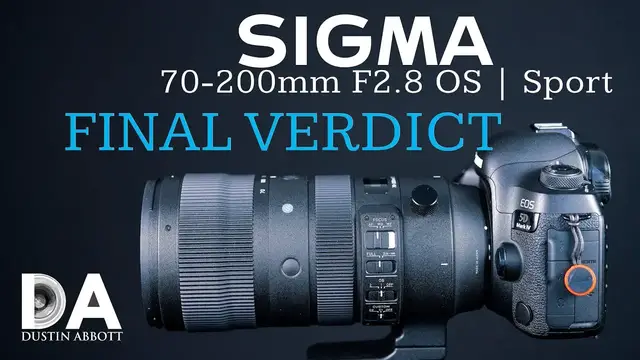
Sigma 70-200mm F2.8 Sport: Final Review | 4K
Jul 24, 2023

Sigma 70-200mm F2.8 OS Sport: Final Verdict | Join Photographer Dustin Abbott for his final verdict on the Sigma 70-200 Sport. How does it work on Canon, Sony, with teleconverters, and more? Find out here! Read the text review: http://bit.ly/70200Sda | See more images in the gallery here: http://bit.ly/70_200SportIG
Purchase the Sigma 70-200mm Sport @ B&H Photo https://bhpho.to/2MRqNNc | Amazon https://amzn.to/2t8hZcu | Amazon Canada https://amzn.to/2TzbafB | Amazon UK https://amzn.to/2UJ6fZT | Amazon Germany https://amzn.to/2TxdEeJ | Ebay http://bit.ly/70_200Sport
Want to support this channel? Use these affiliate links to shop at:
B&H Photo: http://bhpho.to/1TA0Xge
Amazon: https://www.amazon.com/shop/dustinabbott
Ebay: http://bit.ly/DustineBay
Make a donation via Paypal: paypal.me/dustinTWI
Get a discount off all Skylum Editing Software (Luminar, Aurora HDR, AirMagic) by using code DUSTINHDR at checkout: http://bit.ly/LuminarDLA
Become a Patron: https://www.patreon.com/dustinabbott | Check me out on: Personal Website: http://dustinabbott.net/ | Sign up for my Newsletter: http://bit.ly/1RHvUNp | Instagram: http://bit.ly/DLAinsta | Google+: http://bit.ly/24PjMzv | Facebook: http://on.fb.me/1nuUUeH | Twitter: http://bit.ly/1RyYxIH | Flickr: http://bit.ly/1UcnC0B | 500px: http://bit.ly/1Sy2Ngu
My filming setup: Sony a7R III: B&H Photo: https://bhpho.to/2D6ibNO or Amazon: http://amzn.to/2CNxOvH | or | Sony a9 @ B&H Photo: https://bhpho.to/2HyWIyt or Amazon: https://amzn.to/2s1vYE0
Tamron 28-75mm F2.8 RXD @B&H Photo: https://bhpho.to/2FA00la or Amazon https://amzn.to/2G2kaEr
Lights: Rotolight AEOS @B&H Photo https://bhpho.to/2IK7mqV | Genaray Contender @B&H Photo: https://bhpho.to/33HbGNM | and Aputure AL-MW: https://bhpho.to/2N3MtZV
DISCLAIMER: This video and description contains affiliate links, which means that if you click on one of the product links, I’ll receive a small commission. As an Amazon Associate I earn from qualifying purchases.
Show More Show Less View Video Transcript
0:00
Hi, I'm Dustin Abbott and I'm here today to give you my final review on the new Sigma 70-200mm
0:17
This is the F2.8 OS Sport Lens. Now, when Sigma launched its global vision, you know, around six years ago
0:26
they divided their future lens releases into three categories. The art series, which of course
0:31
is where I've spent the bulk of my review time covering lots of those lenses that have been
0:37
reviewed. There's also the contemporary lenses that tend to be a little bit more mass market
0:41
and commercial grade. And then on top of that, you have the sport series, which is seeing the
0:48
fewest releases because to qualify for sport, you're essentially looking at a telephoto lens
0:53
which there are fewer telephoto releases. And also it has to come with the kind of build grade
0:59
and quality that Sigma has reserved for that. So their highest grade of build goes into these
1:04
sport lenses. So in the case of the 70 to 200 sport, you've got a magnesium alloy body. So a
1:11
really, really robust material, same as what goes into cameras, very tough, very durable. And it has
1:17
Sigma's highest grade of weather sealing as well. Now in my first look episode I broke down
1:24
in detail all of the specifics to the handling, the lens design, all of those things and so I'd
1:30
recommend that you take a look at that if you want more details on the actual construction and the
1:34
design of the lens. For time's sake I'll just hit a few of the highlights here. So as noted you get
1:40
a high grade of build, that magnesium alloy body, good weather sealing including internal seals
1:46
coatings on the external lens elements and then of course a lens gasket at the lens mount
1:52
and I will note that the Tamron 70 to 200 millimeter f2.8 g2 which I consider to be the
1:59
chief competitor and I've done my comparisons with it has a really sleek design but it also has a
2:07
it has a metal finish a lighter probably aluminum alloy and so it's not quite as robust also its
2:13
finish is prone to picking up fingerprints and here we have got more of a flocked matte finish
2:20
that seems really resistant to fingerprints and looks to be really really durable so that's
2:25
that's positive the trade-off however is that although this was already a large and heavy
2:31
category of lens sigma has managed to make it larger and heavier yet and so on average if you
2:38
compare it with the Tamron or the Canon L lens f2.8 to the newest Nikon Nikkor lens, you're
2:47
looking at between 300 and 400 additional grams of weight, a half pound or so of the Sigma being
2:56
heavier compared to the others. And so it is definitely towards the top or definitely at the
3:01
top of the class when it comes to weight and size. It's nearly four pounds, 1.8 kilograms
3:08
And compounding that heft is the fact that the tripod collar here, while it's a very nice tripod collar and foot, it's fully rotatable
3:17
It is not removable, whereas all the competing lenses do have a removable tripod collar
3:23
And so in the case of the, for example, the Tamron, which I often use without the tripod collar for events or weddings just to make it a little bit lighter and also to keep the tripod foot out of the way
3:35
that with that removed, comparing the two, it's closer to a half kilogram between the two of them
3:42
So, you know, a significant amount of weight there, over a pound difference between the two
3:47
Now, the Sigma is longer than these competing lenses, but it's just by a millimeter or two
3:54
Not really significant. What is significant, however, is that it averages about six millimeters
4:01
around wider than what any of the lenses in diameter, about six millimeters more in diameter
4:08
And so it grows. It's the first 70 to 200 millimeter lens that I've seen grow from
4:12
a 77 millimeter filter thread to an 82 millimeter filter thread. And so that of course is attested
4:20
by that extra diameter. That may not be the end of the world if you're wanting to shoot all Sigma
4:25
for example, or for that matter, if you're pairing it with any of the modern 24 to 70 millimeter
4:30
lenses. All of the 24-70mm f2.8s that have been released in the last handful of years actually
4:36
have an 82mm front filter thread. So, I mean, that actually produces more rather than less
4:42
commonality if you're shooting kind of a traditional pairing of those lenses. So maybe not a huge deal
4:49
Beyond that, a few other extra features. I will note that, I mean, all of the action and the feel
4:55
of everything here does feel more premium than what the Tamron does. And frankly, more so than
5:01
what the Canon does. It feels really, I call it kind of military grade. And so you are getting a
5:07
really robust lens for that extra weight, but it is heavier. I mean, and so you do have to note that
5:13
Also included now is Sigma has added a custom button that has three different positions. And
5:18
so you can access it, you know, depending on what shooting rotation you're in. And so you can
5:24
actually program different functionality and how you do that really is a kind of camera system
5:28
specific. On a Canon body, you program that through the Canon camera menu. And then if you're
5:35
shooting a Nikon body you need to use Sigma USB dock to program that functionality And so in the case here I actually for me I applied the ability to switch between
5:46
a single shot and AF servo autofocus. And so that allows me to change things up on the fly, depending on what I'm trying to do
5:56
And so valuable when it comes to that. The other thing that is a standout here that I do want to note is the fact that this Sigma
6:04
lens unlike the Tamron as a third party is supported by Canon's lens aberration corrections
6:11
So what that means is if you're shooting JPEGs it's going to correct just as if it were a first
6:16
party Canon lens. So it will correct a vignette, it will correct for distortion, for chromatic
6:22
aberrations, and then for diffraction. Now there really isn't hardly any chromatic aberrations to
6:28
correct for. There is a bit of distortion at 70 millimeters but it's actually better controlled
6:33
than other 70 to 200s that I've seen. But certainly there is some vignette
6:38
And so that is something that is valuable to have. And it's a feature that Tamron cannot match
6:45
And so some value when it comes to that. I was actually surprised. I expected because of that larger front diameter
6:53
and larger filter thread, I thought we would see lower vignette and less or better light transmission
7:00
compared to say the Tamron. In my direct head-to-head test, I really didn't see that, and so that's not necessarily an advantage
7:08
but if you're a JPEG shooter, being able to have that corrected for is an advantage
7:13
Now, an advantage that applies whether you are a RAW or a JPEG shooter is the fact that
7:18
unlike the Tamron, because the Canon camera recognizes the lens properly, it also recognizes properly when even a Canon extender is attached
7:30
Now, I'm sure that both Sigma and Tamron would recommend that you use their native extenders
7:36
And probably that does give you the best overall performance. I'm not going to gainsay that
7:40
But what I also know as a feedback from a lot of you is that if you already own a Canon extender
7:46
and you're considering buying a Sigma or a Tamron lens, you would prefer to be able to use what you've already invested money in
7:53
And in this case, it actually works great with the Sigma lens, whereas it doesn't with the Tamron
7:58
The Tamron doesn't report aperture properly. It doesn't meter quite right. It just doesn't work
8:04
as well. Sigma performs basically the same as what I saw with the Canon L, at least Mark II that I
8:12
used in that it focuses good and quality looks great. Everything reports properly. So a lot of
8:18
good news on that front. And so even if you don't want to buy a Sigma extender and you have a Canon
8:23
you should be able to use it here without issue. Good stuff there. Also great and a baked in
8:29
advantage for Sigma is the fact that they do have the MC11. Now I've tested I think about four
8:36
different 70 to 200 millimeter lenses via MC11 and similar adapters on a Sony body. And what I've
8:43
found is that none of them really work all that fantastic until this lens. And it performs pretty
8:50
close to native. IAF works well. Autofocus is quick. I saw a little bit of hunting in really
8:56
like low light or very strongly backlit situations. You know, typically challenging AF situations
9:03
although it did still focus or lock focus. It just hunted a little bit more. But for, you know
9:08
typical everyday stuff, autofocus was great and no concerns there. Image quality looks good
9:17
everything reports properly. Interestingly, because some people ask questions, they wanted to know what extenders would work, you know, with MC-11 on Sony. I'm sure that the Sigma probably
9:29
works even better in terms of reportage and in all of that, but I can happily report that the
9:34
Canon extender Sigma MC-11, this lens and a Sony body actually works really great. And the only
9:41
negative that I saw is that the lens no longer reports properly as being the Sigma 70-200
9:47
sport. Instead, it reports as, you know, focal length is appropriate. I think it reports as a
9:53
98 to 280 millimeter DT-SAM F4 lens. You know, so the designation isn't proper, but all of the
10:02
right pieces are there. And so everything focuses fine and image quality remains really strong. And
10:09
so, you know, a pleasant surprise there. Now, Sigma also offers a custom button. And so you
10:15
can program different functionality to that. You are going to need the USB dock to use that
10:19
but I do want to have a quick discussion on both of those things. The first thing that I locked
10:23
into there via the USB dock is there is an option to prioritize autofocus speed. The default setting
10:30
in the lens is to balance between speed and accuracy as much as possible. Through the USB dock
10:35
you have the option to bias it in either one of those directions. A lot of Sigma sport shooters
10:42
have noted, because it's typically the sport lenses that have this option, that unlocking the
10:47
faster speed is the way to go. You do get some a little bit faster speed and you don't seem to
10:52
really lose autofocus accuracy. And so, you know, you might want to play with that because your
10:59
mileage may vary, but I've done that and it does make a mild difference. Autofocus speed is not
11:04
terribly different between these lenses. It's not terribly different across any of them. And so
11:09
autofocus speed is good and fortunately autofocus accuracy as has been the trend in the last year
11:15
that I seen from Sigma autofocus accuracy seems to be quite good and and I had to make very very minor tweaks but for the most part right out of the box autofocus has been quite good and a tiny bit of front focus but nothing significant
11:29
and and so yeah good things when it comes to that. The second thing that I programmed into there
11:35
was a third optical stabilizer mode. Now you have another switch on the side of the lens
11:41
that allows you to choose between the standard mode and then a panning specific mode
11:46
the third option that I program to see two on this lens is one that just prioritizes
11:54
stabilizing the image at capture not stabilizing the viewfinder and so right now I've got that
12:00
mode engaged and if I am looking through the viewfinder you know things are moving around
12:06
a little bit it's just relying on my hand holding ability and so what it does however is that it
12:12
gives you a little bit better image stabilization at capture compared to other modes. So let me give
12:17
you this case in point here. I shot these two shots with the standard mode and then I clicked
12:23
into the C2 there in that capture priority mode. So I was about waist deep in snow. It was about
12:30
minus 20 outside and I was shooting for this example. So kind of an extreme situation, 200
12:36
millimeters, about one 13th of a second, you know, these ice covered branches. In the standard mode
12:41
you can very clearly see motion blur. And I tried a couple of those and I got the same result. I
12:46
switched into the C2 or the capture priority as I've got it programmed. And as you can see, I got
12:51
a much better result. And so if, you know, now the flip side of that is if you're going to shoot
12:56
handheld video, this is the worst option for that. But the fact that you can control that
13:01
by a switch is nice. Tamron handles that and, you know, maybe arguably a better way
13:07
They actually have three different modes on the actual switch for their VC
13:12
and you can program that third option depending on what your priority is
13:16
And so anyway, but two different approaches, kind of the same end result. But certainly that is worth noting because Sigma is rated for four stops of image stabilization at that mark
13:29
If you're shooting in that same kind of mode on the Tamron, it's actually rated at five stops
13:33
So maybe a little bit better image stabilization on the Tamron, but both of them are right there in the hunt and do a solid job
13:42
Now, in a secondary episode, I actually a couple of episodes because it's this kind of a big comparison
13:48
You know, there's a lot of variables here. And so I did one episode where I looked at the resolution between these two lenses and broke down the 70 to 200 sport
13:56
And then a second one where I looked at the rendering. In that first episode, what I noted is that at 70mm, the lenses are roughly equal
14:05
Sigma has a little bit less distortion and a stop down, the Tamron is maybe a little bit sharper
14:11
But you know what, it varies depending on where you're looking at on the frame. And that's kind of the challenge that sometimes if you look at just one section of the frame, one or the other looks better
14:21
If you look across the whole frame, sometimes it balances out and that's what I found there
14:25
At 100 millimeters, the Tamron was actually a little bit sharper, both wide open and stopped
14:31
down a little bit. At 135 millimeters, the Sigma was better wide open, but the Tamron caught up
14:38
more at F4 and even surpassed a little bit. So it made a bigger gain stop down than what the Sigma
14:44
did. At 200 millimeters, the Sigma that I found the Sigma was stronger. It was a little bit stronger
14:51
in the center, definitely stronger in the edges and stopped down. That continued to be the case
14:55
And of course that translated because if you're putting an extender on there, it's because you want extra reach
15:00
So you're most likely to be shooting at the long telephoto end. So at 280 millimeters with the extender attached, I found that the Sigma similarly had better performance compared to the Tamron
15:11
Now I noted just yesterday that Brian Carnathan had published his chart testing of these two lenses
15:18
or really this one, and added to, you know, compared to that. And he actually found with his copies that the G2 lens was a little bit sharper
15:26
basically across the focal range, including at 200 millimeters. I didn't find that personally
15:31
So remember, you know, your mileage may vary depending on a specific copy
15:36
Bottom line is that the Sigma delivers a really, really strong optical performance across the frame
15:42
I would say it's better on the wide end than what the Canon is and about the same on the telephoto end
15:48
but of course none of these wins are by a big margin and we live in this period where it's
15:54
really a law of diminishing returns I mean image quality has gotten pretty much as good as what
15:59
it's going to get and so I wouldn't say that you get you know you have a larger heavier lens in the
16:04
Sigma unfortunately it doesn't translate into demonstrably better optical performance I think
16:11
that there are advantages here as I've detailed and I think that the build is more robust but you
16:16
aren't necessarily getting, you know, an out of the park better performance compared to other 70 to
16:21
200 millimeters. At the same time, Sigma's previous 70 to 200 was lagging way behind them. Now the
16:28
sport is arguably near the very front of the pack, if not the best. So, you know, a nice gain there
16:34
In the second episode, we took a look at rendering. And one of the things that I highlighted there is
16:39
that the Sigma, unlike the Tamron, does not suffer from focus breathing. So at close focus distances
16:45
is you're getting the full 200 millimeters, for example. The Tamron does focus breathe fairly extensively
16:52
The trade off for that, however, it's a little bit more complicated than just that single answer
16:58
You know the Tamron took a lot of heat over its focus breathing Kind of the flip side of that however is that if you 10 to 20 feet away from your subject maybe in a room and you trying to fit as much as you can at 70 millimeters the Tamron is significantly wider at 70 millimeters than what the Sigma is probably
17:14
due to that same focus breathing issue. And so it becomes a net positive if you're trying to, if you
17:19
can't back up further and you're trying to fit more in the frame. The other thing is that because
17:24
Tamron is designed with some floating elements, you know, and that's part of the issue that's
17:28
there, but it's also the flip side is, is it's a little bit sharper at minimum focuses and has
17:33
better contrast, better image quality at minimum than what the Sigma does. And so, you know, again
17:40
again, it's complicated. Bokeh quality. I compared that there's not really a significant difference
17:45
between the two. I mean, it's subjective anyway. Both of them are good, but not as good as what a
17:52
prime lens would be at an equivalent focal length. And that's kind of the trade-off of having lots
17:56
of elements and having a big focal range. And so I would say, as far as Sigma goes
18:04
I prefer the Bokeh from their 105 millimeter or 135 millimeter art primes than what I do this lens
18:11
But it's very good. As you can see from these portrait shots, it's a very nice portrait lens
18:15
and does a really good job. So no real complaints when it comes to that. I was surprised to find
18:22
that light transmission if anything slightly favored the Tamron it's not by much but it actually
18:28
always metered with a little bit faster shutter speed than what the Sigma did so once again
18:33
that bigger front element didn't necessarily translate in better light transmission maybe
18:40
the trade-off is the fact that the Sigma is the most complex it's got 24 elements in 22 groups
18:46
as compared to 23 elements in 17 groups for the Tamron. So maybe that might be the factor there
18:55
What I also found, as noted, there's next to no either longitude
18:58
or lateral chromatic aberrations, no issues there. Distortion is well-controlled on the Sigma
19:05
probably the best of what I've seen of the 70 to 200s. And so, you know, a lot of good things going on there
19:11
No serious optical shortcoming that I can point to and say, this is a big problem
19:15
I didn't see anything like that. And so a good results all around when it comes to those things
19:22
Now, when it comes to autofocus performance, autofocus accuracy has been good. Autofocus
19:28
speed as noted is about, it's about the same between these lenses, which it's, it's about
19:32
the same across any of them. I found I had no issues with moving to outer points and you know
19:39
It has a full range of support of autofocus points on my 5D Mark IV, and I had good autofocus
19:46
accuracy even moving to outer points. On the Sony, obviously different technology
19:52
so I had no autofocus issues when it comes to that. As far as video work goes, as you can see
19:58
from some of this footage, it produces beautiful looking video footage. Obviously, in most cases
20:06
you're going to be working off of a tripod or something similar as opposed to a gimbal. A lens
20:12
like this is not going to balance very well on standard gimbals. And so it's not the best for
20:17
that, but you know, it does produce a good image quality results or video results when it comes to
20:23
that. So at the end of the day, Sigma has done what it needed to do. It's built a great lens
20:30
And so if you're trying to decide between these lenses, let's talk about money for a moment
20:34
in the U.S. market $12.99 for U.S. dollars for this lens, $14.99 for the Sigma. So Tamron does
20:42
have a bit of an advantage. It's been on the market for a little while now. It's less expensive
20:48
And so if you're looking for a value, the Tamron is still a fantastic value
20:52
If you don't mind weight and you want a little bit more robust lens and maybe a hair higher
20:59
performing lens. For $200 more, I mean, I think the Sigma definitely justifies its expense. And
21:05
I would say it really justifies that expense if you've got an extender already on hand that you'd
21:11
like to use. And if you want to use it on Sony, it's also, you know, it's definitely the option
21:17
to go with there. It works better than any of the comparisons. And of course, if you're looking at
21:21
first party lenses, Canon comes in at about $2,100 US and the Nikon is almost $2,800. And
21:28
And so if you're a Nikon shooter watching this, is the Nikkor lens $1,300 better than the Sigma
21:34
I would have to say no way. And so if you're a Nikon shooter, I think that this should be really, really a strong consideration for you
21:44
So at the end of the day, it's a good lens. It's got a lot of great things going for it, and I've certainly enjoyed using it
21:51
If you'll look in the description down below, you can find linkage to my full written review
21:56
There'll be things that I cover there that I didn't include here. There's also linkage to an image gallery
22:01
You know, some of the images I show in this video are kind of fleeting. You can look a little bit more at your own leisure at images there
22:08
There's also buying links if you'd like to purchase one for yourself. And you can also find linkage there to follow me on social media, including now on Instagram
22:16
You can become a patron. And for my patrons, you get sneak preview of upcoming content, a chance to interact with me before the public does on that
22:25
And so I think it's worth it. and always appreciate your support. And of course, if you haven't already
22:30
please click that subscribe button right here on YouTube. Thanks for watching. Have a great day