Up next in 10

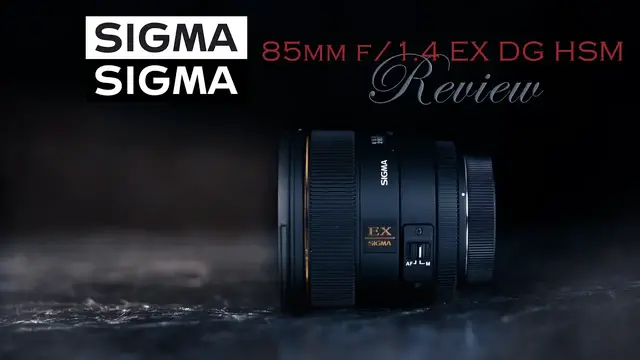
Sigma 85mm f/1.4 EX DG HSM Review
Jul 19, 2023

Photographer/Reviewer Dustin Abbott shares his thorough, real world review of the Sigma 85mm f/1.4 EX DG HSM lens. Shot with a vintage Helios 44-2 lens, this video has a very unique look to it. Read more detail in the written review here: http://bit.ly/1JW0JZE or purchase the lens here: http://bhpho.to/1Ez4uW6
Want to support this channel? Use these affiliate links to shop at:
B&H Photo: http://bhpho.to/1TA0Xge
Amazon: https://www.amazon.com/shop/dustinabbott
Ebay: http://bit.ly/DustineBay
Make a donation via Paypal: paypal.me/dustinTWI
Get a discount off all Skylum Editing Software (Luminar, Aurora HDR, AirMagic) by using code DUSTINHDR at checkout: http://bit.ly/LuminarDLA
Become a Patron: https://www.patreon.com/dustinabbott | Check me out on: Personal Website: http://dustinabbott.net/ | Sign up for my Newsletter: http://bit.ly/1RHvUNp | Instagram: http://bit.ly/DLAinsta | Google+: http://bit.ly/24PjMzv | Facebook: http://on.fb.me/1nuUUeH | Twitter: http://bit.ly/1RyYxIH | Flickr: http://bit.ly/1UcnC0B | 500px: http://bit.ly/1Sy2Ngu
My filming setup: Sony a7R III: B&H Photo: https://bhpho.to/2D6ibNO or Amazon: http://amzn.to/2CNxOvH | or | Sony a9 @ B&H Photo: https://bhpho.to/2HyWIyt or Amazon: https://amzn.to/2s1vYE0
Tamron 28-75mm F2.8 RXD @B&H Photo: https://bhpho.to/2FA00la or Amazon https://amzn.to/2G2kaEr
Lights: Rotolight AEOS @B&H Photo https://bhpho.to/2IK7mqV | Genaray Contender @B&H Photo: https://bhpho.to/33HbGNM | and Aputure AL-MW: https://bhpho.to/2N3MtZV
DISCLAIMER: This video and description contains affiliate links, which means that if you click on one of the product links, I’ll receive a small commission. As an Amazon Associate I earn from qualifying purchases.
Show More Show Less View Video Transcript
0:00
Hi, I'm Dustin Abbott and I'm here today to do a video review of the Sigma 85mm f1.4
0:18
This is the EX-DG HSM lens. Now this lens was not just recently released, it was released back in 2011
0:28
But I wanted to do a review of it for a couple of reasons
0:31
Number one, I've been intrigued with this lens for some time because by all reports
0:36
it has some great optics. At a reasonable price it comes in at right under $1,000
0:41
But when you compare either the Nikon or the Canon equivalents, they are about $1,700 for
0:48
the Nikon and around $2,000 for the Canon. And so this lens represents some great savings compared to those lenses while offering up
0:56
similar image quality. I've seen some beautiful images taken with the lens, and so I was intrigued with the lens for itself
1:03
Of course, also in the last two years, Sigma has been releasing a number of new lenses in its art series
1:11
And one of the hot rumors that goes around in the photography community is that at some point
1:16
Canon, excuse me, Sigma will be releasing an 85mm art series lens
1:22
Because of that, and having never used this lens, I wanted to do a review of it to kind of determine for myself
1:27
kind of the baseline should there ever be an art series release to compare it to
1:33
But also, I wanted to be able to evaluate this lens on its own merits
1:37
but by the standard of 2015. There have been some fantastic prime lenses released in the last couple of years
1:44
not the least of which are some of Sigma's own art series lenses. So, how is this lens standing the test of time
1:50
So, let's jump in and take a look. Let me add before we do that that I've got a kind of a unique look going here today
1:57
I decided for something different. I would film this with an old Helios 44-2. It's a 58mm F2 lens
2:04
back from the Soviet era. Mine says made in USSR on it and it has that unique kind of swirly bokeh
2:11
pattern you can see behind me. So just for something different. Anyway, back to the lens
2:17
Now this lens, let's take a quick look at the specs compared to the Canon 85mm F1.2. Obviously
2:24
the Canon does have a bit of an aperture advantage. It is unique in offering up that 1.2 aperture at
2:30
an 85 millimeter focal length. This lens is just a little bit longer than what the Canon is. It is
2:38
right around 3.4 inches long. The Canon is 3.3 inches. However, the Canon is more dense in its
2:46
build. It has obviously some larger glass with the 1.2 maximum aperture, but also more metal in its
2:53
construction and so it weighs considerably more. This lens weighs 725 grams. The Canon weighs
2:59
actually 1,025 grams, making it a very dense and heavy lens for its fairly compact size
3:06
This lens, it looks quite beautiful when it's mounted on a camera body because of that squat
3:15
prime shape that's so nice. And then of course, when you look at it from the front, you see just
3:21
a huge amount of glass. And of course, it kind of geeks out photographers like myself
3:26
to see all of that glass. And it looks great mounted on a camera. Now, I find that it's
3:32
a little less attractive Comes a little more average looking when you add the pedal shaped lens hood on it I always happy with the Sigma cases They are very nice they padded they useful i wish that other lens manufacturers would do something similar
3:48
with their lenses so kudos once again to sigma for that but one unique thing that's included in
3:54
the box is actually a lens hood extension if you happen to be mounting the lens on a crop sensor
4:00
body i've never seen anything like this before and i as i noted in my written text review i'm kind
4:06
of intrigued to know if anybody is actually using this, if it really is necessary. Sigma
4:11
obviously thought that it was, but to me it seems like a bit of a pain. But as you can see it adds
4:18
on about an inch and a half of additional length to the lens hood and that is so when mounting on a
4:24
crop sensor body with its crop factor, I just threw it here for these purposes on a Canon 70D
4:31
It's a Canon crop sensor body. So Canon has a 1.6 times crop factor. Nikon and Sony have a 1.5
4:40
times crop factor. So mounted on a crop sensor body, the effective focal length becomes something
4:46
closer to 135 millimeters. Sigma obviously felt that that additional focal length required a deeper
4:53
lens hood. And so I don't know if people are actually using this or finding it necessary
4:58
but it's kind of one of the interesting quirks of the design for this particular lens
5:02
On that note, let me just jump out and say I really had no issues with flare
5:08
I shot multiple times with putting the sun into the frame, and I really didn't have flare-related issues
5:14
I actually thought that that was one of the strong points for this particular lens. And so you can determine for yourself whether or not you deem that extension necessary
5:23
But I guess it's nice that it's there in case you do need it. So, this lens, as you can see, it's relatively short. It's not a difficult lens to pack along
5:33
It becomes much longer when you add the lens hood, and particularly if you're adding that
5:37
extension onto it. But beyond that, this lens I found kind of interesting because it doesn't
5:42
really fit into either the older category of Sigma lenses that were kind of marked by what
5:49
sometimes we refer to as a crinkle finish, kind of a very strong matted finish on there that was
5:55
very texturized. This lens is much smoother in its design. Frankly, I find it better looking than
6:00
what that older design was. But at the same time, it's not quite what Sigma's new global vision
6:07
look looks like, which is a little more sleek and modernistic. Beside that aside, this is on its own
6:13
merit. It's a nice looking lens. It has a gold EX Sigma badge on the side. It has a little gold
6:20
ring towards the front. You can hear that it's mostly that engineered plastics like many other
6:25
lenses. It's got a metal mount. The front filter thread is also plastic. And so anyway, it's a
6:34
fairly common. One thing that it does lack in the build is any kind of moisture resistance or weather
6:39
sealing. And that's fairly common for a Sigma Prime lenses. I don't think that I've actually
6:43
encountered one that had moisture resistance or weather sealing. It has only one switch on it
6:49
and that is the on and off switch for the autofocus, the HSM motor
6:54
It does, however, have full-time manual override, and so you probably won't be using that switch all that often
7:00
because at any point, if you do want a manual override, just grab the ring and turn it
7:05
One thing I did note that's somewhat unusual for a lot of autofocus lenses
7:11
is that this actually has a reasonable amount of room between like four feet and infinity
7:15
to where you can actually do some pinpoint auto focus. Sometimes lenses leave so little room between that point that it very hard to actually manual focus them So that another plus for this particular lens As far as the autofocus itself goes the lens it focuses fairly quickly
7:33
certainly faster than what the Canon 85L does, which is kind of notorious for its slow focus
7:40
Although on the plus side, it does autofocus accurately. So this lens is faster
7:45
The only time where I ever noticed it feeling kind of a bit sluggish is if I had it completely defocused towards its minimum focus distance
7:52
and then needed to jump out into a longer focal point, and then it seems kind of gradual
7:58
and it actually feels like it's moving a lot of glass, and of course that's exactly what it's doing
8:05
As far as other quirks, I did have some kind of weird behavior
8:08
when I was actually calibrating the lens. If you want more details than that, look at my written review, the linkages below
8:14
but those issues did not repeat themselves in actual field use. Overall, the lens performed
8:20
quite well, not what I would call top tier in its autofocus, but effective enough that
8:26
you know, although this is a demanding focal length, depth of field at 85 millimeters
8:31
an f1.4 is very shallow. And so it's a, it puts some work on into the autofocus system
8:38
but I found that overall my autofocus consistency was, was quite good. Not the absolute best as
8:44
some of my best lens in my kit, but better than a lot of other prime lenses that I've used. And so
8:49
I was not dissatisfied with that. It doesn't particularly like if you go into a live view
8:56
focus, particularly on my 6D, it does a lot of kind of pulsing and hunting. It's a little bit
9:01
better on this Canon 70D body, which has a far more robust system for live view, that dual pixel
9:09
autofocus there. But on its target bodies, full-frame bodies, it didn't particularly like
9:17
live view and tended to pulse and kind of hunt back and forth more often on that. Probably most
9:22
of you will not be using it very often in that fashion and with traditional viewfinder AF it
9:27
focused fairly quickly and quite accurately for me. The image quality is kind of the nitty-gritty
9:34
for a lens like this, and this lens certainly does not disappoint in that department. It has
9:39
really a beautiful color rendition. One thing that I love about the 85 millimeter focal length is it's
9:45
a great portrait length and delivers some great subject isolation, and so you can put your subject
9:51
at a medium distance. For example, here's a picture that I took of my son taking a picture, and at the
9:57
time I was about 15 to 18 feet from him, and yet you'll see that there's a beautiful isolation both
10:04
in the foreground and then in the background, just a nice narrow plane of focus that looks
10:09
really sharp. And I particularly enjoy that look. And so this lens delivers that very nicely
10:16
The bokeh for the most part is nice. It delivers a lot of that creaminess that you're looking for
10:21
I found in a few unique situations, and it was kind of a definite ratio, distance to the subject
10:27
and then distance from the subject to the background, that some of the edges could be a
10:32
little bit harder than what I would like, which suggests that around the bokeh highlights, there
10:36
can be a little bit harder of an edge than what I would prefer. But overall, the bokeh from this
10:42
lens is really pleasing. And here are some pictures for you to look at to kind of some
10:47
bokehlicious pictures for you to check out. Beyond that, the image quality, it does have
10:54
certainly have some chromatic aberrations. They're not out of control by any stretch of the imagination
10:59
and they not as persistent as what I noted in the Sigma 50mm F1 EX That not the ART series The ART series has much better controlled chromatic aberrations but the EX Sigma had fairly strong green fringing that I found very persistent
11:16
This lens, it's less obvious only really when you're looking at more of a pixel level
11:21
but at the same time, it's not as well controlled as what some of the releases in the last couple
11:27
of years. That's something that seems to have taken a big stride ahead, either through coatings
11:32
or element optimization in the last couple of years, the primes that have been released
11:37
have really done a fantastic job of controlling chromatic aberrations. And I suspect that if Sigma ever did release
11:44
an art series of this lens, that would be one area that you would see a notable difference
11:49
Another area that you might see some difference is in the overall contrast of the lens
11:55
Not to say that this lens lacks contrast. It's actually very usable wide open
11:59
and compared to a lot of other prime lenses, It doesn't have that soft or hazy look
12:05
But at the same time, of course, I've reviewed the Otis 85mm f1.4
12:10
and the contrast, the micro contrast on that lens is stunningly good
12:14
And this lens is not in that category, and that's another area that I suspect would be kind of upgraded
12:22
Beyond that, as you look at the actual resolution from this lens, the resolution is really quite good
12:28
And if you zoom in closely to images at wide apertures, I find that there is, for shooting more like landscape images
12:35
I find that there is a difference between f1.4 and f2. But even shooting at f2, I found that there was a really nice detail
12:43
For example, this elm tree that I shot in a field, this is at f2, and I was about 30, 35 feet from the subject when I shot the shot
12:53
And if you look at the crop here, you'll see that there's really nice detail in the branches
12:58
And that's a lot of detail to resolve there. And so I found that quite impressive
13:03
And so overall, the image quality from the lens is good. Nice color, nice resolution, nice bokeh, and very nice subject isolation
13:12
So if you're looking for a portrait lens and your budget doesn't run as high as the first party options from either Nikon or Canon
13:21
I consider this to still be a very valid option. And another thing is, is that even if you're shooting kind of the more everyday type things
13:30
a lens like this, while it doesn't have the versatility, obviously, of a zoom lens
13:35
and so you may not consider that an everyday type lens. But the reality is, is that shooting with a prime like this will make your everyday pictures seem a whole lot more special in their look
13:45
There's something about that narrow depth of field subject isolation that really sets images apart
13:50
and in a way that no kit lens or zoom lens without a very wide aperture is going to accomplish
13:58
And so I enjoyed using this lens. I enjoyed the images that I was able to produce with it
14:04
And I certainly still think that four years after its release, it's still a very viable option if you're looking for a great prime lens
14:13
but don't have the budget to go up to some of the top tier lenses in this
14:18
And so I think Sigma did a good job with this. And if you get a copy dialed in, and still I think autofocus is kind of your key thing
14:26
but if you get a copy where you get it nicely dialed in, I think that you're going to get some great results out of this
14:32
and produce a lot of images that you and your clients or your friends and family will be very pleased to look at
14:40
I'm Dustin Abbott. If you haven't already, please subscribe. Have a great day
#TV & Video