0:00
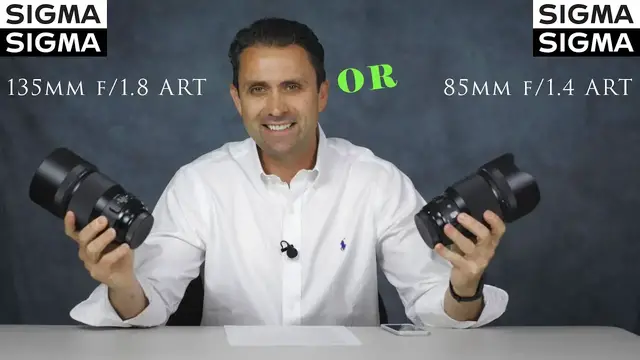
Hi, I'm Dustin Abbott, and I'm here today to give you a kind of five reasons to choose the 135 millimeter F1.8 art from Sigma and five reasons to choose the 85 millimeter F1.4 art from Sigma and five reasons to choose the 85 millimeter F1.4 art from Zima
0:30
Sigma. Now, if you haven't already seen them, I've done a much more detailed two-part breakdown
0:35
between these lenses, and I will throw links up to both of those episodes here. That first episode
0:42
I look at the overall sharpness and a resolution from the two lenses and compare them head-to-head
0:50
In that second episode, I take a look at the overall boca and rendering from the two lenses
0:56
and compare them head-to-head there. is really more of just a quick summation of what I perceive as being kind of the five
1:06
primary strengths as compared to the other lens for those of you that are weighing which
1:11
one of these you would like to add to your kit. And so first let me give you five
1:16
reasons for the 135 millimeter f1.8 art series lens from Sigma. In my opinion it
1:24
has better rendering out in the real world and it will give you more dynamic images
1:29
and because it just has, to my opinion, a little bit better blend between the actual sharpness
1:38
and then the rendering from the lens. And the 85 art is a sharper lens, but to me it's not as nuanced in the image quality that delivers
1:49
And so I think the 135 art stands out in that. The nature of the 135 millimeter focal length along with a larger than typical maximum aperture of F1 and 135 millimeter focal length allows you to create more boca along with a better quality of boca
2:11
And we saw that in our episode where we compared those things. It also has a better maximum magnification figure, which allows you to get closer to your subject
2:20
and thus really blow the background out. And so if you're all about creating more boca, the 135 millimeter art lens is the one to go for
2:31
Although neither of them show a lot of chromatic aberration in a chart test situation
2:37
Out in the real world, the 135 millimeter F1.8 has significantly less chromatic aberration
2:45
And so if you're bothered by CA, if you want to shoot video, the 135 millimeter lens delivers perhaps the
2:52
most neutral color and defocused area of what I've seen with no green fringing around it
3:00
There's no purple fringing when it comes to high contrast areas. It is its chromatic aberration control is exceptional
3:08
Surprisingly, it is the more compact lens of the two. And while it's still quite a heavy lens and is actually equal to the 85 art, it is physically
3:19
smaller in every detail. and that includes right down to the front element
3:25
where the 85 art has a larger 86-millimeter front filter thread, which is a more uncommon and thus much more expensive filter size
3:36
whereas the 135 art has a large but common 82-millimeter front filter thread
3:44
And so filters are going to be cheaper, and by the way, with large aperture prime lenses like this
3:51
If you going to shoot outside if you want to sync up with a flash you going to need to use at least an ND filter on these and maybe using a circular polarizer allow you to get some richer color results from them And so for that reason
4:07
I would recommend the 135 art. If you shoot outdoor portraits and you want to set your work apart
4:15
the 135 millimeter is going to give you a greater subject isolation. It's going to blur out the
4:21
background more. It's going to give you a more of a three-dimensional cutout look to your subjects
4:27
and thus it is the preferred option. However, there are some reasons to consider the 85 art as the
4:35
lens for you. The 85 millimeter focal length is, in my opinion, much more versatile than the 135
4:42
There will be a lot of situations where 135 millimeters is too long, whereas at least you have the
4:48
option with an 85 millimeter, particularly one that resolves. so highly to crop in the image to allow you to get closer. And so there will be situations
4:57
where you can move closer to your subject, but plenty of situations where you can't move any
5:01
further back. And so I think that the 85 millimeter is a more versatile focal length. It also
5:06
translate really well if you throw it on to APSC where it has a field of view, well, just like
5:13
this lens, very close to 135 millimeter. If you're looking for absolute sharpness, the 85 art is
5:21
at least in the copies I've compared, it is demonstratively sharper across the frame
5:26
both in the center and then right out to the edges of the frame. It is an extremely sharp lens
5:31
It is right up with the Zeiss Otis when it comes to overall resolution
5:37
It is of the two, the 85 art is the less expensive by a couple of hundred dollars
5:42
And so if you're trying to manage your budget and you're considering one of these two lenses
5:46
this has the advantage of being the less expensive option. it also has a maximum aperture of f1 which means that if you are a low light shooter f1 definitely trumps F1 and so it just gives you more light gathering potential and about two of a stop more light you going to be able to let into this lens as opposed to the 135 art
6:13
Beyond that of course it is also because of letting in more light and having a you know kind of a shorter focal length it will also be the easier
6:23
lens to hand hold, and so you can use lower shutter speeds by comparison. So if that's a big deal
6:29
to you, then this is the better low light performer. Finally, I would say that of the two, the 85
6:34
art is the better studio lens. Part of that has to do with the nature of the focal length itself
6:41
being a little bit sharper overall. It handles light and skin tones really, really well
6:46
and I think has a little bit more microcontrast compared to the 135 art. Out in the
6:53
real world where you're dealing with harsh sunlight's the better chromatic aberration control of the
6:58
135 comes into play but in a studio setting where you might be stopping the lens down more and you don't
7:04
have to you're not trying so much to just blow out a background i think that the 85 art is the better
7:10
studio option and so there you have it you have five good reasons to choose the 135 art you have
7:17
five good reasons to choose the 85 art and hopefully that will help you to identify
7:23
with, you know, which scenario appeals to you more and help your final buying decision
7:28
I'm Dustin Abbott, and if you'll look in the description down below, I've got linkage to both
7:33
my reviews of both of these lenses, buying links for both of them
7:38
And of course, you can follow me on social media, and if you haven't already, please click
7:42
that subscribe button. Thanks for watching. Have a great day