Up next in 10


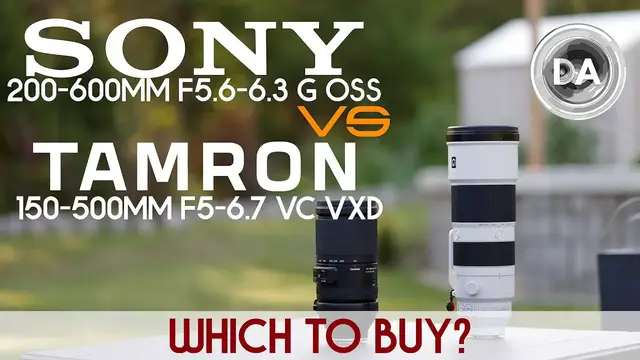
Photographer Dustin Abbott shares the strengths and weaknesses of the Sony FE 200-600mm F5.6-6.3 G OSS vs the Tamron 150-500mm F5-6.7 VC VXD. Which will work better for you? This video should help. Read the Text Review of the Tamron https://bit.ly/A057Review | Read the Text Review of the Sony http://bit.ly/FE200_600DA
Purchase the Tamron 150-500mm VC VXD @ B&H Photo https://bhpho.to/3uypy9y | Amazon https://amzn.to/3yGXJPX | Camera Canada https://shrsl.com/2zwh3 | Amazon Canada https://amzn.to/3c3yhKK | Amazon UK https://amzn.to/3yQgn7R | Amazon Germany https://amzn.to/3fwkf6s | Ebay https://ebay.us/ga91n3
Purchase the Sony FE 200-600mm F5.6-6.3G OSS @ B&H Photo https://bhpho.to/2sHUcUt | Amazon https://amzn.to/2ZRXXmi | Camera Canada https://shrsl.com/2zwhj | Amazon Canada https://amzn.to/37CaUTV | Amazon UK https://amzn.to/37JQLuX | Amazon Germany https://amzn.to/39LpGJF | Ebay http://bit.ly/FE200600
Purchase the Sigma 100-400mm F5-6.3 DN OS @ B&H Photo https://bhpho.to/2MX1XfA | Amazon https://amzn.to/3fmmjej | Amazon Canada https://amzn.to/30Fs5nl | Amazon UK https://amzn.to/2XXSuuS | Amazon Germany https://amzn.to/2Yxejk2 | Ebay https://bit.ly/100_400DN
Check out the DA Merch here: https://bit.ly/TWIMerch
=============================
Table of Contents:
=============================
0:00 - Intro
1:56 - Tamron advantages
6:31 Sony Advantages
10:54 Conclusion
---------------------------------------------------------
Purchase the Sony a73 at B&H Photo: https://bhpho.to/2HTcogD | Amazon: http://amzn.to/2GRoG7T | Amazon Canada: https://amzn.to/2KhSaON | Amazon UK: https://amzn.to/2I3NU4D | Ebay: http://bit.ly/a73DA | Amazon.de: https://amzn.to/2Hk7fwq
Show More Show Less View Video Transcript
0:00
Hi, I'm Dustin Abbott and I'm here today not to give you a review of either of these lenses
0:15
but rather a quick comparison of what I perceive as strengths and weaknesses
0:19
if you're trying to decide between the two. And so those two lenses are the Sony FE 200-600mm
0:25
f5.6 to 6.3 G OSS lens, and then the new Tamron 150 to 500 millimeter f5 to 6.7 Di3 VC VXD lens
0:40
Both of these are for Sony FE and they come in at different price points and obviously a little
0:46
bit different design philosophy, which lends to both strengths and weaknesses for both of them
0:51
Now, if you want a more extensive review of either one of these lenses, you can check out either my
0:55
extensive coverage of the Sony by clicking at the link here. And if you are interested in checking
1:02
out my full coverage of the Tamron, you can do so by clicking on the link up above here. There's
1:08
also links to both reviews down in the description below if you want to check out that. And so both
1:14
of these lenses, while they don't have identical focal ranges, they are designed essentially for
1:19
the same kind of purpose. And I think in many ways are marketed to the same kind of potential
1:24
buyer. So one of the first things to point out as far as distinguishing the two is when it comes to
1:29
price. The Sony reaches out 100 millimeters further, but it obviously is a much larger lens
1:36
and it has a larger price, about $2,000 US dollars. The Tamron goes 50 millimeters wider
1:42
and doesn't reach quite as far, ending off at 500 millimeters, but it is fairly extensively
1:49
relatively cheaper at around $1,400. And so first of all, let's talk about reasons why you might want
1:56
to consider the Tamron lens. And this is, to this point, I think the best third-party telephoto lens
2:03
that has come to the Sony platform, and it does have a number of strengths. Very obviously, as you
2:07
can see the lenses in front of me here, the Tamron is significantly smaller for transport. It's about
2:13
41% shorter in overall length compared to the Sony. And thus, it's going to fit in far more
2:19
carry solutions. It's far more likely that you're going to be able to transport it with the camera
2:24
mounted, maybe even the lens hood in place, ready for use. And so if you value transport
2:31
you know, maybe you have a, you know, a restriction of how much size luggage you can carry going on
2:36
Safari, or if you're backpacking and, you know, you only have so much room in your carry solution
2:41
whatever it is, the Tamron gives you a lot more versatility on how it can be stored and how it can
2:46
be transported Those physical advantages carry on when it comes to the front of the lens here where you have a fairly common 82 millimeter front filter thread And so if you wanting to for example use a circular polarizing filter which can be really
3:03
useful for enriching colors, maybe helping to reduce reflections, you know, depending on your
3:08
where you're shooting and under what conditions, that can be very advantageous. And so an 82
3:13
millimeter versus a 95 millimeter front filter thread. The Tamron switches feel better. As far
3:21
as the overall build, both of these are really, really nicely made lenses. The Sony has ever so
3:25
slightly more metals in the construction. The Tamron has a mixture of metals and engineered
3:30
plastics, but both of them have extensive weather sealing. And so that's not necessarily the problem
3:36
but when it comes to the physical design, I do prefer the switches on the Tamron that have a
3:41
just a little bit more of a high end feel. They're a little easier to access. The ones on the Sony are
3:47
quite small and a little less definite in their action. And so I actually prefer the switches
3:52
on the Tamron. The Tamron is lighter. Now, looking at them, you know, sitting side by side
3:59
you'd expect that weight distance difference to be significant. It's actually not. It's 215 grams
4:04
difference between the two lenses. And that puts the Tamron at right under two kilograms and the
4:12
Sony right over the top of two kilograms. So 215 grams difference, but you know, if you're really
4:18
counting the grams, that could be significant. I'll also note on the weight front that, you know
4:24
you do have the ability to fully remove the entire tripod collar from the Tamron. Whereas on the Sony
4:32
you can actually remove a collar, but you can do is remove the foot, but there's not as much
4:37
potential weight savings there. And just as an aside, I do appreciate the fact that the Tamron
4:42
is actually nicely finished off under this area. Sometimes lenses, if you remove their tripod collar, they really look unfinished
4:49
You know, maybe with exposed screw heads or whatever, this has a nice clean look
4:54
And so it's probably unlikely that you would often want to totally remove the tripod collar
4:58
But if you do so, you know, it doesn't look unwieldy or unfinished
5:03
One significant area of advantage for the Tamron over the Sony is that the Sony has a fairly typical for a big telephoto minimum focus distance of 2.4 meters
5:15
240 centimeters. And that gives you a rather low 0.20 times magnification. Not that that's
5:22
unusable. That's useful. Just not nearly as like what you're going to get on the Tamron
5:27
The Tamron gives you a variable minimal focus distance. And so you can get much closer at
5:33
for example, at 150 millimeters than you can at 500 millimeters. You can get as close as 60
5:37
centimeters or 0.6 meters on 150 millimeters and 1.8 meters at 500 millimeters. Either way
5:46
you can get significantly closer than you can with the Sony And at either point you have a much higher magnification figure The highest figure comes at that 150 millimeter length and that gives you as high as right over 0 times of magnification
6:01
Very useful. Almost one third life size. And then at 500 millimeters, you have a still very useful
6:08
0.27 times. Both of those figures significantly higher than the 0.20 times for the Sony
6:15
One final advantage for the Tamron that I want to point out is when it comes to the tripod foot
6:21
The tripod foot is Arca Swiss compatible, which means you can go right on a tripod with it
6:25
The Sony doesn't have that, and I have no idea why. So let's talk about why you might want to consider the Sony instead
6:34
The Sony, for some people, will particularly value the fact that this is an internally zooming design
6:39
And what I mean by that is that the overall length of the lens is fixed, which is, by the way, why it is so much larger physically
6:46
If you zoom the Tamron out 8 centimeters as, you know, when it's fully zoomed out, the difference in the two lenses is far less significant, though still appreciable
6:57
But the Sony is internally, completely internally zooming, which gives you a few advantages
7:03
Number one, I know that some of you will value the weather sealing on an internally zooming lens
7:08
Trust it more than what you do on a lens that is kind of going in and out
7:12
And there's the concern that that pump action will suck some dust into the lens barrel, eventually overuse
7:18
The Tamron is weather sealed against that, but I know that a lot of you trust internally zooming lenses more
7:24
And so that's an advantage. Also in the field, I find that just changing focal lengths, it's literally something you can do with just a fingertip and do very quickly
7:32
in the field. Once I'm already there, I certainly prefer the handling of the Sony for that reason
7:37
It's really, really great for, uh, for utilizing in the field because it's, it's big to get it
7:43
there. But once you get it there, it's really great to use. Uh, another thing that the Sony
7:48
has that the Tamron doesn't is that we actually have in three different positions, we have Sony's
7:53
focus hold button, which just gives you another point of control on the lens and a little bit
7:58
more versatility in controlling it. Now, a big difference between the two that is kind of Sony
8:05
imposed, but it is a factor to consider. And that is that the Sony is designed for use with
8:11
teleconverters. You can use either a 1.4 times or Sony branded two times teleconverter and
8:17
you know, obviously have those variations to the actual focal range. And so, you know
8:23
getting you out to about 840 millimeters, even with the 1.4 times, as much as 1200 millimeters
8:30
using a two times teleconverter. The Tamron is not physically designed to receive a teleconverter
8:37
And from what I understand, that is an imposed limitation by Sony. And so unfortunately, we
8:43
haven seen any third party lenses that are designed for use with teleconverters on the Sony platform So that a pretty big significant advantage Obviously the Sony does have a slightly bigger zoom range in general And
8:58
so going from, you know, two times all the way up to, or 200, I should, 200 millimeters all the way
9:04
up to 600 millimeters, it just covers a, you know, 400 millimeter span, which is a bit more than the
9:10
350 millimeters that you see covered by the zoom range on the Tamron. And of course, being able to
9:17
get that extra 100 millimeters on the telephoto in, where it's arguably most useful and far less
9:23
likely to be replicated by other lenses, is a significant factor for sure. And finally, if you
9:30
use one of Sony's action cameras, be it the A9 series or the Alpha 1, there is a big, big reason
9:38
why you might want to consider the Sony rather than the Tamron. It's another artificial Sony limitation
9:44
but at this point, Sony is capping off third-party burst rate on its sports bodies at 15 frames per second
9:51
Now, obviously, 15 frames per second is still a lot, and you can capture a lot of action with the Tamron at that
9:57
However, if you've invested in that shiny Alpha 1, and it's 30 frames per second
10:02
you're only going to get half of that with the Tamron, whereas if you use the Sony, you can unleash the full potential
10:08
of frames per second on the lens. And that obviously can be a really big factor if you're
10:14
invested in one of the actual action cameras from Sony. There is less variability in the
10:20
aperture on the Sony, but I don't consider that to be a tremendous strength. There's only one
10:26
third difference over the focal range. So you don't have much lighting changes. And I do like
10:31
that. But the reality is, is that over a lot of the shared zoom range, the Tamron actually has a
10:38
bit of an aperture advantage and lets in a little bit more light. And it's only when you get to about
10:42
480 millimeters that it goes past the Sony's f6.3 to f6.7. So we're going to call that a wash at the
10:50
end of the day. So hopefully this helps you in trying, if you're trying to weigh between these
10:54
two lenses and looking beyond the obvious factor of the differences in price, there's quite a
10:58
different philosophy in the design here and different strengths and weaknesses. And maybe
11:02
this list can help you to parse out what matters most to you. And that may be able to help to
11:08
influence, to give you a wise buying decision. I'm Dustin Abbott. And again, if you'll look in
11:12
the description down below, you can find links to my reviews of both of these lenses. And of course
11:18
there's buying links there if you'd like to check that out for yourself. And beyond that
11:21
there's linkage to pick up some DA merch, to follow me on social media, to become a patron
11:27
sign up for my newsletter. And if you haven't already, please click that subscribe button right
11:31
here on YouTube. Be sure to ring that bell so you get notifications when new content drops
11:35
Thanks for watching. Have a great day. Let the light in
#Science