Up next in 10


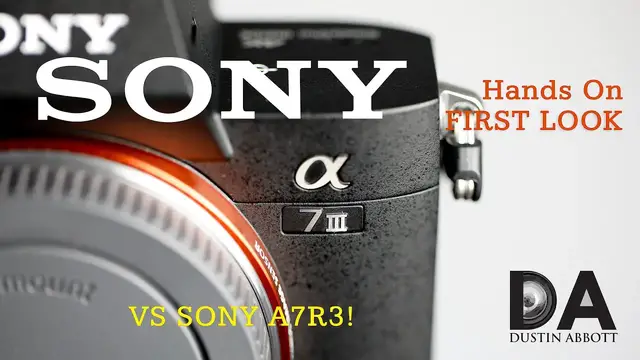
Sony a73 vs Sony a7R3: First Look | Photographer Dustin Abbott takes a thorough, detailed first look at the Sony a73 and breaks down some of the key features that set it and the Sony a7R3 apart. Visit the Image Gallery: http://bit.ly/a73ig | Purchase the Sony a73 at B&H Photo:
https://bhpho.to/2HTcogD | Amazon: http://amzn.to/2GRoG7T | Amazon Canada: https://amzn.to/2KhSaON | Amazon UK: https://amzn.to/2I3NU4D | Ebay: http://bit.ly/a73DA
Watson Chargers: https://bhpho.to/2JCHmcM
My a73 Strap of Choice: Peak Design Slide Lite: Peak Design Store: http://bit.ly/pdslidelite B&H Photo: https://bhpho.to/2BsubH2 | Amazon: http://amzn.to/2GcxINh | Amazon Canada http://amzn.to/2Fa5Yr7 | Amazon UK: http://amzn.to/2n6ALxC
Want to support this channel? Use these affiliate links to shop at:
B&H Photo: http://bhpho.to/1TA0Xge
Amazon: https://www.amazon.com/shop/dustinabbott
Ebay: http://bit.ly/DustineBay
Make a donation via Paypal: paypal.me/dustinTWI
Get a discount off all Skylum Editing Software (Luminar, Aurora HDR, AirMagic) by using code DUSTINHDR at checkout: http://bit.ly/LuminarDLA
Become a Patron: https://www.patreon.com/dustinabbott | Check me out on: Personal Website: http://dustinabbott.net/ | Sign up for my Newsletter: http://bit.ly/1RHvUNp | Instagram: http://bit.ly/DLAinsta | Google+: http://bit.ly/24PjMzv | Facebook: http://on.fb.me/1nuUUeH | Twitter: http://bit.ly/1RyYxIH | Flickr: http://bit.ly/1UcnC0B | 500px: http://bit.ly/1Sy2Ngu
My filming setup: Sony a7R III: B&H Photo: https://bhpho.to/2D6ibNO or Amazon: http://amzn.to/2CNxOvH | or | Sony a9 @ B&H Photo: https://bhpho.to/2HyWIyt or Amazon: https://amzn.to/2s1vYE0
Tamron 28-75mm F2.8 RXD @B&H Photo: https://bhpho.to/2FA00la or Amazon https://amzn.to/2G2kaEr
Show More Show Less View Video Transcript
0:00
Hi, I'm Dustin Abbott and I'm here today to begin my review series of taking a look at the new Sony
0:13
a7 III. And so as you can see I'm going to be doing a number of comparisons to the a7R Mark III
0:22
and you know kind of compare and contrast how these two models shape up when you're looking
0:28
at each one of them because I recognize there's a lot of people that are going to be debating between these two models. Now, just so you know, every time that I do a new review, I get a number
0:38
of requests to compare it to any number of possibilities out there. And I understand that
0:43
each one of you are making your own unique buying decisions. And so you want to see it compared to
0:48
this or that that might be on your radar. But just note that for the sake of this particular review
0:53
I'm going to be reserving my comparisons between the a7 III and the a7R Mark III for the simple
1:00
reason that I've compared the a7R Mark III to a lot of different competing cameras already
1:07
And so if you're interested in knowing how the a7 III compares to those others
1:11
you can look at how I cover compared to the a7R Mark III and then draw your own conclusions based
1:17
on my extensive playlist on the a7r mark iii, which I'll throw a link to that playlist right
1:24
here. And so today I'm going to be looking at the physical design and just kind of highlighting
1:30
some of the essential differences between the camera. And then we're going to spin out from here
1:34
and look into more detailed ysis of things like the sensor performance, the autofocus
1:41
performance, how it handles with, you know, adapted lenses and adapters. And so anyway
1:46
We're going to jump into those. Today I'm going to give you kind of a breakdown of some of the things that have stood out to me in the early going here as being kind of important in your buying decision
1:57
Now, of course, first thing to note is that the A7 III is a very, very competitively priced camera
2:05
And so part of the reason why it has captured so many people's attention is that unlike Canon's approach in particular and Nikon's to a lesser degree, both of those companies, particularly Canon, really kind of intentionally cripples their entry-level models in very obvious ways
2:26
I think that Sony's approach here has been a little bit more nuanced, and part of what they've done, of course, is they've kind of swung for the fences here in trying to entice people to make the switch to Sony
2:38
And so they've packed a lot into the a7 III that, frankly, competing cameras from Canon and Icon simply don't offer
2:47
And so, I mean, there's no question in terms of a complete package feature set, the a7 III blows the, say, the Canon 5D, or excuse me, Canon 6D Mark II out of the water in terms of the feature set
3:00
And so, you know, that's certainly a component of what's happening here. But priced at right under $2,000, this is a lot of camera for the money
3:09
And of course, you know, comparing it to the a7R Mark III, the price point of that is around $3,200
3:15
And so you're talking a more than 50% increase to go to the a7R Mark III as opposed to the a7 III
3:23
And so the biggest two things that, not to say that these are the only things that differentiate these models
3:29
but kind of like when I did an article years ago comparing the original 6D to the 5D Mark III at
3:35
the time, I noted that there was a lot of give and take between the two cameras. There were some
3:39
areas where the 5D Mark III was clearly superior, other places where the 6D was superior, and so
3:45
that made it a bit of a challenging decision-making process for a number of potential buyers at that
3:53
point, and I think that the same is going to be true here with the a7 III versus the a7R Mark III
3:58
So obviously, the number one most obvious way of differentiating these two models is where the R comes in, which refers to resolution
4:06
A7R Mark III has a 42, effective 42 megapixel sensor compared to an effective sensor of 24 megapixels in the A7 III
4:18
And so obviously, that does make a significant difference if, you know, depending on what your priorities are
4:24
There's probably a number of you that might conclude, well, 24 megapixels is plenty for what I do
4:28
And you're probably right. Others that say, I need that higher resolution for certain applications
4:34
And, you know, if you actually need the higher resolution, then, of course, you are right to say that you need that
4:40
On a practical level, let me tell you one way that I think that the difference in resolution does play out in my use so far
4:49
And that is with the a7R Mark III, because of that higher resolution, it has a very useful APS-C crop mode of 18 megapixels
4:58
which of course is 75 of what you going to get out of an a6500 in terms of resolution at an APS factor and of course with the sensor improvements that are inherent to the A7R Mark III
5:11
With the A7 III, your crop mode is only 10 megapixels, because you're cropping a much
5:17
smaller resolution to begin with. Byproduct of that, of course, is I find that 10 megapixel
5:23
images, to my eye, they lack the detail that I'm accustomed to seeing at this stage
5:29
And so I don't find the APS-C mode, at least for stills, to be as useful as they do on the A7R Mark III
5:36
The other kind of primary feature that differentiates these models is when it comes to the viewfinder resolution
5:43
And the viewfinder resolution and refresh rate is essentially double on the A7R Mark III
5:49
And so its OLED viewfinder will say 3.68 megapixels of resolution with a refresh rate of 120 frames per second
6:01
Byproduct of that is that it behaves much more. It's not quite to an optical viewfinder level, obviously, but it behaves a lot more like that
6:09
It also is very, very nice when you want to kind of magnify in on an image
6:13
So, you know, for example, I really highlighted in my review how much I like using manual focus lenses on the a7R III
6:19
Part of that, of course, is that great viewfinder when you're zooming into the image to magnify for focus
6:26
You can see a lot of detail. When I switched over to the a7 III, where it has, you know, 2.3 megapixels
6:35
basically it has basically half the resolution, and it also has half the refresh rate at 60 frames per second
6:41
It means that it kind of feels like someone who needs glasses and has forgotten to put them on
6:47
If you're familiar with the higher resolution, you certainly miss it on that
6:53
That also applies to actually to the LCD screen where you have a 1.4 megapixel resolution on the LCD screen compared to a 921,000 pixel resolution on the LCD screen of the a7 III
7:14
So, you know, two kind of major differentiators right there. But of course, at the same time, there are some advantages for the a7 III, part of which we're going to highlight here
7:24
Now, in terms of how that resolution plays out, a7R Mark III is 7,952 by 5,304 pixels compared to a very straightforward 6,000 by 4,000 pixels that are here on the 24 megapixels
7:41
Advantage of that is when it comes to your video performance, basically you've got a native 6K resolution there that is down sampled to a 4K resolution
7:54
Which means there's no pixel binning and you get a very, very clean look
7:58
That's at 24 or 25 frames per second. If you switch to 30 frames per second, there actually is a crop factor of 1.2
8:07
So a fairly minute crop factor, but there is a crop factor there. And so that is an advantage over you don't really get any full-frame readout without pixel bending on the A7R Mark III
8:21
And so you're going to get somewhat cleaner video in that mode out of the A7 III
8:26
And we'll do some comparison in the future about that. Another thing that stands out about the A7 III is that it actually inherits more of the A9's focus system than what the A7R Mark III does
8:39
Now, clearly Sony made a choice there. It may have been due to the amount of processing required
8:45
for that kind of focus system with the higher resolution. For whatever reason, the a7 III
8:51
whether that's the reason or not, it got a full 693 phase detection point, 425 contrast detection
9:01
points with a 93% coverage. And so we're talking about almost the whole frame is covered with AF
9:09
points, which of course gives this a very, very effective autofocus system that is very, very
9:15
similar to that of the A9. And so by comparison, the A7R Mark III, it has 399 phase detection
9:22
points, which of course is still a lot. It has the same contrast detection points, 425
9:29
Big difference, though, is that the coverage of the frame is 68% compared to 93%
9:35
You know, that's pretty huge. And so as a byproduct of that, I have noted already that I do see a difference when I'm using an adapter, for example, in adapted lenses
9:44
And, for example, if you look at some of these quick series here, I was using the Sigma MC11 and the Canon 100-400L Mark II
9:53
And while I got an occasional focus rack, which I helped to solve by starting to utilize the focus limiter on the lens
10:02
but I was able to actually track bird and flight surprisingly well And again and again when I zoomed in the images and saw them very very you know excellently focused I was pretty delighted about that And so you know for an
10:16
action camera, which really this is capable of doing because you combine a great focus system
10:21
with a 10 frames per second burst rate and then also you have a fairly robust buffer, which is
10:28
another advantage over the, it's a slight one, but, and it may not be a practical one for most
10:34
of us to be honest, but it is an advantage in that the A7R Mark III, when you're shooting
10:39
RAWs, you can have a buffer that runs as deep as 76 frames, whereas you can get up to 89 frames
10:48
in the A7 III. And so, you know, just a little bit of an advantage there and also some more JPEGs
10:55
as well. And so anyway, you know, it's got a great frame rate. It's got a fairly deep buffer
11:01
And so byproduct of that combined with a great focus system is that this is going to be a
11:05
surprisingly strong sports camera, particularly at this kind of price point. And you think about
11:10
the specs here compared to, you know, the $6,000 Canon 1DX, you know, a generation ago, and you
11:18
basically have almost everything there. I think the 1DX had a 12 frame per second burst rate
11:27
so just a little bit higher. But I mean, this is higher resolution and it has a firm rate almost as
11:33
high. I mean, that's pretty impressive performance there for a camera that comes in at $2,000
11:40
And so another advantage that we have here for the A7 III is that it has a higher native ISO range
11:48
And so it goes up to a native ISO range of 51,200, which of course has always been an expanded mode for most, well, basically any other camera that I've tested
12:00
Here on the A7R Mark III, you have a native ISO range up to ISO 32,000
12:07
And so, you know, expandable mode will go up to 102,400, but the expandable mode here goes up to 204,800
12:14
Which, by the way, there are very, very few applications for going into those extended ISO modes
12:20
I mean, just frankly, it's very rarely worth the trade-off. But we'll take a look at it in our ISO episode just to see how it plays out
12:28
But, of course, you're able to accomplish that with, you know, the sensor improvements that Sony has been doing
12:32
combined with the fact that it's not having to push a huge amount of resolution
12:37
You know, the A7RMR3 is carrying the weight of that 42 megapixels of resolution in everything that it does
12:44
We'll see how that actually plays out in a future episode. I was very delighted to see that unlike Canon
12:50
Sony has not chosen to cripple the camera in terms of things like its maximum shutter speed
12:56
Both of these are 1 8000th of a second. The maximum flash sync speed is still 1 250th of a second
13:02
And so, I mean, that is great things. The only thing that's really missing in terms of any kind of port on the A7 III
13:10
is that it does not have a PC terminal, flash sync terminal, and that may be a big deal for
13:17
a few of you. I suspect that most people, that's really not going to be an issue at all
13:22
Physically, the bodies are basically identical, other than, as I've noted, that one missing port
13:28
which you can't see unless you open up and look for it. The other thing is that the mode dial is
13:33
different between the two. The mode dial on the A7R Mark III has a lock button in it. It's got a
13:42
little bit more sophisticated bezel on the top where everything is actually, it's not just printed
13:48
on there, but it's actually etched in. There's also one more custom mode there compared to the
13:53
dial on the A7 III, which as I've noted, it doesn't feel quite as premium. It doesn't have
13:58
the lock mode and everything seems to be printed as opposed to etched on there. I don't know how
14:04
many people are wearing out the top of those buttons anyway, so maybe not a big deal in practice
14:09
Beyond that, the physical bodies are essentially identical right down to the weight that is only
14:15
seven grams different between the two. A7R Mark III is 657 grams. A7 III, 650 grams. So 1.43 pounds
14:26
versus 1.43 pounds. In truth be told, it is very hard by picking up these cameras and looking at
14:34
them even to be able to tell the difference between the two of them. Of course, the badge
14:38
on the front might be the only giveaway that you have to differentiate these two models. Both of
14:44
them, including the a7 III, fortunately inherits the new FZ100 battery pack, which is a huge
14:52
huge improvement over previous batteries on these cameras. And in fact because of the nature of the camera, again, it's not having to push that huge amount
15:01
of resolution so it conserves a little bit more power. The actual rating on the a7R Mark III is 650 shots per charge It 710 on the a7 III My own personal experience so far is that I actually routinely exceeding the rating on the a7R Mark III And after about five days of testing so far on the a7 III
15:25
I am showing still on my first charge, 84% battery. And so, I mean, battery life seems to be
15:32
fantastic on it thus far. And I'll report back to you on how that goes. By the way, you know
15:37
three, four weeks ago, I shot a wedding using A7R Mark III and my 5D Mark IV. And I actually
15:45
ran through the battery faster on the 5D Mark IV with about similar amounts of use. Battery went
15:51
dead. I still had about 40% charge on the A7R Mark III. So, I mean, it's a huge improvement
15:57
for Sony in that regard. Glad to see that carry on here. And so, as you can see, there's not a
16:02
whole lot to differentiate these in terms of the physical dimensions. They are exactly identical
16:07
It's the same casing, same frame. And so, of course, that comes with the pros and the cons of these bodies
16:14
There's ergonomic improvements to them. But also note that tests have shown a number of a teardown from Lens Rental that I've seen
16:22
and then some other tests show that the weather sealing is good on a good part of the camera
16:28
The bottom plate is not all that well sealed on either one of these
16:32
and so you're going to want to be careful about make sure it's never setting in water
16:37
because there's not a lot of weather sealing on the bottom. And so just note that ergonomically, the big advantage of Sony cameras
16:45
is that you can do a whole lot to customize them in terms of what button does what
16:51
in terms of your custom menu settings. A lot of people are not fans of Sony's menus
16:56
but if you will take a little while and you'll set up the custom menu
17:00
You can put the stuff that you actually need easily accessible and save yourself a lot of hassle
17:06
So if you'll invest a little time and learn how to set everything up on here
17:09
you can customize these cameras to work pretty much how you want them to work
17:14
And so I don't enjoy Sony cameras out of the box. After I customize them and get them set up, I do enjoy using them
17:20
And so, you know, that's equally true here. I'm going to give you one final note about what's in the box
17:26
There's one other kind of price-saving measure that I saw, and that is that it does not come with a dedicated battery charger
17:35
What you do have is an AC adapter, and it's going to rely out of the box on charging batteries in the camera
17:44
Obviously, that's not an optimal situation for anybody that does extended shooting to where you may need to swap a battery in the middle of a shoot
17:53
It's not going to be an option to charge the camera right in the middle. So, I mean, you do have the option of purchasing that Sony branded battery charger separately
18:03
It's over 80 bucks. I'll throw a link in the description down below. But there's also some options from Watson
18:09
I've done a review of some of these Watson chargers before. And, you know, the advantage of this, you know, Watson charger here, for example
18:18
is that it costs you about 20 bucks compared to 80 something bucks
18:22
And it does the trick, you know, it has a USB port there on the side
18:26
And so you could also, you know, theoretically, you could also charge a battery inside the camera as well if you wanted to do that, along with being able to just, you know, do a dedicated charge
18:36
And so I'll also throw the link to that Watson charger down in there. I suspect that if you don't already have it, you're going to want a, you know, an actual dedicated charger for the camera itself
18:48
But fortunately, I mean, that's not going to be a major expenditure if you go with a third-party alternative there
18:54
All in all, I mean, just as I found the A7R Mark III a very enjoyable camera to use
18:59
in most ways I'm finding the A7 III also equally enjoyable to use
19:04
The one area that I would say that I don't enjoy it as much is when it does come to the viewfinder
19:08
where it's a little less lively experience than what it is with the A7R Mark III
19:13
due to that lower resolution and refresh rate that goes a long way to helping you forget
19:18
that you're not using an optical viewfinder. And so, I mean, not quite as fantastic on the a7 III, but this is shaping up to be a great camera
19:27
If you look in the description down below, I have already got image gallery going where I'm doing some shooting
19:33
obviously, with adapted lenses along with native mount lenses, and there are image galleries for those things
19:39
some photos of the camera itself, and take a look at that. And, of course, you know, already huge demand for this camera, as you might expect
19:47
and so I do have linkage in the description down below where you can get your order in if you want one
19:52
It may be back order for a little bit, but if you'll get it in, the camera will get to you fairly soon here
19:58
Of course, you can also find linkage there to follow me on social media, sign up for my newsletter
20:03
become a patron, and of course, if you haven't already, please click that subscribe button
20:08
Thanks for watching. Have a great day. Thank you
#Consumer Electronics
#Camera & Photo Equipment
#Electronics & Electrical
#Sports