Up next in 10


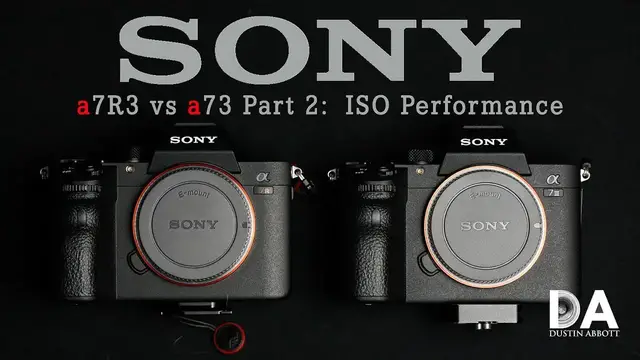
Sony a73 vs Sony a7R3: First Look | Photographer Dustin Abbott breaks down the ISO Performance in this first of a series of sensor reviews on the new a73. Visit the Image Gallery: http://bit.ly/a73ig | Purchase the Sony a73 at B&H Photo:
https://bhpho.to/2HTcogD | Amazon: http://amzn.to/2GRoG7T | Amazon Canada: https://amzn.to/2KhSaON | Amazon UK: https://amzn.to/2I3NU4D | Ebay: http://bit.ly/a73DA
Watson Chargers: https://bhpho.to/2JCHmcM
My a73 Strap of Choice: Peak Design Slide Lite: Peak Design Store: http://bit.ly/pdslidelite | B&H Photo: https://bhpho.to/2BsubH2 | Amazon: http://amzn.to/2GcxINh | Amazon Canada http://amzn.to/2Fa5Yr7 | Amazon UK: http://amzn.to/2n6ALxC
Want to support this channel? Use these affiliate links to shop at:
B&H Photo: http://bhpho.to/1TA0Xge
Amazon: https://www.amazon.com/shop/dustinabbott
Ebay: http://bit.ly/DustineBay
Make a donation via Paypal: paypal.me/dustinTWI
Get a discount off all Skylum Editing Software (Luminar, Aurora HDR, AirMagic) by using code DUSTINHDR at checkout: http://bit.ly/LuminarDLA
Become a Patron: https://www.patreon.com/dustinabbott | Check me out on: Personal Website: http://dustinabbott.net/ | Sign up for my Newsletter: http://bit.ly/1RHvUNp | Instagram: http://bit.ly/DLAinsta | Google+: http://bit.ly/24PjMzv | Facebook: http://on.fb.me/1nuUUeH | Twitter: http://bit.ly/1RyYxIH | Flickr: http://bit.ly/1UcnC0B | 500px: http://bit.ly/1Sy2Ngu
My filming setup: Sony a7R III: B&H Photo: https://bhpho.to/2D6ibNO or Amazon: http://amzn.to/2CNxOvH | or | Sony a9 @ B&H Photo: https://bhpho.to/2HyWIyt or Amazon: https://amzn.to/2s1vYE0
Tamron 28-75mm F2.8 RXD @B&H Photo: https://bhpho.to/2FA00la or Amazon https://amzn.to/2G2kaEr
Show More Show Less View Video Transcript
0:00
Hi, I'm Dustin Abbott and I am here today to give you a look at the high ISO performance
0:12
throughout the range of the new Sony a7 III. I'll be directly comparing it to the
0:19
Sony a7R Mark III using identical settings, same lighting, same color balance, same lens
0:28
on both of them and and so we can see how they perform up near the limits when it comes to ISO
0:34
performance and just so you know I have worked to upgrade these kinds of segments number one by
0:41
upgrading to a 4k display the BenQ SW271 display that I reviewed recently that you might want to
0:50
take a look at that if you haven't already I'm also I've moved to a new piece of software for my
0:56
screen capture that does allow me to record at 4k and it's the Wondershare Filmora software and so
1:04
as a byproduct of that you should be able to see more detail than you've ever been able to see
1:09
before in these segments and I hope it will make them more enjoyable for you. So without any further
1:14
ado let's jump in and let's look at some images together. Okay we're going to start off and for
1:20
this comparison the a7r mark iii is going to be on the left a7ii on the right and so looking at the
1:28
images globally starting at we're going to have identical settings throughout and one thing i
1:33
think will stand out let's just take a quick peek here just so you might note and that is that
1:40
there's a little bit more exposure value on the a7ii and so that's just something to bear in mind
1:49
for these ISO setting comparisons. And so there's a few things that we'll be looking at here
1:54
you know, kind of the black areas that should remain black, color fidelity, how things hold up
2:00
and how kind of noticeable grain becomes, an out of focus area
2:04
And then this is a particularly good area that will show any kind of discoloration
2:08
should that start to exist. And even inside here, sometimes you can see an area
2:14
where there is some pattern noise starting to observe in a darker area
2:19
So of course at ISO 100 everything looks very clean on both of them. One thing you will note
2:25
just by the comparison is how much more resolution there is, how many more pixels there are
2:30
with the a7R Mark III. And so looking for example here and you should be able to see because I'm now
2:37
using a 4k screen capture. You can see that in here there's actually you can actually see the
2:42
print texture on this, whereas that's not going to show up on the A7 III, just the sheer difference
2:49
in pixel size, and that's why one looks so much bigger than the other. Now, while I shot all of
2:55
the full ISO stops along the series, I'm going to skip through a few of them for the sake of time
3:00
so particularly some of these early ones between ISO 100 and ISO 800, because frankly
3:06
these cameras these days are so good that you're not really going to see any kind of
3:11
noticeable difference in those stops along the way. And in fact, even here going to straight to
3:17
800, you're really not going to see any difference than what we did before. Image quality on both of
3:22
these is essentially perfect. And so absolutely nothing to complain about. There's no noise
3:28
there's no patterning. Colors stay very true. I mean, there's just, everything looks great here
3:35
Okay, jumping up to ISO 3200, we're going to see that the picture is really quite similar here
3:41
and looking at the images globally I mean both look really really great Lots of you know apparent resolution at a just kind of standard viewing level Jumping into a pixel level you beginning to see just the faintest bit of
3:54
pattern noise in some of this. For example the text here and a little bit of noise in the defocus
4:02
region. It's not at all noticeable in any kind of meaningful way. However this is still a remarkably
4:08
clean image. I'm not seeing on either of them any kind of color banding starting to penetrate here
4:14
and any of the places where it would show up. Everything looks nice and clean still on both of
4:20
them. And I don't know that one looks better than the other here at this point. They just both look
4:25
pretty much perfect. From here on out, we'll climb at single stops. So jumping up to ISO 6400
4:31
once again, on a global level, everything looks really fantastic. And one thing I've really noted
4:36
on recent Sony bodies is that colors really hold up. They don't start to get kind of that faded
4:43
washed out look that has been typically associated with high ISO images. And that's just not the case
4:49
here. Probably the pattern noise is just, you know, one tiny degree further in terms of showing up
4:57
But once again, I mean, that is a perfectly usable image. And in fact, I doubt that anybody would
5:03
pick up on that if you weren't looking at a critical level like I'm looking right now that
5:08
this is ISO 6400 on either one of them. I mean it's just it really is perfect and maybe in this
5:13
area here we're seeing you know the the most highly defined noise and it is a little bit more
5:18
apparent on the a7R Mark III but remember also that's because there are so many more pixels here
5:24
that are being shown and so as a byproduct of that it does show up a little bit more but both
5:30
of them frankly are very clean. Now taking the next step up to ISO 12800, once again looking at
5:36
them globally, the images still look basically the same and so not a whole lot to pick up on there
5:44
Looking at them at a pixel level, I would say that the kind of the pattern noise is becoming a
5:49
little bit more apparent on both of them because of the size here, the resolution, it's a little bit
5:57
more apparent on the a7r mark iii but it's you know both of them are still very clean same is
6:04
true of our out of focus area noise here i do think what i am seeing is just a little bit of
6:10
green banding in here that i don't see um are i'm seeing a very very constant on the a7ii just a
6:17
very constant complete lack of any kind of discoloration meanwhile i do see a little of
6:23
that creeping into the a7r mark iii but again both of these have delivered at iso 12800
6:31
i would say a perfectly usable image now at the top part of the range for this sake of at to this
6:38
point there's really there's not as we've seen there's really not much difference to be seen from here on out i have what i've done is i have down sampled the a7r mark iii to the resolution
6:48
level of the A7 III. And so we can see kind of an apples to apples comparison here at the top part
6:55
of the range. Now doing this would create a very, very slight scenario that favors the A7R Mark III
7:03
just, you know, downsampling that increases apparent resolution while decreasing apparent noise. But as we can see, you know, now it is more equal between the two sides in the out-of-focus
7:14
area just in terms of the pattern noise there. I also will note here that there now is maybe
7:22
equal amounts of the kind of green discoloration. In some ways it's almost a little bit more apparent
7:28
on the A7 III at this point with all those pixels packed in At this point both of them are still showing a nice clean result in this area here And even if you look inside here while the noise is a little bit
7:40
rougher, it's not going turning any kind of discolored. It's still accurate. I will note
7:47
looking at these images globally that as we move into these higher ISO ranges, even with the down
7:53
sampling, you're going to see that while settings are identical, it's the exact same lens, native
7:58
mount lens and I'm using the brand new Miki 50mm f1.7. It's not an expensive lens but
8:07
works fine for this purpose here. I just happen to be testing it at the time. Anyway, what we're
8:13
going to see is globally it is a little bit brighter in image coming off the a7 III and so
8:19
I think that the sensor's sensitivity might be a little bit higher than what the a7R Mark III is
8:26
We'll see that a little bit more as we jump up further. Now at ISO 32000 we are actually at the
8:33
normal limits of the A7R Mark III and this is anything past this goes into what they call the
8:40
expanded range which typically I don't highly recommend. I will note that even looking at it
8:45
globally you can see that in this area here there is a little bit of kind of a green pattern that
8:52
is not there on the a7 III. You can also note that the image here is taking a slight greenish
8:59
tone, overtone, that while we have a very neutral looking result on the a7 III. Just so you note
9:07
I have set the same Kelvin balance for both these cameras, and so it's not a matter of just
9:13
you know, metering or anything. This is the exact same settings on both of them
9:17
So what we're going to see as we look at the camera here is that this is definitely a more accurate color
9:25
There is a little bit of a green bias that has come into the a7R Mark III that the a7 III does not have
9:32
Now, if we look in this zone here, both of them look very, very good
9:36
There is a tiny, tiny, tiny bit of extra contrast on the a7R III, and that is probably mostly a byproduct of the down sampling
9:45
In terms of the apparent kind of noise pattern, it is roughly similar on both of them
9:51
maybe a slight bit more pronounced on the A7 III. But as noted before, up in this area here, you can see some kind of green tinting
10:01
that's taking place on the A7R Mark III. It's not there on the A7 III
10:06
And so definitely at ISO 32000, I have to give the overall advantage to the A7 III
10:13
Now the upper normal limits of the A7 III is ISO 51200. This is actually into the expanded range for the A7R Mark III and so as a result you can just see that even more of that green bias is affecting kind of our color balance here
10:32
looking at the global image while you can see at a global level that there is some noise in this
10:38
it's very very good in terms of pattern there's not any kind of you know magenta patterns there
10:45
you know maybe a slight slight bit of a green bias which is the way that sony centers tend to
10:52
go in my experience but i would say that our color here is actually really really neutral
10:57
It almost looks like a comparison sometimes between a Canon and a Sony, but a7 III has done a really good job at maintaining color fidelity even this deep into the actual ISO range
11:11
So yes we are expanded here for the a7R III but I have down sampled to help it to look a little bit cleaner And so in result really is it actually better than what I expected That being said you can see some pretty serious you know kind of decoloration
11:27
and some of this going through that area there. Looking inside here, things are a little bit
11:33
you know, kind of rough. They're definitely cleaner on the A7 III. In terms of our colors here
11:39
color saturation is looking surprisingly good on both of them, really. I do think that the greens
11:46
are maybe a little overaggressive here on the A7R Mark III. But, you know, and you can see a little bit of green bias here
11:53
So for the A7 III, I would say, although I'm surprised to say it
11:58
that I would say this is still a very usable image at ISO 51200
12:04
And so all throughout the normal range, the A7 III is doing a great job
12:09
And this is definitely by far the best result that I have seen at ISO 51200 before
12:16
And so in my personal experience, the A7 III is the new ISO champ
12:21
Those of you that were a part of and watched some of my recent comparisons
12:26
I compared the 5D Mark IV with the Nikon D850. I compared the Canon 5D Mark IV with the A7R Mark III
12:37
And so in all of those, I found that the very best performance that I saw
12:42
was actually out of the A7R Mark III. What we have seen here is that Sony has managed to build upon the excellence of the a7R Mark III's sensor
12:51
And when it comes to the ISO range, they have given us an even stronger sensor in the a7 III
12:58
I have never seen so awesome a performance at the high end of the ISO range is what I see from the a7 III
13:05
in which I think without hesitation that those that shoot events, for example
13:11
they could shoot all the way up to the upper limits of the normal range of ISO 51,200
13:16
and still have perfectly useful images for things like events or photojournalism
13:24
Really even a portraiture in the sense that we're not getting skewed color balance
13:29
Everything is staying remarkably clean. And so if you have, you know, tolerance for a little bit more noise, but frankly, the noise at the high end is what we saw just a generation or so ago at ISO 1600
13:43
And so, I mean, the a7 III has gone a long way in expanding that upper range
13:48
And so if you're looking for a low light monster, the Sony a7 III is very impressive when it comes to that
13:56
And so when it comes to some of the features that have been touted with the new Sony a7 III
14:01
this is certainly one that it does live up to. Stay tuned and I'll be back to you shortly
14:06
I'm going to be looking in the next episode comparing these two cameras. I'm going to be looking at the dynamic range, both kind of in a lab setting
14:13
And then we'll take a look at how that plays out with some real world kind of landscape images and drawing back shadows
14:19
I already know that the a7 III is excellent when it comes to dynamic range
14:23
We'll see if the a7 III can keep up in that regard. So stay tuned
14:27
In the meantime, if you want to check out the description down below, you can find a linkage to the image gallery
14:32
that I've been adding a number of images to there from the Sony a7 III
14:37
You can also find some buying links if you'd like to order one for yourself
14:41
And if you're considering the camera, I think getting an order in sooner rather than later is probably wise
14:46
because this camera is going to have a ton of demand. You can also find linkage there to follow me on social media
14:52
become a patron, sign up for my newsletter. And if you haven't already
14:57
please click that subscribe button. Thanks for watching. Have a great day
#Computers & Electronics