Up next in 10

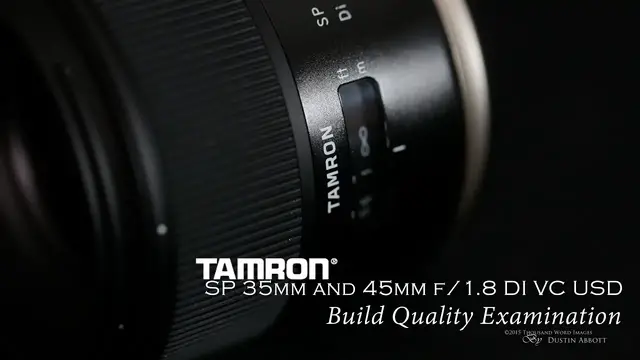
Tamron 35/45mm f/1.8 VC: Episode 1 - Build Quality
Jul 17, 2023

Photographer and Reviewer Dustin Abbott takes a close look at the build quality of the new Tamron primes - the SP 35mm f/1.8 Di VC USD and the SP 45mm f/1.8 Di VC USD. They are compared with their main competitors. To see an image gallery, click here: http://bit.ly/1Kx9cTy
To purchase the 35mm VC: http://bhpho.to/1LSgL51
To purchase the 45mm VC: http://bhpho.to/1MrXM45
Want to support this channel? Use these affiliate links to shop at:
B&H Photo: http://bhpho.to/1TA0Xge
Amazon: https://www.amazon.com/shop/dustinabbott
Ebay: http://bit.ly/DustineBay
Make a donation via Paypal: paypal.me/dustinTWI
Get a discount off all Skylum Editing Software (Luminar, Aurora HDR, AirMagic) by using code DUSTINHDR at checkout: http://bit.ly/LuminarDLA
Become a Patron: https://www.patreon.com/dustinabbott | Check me out on: Personal Website: http://dustinabbott.net/ | Sign up for my Newsletter: http://bit.ly/1RHvUNp | Instagram: http://bit.ly/DLAinsta | Google+: http://bit.ly/24PjMzv | Facebook: http://on.fb.me/1nuUUeH | Twitter: http://bit.ly/1RyYxIH | Flickr: http://bit.ly/1UcnC0B | 500px: http://bit.ly/1Sy2Ngu
My filming setup: Sony a7R III: B&H Photo: https://bhpho.to/2D6ibNO or Amazon: http://amzn.to/2CNxOvH | or | Sony a9 @ B&H Photo: https://bhpho.to/2HyWIyt or Amazon: https://amzn.to/2s1vYE0
Tamron 28-75mm F2.8 RXD @B&H Photo: https://bhpho.to/2FA00la or Amazon https://amzn.to/2G2kaEr
Lights: Rotolight AEOS @B&H Photo https://bhpho.to/2IK7mqV | Genaray Contender @B&H Photo: https://bhpho.to/33HbGNM | and Aputure AL-MW: https://bhpho.to/2N3MtZV
Show More Show Less View Video Transcript
0:00
Hi, I'm Dustin Abbott, and I'm here to take a first look at the new primes from Tamron
0:27
The new 35mm f1.8 DIVC USD along with the 45mm f1.8 DIVC USD lenses
0:40
And so today we're going to take a quick look at the overall size and dimensions along with the build quality here
0:46
and look to see if Tamron really is bringing something new and exciting to what is a fairly crowded field
0:53
I was excited to hear about the release of these prime lenses because I always like to have more options
1:01
And we've entered a time where there's some great competition in the market due to both products from the first party manufacturers of Canon and Nikon
1:09
But also Sigma has been producing some great lenses with its Art Series primes
1:15
And so really probably the chief target for Tamron is to try to get some of that market that Sigma has carved out for itself
1:23
And so we're going to take a quick look at the way that these lenses are designed and built
1:28
Now, as you can see, both of these lenses are not minuscule, but neither are they massively sized
1:37
And so just to give you a sense, here is the Canon 35mm F2 IS lens compared to the Tamron 35mm F1.8
1:49
And so as you can see, the Tamron is a little bit larger overall
1:54
To break down those numbers, the Tamron weighs 479 grams compared to 335 grams for the Canon
2:04
They both have a 67mm front filter. One thing to note differently between the two, however, is that the Canon has plastic filter threads in the front
2:15
The Tamron is actually almost all metal construction and has metal front filter threads, which
2:20
these days is fairly rare and unique, and it kind of sets it apart
2:25
Also, construction-wise, the Canon is primarily engineered plastics. You can hear that, very common, but the construction here of the actual Tamron is all of various
2:39
metals, and so it has a superb build quality. They both are similar in that they both have 10 elements
2:48
The Tamron is 10 elements in 9 groups. The Canon is 10 elements in 8 groups
2:54
The overall length, you can see that the Tamron is a bit longer
2:59
That difference is 63 millimeters for the Canon or 2.46 inches. The Tamron is 3.2 inches or 81 millimeters
3:10
and so another thing that Tamron is advertising is setting these apart is an incredible class
3:17
leading minimum focus distance and thus maximum magnification. In the case of these two lenses
3:23
this Canon is already really well performing in that regard. It will focus down to 24 centimeters
3:28
and has a 0.24 times maximum magnification. The Tamron will focus down a little bit closer 20
3:35
centimeters and thus has a 0 times maximum magnification And so of course another thing that a killer app for these Tamrons is that they have image stabilizing This Canon also has that It has a little bit
3:50
slower aperture, F1.8, or excuse me, F2 compared to the F1.8 for the Tamron. And so that image
3:57
stabilizer now becomes, on this lens, this becomes a lens with the widest aperture to have an image
4:04
stabilizing. And so in some ways, this becomes one of the most hand-holdable lenses available for a
4:10
Canon or a Nikon system, also for a Sony system. The Tamron has nine aperture blades, and of course
4:19
they're rounded blades. Everything stays nice and round when you stop it down. Similar for the Canon
4:24
except for it has eight aperture blades. A lot of people prefer the nine aperture blades because the
4:29
sun stars, sun bursts that can be created are a little bit more stylish with those nine aperture
4:35
blades. And certainly they look really nice in the Tamron. Now, of course, the real target for Tamron
4:41
is towards the Sigma Art series. And so the Sigma Art series 35 millimeter f1.4, it has been a very
4:51
popular lens and very well received by the photography community. And so this is really
4:57
going right after that and it brings a few extra things to the table. The big notable advantage for
5:02
the ART series of course is a wider maximum aperture of f1.4 compared to the f1.8 of the
5:09
Tamron here. However this lens of course is more compact comparative to this 479 grams for the
5:17
Tamron, 665 grams for the Sigma. Overall length is 3.2 inches or 81 millimeters compared to for the
5:26
Sigma is 3.7 inches or 94 millimeters. And then the Sigma is a little bit more complex, 13 elements
5:33
in 11 groups, and it doesn't have quite the maximum magnification. It only focuses down to 30
5:40
centimeters, giving it a 0.20 magnification compared to the 0.25. Also, there's a pretty
5:47
notable difference in price. This new Tamron is coming to the market at a price of $599
5:52
which by the way is the same as the Canon although the Canon currently has a $50 off sale on it at
5:59
I'm using U.S. photos or excuse me U.S. prices from B&H Photo and so in the U.S. right now it's
6:07
$549 for the Canon compared to $599 for the Tamron but the Sigma is $899 and so a $300 premium
6:16
for that. Of course, the Tamron also, to kind of offset that aperture disadvantage, it does add a
6:25
couple of things that might make you consider it when you're cross-shopping with the Sigma
6:30
Number one, it does come with an image stabilizer. It's a big asset in a lot of ways, but particularly
6:36
if you want to do video work. Also, if you're looking to do video work, I'm happy to report that
6:41
the focus rings on both of these new Tamron lenses is amongst the nicest I have ever seen
6:47
on a non-manual focus only lens. They really are damped beautifully. They work very accurately
6:56
It's really actually a joy to use them, which I don't often say that for autofocus lenses where
7:01
manual focus seems to be an afterthought. This overall build is also set apart. You can kind of
7:08
tell that Tamron took a page out of Sigma's book when they designed these lenses. They
7:15
don look much like the older Tamron lenses And of course my older Tamron 24 is only a few years old three years old at this point but they gone to a very different look that really is more like Sigma art series a kind of more serious contemporary
7:32
professional looking design. But while cosmetically they are similar, the new design of these Tamarons
7:40
is actually, it's a superlative build. It's much more use of heavy grade materials. And of course
7:48
they are claiming a weather sealing for this and that is manifest in a couple of ways. It has a
7:54
gasket here around the rear lens mount and then it also has a flooring coating on the front element
8:03
to resist moisture to allow it to be more easy to clean. So on these new lenses the new flooring
8:14
coating should make them very easy to wipe off and also to protect that front element and we see
8:20
that with just a quick wipe we restore a perfect front element so a nice addition to these Tamron
8:27
lenses. There's a lot of high grade the switches are very different than previous Tamron switches
8:34
this is a radically new design for Tamron and certainly it is more professional grade and so
8:41
there's a lot to like there. Now, when we go to look at the 45 millimeter, it is a lot of the
8:47
things that I've already said are highly similar for this. Let's just take a quick look at the
8:51
stats for this. As you can see, this lens, and I'm going to remove this lens cap. By the way
8:57
the rear lens cap and the front lens caps have been redesigned, much more classy looking. And
9:02
I've not been a fan of Tamron's caps previously. These are a huge step up. They're flared and
9:09
contoured and also they just fit on before the Tamron caps. They were kind of fussy about the
9:15
way that they would go on and where they would go on. Also with the new caps, they're chunkier
9:21
They're much smoother in operation. The actual pinch design in the middle is probably the nicest
9:27
that I've seen. And so they've really stepped up with these. You can see now that these Tamrons
9:34
that the 45 millimeter is a bit longer it's also a bit heavier because of that these are dense lenses
9:40
i mean there's a lot of metal in there they're nicely designed and so do compare them it's 479
9:47
for the 35 millimeter 554 grams for the 45 millimeter overall length 3.2 inches versus 3.6
9:55
inches they both have a 67 millimeter front filter thread this one is 10 elements in nine groups the
10:02
the 45 millimeter is 10 elements in eight groups. Now, while a 35 millimeter lenses tend to be
10:10
fairly decent when it comes to minimum focus, that's not been the case for 50 millimeter lenses
10:15
And I realize this isn't, isn't exactly 40 or 50 millimeters, but it's, that's the closest
10:20
competitors for this. And the average magnification for 50 millimeter lenses has been
10:26
pretty low 0.15 times. And so it's not completely unuseful, but it's far from being as useful as
10:34
what other lenses provide. This lens really differentiates itself from other lenses in that
10:41
regard. For example, other lenses, for example, the Canon 50 millimeter F1.4, it can focus down
10:50
to 45 centimeters for a .15 magnification. The Sigma Art Series is a little better. It can focus
10:58
down to 40 centimeters providing a 17 times magnification But this new Tamron it can focus down much closer 29 centimeters which results in an almost 0 times magnification 0 which makes this the highest magnification factor
11:20
outside of a macro type lens for a 50 millimeter-ish focal length. And so that makes this
11:28
very, very useful for a lot of applications. And frankly, for me, that's one of the key
11:32
things. I like to use 50 millimeter lenses, getting close to things, throwing backgrounds out
11:38
fine art shots, flowers, leaves. I spend a lot of time, as many of you know, out in the woods
11:44
So this is a big deal to me. And I really like that aspect of this lens
11:48
beyond that it also is $599 and and so it's a very very competitive price for a lens that
11:58
really has a build quality that is as a more professional grade than almost any of the other
12:03
50 millimeter lenses available almost none of the other 50 millimeters are truly weather sealed
12:08
and those that are the Canon 50 millimeter f1.2 for example is of course almost three times the
12:16
price. And so this is an overall, actually the build quality of this Tamron lens is actually
12:24
nicer than the 50 millimeter F1.2. And so these are really, really nice build quality lenses
12:30
Now, of course, that is a larger lens by a good margin than Canon's 50 millimeter F1.4
12:36
That lens is very diminutive, only two inches long and weighs 290 grams versus 3.6 inches and
12:45
544 grams. But again, the target probably is the Sigma Art Series. And of course that
12:52
Sigma Art Series is more akin in size to this 24 to 70 millimeter f2.8 lens. And so you can see
13:01
there's a significant size difference there. And just to give you the actual raw numbers
13:06
The Sigma Art Series is 815 grams versus 544 grams. It is just right under four inches long
13:16
compared to 3.6 inches. And so in millimeters, it's a difference between 100 millimeters and 91 millimeters
13:23
Larger front filter, 77 millimeters versus 67. The Sigma is 13 elements in eight groups
13:29
and its price is $949. and so there's even a bigger price difference when it comes to these two lenses and so certainly a lot
13:41
to think about and in our next segment we're going to begin to look at the image quality and some of
13:47
the feature list of these lenses and Tamron is really touting them as kind of pushing the SP as
13:55
the the line here or super performance and so let's answer the question are these lenses really
14:01
super performing. And so my name is Dustin Abbott. If you haven't already, please subscribe
14:07
We'll be looking at the overall performance in our next segment. And in the segment following
14:12
that, I'll be giving you my final verdict on these lenses. I'm personally interested in them myself
14:18
These are useful lenses at very good prices, very, very competitive prices. And so I'm scrutinizing
14:24
them very close, evaluating them whether or not they are potential candidates for my own kit
14:29
so thanks for watching i hope this begins to help you in your decision making process but
14:35
i'm excited about these new lenses and i look forward to delving deeper into them as we move
14:40
ahead have a great day