videocam_off
This livestream is currently offline
Check back later when the stream goes live
Up next in 10

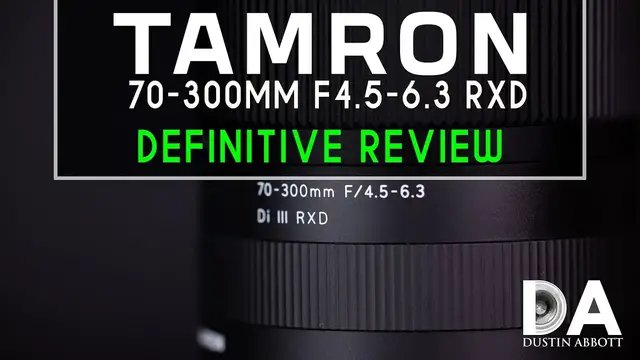
Tamron 70-300mm F4.5-6.3 RXD (A047) Definitive Review | 4K
Jul 19, 2023

Build and Handling 01:28 | Stabilization Observations 07:18 | Autofocus Performance 10:37 | Image Quality 13:00 | Summation 26:31 Photographer Dustin Abbott shares a thorough review of the bargain Tamron 70-300mm F4.5-6.3 RXD telephoto lens for Sony FE. | Read the Text Review: https://bit.ly/A047Review | Visit the Image Gallery: https://bit.ly/A047Images | Purchase the Tamron 70-300mm F4.5-6.3 RXD @ B&H Photo https://bhpho.to/3mKVfJl | Amazon https://amzn.to/3pnSAHI | Amazon Canada https://amzn.to/2K3PKY9 | Camera Canada https://shrsl.com/2mazp | Amazon UK https://amzn.to/2UtFo5S | Amazon Germany https://amzn.to/3nCgTAf | Ebay https://bit.ly/A047DLA
Purchase a Sony a7C @ B&H Photo https://bhpho.to/323jP0m | Amazon https://amzn.to/34MlE3z | Camera Canada https://shrsl.com/2l7yt | Amazon Canada https://amzn.to/3jGoN93 | Amazon UK https://amzn.to/2JoSnDL | Amazon Germany https://amzn.to/3mFxBy1 | Ebay http://bit.ly/Sonya7C
Purchase the Sony a73 at B&H Photo: https://bhpho.to/2HTcogD | Amazon: http://amzn.to/2GRoG7T | Amazon Canada: https://amzn.to/2KhSaON | Amazon UK: https://amzn.to/2I3NU4D | Ebay: http://bit.ly/a73DA | Amazon.de: https://amzn.to/2Hk7fwq
Sony a9 Camera @ B&H Photo https://bhpho.to/2HyWIyt | Amazon https://amzn.to/2B4NAjh | Camera Canada https://shrsl.com/2ikpx | Amazon Canada https://amzn.to/2peQkbn | Amazon UK https://amzn.to/2M7XPcY | Amazon Germany https://amzn.to/2VHbDOP | Ebay http://bit.ly/Sonyalpha9
Purchase the Sony a7RIV @ B&H Photo https://bhpho.to/2nUgnno | Amazon https://amzn.to/2oGpVD1 | Camera Canada https://shrsl.com/2imqe | Amazon Canada https://amzn.to/2mY8UDW | Amazon UK https://amzn.to/2n9GWF3 | Amazon Germany https://amzn.to/2nXhene | Ebay http://bit.ly/a7RIVda
Want to support this channel? Use these affiliate links to shop at:
B&H Photo: http://bhpho.to/1TA0Xge
Camera Canada: http://bit.ly/DLACameraCan
Ebay: http://bit.ly/DustineBay
Make a donation via Paypal: https://www.paypal.com/paypalme/dustinTWI
Get a discount off all Skylum Editing Software (Luminar, Aurora HDR, AirMagic) by using code DUSTINHDR at checkout: http://bit.ly/LuminarDLA
Become a Patron: https://www.patreon.com/dustinabbott | Check me out on: Personal Website: http://dustinabbott.net/ | Sign up for my Newsletter: http://bit.ly/1RHvUNp | Instagram: http://bit.ly/DLAinsta | Google+: http://bit.ly/24PjMzv | Facebook: http://on.fb.me/1nuUUeH | Twitter: http://bit.ly/1RyYxIH | Flickr: http://bit.ly/1UcnC0B | 500px: http://bit.ly/1Sy2Ngu
Show More Show Less View Video Transcript
0:00
Hi, I'm Dustin Abbott and I'm here today to give you my definitive review of the new Tamron 70-300mm F4.5-6.3
0:20
This is a Di3, which means it's made for mirrorless, in this case specifically for Sony FE full-frame E-mount
0:27
and it has their RXD focus system, which is something like rapid extra silent stepping drive
0:36
Now, of course, Tamron has really been kind of hitting it out of the park when it comes to their
0:41
zoom development for Sony FE, giving us one lens after another that, you know, while it's light on
0:47
features and sometimes skimps a little bit on zoom range, has delivered really consistently
0:53
excellent image quality and autofocus performance. And that continues to be a trend here, though in
0:58
this case we're getting a very traditional focal length of 70 to 300 millimeters. Now, today we're
1:04
going to be doing the definitive review of this particular lens, and so I'm going to be taking
1:09
time with features such as they are with autofocus and then particularly with the image quality
1:16
breaking things down. And so if you don't want all of those details, you want kind of the highlights
1:19
to my conclusions and I recommend you check out the standard review instead. Should be a little
1:24
bit more your speed. If you like the details though, you're in the right spot. We're going
1:28
to start by jumping in and taking a look at the build and the design and seeing what is present
1:33
here. So let's jump in and let's take a look. So the first thing that kind of stood out to me when
1:37
I unpacked the 70 to 300 AO47 as Tamron internally calls it, it was that it was a little bit larger
1:44
than what I expected. And that's partly because Tamron's early marketing, you know, talked about
1:49
how basically how small and light it was and certainly the lightness we'll get to in just a
1:53
second. That part of the marketing is true but as you can see physically it's really not any smaller
2:00
It's a little narrower but it's not really any smaller than Tamron's 70 to 180 millimeter f2.8
2:06
and so you know physically it's not necessarily a small lens. Now obviously it's considerably
2:12
smaller than a lens like the Sigma 100 to 400 millimeter you know which should be expected when
2:18
it comes to the overall focal length. And so it is more compact than that. But I think the big
2:23
thing that Tamron is marketing here is the fact that this particular lens, when you compare it
2:30
to the weight of say the Sony FE 70 to 300 millimeter, that lens weighs in at 854 grams
2:37
The Tamron is 545 grams. So we're talking about 300 grams difference in terms of weight. Now to be
2:44
fair, the Sony lens, you know, maybe a little bit higher grade of build, a little bit more feature
2:48
rich, and it does have OSS. However, if, you know, your priority is to travel light, Tamron has really
2:55
done a great job throughout their zoom lenses on Sony of, you know, making, I think, fairly smart
3:02
decisions about what to cut out and so that they can offer up really optically excellent lenses
3:08
that, you know, can come at a much more affordable price. And bottom line, I mean
3:13
this Tamron lens is incredibly affordable by comparison. It's $549, $550. The Sony lens on
3:21
sale right now, I think $100 off is $1,200. And so, I mean, it's less than half of the price of
3:29
that lens. So this is a fairly simple segment here because, you know, outside of, you know
3:36
a lens hood that mounts on and two rings, a manual focus ring, which has, you know, a decent amount
3:42
of damping works fine. You probably won't use it all that often, I suspect, but it does work fine
3:48
And then we have a zoom ring and the zoom ring also turns nice and smooth. There's just a little
3:53
bit of an extra release between 200 and 300 millimeters. And so the damping is not, I don't
3:58
think perfectly even. There's just a little extra movement there, but I mean, overall it works fine
4:03
The one thing I will say is that there's nothing else on here. There's no switches, there's no
4:08
locks and I did find, you know, I did a lot of hiking with this lens. I encountered a lot of
4:14
zoom creep. Now, as you can see, it's not because things are so loose here that it's just collapsing
4:18
in and on itself. But what happens is, you know, it's a big wide focus ring or zoom ring, you know
4:26
that's easy to get friction on it. And so as you're moving along hiking, invariably there's
4:30
going to be little bits of rubbing. And so it starts to extend out. And I just find that when
4:33
I go to reach for it, it's almost always extended. A zoom lock would be welcome
4:38
What Tamron has included is in good quality weather sealing which has been true of all their lenses
4:44
It has the shared 67mm front filter thread which so far all of their lenses for Sony which is now
4:51
I think somewhere close to eight of them all of them have a 67mm front filter thread which obviously
4:56
is incredibly useful to be able to share filters across the lenses. And so we've got a nice light
5:03
weight the lens is fairly long it's actually a hair longer 148 millimeters than the sony lens is
5:10
143.5 millimeters but the sony lens is 84 millimeters in diameter while this lens is only
5:17
77 millimeters and so obviously slimmer the sony lens has a 72 millimeter front filter thread
5:26
compared to 67 millimeters now you're able to focus down actually to a couple of different
5:31
focus distances depending on which end of the spectrum you're at. However, magnification is
5:36
going to be highest at 300 millimeters. And so you can't get as close, but obviously there's a lot
5:42
more focal range there. And so there you get right around a 0.20 times magnification, you know, good
5:48
not exceptional, but certainly useful. The Sony lens definitely exceeds that. However
5:53
it allows you to get a 0.31 times magnification. So it's much more useful in that particular metric
6:01
We've got 15 elements in 10 groups inside. We've got seven rounded aperture blades. And from what
6:07
I've seen, aperture of the aperture, it keeps the aperture fairly circular as you stop down
6:13
So overall, I mean, this is a, it's a very simple lens in terms of the feature set that's there
6:18
But, you know, Tamron has, you know, focused more on giving us a nice quality build and the build
6:23
does feel very good. I mean, and I've used, for example, the 28 to 75, which I'm filming on at
6:29
the moment. I've used that now for over two years, zero issues with it. And so I think they've done
6:34
a good job with the build. And as we're going to see, the performance of the lens is very good
6:39
It's just not all that feature rich. So as I noted, my first reaction to the lens was it was
6:43
larger than what I had expected. And that was largely because Tamron had really highlighted
6:48
smaller and lighter as a part of their marketing material. And it's definitely true that it is
6:53
lighter as we have seen, but it's not really smaller, maybe a little bit narrower, but
6:59
it's actually a little bit longer than some competing lenses, including the Sony
7:04
And so lighter I certainly grant the premise Smaller Not really I think that a marketing technicality But what we do have is a competent lens even if it is pretty light on features Now of course one of the areas or the one of
7:19
the features that really matters the most is a lack of in-lens stabilization. That's obviously
7:25
going to be a factor for certain people, and particularly if you have a camera body without
7:30
in-body image stabilization, then I don't really recommend that you buy this lens
7:35
hand-holding 300 millimeters is not fun if you don't have some kind of assistance from image
7:41
stabilization. For one thing, in the viewfinder itself, it's not much fun because without any
7:46
kind of stabilizer on, you're constantly dealing with movement within the viewfinder itself. And so
7:53
certainly it's better to have a lens or a camera with in-body image stabilization
7:58
And frankly, the newer your Sony camera is, the better performance you get with
8:02
IBIS in my experience. And so I actually did, you know, I did my formal test on the A7R Mark III
8:09
took some shots with that. However, because I had the Sony A7C in for a review at the time
8:14
I actually took a fair number of shots on that and then a few on my A9 following all of that
8:20
And what I found, of course, with the A7C having two advantages. Number one, it's the newest camera
8:26
of that trio, and it has the newest version of Sony's embodiment stabilization, which I find to
8:33
be a little bit more effective than what I've seen on third generation. So basically, fourth
8:36
generation cameras, which I include the A9 Mark II in there, they have tended to be a little bit
8:42
better than what I saw with third gen. And so I definitely saw improvement there, and of course
8:47
it's also, you know, only 24 megapixels of resolution. So I actually found that I didn't
8:52
really notice the lack of stabilization on that platform basically at all. I was able to get
8:58
you know, what I would consider the really important shots for image stabilization
9:03
you know, where for some reason changing lighting conditions drop you into, you know, an unexpected
9:08
160th or 150th of a second shot. And so, you know, under, you know, normal circumstances
9:14
those shots would be lost if you didn't have image stabilization. And so the fact that the matter was
9:19
is that I had pretty good success with all of those type shots, and so I was satisfied
9:24
You know, a little bit lesser true on my A9 just because it's not quite as good for image stabilization
9:30
but if you have an A7R Mark III, you're going to expect a little bit more punishment
9:34
because the in-body image stabilization is not quite as good, and it's higher resolution, so it shows off the motion blur a bit more
9:42
So my point is that your mileage will vary. I always recommend, however, that you keep your shutter speed up to an appropriate level
9:51
You know, if you try to keep it, even with, you know, even with lens stabilization, with a longer focal length
9:57
it's better to keep your shutter speed up, you know, well above, say, 1 1 20th of a second
10:03
I would kind of use 1 200th of a second as a threshold, just because even a little bit of movement in your subject
10:08
is going to show up as motion blur if you're using a low shutter speed
10:12
So, you know, just take that into consideration. I think that for many people that own a decent, you know, Sony camera with in-body image stabilization
10:21
you'll probably get by okay and won't really notice it too much. But just note, it's not as good as having in-lens stabilization
10:29
So that's one area where I think that the Sony, say, 70-300G is going to have an advantage
10:37
So how about autofocus? I've been really impressed with every lens so far that I have tested using Tamron's RxD
10:45
focus motor. You know even though it's a mouthful of of names when you break down what RxD means
10:50
the reality is is that this is a you know kind of a higher end linear motor stepping motor
10:56
where you're getting very very fast very very quiet and very accurate autofocus. And the only
11:03
time that I've really noticed any kind of issue is that if I'm shooting in really low lighting
11:08
conditions to where, you know, basically phase detect doesn't work as well. You know, F6.3 is
11:14
F6.3, which means that 300 millimeters, you know, an F6.3, that's not a big maximum aperture. So
11:20
there's only so much light that is reaching the sensor. You basically, no matter what you do
11:25
it can't open up wider than that. So it means that in low light conditions, this lens is going
11:29
to be no substitute for, you know, say a, the 70 to 180 millimeter F2.8 or a similar type lens
11:36
There's a reason why we pay more money for lenses like that for that kind of situation
11:43
But in reasonable light, autofocus was actually very, very fast and very accurate
11:48
And so again, you have to be smart about the way you use a variable aperture lens that has
11:53
a maximum aperture on the long end of f6.3. But my autofocus accuracy was excellent and IAF was very good, whether it was shooting
12:02
animals or even in a portrait session. And in both cases, I had very good IEF tracking and very consistently focused results
12:12
We can also see that when it comes to focus pulls that there's nothing but good here
12:16
Basically, complete silence in focus movement and good confidence without any kind of pulsing or settling
12:22
Let's take a peek. So I think we can agree that is a very nice end result
12:33
And so I'm very happy with autofocus performance there. And I just found that my accuracy throughout the whole time, I had no concerns at all
12:42
Focus speed was always good enough. I didn't really have an opportunity to shoot action so much
12:47
But in terms of the basic speed that I see, I think that, you know, under the right lighting
12:52
conditions and using a decent camera body, there's no reason why you shouldn't get good
12:56
tracking action as a part of that. So how about the image quality
13:01
Let's jump in and let's take a detailed look at what we've got in terms of image quality
13:06
First of all, this gives you an idea of the difference in the focal range, and obviously
13:10
you have quite a considerable amount of zoom capability, 70 millimeters to 300 millimeters
13:16
obviously a popular focal range for a reason, and you can see the reasons for that here
13:23
Now at 70 millimeters, we have an almost imperceptible amount of distortion and a bit of
13:30
vignette that is fairly concentrated into the corners not all that linear and so as you can see
13:35
as far as manual correction makes it a little bit harder to manually correct. I prefer a kind of a
13:41
more linear pattern but fortunately it's really insignificant as we'll see here. So for the manual
13:46
correction here I've input a plus 35 not all that significant or maybe a couple of stops right under
13:52
in the corners. Slid the midpoint over to give as you know clean a look as possible and I think that
13:57
for a manual correction it looks quite good obviously the ability to do that with a with a
14:04
correction profile will probably allow it to be a little bit cleaner which you'll get in camera or
14:09
for video and hopefully soon with for raw files now at 300 millimeters there's a much more obvious
14:15
amount of pin cushion distortion and frankly you start to see that at about 100 millimeters and it progressively gets worse as you move throughout the range so you have a little bit more distortion to correct Once again that pin cushion distortion will get corrected by the profile Now vignette is not quite as pronounced And so we take a look at what I did to correct
14:35
which I feel like I got a nice clean end result. So as you can see, I plugged in a minus eight
14:40
value to correct for the distortion. We have only a plus 17. Again, I slid the midpoint over, but
14:46
easy to really correct for and it corrected in a nice linear fashion and so everything looks fine
14:51
after correction as far as the distortion goes. So anyway not a huge deal there. So maximum aperture
14:59
at 70 millimeters is f4.5 and so if we take a look at our resolution this is at 200% on an a7r
15:09
Mark III, so 42 megapixels. You can see we have got good resolution with improving contrast
15:17
As you stop down a little bit, stop down to f5.6, our sender result becomes excellent. You can see
15:24
the moir pattern that is developing just because there's so much sharpness there. Mid-frame result
15:29
looks good. Wide open looks excellent by f5.6. Now, where I was a bit surprised is here in the
15:38
corners. And so, and I'll come back to this in just a second, that at 70 millimeters, the corners
15:43
didn't look all that great. It kind of reminded me actually of the Canon 70-200L that I recently
15:49
reviewed. And so I'm not all that impressed with that. And as we'll see, I can stop on down to F8
15:56
And while there is some improvement there, corners are still not exceptional, even at F11
16:02
We have, you know, I think, okay corners now. Corners would look fine at F11, but you're going
16:07
have to stop down pretty considerably if you want sharpness all across the frame. If we go back to
16:12
the middle, I mean everything is looking really fantastic elsewhere in the frame. We can see if
16:17
we look down here that, you know, contrast, everything looks good. No real sign of lateral
16:22
chromatic aberrations being any kind of issue there and contrast obviously looks really great
16:27
now even in the corners, but stopping down to f11 is necessary for that end result. So finally
16:34
minimum aperture which because it's variable aperture the minimum aperture will change f22
16:39
down to I think f35 and so anyway what we're going to see is that obviously the smaller the aperture
16:46
goes the more diffraction kicks in and so you can see that contrast has taken a pretty serious hit
16:52
and and so I mean I would only go to minimum aperture you know out of desperation because
16:57
you can see even compared to wide open we've lost a lot of contrast and clarity due to diffraction
17:03
here. So at 135 millimeters now our maximum aperture is f5 and so let's take a peek here in
17:10
the center of the frame. We can see that things look even better I would say wide open center of
17:15
the frame and even though it's only stopping down a bit f5.6 in this case it's only another third
17:22
of a stop you can see that it does look better in terms of our contrast. If we pop over here to
17:29
mid-frame. We can see the mid-frame looks excellent wide open and sharper still at f5.6
17:35
And we also will now see that the corner performance before is really an aberration
17:40
in that at 135 millimeters, corners look really excellent wide open and fantastic by f5.6
17:47
Stopping down to f8 gives us a little bit more contrast and clarity in those corners, but I mean
17:53
and back in the center of the frame, everything looks excellent. And so, you know, much less
17:58
necessary to stop way down to get a good corner performance here. It's available right from wide
18:04
open and even better at f5.6 and smaller. So by the time we get to 200 millimeters, in this case
18:10
it actually registered as 195, we can see we're now down to f5.6 as our maximum aperture. And as
18:18
we look at center of the frame and now we're doing the full stop comparison down to f8, we can see a
18:24
familiar pattern. It looks good. Good contrast, good sharpness wide open, and contrast kicks up
18:30
and a little bit more resolution at a stop down at F8. Mid-frame looks good wide open at F8. It
18:37
looks fantastic. Very, very sharp. Once again, corners look quite excellent. We get more brightening
18:43
of the corners as we go to F8. At F8, corner performance is really fabulous here. Just really
18:49
fantastic looking. Now this is a little bit lower resolution on the a7c this is f8 here but around
18:57
200 millimeters and we can just see how beautiful the just the all of the acuity kind of rendering
19:04
of these fine details is throughout the frame and so even as kind of the haze allows us to
19:10
not have as much contrast moving ahead you can see that the clarity rendering of all the details
19:15
there is really excellent. And so, you know, outside of that kind of quirk, you know, near the
19:22
corners of 70 millimeters, we really have a fabulous, fabulous amount of resolution here
19:29
So if we jump on to 300 millimeters, we see that we, it's not as sharp as what I saw at 200
19:35
millimeters, a little less contrast. And I think there's a little less in the tank in terms of
19:41
punch as we stop down to f8. Obviously we're at f6.3 by this point. However, it still looks quite
19:48
good. Very good resolution still. Mid-frame resolution looks basically as good wide open
19:54
as what we see stopping it down. And we can also see that the good performance in the corners is
19:59
continuing. And so a nice even performance. If we go from f8 to f11, it gives us just a little bit
20:05
more punch. And so don't hesitate even on a higher resolution to stop down if you're wanting to shoot
20:10
like for a landscape type situation. So of course I immediately kind of doubted my initial results
20:17
when I looked at my chart test and 75 millimeters seemed to be so far off. But fortunately I did
20:23
shoot also on a tripod. I shot infinity and so you know field curvature should not be an issue
20:30
here at infinity. And so if we look at the center of the frame both 70 millimeters and 101 millimeters
20:35
look really really excellent but as we start to pan towards the side things start to change what
20:42
we find is that it still looks really really good over here towards the edge of the frame at 100
20:48
millimeters but we see it has really softened up at 70 millimeters and so our distant textures are
20:54
towards the edge are not all that crisp and you can see even our distant textures at 101 millimeters
21:00
here they still look really really good right off into the distance and so it wasn't just an
21:05
aberration this was a reality that we can see there and as we saw as we stop on down 101 or
21:12
move on through the zoom range it said 101 millimeters and 134 millimeters at 134 millimeters
21:19
it looks really fantastic both of these looks looks wonderful moving from 134 millimeters to
21:25
around 200 millimeters we see that edge and even corner performance wide open still is looking quite
21:31
good right down there into the corner And finally at 300 millimeters obviously our framing changes because it getting tighter and tighter here but we can see that even looking into the distance
21:42
we still have good performance, though as we saw, contrast could probably improve
21:47
if we stopped down a little bit. And of course there's environmental factors
21:51
when you shoot over that kind of distance that makes it a little bit harder to make a verdict about sharpness
21:57
But at the same time, we can see that the pattern we saw on the chart test
22:00
does repeat itself out in the real world. So our magnification comes out to right around 0.20 times
22:08
and so it's a useful figure, not a mind-blowing one, but what we can see here is that our contrast
22:13
and our resolution up close is really quite impressive and so a really good result in terms
22:20
of the up-close focus ability. Now you can get physically closer at 70 millimeters, but you can
22:26
see that your magnification compared to 300 millimeters is still not nearly as good. What I
22:32
do see is that I think that sharpness is a little bit better at that kind of figure up close like
22:38
that. At 70 millimeters, it looks really, really fantastic. And so you might be able to find a
22:43
happy medium somewhere in between the two and kind of in the sweet spot if you don't need as
22:49
much magnification. But what we see is that at 300 millimeters, you can really, really blur out
22:53
that background, which is obviously an attractive option. Now we saw that lateral chromatic
22:59
aberrations are pretty well controlled. Here we can also see that longitudinal chromatic
23:04
aberrations at 70 millimeters on the left are just basically perfect. And so you can see really
23:10
really crisp contrast there. On the right side, we see that kind of an interesting phenomenon
23:18
And that is that typically I see more like purple fringing before the plane of focus and blue or
23:23
green fringing after. It's actually reversed here, which I don't know that I've ever hardly seen
23:28
before, but you actually will see a little bit of a blue-green fringing ahead of the plane of focus
23:33
and it's more neutral after the plane of focus. The good news about that is that you're far more
23:38
likely to have things after the plane of focus, and so you probably won't see a lot of it in the
23:44
real world. Here's a case in point here. We can see if we look at the out-of-focus area that you're
23:50
not really seeing any kind of fringing. However, you can see stuff right before the plane of focus
23:54
you do see a bit of that fringing. But what we also see is that even here at minimum focus
23:59
we've got really, really good contrast and detail there. And of course, a really good looking overall
24:05
scene. Now, in this case, at 300 millimeters, even though we've got bright light coming through
24:11
you know, difficult light catching areas, we don't really see any kind of fringing there on
24:16
the plane of focus. We can also see at quite a distance from the subject, you know, this is a
24:21
little, this is a much busier scene. And so you can see it gets a little bit busier. Overall, however
24:26
I think the bokeh from the lens is actually quite good. Here's a case in point. This is about 100
24:31
millimeters, which by the way, is a very strong point optically. Look how great, how sharp that is
24:37
And so you can see the bokeh there at that. If we zoom into 168, you can see the background starting
24:43
to get more compressed. And I think that the bokeh is looking better still. Subject matter
24:47
still looks fantastic. Very, very sharp at that point. And then of course, at 300 millimeters
24:53
the calculus completely changes and the bokeh looks really lovely. Sharpness looks good here
24:58
You can see again, a little of that blue green fringing before the plane of focus. I don't think
25:03
it's all that big a deal, frankly. And, you know, and here you can see some foreground bokeh
25:08
which also looks quite good and so overall I really do like the bokeh from the lens
25:14
Here's another example that shows that great combination of a really soft background. In this
25:18
case it's quite distant but then you can see just really amazing clarity and detail there
25:24
on our subject and so very very impressive end result. Great contrast there. Here's another case
25:31
in point you can see in this case if we zoom in great clarity and all the veins of the leaf it
25:37
looks really really fantastic. So of course you can use this lens for portraits certainly and as
25:43
you can see our detail even wide open is really really beautiful. IAF worked great in this scenario
25:49
and you know it's not going to crush backgrounds at you know this is somewhere around 105 millimeters
25:54
like an f2.8 lens would but everything still looks quite good. Here's another example and this is
26:01
more about like around 150 millimeters but you can see IAF has done a great job detail looks good
26:07
and the background looks nice and so you know again it's not going to to bleed away in the way
26:13
that a wide rapture lens would do but I think that you certainly could use this for portraits if you
26:19
were to purchase it. Finally a look at flare resistance and so you can see here as far as
26:24
stills go, we've resisted the sun quite well. And, you know, as you pan across here, you can see a
26:32
little bit more of the detail. So essentially there's only one misstep there, and that is the
26:37
corner performance at 70 millimeters. Outside of that though, basically everywhere you look in the
26:42
frame throughout all the rest of the zoom range, you have really, really good sharpness and contrast
26:48
So once again, Tamron, you know, it delivers a lens that's kind of short on features, but long
26:53
on autofocus and image quality performance. And I think it's been a winning formula for them so
26:58
far. And of course, what really makes this lens even more attractive is when you consider the
27:03
fact that the Sony 70-300G lens, while it has a bit more features and it does have an optical
27:09
stabilizer, it also retails for about $1,200 US dollars. Tamron is coming to market with a lens
27:16
that I, at least looking at the MTFs, I have not reviewed the 70-300G, but in terms of looking at
27:21
the MTFs. It is delivering, if at the very least, equal image quality. I suspect that autofocus
27:29
performance is probably going to be just as good, if not better. And it's coming to market at a
27:33
price tag of 550 US dollars, so less than 50% of the price of the Sony lens. And I think that for
27:41
a lot of you who are not looking for a serious telephoto that has longer reach than 300 millimeters
27:47
but you're just looking for a lens that will give you quality telephoto results
27:52
I see no reason why this lens should not be high on your list, so long as you have a camera that has in-body image stabilization
28:00
But it's delivering a well-above-its-price-point optical performance, has great autofocus, and, I mean, you know, it just delivers images in a, you know
28:09
lightweight, reasonably compact package that I think is going to make a lot of people very happy
28:15
I'm Dustin Abbott and if you'll look in the description down below you can find linkage to my full text review there's also linkage there to an image gallery
28:22
if you want to look at more photos and beyond that of course there's buying links if you'd like to purchase one for yourself also linkage to follow me on
28:29
social media to become a patron or to sign up for my newsletter and if you
28:33
haven't already please click that subscribe button right here on YouTube thanks for watching have a great day
#TV & Video
#Camera & Photo Equipment
#Home Furnishings
#Product Reviews & Price Comparisons