Up next in 10


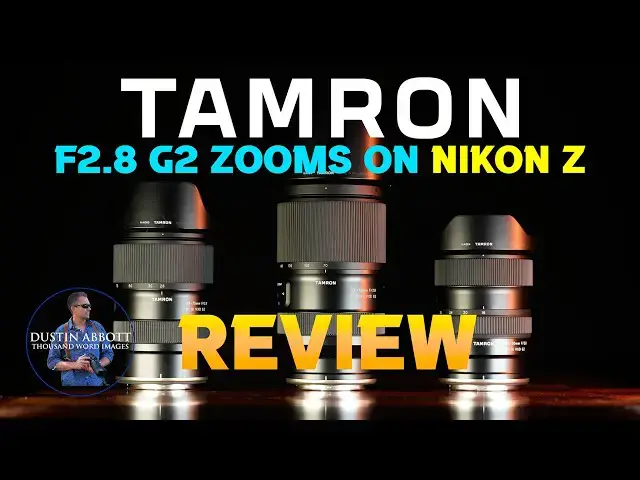
Photographer Dustin Abbott shares a deep dive review of the Tamron 16-30mm, 28-75mm, and 70-180mm F2.8 G2 for Nikon Z-mount. Is this Tamron trilogy worth investing in? |
16-30mm Reviews: Text: https://tinyurl.com/TAM16-30G2da | Video https://youtu.be/CxxObzTNm-E
28-75mm Reviews: Text: https://bit.ly/A063review | Video https://youtu.be/qbzpsV-PZWA
70-180mm Reviews: Text: https://tinyurl.com/70-180G2Z | Video https://youtu.be/ehB_9W3ofNk
Purchase the Tamron 70-180mm F2.8 G2 Z @ B&H Photo https://bhpho.to/4qFsyzn | Adorama https://howl.link/r42uye9xa2uym | Camera Canada https://tidd.ly/4hGp9MF | Amazon https://amzn.to/4oWsgTf1
Purchase the Tamron 28-75mm F2.8 G2 @ B&H Photo https://bhpho.to/4paV9ez | Adorama https://howl.link/bczdushpi55tt | Camera Canada https://tidd.ly/4olggKP | Amazon https://amzn.to/4hM9Uly
Purchase the Tamron 16-30mm F2.8 G2 @ B&H Photo https://bhpho.to/4ouj0WE | Adorama https://howl.link/d6ay2oacic5to | Camera Canada https://tidd.ly/3JtDzmK | Amazon https://amzn.to/4oxrT1i
Check out the DA Merch here: https://bit.ly/TWIMerch | Become a Patron: https://www.patreon.com/dustinabbott | On the Web: http://dustinabbott.net/ | Sign up for my Newsletter: http://bit.ly/1RHvUNp | Instagram: http://bit.ly/DLAinsta | Facebook: http://on.fb.me/1nuUUeH | Flickr: http://bit.ly/1UcnC0B | 500px: http://bit.ly/1Sy2Ngu Follow Craig @ https://www.instagram.com/craigstoffersen/
Want to support this channel? Use these affiliate links to shop at:
B&H Photo: http://bhpho.to/1TA0Xge
Adorama: https://howl.link/nt4zdz1goa7ql
Camera Canada: http://bit.ly/DLACameraCan
Sony Canada: https://www.thesonyshop.ca/?ref=abbott
Amazon: https://amzn.to/3HrY64d
Show More Show Less View Video Transcript
0:00
[Music]
0:10
Hi, I'm Dustin Abbott and I'm here today
0:12
to give you my overview of the Tamron
0:16
Trilogy/Trinity
0:17
of fast zoom lenses including the 16 to
0:20
30mm f/2.8 G2, 28 to 75mm f2.8 G2 and
0:25
then the 70 to 180 millimeter f2.8 8 G2
0:29
that I just reviewed uh just a couple of
0:31
weeks ago. Now, while I've reviewed all
0:33
three of these lenses previously over
0:35
the last around four years on Sony
0:37
E-mount, they have now all finally
0:40
arrived on Nikon Zmount. Not all at the
0:44
same time, but one after another. So,
0:45
I'm looking at the whole series if they
0:47
are a legitimate alternative for those
0:49
of you that are looking for a series of
0:52
f2.8 8 zooms and maybe you don't have
0:54
the same kind of budget that would go
0:57
all the way to the high-end very good
0:59
but very expensive S-line lenses from
1:01
Nikon itself. And so today I'm going to
1:04
give you just an overview of the
1:05
performance, what the features look
1:07
like, the autofocus and video
1:09
performance, and then of course a brief
1:11
look at the optical performance as well.
1:12
and we're going to determine whether or
1:14
not these lenses they hold up in the
1:16
transition first of all to Zmount, but
1:18
also if they are good options for you if
1:21
you are looking for zooms that fall into
1:23
these particular categories. And so all
1:25
of the three of these lenses were loan
1:27
to me by Tamron USA. However, they have
1:29
had no input on these reviews. As
1:32
always, it is a completely indiv review.
1:34
We're going to jump in and take a look
1:35
at the performance now. All right, let's
1:37
talk about the kind of build and
1:38
features, what you're going to get with
1:40
each one of these lenses. So, first of
1:42
all, in terms of price, 16-30 is $929
1:47
currently. The 28 to75 is the least
1:49
expensive at $849.
1:51
And then most expensive is the 70 to 180
1:54
mm, which is $1,149.
1:58
All three of these lenses do have very
2:00
similar levels of build build. They have
2:03
a similar kind of sculpted look to them,
2:06
similar feel to the various rings that
2:08
are on them. These would be on the nicer
2:11
side of what I would call a midlevel of
2:14
build quality here. So, they're largely
2:15
engineered plastics in the frame. So, it
2:18
doesn't feel like high-end metal
2:19
construction that you're going to see uh
2:22
you probably not the same degree you're
2:23
going to see on the highestend S-line
2:25
lenses, but not far off that either. All
2:28
three of them have a thorough weather
2:30
sealing to them. Starting with a gasket
2:32
at the rear mount, internal seals
2:33
throughout, flooring, coating on the
2:35
front element. So, ready for
2:37
professionalgrade use. As far as the
2:39
feature set, all of them are pretty
2:41
similar in that they have a function
2:43
button and then which is programmable
2:46
and then of course there is a USB C port
2:49
that will allow you to really control
2:51
the function of that. It also allows you
2:53
to tweak other behavior as far as the
2:55
behavior of the focus ring. And on here
2:57
on Nikon, that ring can it does operate
3:00
as a customizable control ring. And so,
3:02
for example, one of the things that I
3:04
like to do is I will set the ring up in
3:07
camera to function as an aperture ring
3:09
and then I'll program the function
3:11
button to function as AFMF. And so, if I
3:14
click that, then I can immediately focus
3:17
with the ring. And so it allows me to
3:19
get kind of the dual function out of
3:20
that ring very easily. One exception to
3:23
this is on the 70 to 180 millimeter. It
3:26
has a custom a custom switch with three
3:29
different positions. And so rather than
3:30
having just one function you can assign
3:32
to that, you can actually assign three
3:33
functions to it. It's useful and I do
3:36
like the customizable control here that
3:38
we have. I would prefer a more
3:41
conventional control structure, you
3:43
know, in terms of aperture ring and AFMF
3:45
switch on there, but Tamron has elected
3:47
to go a different route on that. Now,
3:50
all of these three lenses, two of them
3:53
to the 70 or 28 to 75 and 70 to 180,
3:56
they are externally zooming and so it's
3:59
not a long zoom, but there is an
4:01
external zoom to it. That's part of what
4:03
allows them to be a little bit more
4:05
compact in their retracted mode. The
4:07
16-30 is the exception to that rule, it
4:09
is an internally zooming lens. And so
4:12
while all three of them zoom relatively
4:14
smoothly, it is the 16 to30 as an
4:18
internally zoom that is the most
4:20
desirable in that quality there. All
4:22
three of them have share a 67 millimeter
4:25
front filter thread. That's a priority
4:27
for Tamron in the vast majority of their
4:29
mirrorless releases. And so great that
4:31
you can buy one set of filters and share
4:32
it across all three lenses. That's
4:35
great. Um, and each one of these lenses
4:37
is smaller and lighter than the
4:40
alternatives. At the same time, to be
4:42
fair, they also will often have a little
4:44
bit more constrained a zoom range
4:46
relative to the lens to compete with.
4:48
For example, the 28 to 75, instead of it
4:50
being a 24 to 70 millimeter, it doesn't
4:52
go quite as wide. And so, and it goes a
4:55
little bit longer, but that's an easier
4:58
zoom range to engineer for than what 24
5:00
to 70 is. And so, you know, part of the
5:02
reason why they achieve that, you know,
5:03
70 to 180 millimeter instead of 70 to
5:06
200 millimeters. And so, just be aware
5:08
of that. And I will note one other
5:09
caveat. And for the 70 to 180
5:12
millimeter, it's main limitation here on
5:14
Nikon is that it is not compatible with
5:17
teleconverters. Whereas the Nicor 70 to
5:19
180 mm, it is compatible with Nicor's
5:22
teleconverters. And so, uh, but that's
5:25
about the only way that that older Nicor
5:27
lens um competes with this one. This is
5:30
updated in pretty much every area
5:32
including autofocus. Let's talk about
5:33
that. So let's talk autofocus. Now all
5:36
three of the original Tamron G1 lenses
5:39
on Sony and then of course the Nicor
5:41
branded 17 to 28, 28 to 75 and 70 to 180
5:44
millimeter kind of rebrand rebranded
5:48
Tamron lenses and a hush hush wink wink
5:50
configuration. But uh all of those used
5:53
an STM type focus motor. Tamron called
5:55
it RXD. It's just called STM in the
5:57
nicor lenses. But in this case, all
6:00
three of these G2 lenses are using
6:02
Tamron's higherend VXD focus motor. And
6:04
that stands for voice coil extreme
6:07
torque drive. And so it is a a higher
6:10
thrust uh linear style motor that is
6:13
quieter and smoother in operation. And
6:15
as you can see here from these various
6:17
tests, all three of these lenses are
6:19
nice and snappy in terms of autofocus
6:21
speed. I would say if anything, they all
6:24
felt very much like using a Nicor lens
6:26
on my Nikon Z8. There was that same
6:29
degree of confidence and smoothness. It
6:31
didn't feel like a third-party lens
6:32
that's trying to figure out focus
6:34
algorithms, but it felt very natural and
6:36
at home for stills work. I would say
6:39
that the 16 to 30 and 28 to 75 are
6:43
pretty much perfect u in all the
6:45
situations that I use them in, whether
6:47
it's my outdoor style shooting or for
6:49
events or things like that. With the 70
6:51
to 180 millimeter, I had mostly
6:53
excellent results. I was able to track
6:55
birds in flight, for example, and had no
6:57
problem with tracking. And I do love
6:59
that here on Nikon, there is no
7:01
limitation on burst speed, for example.
7:04
And so, I was able to shoot at the full
7:06
up to 30 frames per second on my Z8,
7:07
which is fantastic, and was able to get
7:10
good results using that. However, at the
7:11
same time with the 70 to 180, I did feel
7:14
like there was a couple of occasions
7:15
where a focus was just very slightly off
7:18
where it was, you know, if it was a
7:20
face, it was just a little bit before, a
7:22
little bit after the eye and the plane
7:23
of focus. But, uh, in general, autofocus
7:26
was was pretty excellent. And I feel
7:28
like the little bit of tweaks that are
7:29
there on the 70 to 180, which is the
7:31
newest one released here, could probably
7:33
be smoothed out with a firmware update
7:35
and to get to just all-around excellent
7:37
performance, which is what I'm seeing
7:39
from the 16 to 30 and 28 to 75
7:41
millimeter G2 lenses. In general,
7:43
however, I would say for a third party
7:45
zoom, you're probably not going to get
7:47
better autofocus than what these three
7:48
lenses offer. Now, let's talk about
7:51
video autofocus. state of play here on
7:54
Nikon is that I would say video
7:56
autofocus generally is just not quite as
7:59
good as either Sony or Canon at this
8:01
point. It's making progress and moving
8:03
in the right direction. And in many
8:04
situations, obviously all of these
8:06
outdoor segments with any of these
8:07
lenses that I've used them, autofocus is
8:09
great. No problems there. However, there
8:12
are a couple of things that I do want to
8:14
delineate as a part of this. All of
8:16
these Tamron zooms, I would say that
8:18
autofocus for video is mostly excellent.
8:20
When it comes to touch to focus, you
8:22
know, pokes pulls back and forth. That's
8:24
one of the areas where there's a little
8:26
sophisticated sophistication needed on
8:29
Nikon. And so, most of those were pretty
8:31
good. Probably the least of those would
8:33
be the 70 to 180 at a longer focal
8:35
length. There's just a little bit more
8:37
burbles along the way and uh pulses as a
8:39
part of that process. I found when doing
8:41
my hand test, you know, where I I block
8:44
and then remove my hand, it it's it was
8:47
give and take a bit. Some of them work
8:49
like 16 to 30 was fantastic. 28 to75,
8:52
there was a reluctance to transition in
8:55
some cases. And even when approaching
8:57
the camera, for example, I tested just
8:59
here today on the 28 to 75mm, which I'm
9:02
filming with at the moment, and I found
9:04
that when I approached the camera and
9:05
then I duck down out of frame or I
9:08
stepped out of the side frame, I saw the
9:09
same thing I saw with the 70 to 180 mm,
9:12
which was essentially that the it just
9:15
kind of waited. It was very slow to
9:16
react. And so when I stepped back in
9:18
frame, I was basically in focus already
9:20
because focus had not left. But if
9:22
you're looking for something intentional
9:24
where you're wanting to be out of frame
9:25
and you're wanting focus to go to the
9:27
background, you know, there's there's a
9:28
little bit of sluggishness sluggishness
9:30
sometimes in that focus process. And so,
9:33
um, I would say in general, uh, however,
9:36
for just shooting clips, focus was
9:38
stable. I've used these lenses for some
9:40
of my YouTube episodes, as I'm doing
9:42
right now. No problems there. I found
9:44
with all three of them that I was
9:45
generally impressed with the ability to
9:47
zoom them and and for focus to stay
9:50
stable during that process. I'm not
9:52
saying that they're par focal, but I
9:54
will say that it's very hard for me to
9:56
perceive focus adjustment that is taking
9:59
place during any kind of zooming while
10:01
shooting video. And so I liked that. It
10:04
adds some versatility and particularly a
10:06
lens like the 16 to 30 millimeter
10:08
because it's internally zooming. You can
10:09
really really smoothly zoom that lens.
10:11
But in all three cases, they they zoom
10:14
fairly smoothly and so I was able to
10:15
incorporate that as a part of the video
10:19
process and uh I was able to do that
10:21
handheld in most cases. And so uh all of
10:24
that is good. So in general, I would say
10:26
autofocus is good. However, it is good
10:29
up to a Nikon standard and maybe a
10:32
little bit low below what I would see
10:34
with a native nicor lens, but close.
10:37
I've seen, let's just say, much much
10:39
worse results with some other thirdparty
10:41
brands here on my Nikon Z8. One other
10:44
thing that I will add to the video
10:46
autofocus area is that with all of these
10:49
lenses, I did test doing an aperture
10:51
rack and sometimes to incorporating both
10:54
a flare shot with an aperture rack to
10:55
show you the different quality of the
10:57
flare at different aperture values. I do
10:59
like the fact that here on Nikon with
11:01
that customizable control ring, you can
11:03
control that as as an aperture ring and
11:06
thus get those aperture racks. Something
11:07
I couldn't do previously on Sony. So
11:10
great on that front. Um, good news
11:12
there. So, let's talk about the image
11:15
quality here. And in this case, I'm just
11:17
going to give you a quick overview
11:18
because I've covered all of these lenses
11:20
thoroughly previously and you can find
11:22
my individual reviews on at least on
11:24
Sony and in the case of the 70 to 180
11:27
here on Nikon. You can find those linked
11:29
in the description down below. Each one
11:31
of these lenses is very competitive in
11:33
terms of sharpness and contrast. And if
11:35
you're looking comparing to an
11:37
equivalent Nicor Pro product, uh even
11:39
when you're comparing to the higherend
11:41
Sline, they're not quite as sharp, but
11:43
they are not radically less sharp. These
11:46
are all very high performing lenses that
11:48
have stood up against in, you know, both
11:50
of the platforms where I've tested them.
11:51
They hold up very well against
11:53
first-party competition. So, I don't
11:55
know that anybody's going to be truly
11:56
disappointed with the amount of
11:57
sharpness and contrast you can get out
12:00
of these Tamron zooms here. I would say
12:03
that each one of them also has a little
12:05
bit more flare issues than what is
12:07
optimal for me. I do like Tamron's BAR 2
12:11
coatings, but I would say that on these
12:12
zooms, there's there's moments where I
12:15
like would like a little bit more flare
12:17
resistance. And particularly with the 16
12:19
to30 and the 28 to75, these are lenses
12:21
that you're more likely because they
12:23
have a wider focal length to actually
12:24
have sun in the frame. And I would not
12:27
point to that as being an strength for
12:29
these lenses, but a bit of a weakness
12:31
for them. All of them do have some
12:34
distortion. And here on Nikon, they have
12:36
a bit more vignette than what I saw on
12:38
Sony E-mount. But in neither case is it
12:41
to any kind of significant level. And of
12:43
course, the fact that they constrain the
12:44
zoom sometimes and don't go as extreme
12:47
with them allows them to moderate the
12:49
amount of vignette. And in all cases
12:51
here, it is not bad relative to
12:53
competing lenses that I have test tested
12:55
before. I will also note that all three
12:57
of them receive full support in camera
13:00
for corrections, whether that be for
13:03
JPEGs or for video. And so that further
13:05
extends their usefulness. One thing that
13:08
stands out to me for all three of these
13:09
lenses is they exhibit really really
13:11
beautiful color and very very nice bokeh
13:14
and and I would say that that is a
13:16
strength for all of them. And in the G2
13:19
versions, I found definite improvements
13:21
on all three lenses relative to the
13:23
first generation lenses. And since those
13:25
Nicor lenses that I've mentioned, 27 to
13:28
excuse me, 17 to 28 millimeter, 2875, 70
13:31
to 180, since those were all those
13:33
Tamron optical designs, these are all
13:35
going to be improved in the smoothness
13:37
and the quality of the bokeh. I also
13:39
feel like the colors are richer in the
13:41
G2 versions. the optical glass and the
13:43
coatings has improved a bit to where I
13:45
did find more of just a general pop to
13:48
images that I didn't see in the first
13:50
generation of the lenses. All three of
13:52
them also have very useful levels of
13:54
magnification. You're typically going to
13:56
access that on the wide end where you're
13:58
going to get your highest level of
13:59
magnification, but they are all very
14:01
competitive in that regard. And you
14:03
know, for example, here with this shot
14:05
with the 16 to 30 mm, you can see I can
14:07
get very close to the subject and get a
14:10
very high level of magnification with
14:12
still very sharp looking in results. So
14:14
all of that is really good. The 16 to 30
14:17
and then the 70 to 180 millimeter, I
14:19
feel like they have very very good
14:21
chromatic aberration control. Very low
14:23
levels of fringing. I noticed the most
14:25
fringing with the 28 to 75 millimeter,
14:28
but I also noted at the same time, which
14:30
is sometimes a trade-off when there's a
14:31
bit of fringing, the bokeh rendering is,
14:34
you know, kind of a little extra special
14:36
for a a lens in this category, a zoom in
14:38
this category. And so there's some give
14:41
and take there, but you will notice a
14:42
bit of fringing, particularly after the
14:44
plane of focus with the 28 to 75 that
14:46
you won't see on either one of the other
14:49
two. I would say in summation that all
14:51
three of them are very competitive
14:53
optically and I suspect that everyone
14:55
who uses them is going to find that they
14:58
are pleased with the kind of images they
15:00
can get out of these lenses. And that
15:02
leads me to my conclusion because the
15:05
fact that these are competitive
15:07
optically and also now on the autofocus
15:10
end of things with more expensive lenses
15:13
really makes them a very intriguing
15:15
option from a value perspective. I noted
15:18
that you could put you could buy the all
15:20
three of these lenses, the 16-30, the 28
15:22
to75, and the 70 to 180 for just $28
15:27
more than the 70 to 200 S-line lens
15:30
alone. And that is, you know, roughly
15:33
similar for some of the competing
15:34
lenses, you know, like the new 24 to 70
15:37
Mark II from Nicor. Those lenses,
15:39
they're great, but they are very
15:41
expensive. So, if you're someone who's
15:43
on a tighter budget and you're looking
15:44
for professionalgrade zooms, these are
15:47
going to be a really intriguing option
15:49
for you. And certainly, you could buy
15:50
any two of these lenses for far less
15:53
than any of any one of the equivalent
15:55
nicor lenses. And so, that is, I think,
15:58
going to be a really, really compelling
15:59
value. I think these are great additions
16:01
to Nikon because of the strong
16:03
performance, better autofocus, more
16:05
features than the original Nicor branded
16:08
Tamron zooms and are a a solid upgrade
16:12
in some cases. Um, you know, but if
16:15
you're happy with what you have already,
16:16
continue to use it. But certainly as a
16:19
level of competition, these are great
16:20
additions to the market. Again, if you
16:23
want more information, feel free to
16:24
check out the linked reviews in the
16:26
description down below, and there's some
16:28
buying links there. As always, thanks
16:30
for watching. Have a great day and let
16:32
the light in.
#Science