Up next in 10


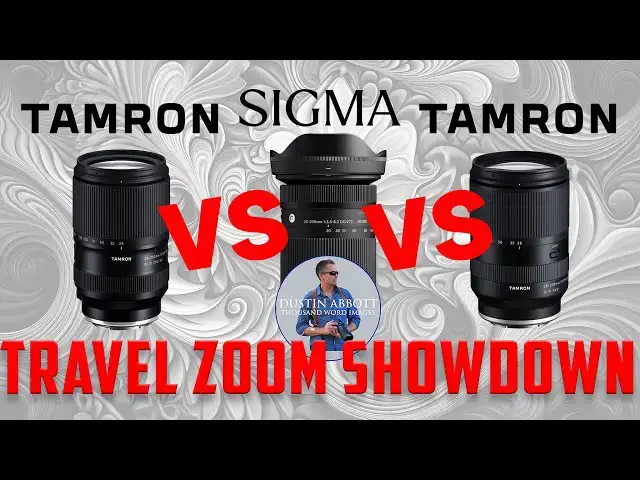
Photographer Dustin Abbott compares the three main travel zoom options - the Sigma 20-200mm Contemporary vs the Tamron 25-200mm VXD vs the Tamron 28-200mm RXD.
25-200mm Reviews: Text: https://tinyurl.com/Tamron25-200DA | Video: https://youtu.be/BuxlULsLJdw
20-200: Text: https://tinyurl.com/Sigma20-200Cda or Video: https://youtu.be/tcIXarksRjs
28-200mm: Text: Read the Text Review: https://bit.ly/A071Review or Video: https://www.youtube.com/watch?v=BoqMuRg4sio
Purchase the Tamron 25-200mm F2.8-5.6 VXD G2 @ B&H Photo https://bhpho.to/48MfXUA | Adorama https://howl.link/7y6xvy0fzxug6 | Amazon https://amzn.to/4nabqyF | Camera Canada https://tidd.ly/3WMYiVL | Amazon Canada https://amzn.to/4oeZYTW | Amazon UK https://amzn.to/4oFALBL | Amazon Germany https://amzn.to/4noqKb1
Purchase the Sigma 20-200mm DG @ B&H Photo https://bhpho.to/42p6rT9 | Adorama https://howl.link/wzx5nhpoc91sz | Amazon https://amzn.to/42o2y19 | Camera Canada https://tidd.ly/4mrm3gj | Amazon Canada https://amzn.to/46uXw3S | Amazon UK https://amzn.to/4nEHco3 | Amazon Germany https://amzn.to/3I6USJL
Purchase the Tamron 28-200mm F2.8-5.6 RXD @ B&H Photo https://bhpho.to/2V1oooe | Amazon https://amzn.to/2zTeqy2 | Amazon Canada https://amzn.to/3dj79Fn | Amazon UK https://amzn.to/2Yh31S2 | Amazon Germany https://amzn.to/2V5JEJH | Ebay https://bit.ly/A071DA
Check out the DA Merch here: https://bit.ly/TWIMerch | Become a Patron: https://www.patreon.com/dustinabbott | On the Web: http://dustinabbott.net/ | Sign up for my Newsletter: http://bit.ly/1RHvUNp | Instagram: http://bit.ly/DLAinsta | Facebook: http://on.fb.me/1nuUUeH | Flickr: http://bit.ly/1UcnC0B | 500px: http://bit.ly/1Sy2Ngu Follow Craig @ https://www.instagram.com/craigstoffersen/
Want to support this channel? Use these affiliate links to shop at:
B&H Photo: http://bhpho.to/1TA0Xge
Adorama: https://howl.link/nt4zdz1goa7ql
Camera Canada: http://bit.ly/DLACameraCan
Sony Canada: https://www.thesonyshop.ca/?ref=abbott
Amazon: https://amzn.to/3HrY64d
Show More Show Less View Video Transcript
0:00
[Music]
0:11
Hi, I'm Dustin Abbott. For the last
0:13
probably about 5 years, Tamron has
0:15
pretty much been able to dominate the
0:18
travel zoom space all-in-one for
0:21
full-frame with their 28 to 200
0:23
millimeter RXD lens. Now, there is a
0:27
Sony branded lens, but that lens is
0:29
considerably older and not nearly as
0:31
optically competent as this. So, this
0:32
has been the lens I've been recommending
0:34
for years. Over the last couple of
0:37
months, however, we've seen first Sigma
0:39
with their 20 to 200 millimeter and then
0:42
Tamron with their updated 25 to 200
0:45
millimeter enter into the space and now
0:47
give us more options. Now,
0:49
unfortunately, I did not manage to have
0:52
the Sigma and the new Tamron together at
0:54
the same time and so that I could do one
0:56
of my true head-to-head videos where I
0:59
can shoot them in identical situations.
1:01
And so, for those of you that are
1:02
looking for a video like that, I want
1:04
you to know upfront I'm not able to do
1:06
that here. But I thought you would
1:08
probably still like many of you to hear
1:10
at least a quick video of my
1:12
observations having now used all of
1:14
these three lenses extensively and
1:16
reviewing them knowing that I'd want to
1:17
draw some comparisons as to what I feel
1:20
are the relative strengths and
1:21
weaknesses for each one. And so if that
1:24
is interesting to you, stay tuned and
1:26
we're going to jump in together why you
1:28
should choose each one of these three
1:30
lenses. So let's start by taking a look
1:32
at the price of all three of these
1:34
lenses. The least expensive is the 28
1:37
to200 from Tamron at $800 US MSRP. The
1:42
25 to200 is $899 or $900 MSRP. And then
1:48
the Sigma is the most expensive at
1:51
$1,999.
1:54
Now, at the moment, all three of them
1:56
are available. There's this lens will
1:58
probably not be on the market for too
2:01
much longer. basically probably when
2:03
they sell out the original stock with
2:04
all the other G1 lenses, they have been
2:06
phased out once the G2 lenses are
2:08
readily available. Just bear that in
2:10
mind moving ahead. So, let's start by
2:12
talking about the Sigma and reasons to
2:14
choose it. And so, I'm going to give you
2:16
a short list of positives and then a
2:19
couple of primary negatives for each one
2:21
of these lenses. So, as far as the
2:23
positives, obviously the Sigma's big big
2:25
appeal is that it it has the ability to
2:28
go all the way to 20 mm. And you can see
2:31
relative to the the 28-200 that that is
2:34
a radical difference. And so, if I then
2:37
show you the difference between the 25
2:40
uh and to 200 and the 28 to 200, you can
2:43
see that it is a difference. And so,
2:44
obviously, it's not going to be as
2:46
significant between the 20 millimeter on
2:48
the wide end and the 25mm on the newer
2:50
Tamron. However, that is a significant
2:53
difference. There's no question you're
2:54
going to be able to get certain scenes
2:56
in frame on the Sigma that you just
2:58
can't on either one of the Tamrons
3:00
because it goes wider. It also means
3:02
that it has the biggest zoom ratio. It
3:05
has a 10 times zoom ratio and thus the
3:08
most uh focus possibilities in terms of
3:12
the framing there along the way. It also
3:14
has the most useful maximum
3:16
magnification on paper. Both the Tamron
3:19
and the Sigma, the newer Tamron and the
3:21
Sigma can achieve a 050
3:23
times magnification or a 1:2
3:25
magnification ratio. However, the Sigma
3:28
you can you can manage to hit that mark
3:31
anywhere between 28 and about 85
3:33
millimeters. So, it gives you a lot of
3:35
different useful framing opportunities,
3:37
including with a longer focal length
3:38
where you can be a little bit further
3:40
away and have a little bit better
3:41
working distance. Technically, the
3:43
Tamron can achieve that same as well,
3:45
but it does so in a way that is almost
3:49
unusable usable in my opinion. You can
3:52
you have to be only 2 cm away from your
3:54
subject, which means it would be well
3:56
within the actual lens hood range as you
3:58
can see from this. And it's it's almost
4:01
impossible to not fully shade your
4:02
subject when you're that close to it.
4:04
So, to me, not nearly as useful. So, I
4:07
like the Sigma's magnification the best.
4:09
The Sigma is the only one of the three
4:11
to have a dedicated AFMF switch. And if
4:13
that's a big deal to you, then certainly
4:15
something to consider. The autofocus
4:17
from the HLA, high-speed linear actuator
4:20
focus motor, is excellent on the Sigma.
4:22
And so it has nice snappy autofocus.
4:25
Really great on that front. The main
4:28
downsides to the Sigma relative to the
4:31
others is that it has by far the least
4:35
light gathering potential. It starts
4:37
slower. it ends slower and more
4:39
importantly it very very quickly arrives
4:42
at very small maximum apertures. The
4:45
most significant difference is that it
4:47
hits f5.6 by just 51 mm whereas the 28
4:52
to 200 which is the best of the bunch in
4:54
that regard. It doesn't hit f5.6 until
4:57
147 millime. And so if you are to go
5:00
through and you calculate the, you know,
5:02
brightness averages here, it averages
5:04
out to being an F4 lens, whereas the
5:06
Sigma averages out to being an F5.6
5:10
lens. That's a full stop difference,
5:12
almost a different class of lens. The 25
5:14
to 200, as you can see from this chart,
5:16
it falls somewhere in between, but it is
5:19
closer to the 28 to 200 than it is to
5:22
the 20 to 200 from Sigma. So that is a
5:25
big big issue. Also, the Sigma is really
5:28
compromised by going so wide. On the
5:30
wide end, it has absolutely terrible
5:33
barrel distortion. It's both it's by far
5:36
the most amount of distortion and by far
5:39
the most complex distortion. It has the
5:42
most vignette. So much so that if I'm
5:44
trying to manually correct, I have to
5:46
crank the slider all the way and there's
5:48
still more vignette to be corrected
5:50
after that. And so it is really really
5:52
optically compromised to get to that 20
5:55
millimeter mark in a way that neither of
5:57
the other two lenses are. And so some
6:00
really great strengths, but also
6:01
probably the most profound weaknesses um
6:04
come on the Sigma lens. How about
6:07
reasons to choose the new Tamron 25 to
6:09
200? Well, obviously it has far less
6:12
distortion, though it goes wider than
6:14
with the 28. It's and then the 28 is
6:16
really good on the distortion front, but
6:18
it's not nearly as wide. Even at 25
6:20
millimeters, the stor the distortion
6:22
pattern, there's definitely barrel
6:24
distortion there, but it's very linear.
6:26
It's less than half the distortion that
6:28
you're going to see on the Sigma, it's
6:30
very easy to correct. It's not going to
6:32
be a real world issue. Whereas the
6:34
Sigma's is so profound that even with
6:36
electronic corrections, it still leaves
6:39
some damage in its wake. And so I think
6:41
that Tamron did a much better job of,
6:44
you know, finding the balance between
6:45
going wider but not completely optically
6:47
destroying their lens design. It's a
6:50
$100 cheaper than the Sigma and that
6:52
could be a significant factor for some
6:54
people. The Tamron has the most robust
6:58
weather sealing. It has around 11 seal
7:00
points whereas the Sigma has around
7:03
seven seal points. So the Tamron is just
7:05
the more robust in terms of the build
7:08
quality and just the overall
7:11
professional grade of weather sealing
7:13
inside. It is brighter throughout the
7:16
zoom range relative to the Sigma though
7:18
it is dimmer relative to the older 28 to
7:22
200. They I knew that there was going to
7:24
be some compro compromise involved
7:26
unless they actually grew the size of
7:28
the lens significantly, which they
7:30
didn't do, which means that it doesn't
7:31
have as much light gathering potential,
7:33
but it's still very good for a lens in
7:36
this class. And so I will give it some
7:38
regard for that. This is the only one
7:40
lens of the three that actually gives
7:42
you some customization options. And so
7:44
what that means is that through the USBC
7:47
port and then the button and the rings,
7:49
you have some options. You can utilize
7:51
this to customize the function of the
7:54
custom button there. But also, you can
7:56
customize the way that the focus ring
7:59
works. You know, whether it's linear,
8:01
nonlinear, how far the throw is, whether
8:03
you would like to switch it between
8:04
being a focus and an aperture ring. You
8:06
have the option to do that as well. And
8:08
so, you have some ability to tweak the
8:10
controls to your preference in a way
8:12
that you don't with the other lenses.
8:14
While I've already complained about the
8:16
way that it gets to that maximum stated
8:18
magnification, which I think is
8:20
unusable, I did find that I could shoot
8:22
at around 47 mm and, you know, 47 to 50
8:26
millimeters in that range. And I could
8:28
actually get a very high level of
8:30
magnification, not as good as the Sigma
8:32
and not as good as its maximum
8:34
potential, but a very usable and very
8:36
high level that has a nice flat plane of
8:38
focus, good sharpness and contrast. And
8:40
so it still is a very usable metric. You
8:43
just have to figure out the best way to
8:44
get the best performance out of it. It
8:46
also has the best autofocus. Um, it has
8:50
a VXD uh focus motor, which is a voice
8:53
coil, extreme torque, linear drive, kind
8:56
of a
8:58
wordy way of saying a good quality voice
9:00
coil motor. But what's what's more,
9:03
Tamron has a little bit of an advantage
9:04
that Sigma doesn't in that Sony, at
9:06
least on email, because Sony has a
9:09
little over 15% stake in Tamron. And it
9:12
feels like Tamron lenses maybe get a
9:15
little bit of that inside connection.
9:17
And thus, I found that it was the best
9:19
for tracking action. I could shoot birds
9:21
in flight, no problem with it, and get
9:24
really, really consistent results out of
9:26
that. So, you know, that's nice. I also
9:28
feel like it has the nicest bouquet of
9:30
the three. Um it is uh it while the 28
9:34
to 200 is good as well, there is a
9:36
little bit extra that goes into the
9:38
newer 25 to 200 and and so I think it
9:40
does really well there. It also is
9:42
really really strong when it comes to
9:43
flare resistance and it is the sharpest
9:46
lens by at least a a margin depending on
9:50
where you're at. It's it's a small or a
9:51
little bit bigger margin, but is the
9:53
sharpest of the three lenses. And so I
9:56
feel like they've done a great job of
9:58
making less optical compromises even
10:00
though they stretch that zoom range a
10:02
little bit. So as far as the negatives
10:05
go, the biggest negative is that I I
10:08
feel like the one to two times
10:10
magnification or 0.50 times is basically
10:12
just marketing. It's almost impossible
10:14
to get that in any kind of usable way.
10:16
So I would forget that. That's just
10:18
them, you know, trying to put out
10:20
something that's competitive in terms of
10:21
their marketing, but not really
10:23
realistic. And of course, as a secondary
10:26
negative, it's loses some brightness
10:28
relative to the lens that it replaces.
10:30
It's not as bright as the 28 to 200. So,
10:33
that leads us finally to reasons to
10:35
choose the 28 to 200. Well, it is the
10:38
cheapest. Now, as I mentioned, it's
10:40
probably going to get phased out of the
10:41
new market, but they're probably going
10:43
to be a lot of them on the used market
10:45
with some new newer options available.
10:47
It's still a really solid lens. It's not
10:49
as sexy as the other two. It's it's
10:51
older. It's a little bit more boring in
10:52
terms of its design. It doesn't have as
10:54
many features. However, it's still
10:56
optically really really solid. And while
10:58
the autofocus isn't as good as the other
11:01
two lenses, it's got a stepping type
11:02
motor rather than a linear or voice coil
11:05
type motor. However, I have been using
11:07
this lens for 5 years at this point, and
11:09
I've never had any issues with the
11:11
autofocus. It's still a very good lens
11:13
uh for that. And so I feel like, you
11:15
know, it's it's still a viable option.
11:17
It is the brightest of the three and in
11:20
some cases by a pretty good margin. And
11:22
so if your priority is getting good
11:24
light gathering, this is the best of the
11:26
bunch. The negatives, obviously, while
11:29
autofocus, as I've said, is is good,
11:31
it's not as good as either the other two
11:32
that have newer, more sophistic
11:34
autofocus motors. It obviously also has
11:37
the narrowest angle of view on the wide
11:40
end. 28 millimeters is significantly
11:43
less wide than either 25 or even more so
11:45
20 millimeters. And so it just means
11:47
that there's going to be situations
11:48
where you're in interior spaces, for
11:50
example, where you just can't get as
11:52
much as what you would like in the
11:53
frame, whereas one of the other two, you
11:55
know, would do a better job there. It
11:57
also obviously has the smallest zoom
11:59
range. And of course, you know, it's
12:01
probably soon to be discontinued. So you
12:03
wonder if it's going to achieve kind of
12:05
the same level of support as the current
12:07
lenses on the market. This is my
12:10
conclusion after I've used all three
12:12
lenses, one extensively, the other two
12:14
for my dedicated review processes,
12:16
thinking about how that they compare
12:18
relative to other lenses in the class.
12:21
To me, the new Sigma is too optim
12:24
optically compromised in its quest to
12:26
get the biggest width. It is the most
12:28
attractive lens on paper, but in
12:31
practice, it isn't. I find that there
12:34
are just too many um places where it is
12:36
compromised relative to the other lenses
12:38
and I just feel like while you don't get
12:40
as much width at the others, you get a
12:43
better lens as a byproduct. The 25 to
12:46
200 millimeter isn't as wide, but it has
12:48
much less compromises involved and I
12:52
feel like it represents the overall best
12:54
package that's currently available. If I
12:56
were buying one of these three lenses at
12:58
this moment, I would buy the new 25 to
13:00
200 millimeter from Tamron. Now, I do
13:03
think as I mentioned that the 28 to 200
13:05
is still a very viable option and
13:07
particularly if you're looking to make
13:08
the smallest investment and you just
13:10
you're not looking for a lens that has
13:12
necessarily all the newest and the best,
13:13
but just is just a really really solid
13:16
lens. This is a great option
13:17
particularly if you can get one uh maybe
13:19
with sale prices upcoming as we get
13:21
towards the holiday season or if you
13:24
get, you know, get one off of a used
13:26
market. it still might give you the best
13:28
bang for the buck at the end of the day,
13:30
even if it isn't quite as attractive in
13:32
some ways as the new G2 lens that
13:34
replaces it. So, while this isn't as
13:37
indepth as some of these comparisons, I
13:39
hope that this has given you what are my
13:41
real world observations. As someone
13:42
who's familiar with this class of lens
13:44
and having used all three of them, this
13:47
is my takeaway and hopefully that helps
13:48
you in making your own buying decision.
13:50
If you want my deeper thoughts on any of
13:52
these three lenses, look in the
13:53
description down below. And I do have
13:55
links to both video and text reviews for
13:58
all three. As always, thanks for
14:00
watching. Have a great day. Let the
14:02
light in.
14:04
[Music]
#Science