Up next in 10


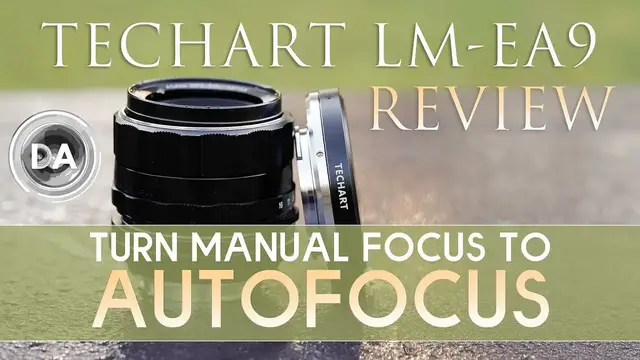
The Techart LM-EA9 is a unique adapter that claims to turn manual focus lenses into autofocusing ones. Does it work? Join Photographer Dustin Abbott to find out as he pulls out his vintage Takumar and Helios lenses | Visit the Image Gallery: https://bit.ly/LMEA9da | Purchase the Techart LM-EA9 @ Techart Store https://bit.ly/buyLMEA9 | B&H Photo https://bhpho.to/3PUfGTk | Amazon https://amzn.to/3bnYHK1 | Amazon Canada https://amzn.to/3cRCSTn | Amazon UK https://amzn.to/3zMhOXA | Amazon Germany https://amzn.to/3zogkkL | AliExpress https://s.click.aliexpress.com/e/_DCk660r
Check out the DA Merch here: https://bit.ly/TWIMerch | Become a Patron: https://www.patreon.com/dustinabbott | On the Web: http://dustinabbott.net/ | Sign up for my Newsletter: http://bit.ly/1RHvUNp | Instagram: http://bit.ly/DLAinsta | Facebook: http://on.fb.me/1nuUUeH | Flickr: http://bit.ly/1UcnC0B | 500px: http://bit.ly/1Sy2Ngu Follow Craig @ https://www.instagram.com/craigstoffersen/
Want to support this channel? Use these affiliate links to shop at:
B&H Photo: http://bhpho.to/1TA0Xge
Camera Canada: http://bit.ly/DLACameraCan
Amazon: https://amzn.to/3HrY64d
Amazon Canada: https://amzn.to/3qG1p18
Ebay: http://bit.ly/DustineBay
Make a donation via Paypal: https://www.paypal.com/paypalme/dustinTWI
=============================
Table of Contents:
=============================
0:00 - Intro and Concept
2:30 - What's New
4:30 - Autofocus Demonstration
6:00 - Observations and Tips
11:30 - Conclusion and Pricing
Show More Show Less View Video Transcript
0:00
Hi, I'm Dustin Abbott
0:12
Early on in my photography career where I was really just an amateur, enjoying, developing
0:17
my passion and love for photography, I participated in a variety of Flicker groups
0:22
And in one of those groups, I became inspired by the work and the discussion, dialogue with
0:27
other photographers, in trying out some of the different. of the vintage lenses, film-era lenses on modern DSLR cameras
0:34
And so I began to experiment with that and begin to haunt pawn shops and eBay
0:39
and begin to grow a collection of vintage lenses, mostly M-42 mount
0:45
Some of those lenses were only so-so and I let them go
0:49
Other lenses I found that I really enjoyed and I've held on to them now for well over a decade
0:55
Now there were some challenges in using those lenses on DSLRs. The good part is you could get a very inexpensive adapter, often $30 or $40 or less
1:03
and you could adapt that M-42 mount to, in this case, a Canon EF mount, though with some limitations
1:09
Obviously, it's still manual everything, and so you've got no electronic communication
1:15
but a bigger problem was, is because these lenses were not designed with that particular mount in case
1:20
in this case a Canon full-frame DSLR, the mirror sometimes on certain lenses would hang
1:27
and you'd run into little technical problems like that, or you wouldn't quite get infinity focus
1:31
you know, this, that, or an other thing. So there were quirks involved in the process
1:36
Fortunately, when mirrorless came along, it kind of breathed new life into the whole process
1:40
and that there was no mirror to foul up on the lens and you begin to get some focus aids
1:45
making it easier to manual focus. And then on top of that, later on
1:49
you got in-body image stabilization, which of course added a whole other layer on there
1:55
But several years ago, tech art came out with an idea that propelled the idea or the concept even further. And that was
2:02
their LMEA series adapters, which added autofocus to the process. Now, typical autofocus works
2:10
that inside every lens, there is a group of elements that are driven back and forth by an
2:15
autofocus motor. And, you know, depending on the strength of the motor and its speed, you know
2:20
with varying degrees of success. Obviously, tech art couldn't do that with these old manual focus
2:25
lenses, but what they did instead is design an adapter that actually moves the whole lens
2:30
forwards and backwards to achieve proper focus. It was an intriguing, you know, idea. And now with this
2:37
newest version, which is the LMEA-9, they have been taken that to a new level by improving the
2:43
autofocus motor in the adapter and also its design and shape. The autofocus motor has gone from more
2:50
of a micro motor to a faster, quieter USM motor. Now, that's not to say
2:55
that this is absolutely quiet in operation. You can hear there's some shuffling sounds
3:00
There's a little bit of noise that's involved in the autofocus process
3:04
But what matters is that now it is doing the process faster and quieter than what it was before
3:10
And it enables you to actually get that autofocus. They also redesigned this design where before it had a little bit of a chunky section squared off at the bottom It would cause varying issues with either having plates mounted on there or maybe interfering with certain lenses
3:25
That's no longer the case. And it's a nice sleek adapter, just fully circular in shape
3:31
And of course, now it doesn't have any bottom plate, but it's been reinforced and so that can handle the weight in and of itself
3:38
Now, this is by nature, it is an M-M-mount-M-M-M-M-Mount, it is an M-M-M-M-Mount to Sony F-E mount
3:47
Now, I actually didn't have any M-M-M-M-M-M-M-Lenses kicking around. And so when Tech-Art reached out to me, I had been intrigued in the Tech-Art adapters for several years
3:55
because I do have vintage lenses that I still am passionate about. But I just never gotten around to doing a review
4:01
And so when they reached out and I saw it was only M-mount, it's like, you know what, I'm sorry, I don't actually own any M-mount lenses
4:06
They said, no problem. All you got to do is put one of those simple passive adapters in front of that, and you can basically adapt pretty much any mount to the M mount
4:15
And so in this case, I was able to get an M-42 adapter to like an M-mount and away I went with a variety of my vintage lenses, and it just does the job
4:26
So does it actually work? Well, yes, it does, though with some minor caveat
4:32
First of all is that while it is now fairly fast and fairly quiet, it's not
4:37
as fast or as quiet as most modern mirrorless lenses. And maybe you wouldn't expect it to
4:43
Those lenses only have to move a few elements with their focus motor. This adapter has to move
4:48
the whole lens back and forth. And so I will note that probably the bigger and the heavier
4:52
the lens that you're using, well, it's probably going to have a corresponding effect on the
4:56
focus speed. There seems to be a fair bit of power here, but if you're throwing some big heavy
5:01
lens on the front of this, don't expect to get great results. But fortunately for me, many of my lenses
5:05
are relatively lightweight, even though they're all metal, as most things were back then
5:10
and it seems to work just fine in terms of focus speed. I did find that focus changes happen fairly quickly, and as you can see here, it does modern
5:19
mirrorless things quite well, including the tracking of the eye, and you can see as my model
5:25
moves around that it stays nice and sticky there on the eye, and that is with the SMC Tacumar
5:30
50mm F1.4, which is probably my favorite of my vintage glass. and it hung right there on there and you can see that there is a unique and beautiful
5:39
blend or you know just kind of rendering of the image behind that
5:43
I also found that focus accuracy was quite good and even if my subject was turned away
5:49
and I was just kind of catching the side of their eye, you can see that the eyelashes are
5:53
well focused on in these shots. Also in shooting at very large apertures and narrow depth of field, I was able to get well-focused
6:01
accurate results and I would say I got quite consistent results. Not 100% perfect, not G master flawless, but I would say a pretty high keeper rate of anywhere between 80 and 85% accurately focused results, maybe even a bit higher than that
6:16
And so I felt pretty good about that. Though I will note that if you're trying to track moving objects, it's probably not going to be fast enough necessarily to keep up with that
6:26
And, you know, this shot of my cat, for example, you can see that focus lagged a little bit
6:30
Now obviously the quality of the images you going to get depends a lot on the glass you putting in front And so I going to show you a series of images from the aforementioned SMC Takumar 50mm F1 along with an SMC Takumar 55 millimeter F1 SMC Takumar 28mm F3 a vintage Soviet Helios 442
6:54
and a Super Takumar 150 millimeter F4 lens. And as you can see with all of them, they all have certain charms to them
7:01
They're not optically perfect, but there's still a lot of life and sometimes some really beautiful color rendering that I happen to be really fond of
7:10
Now, one of the thing that I do want to detail as a part of this is that they actually have the ability to, by using aperture in camera, to actually set some information to the adapter
7:20
So, for example, you can see from this chart that if you're wanting to set for a certain focal length
7:26
And so, for example, when I am shooting with a 50 millimeter lens, I want to go to F8
7:31
And so the first time I'm going to use a 50 millimeter lens, I go to F8
7:35
In my camera aperture, I take a photo, and that registers into the adapter
7:39
I then dial back to F2, which, by the way, is always the appropriate aperture value to get proper metering in your camera
7:47
And if you switch away from that, you're going to get metering messed up. So shoot at F2
7:52
However, in every subsequent attempt that I'm using that lens, until I change the value to suit another lens
7:58
It's going to register as that 50 millimeter focal length. And it does that for XF information
8:05
It also does that even more importantly for in-body image stabilization, so I'm getting the proper value input into the camera for that
8:12
And so it worked whether I needed to change it for my 28mm F3.5 or the 150 millimeter F4
8:20
I was able to change that value and to get the appropriate focal length, though obviously it's within reason
8:25
My Helios 44-2 is actually a 58-millimeter. lens. There's no like really specific, you know, option for an odd focal length like that
8:35
And so in that case, you're going to want to choose whatever is the closest common focal length
8:39
to what you're putting on on the camera. I also, there's one other quirk that I'll detail
8:45
and that is that, you know, you still have that manual focus ring. And so you have to make a
8:49
decision on what you're going to do with that. In many cases, you can go all the way to infinity
8:53
and you'll get appropriate focus over most of the range. Some people prefer to come back from
8:58
infinity a little bit and in that case you can still get pretty much everywhere though if you're all the way out at infinity you may need to pull it back just a little bit and if you're at one of those longer ones and you want to shoot really up close you may need to switch over to a shorter focal length on the manual focus lens but there is one interesting benefit that comes from that and that these adapters actually serve almost like an extension tube and as a byproduct of that i found that i was actually able to get a much higher magnificence
9:28
location level, focus up closer than what I could with the bare lens longer or closer than
9:33
it stated focal length. Now I did find that I had to play with, depending on the lens focal
9:39
length, I had to play with things more. So with my 50 millimeter lenses and even more so with the
9:44
28 millimeter lens, I didn't have to hardly touch them all that much. But with the 150 millimeter
9:48
lens because there is such a variety of depth of field there I did find that I had to play with the manual focus ring more to continue to get proper focus So it one other quirk that you may have to be aware of from that One thing
10:01
that is also worth noting is that they do have the ability to update firmware on here. And already
10:07
I had an early problem on either my Alpha 1 or my A7R Mark 4, where occasionally I would get a
10:14
freezing up on the camera, where everything locked up and I needed to remove the battery to reset it
10:18
And so I let them know that they found the problem. They issued a firmware update and I've had zero lockup issues after that point
10:25
So that firmware updating can be done either via a computer on a website and you can actually plug it in because there is a USBC port on the lens
10:33
But also you can be done via an app once the adapter is publicly released and that adapt can be done via Bluetooth, which simplifies the process even more
10:44
Now, because I'm filming before the actual release date of this, I'm going to be traveling at the time this is being released, and so I won't be able to film at that point
10:52
And so the final price point has not been communicated to me
10:56
However, the LMEA7 adapter retails for about $379.US. And I suspect if I look back over the trends of these adapters, the new price is probably going to be somewhere similar to that
11:09
So is that worth it? that really comes down to how much you love your vintage lenses
11:14
The thing is, is that if you have a collection of legacy lenses or you're interested in the notion
11:20
it can be an inexpensive way to, although you're paying some up front for this adapter
11:25
there's a variety of lenses out there for a whole lot of different mounts that you can adapt all of them to this same adapter
11:31
and then get autofocus with them. And so if it's an intriguing concept to you, it might be worth it
11:37
If you love manual focus and part of the reason why you use these lenses
11:41
is because of that process, well, obviously you're going to get a very similar performance
11:46
with a much cheaper adapter and so you're not going to want to go that route. I've been intrigued with this concept for a while and I will say after having used it
11:53
it did breathe some new life into some lenses that I loved and made me want to use them more
11:58
Took them along on some hikes. I used them in more settings than what I had previously because there is a charm to that glass
12:05
that just becomes all that more accessible when I can use it with autofocus
12:09
an auto focus that actually works. So at the end of the day, I would say for me, it might be worth it
12:14
For you, well, we'll have to decide that for yourself. But if you do decide to purchase, there are buying links in the description down below
12:21
though as anything that is just being released, it may take a few days, even a few weeks for those links to be populated by the retailers
12:27
But if you will check back and use those links, I really do appreciate it as it helps to support this channel
12:33
and it doesn't cost you anything extra. Beyond that, there is also linkage to an image gallery
12:38
If you want to look at these photos a little bit longer and see the charm of some of this vintage glass
12:42
be sure to check out the image gallery and those buying links will be there as well
12:46
There's also a link to follow myself or Craig on social media or to check out our collaborative channel
12:51
let the light in TV. Beyond that, you can also get channel merchandise, become a patron
12:56
Of course, if you haven't already, please click that subscribe button. Be sure to ring that bell so you get notifications when new content drops
13:02
Thanks for watching. Have a great day and let the light in
#Camera & Photo Equipment