Up next in 10


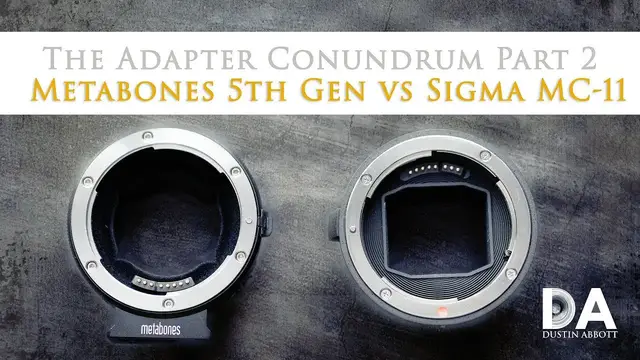
Adobe Update and Sony Color - 3:00 | Metabones Physical Controls - 4:15 | Focus Modes - 9:00 | Native Canon Lenses Focus - 11:50 | Wedding Shooting Observations and Photos - 15:49 | The Adapter Conundrum Part 2: Getting Your F/EF Glass on Sony - Metabones Fifth Generation (V) vs Sigma MC-11 | Photographer Dustin Abbott examines the top adapters for Canon EF/EF-S mount lens to Sony E Mount - Metabones Fifth Generation vs Sigma MC-11 on the Sony a7R3. Is this a viable solution? Which is better? See the wedding article: http://bit.ly/macyzack
Purchase the Metabones V Adapter: B&H Photo: https://bhpho.to/2Bc20Mu | Amazon: https://amzn.to/2HPqQX1 | Amazon Canada: https://amzn.to/2K2PUL0
Purchase the Sigma MC-11 Adapter: B&H Photo: https://bhpho.to/2wAj3cG | Amazon: https://amzn.to/2Jdc8J4 | Amazon Canada: https://amzn.to/2HQ6ihl
Want to support this channel? Use these affiliate links to shop at:
B&H Photo: http://bhpho.to/1TA0Xge
Amazon: https://www.amazon.com/shop/dustinabbott
Ebay: http://bit.ly/DustineBay
Make a donation via Paypal: paypal.me/dustinTWI
Get a discount off all Skylum Editing Software (Luminar, Aurora HDR, AirMagic) by using code DUSTINHDR at checkout: http://bit.ly/LuminarDLA
Become a Patron: https://www.patreon.com/dustinabbott | Check me out on: Personal Website: http://dustinabbott.net/ | Sign up for my Newsletter: http://bit.ly/1RHvUNp | Instagram: http://bit.ly/DLAinsta | Google+: http://bit.ly/24PjMzv | Facebook: http://on.fb.me/1nuUUeH | Twitter: http://bit.ly/1RyYxIH | Flickr: http://bit.ly/1UcnC0B | 500px: http://bit.ly/1Sy2Ngu
My filming setup: Sony a7R III: B&H Photo: https://bhpho.to/2D6ibNO or Amazon: http://amzn.to/2CNxOvH | or | Sony a9 @ B&H Photo: https://bhpho.to/2HyWIyt or Amazon: https://amzn.to/2s1vYE0
Tamron 28-75mm F2.8 RXD @B&H Photo: https://bhpho.to/2FA00la or Amazon https://amzn.to/2G2kaEr
Lights: Rotolight AEOS @B&H Photo https://bhpho.to/2IK7mqV | Genaray Contender @B&H Photo: https://bhpho.to/33HbGNM | and Aputure AL-MW: https://bhpho.to/2N3MtZV
DISCLAIMER: This video and description contains affiliate links, which means that if you click on one of the product links, I’ll receive a small commission. As an Amazon Associate I earn from qualifying purchases.
Show More Show Less View Video Transcript
0:00
Hi, I'm Dustin Abbott and as promised back when I was doing the Sony a7R Mark III review
0:12
I promised that I would at some point take a look at the Metabones fifth generation and do a
0:18
comparison to the Sigma MC-11 mount converter or adapter that allows you to use Canon EF mount
0:28
lenses on the Sony a7R Mark III. And so I have been taking a look at the Metabones fifth generation
0:36
I own the MC11, been using it now for eight or nine months. And so I'm pretty familiar with the
0:43
performance on that. And in fact, if you missed it, I did a comparison with the MC11 and some other
0:50
less expensive alternatives to it, and you can find that video episode here
0:57
Now, that previous episode was really done more on the Sony a6500, along with some references to
1:03
the Sony a7R Mark II. With the release of the a9 and then the a7R Mark III, and of course now the
1:11
a7 III, Sony has demonstrated that they have taken huge strides forward in the autofocus systems
1:18
that are employed in these cameras. And while, of course, there are gains all across the board
1:24
in the functionality of IAF and tracking and all of those things, the result of that is that there
1:30
is definitely a noticeably improved performance with adapted lenses on the A7R Mark III. And of
1:38
course, my primary familiarity is previously with the A6500, which was considered to have
1:44
at that point one of the better focus systems in a Sony camera. I can tell you that the a7R Mark III
1:51
is a huge step forward from the a6500 and that the performance of adapted lenses is much much better
1:59
on the a7R Mark III and I'm assuming on the a7 III than what it is on the a6500
2:06
And so, but how good is that? And that's what we're here to explore here today. I do want to
2:13
note that there's an excellent episode that deals with this from the guys at the camera store TV
2:21
You might want to check that episode out here because there they cover, you know, Jordan there
2:27
is more of a video guy. And so byproduct of that is that they look at the video side of things a
2:34
little bit more than what I do. And they're better versed in that than what I am as well. But anyway
2:39
Check out Kyle and Jordan and their approach to this episode because it's a great counterpart to what I'm going to share here today
2:48
I do want to also note, just as for those of you as Sony shooters, my episode in which I covered the difference between Canon and Sony Color has been a really popular slash maybe even controversial episode for some people
3:04
And I do want to note a positive on that front, and that is that the newest release of Adobe Lightroom and Camera Raw
3:11
is really about color profiles, and they've made a major overhaul there like I've never seen before
3:20
But the byproduct of that is that they're doing a much better job, in my opinion, with Sony Color
3:25
I recently, since they've released that, I just shot a wedding a week ago
3:29
and I used the Metabones as a part of that, and I'll detail that more in just a second
3:33
But I did find that it's the first wedding that I've shot using a combination of the A7R Mark III and the Canon 5D Mark IV
3:42
And so mixing and matching systems. And what I found is that I was pretty happy with the color consistency between my two results
3:53
And in terms of processing those now in Adobe Lightroom, I found that my results were not dissimilar
4:00
And so I didn't, you know, kind of have an issue where you could really clearly see what was shot on a Canon and then really clearly see what was shot on a Sony
4:09
That really wasn't a problem. So anyway, let's take a look at these adapters
4:14
So first looking at the metabones, this is the fifth generation. I had previously looked at the fourth generation
4:21
And so there are some physical changes to the fifth generation, a little bit more of a difference in the shell and then physical controls
4:29
Now in terms of the physical controls, there is an advantage here for this in that the MC11, basically all it has is the port for firmware updates
4:40
Now, I will say to the credit of both of these is that both Metabones and Sigma, they have been good at releasing new firmware updates
4:49
And in fact, I discovered after my first look at the new Sigma 14 to 24 millimeter F2.8, that there was a dramatic improvement in metering and performance after I did a firmware update to the MC11
5:03
And, you know, I think some improvements may be across the board that have come to that
5:07
And so kudos to both of these companies for supporting their product
5:11
And even the fourth generation Metabones is going to give you a fairly similar performance
5:17
if you have the most recent firmware updates to it. But there are some improvements that are made to the physical design
5:24
So one thing that is a big selling point for the Metabones over the Sigma is that the Metabones has an incorporated tripod foot here as a part of it I think that kind of a big deal in that a
5:38
lot of times adapted lenses, and by the way, that's really true when it comes to Sigma lenses
5:43
that tend to be often some of the largest and heaviest in all of their respective classes
5:48
and so I'm kind of surprised that Sigma did not elect to include the tripod foot because
5:53
a lot of the Sigma lenses are big. And so anyway, the Metabones does have the advantage of having a
6:00
tripod foot that may just help you with weight distribution and balance. And if you're concerned
6:04
about stressing them out, I think that these lens mounts are maybe a lot less fragile than what we
6:09
think they are. But nonetheless, having a tripod foot is definitely a positive. Another positive
6:15
is that the Metabones does have a weather sealing gasket. And so it does help that if
6:23
you're concerned about weather sealing, moisture resistance, dust resistance, that obviously these
6:28
are just air inside. And so a lack of sealing just means that there's one more point of vulnerability
6:34
maybe for your lens or your camera body. And so that's another advantage for the Metabones is it
6:41
does have a weather ceiling and the MC-11 does not. Some other things where these differentiate
6:47
is, again, there are physical controls on this. And so one thing that is there is there's an
6:53
actual dedicated switch for the in-body image stabilization. And so you can control that
6:58
there. With the MC-11, you're left with just controlling that from within the camera body
7:04
And so it's two different approaches to the same destination. But having a physical switch, a lot of people like that because obviously it's always going to be faster to be able to do that
7:17
It also does have a little button down here that can be AF hold
7:23
You can use it for IAF. You can assign functionality to it. Now, because of the position, it's really low down
7:31
and the fact that the tripod foot is right here, frankly, I don't find the button for my own use
7:38
You know, your mileage may vary, but I don't find it incredibly useful just because of that button
7:43
placement. And, you know, in some ways I wish maybe that the up here you have the port for
7:49
where you can do firmware updates. And, you know, if that was, if those two things were situated
7:57
kind of reversed to where the button was up here. And then the port down here, I think it might be
8:03
in a more useful position to actually find with your hand. As it stands, it's not really a natural
8:07
ergonomic position to reach forward. Now, another thing on the note of that port is that I think
8:15
Sigma's design is much better in that it's got a flap that opens up and then seals back down
8:22
over the, in this case, it is a, it's not necessarily a proprietary shape, but it's not
8:30
a typical micro USB shape. It's a little more of a small square. But anyway, so I don't consider
8:36
that a positive because it means you're going to have less of those cables bouncing around. And so
8:41
anyway, but here you have this little, you know, rubber plastic piece that pops out of there and
8:49
it's small. And so there's a good chance that at some point, if you're not very careful, you're
8:54
going to lose that. And thus you're opening up a vulnerability for moisture to get into
9:00
the electronics here. So I think that that's not a great physical design on the Metabones
9:06
Metabones also does have an LED status indicator that kind of will give you some feedback as to
9:12
what mode the adapter's in. It does have an advanced mode. And I'm not going to go into
9:16
all the details of that here today, but part of that functionality. Now, it also, there is some
9:21
difference in the performance of these. One thing that the Metabones enables that the Sigma MC-11
9:27
does not is that with, now with Sigma lenses, the MC-11 will allow all the different focus modes
9:35
including DMF, direct manual focus mode, but the Metabones will allow that with, you know
9:42
all these other adapted lenses, including Tamron or Canon lenses. And what that means
9:47
because you have DMF, is that you can manually override at any point. And what I really like
9:54
is that with, at least with autofocus lenses, it doesn't do it, say I tried throwing on my
9:59
Zeiss Milva's 135mm F2 lens. It didn't happen there. But with autofocus lenses, when you do
10:06
grab the focus ring and you start to focus, it does automatically magnify the image as in either
10:14
the viewfinder or the LCD screen, just like native mount lenses do. And so it's a true DMF experience
10:22
which is actually really nice. The MC-11 is not going to allow you to have DMF on non-sigma lenses
10:28
at this point with any of the ones that I have tested. Now, as far as the actual focus performance
10:35
Here's how things boil down. If you're using either Sigma or even Tamron lenses
10:43
I think at the end of the day, while the focus experience is different on both
10:47
I think that you're getting a better focus experience. Definitely with Sigma lenses, the MC-11 is the way to go
10:52
And the MC plus Sigma lenses is about the closest you going to get to native focus performance with an adapted lens that you going to see period And the new line of you know FE mount lenses that is
11:07
coming from Sigma at this stage is basically, you know, Sigma, existing Sigma lenses with an
11:14
incorporated and maybe, you know, tweaked and customized MC11 type adapter built into there
11:20
So, I mean, for those of us that are hoping for lenses that are better physical matched to the A7R Mark III, that's a negative
11:27
But what it does speak of is how good the MC-11 is with Sigma lenses, and it's a very good experience
11:36
Tamron lenses also seem to have maybe a closer focus affinity, and so they don't work as well as Sigma lenses via the MC-11
11:44
But I feel like the experience is better than it is with the Metabones
11:48
Now, the complete opposite is true if you're talking about native Canon EF lenses
11:55
and that I found that they worked better on the Metabones adapter
12:01
Now, another plus for the Metabones versus the MC-11 with Canon glass is that
12:06
say, if you're shooting an A6500 or other APS-C body, The Metabones actually does allow both EF and EFS lenses to be mounted to it
12:19
The Sigma only allows EF mount lenses to be attached. And so if you're using an APS-C body and you want to use an APS-C specific Canon lens
12:30
you can't do it with the MC-11. You can do it with the Metabones. And so that might be a consideration for you as well
12:36
So that's a plus there. And so Canon lenses, they focus better
12:41
Now, lenses that are notably improved, this Canon 100mm f2.8 LIS macro lens, it doesn't focus very well at all with the MC-11
12:54
It actually focuses fairly well with the Metabones, and so that's a positive there
13:00
Long glass, be it long Tamrons, or in this case, the Canon 100-400 L Mark II
13:08
frankly while it focuses different with both adapters it doesn't necessarily focus better
13:14
and and so I don't I still have not found a great focus experience with this lens and any of these
13:21
adapters I think that what you're going to find with adapters is that larger aperture lenses tend
13:28
to work better than smaller aperture you know variable aperture zoom lenses and I think that
13:33
that probably has a lot to do with the amount of light that they let in and thus it makes it easier
13:38
on the adapter to focus. Anyway, this is not a great experience at this point with either one
13:45
of these lenses. The behavior is different. The Sigma will sometimes just kind of give up. It will
13:50
get stuck and it won't even try to focus anymore. The Metabones keeps trying, but unfortunately
13:55
what that also means is that it just kind of pulses back and forth and sometimes will carry
14:00
that on for quite a while before it finally settles on a focus lock. And so, you know
14:06
neither experience is really fantastic with a lens like this. And so if you're hoping to have
14:11
you know, an amazing performance with a lens like this, I don't think that's going to happen
14:15
However, if you're moving into some of the super teles that have a larger maximum aperture, f2.8
14:20
f4, those lenses actually perform a, they perform better. And I think it, again, it has a lot to do
14:27
with the amount of light that they let in and how that positively impacts the focus system
14:32
and so anyway a net positive on those but not so much with this lens now I do find that the
14:41
MC11 does provide a smoother focus experience in a lot of cases there's less of that pulsing
14:47
and so if you're using something like AFC mode it actually I think transitions a little bit more
14:53
smoothly and less pulsing there but as I noted there will be occasions that for whatever reason
14:59
it's like focus just gives up. And I find, by the way, if you're, you're the kind of the best way to
15:04
reset that is to just quickly switch the AF MF switch on and off cycle that. And a lot of times
15:12
it'll, you know, kind of reawaken things and it'll start trying again. Now, if you're, again, if you're
15:18
using Sigma lenses, MC 11 is the way to go. The MC 11 is less expensive and it's, you know, with a
15:25
lot of lenses, I find that it's giving a fairly positive experience, like the Tamron 45 millimeter
15:31
VC lens, Tamron 85 millimeter VC lens. They're not native performance good, but they're good
15:38
enough that I've been using them in a lot of settings and been very happy with the result
15:42
that I'm getting, enough so that I don't consider that to be a negative experience at all
15:48
Now, at this wedding, let me just detail that, and I would encourage if you'd like to take a look at
15:52
some of the photos. And also I wrote an article that detailed some of the challenges of shooting
15:58
mix systems there and how I worked to overcome them, the technical challenges. And I encourage
16:03
you to take a look at a link to an article that I've got in the description down below
16:08
But what I did is that I primarily shot the, on my 5D Mark IV, I shot the Tamron 70-200 f2.8 G2
16:17
lens primarily. And on the a7R Mark III I use the Metabones and I use the Canon 35mm F1 L Mark II And that kind of been my go combination for weddings with two bodies although typically my second body has been a Canon I experimenting with trying the Sony
16:37
in that setting. So the end result was that in terms of focus accuracy and the look of the images
16:45
I got with the A7R Mark III, 35L Mark II combination, images were exquisitely good and
16:53
exquisitely well focused. And of course, with that 42 megapixels, you've got a lot of cropping
16:58
latitude. I got really, really good results of what I brought home. However, the experience was
17:05
not as fantastic. I found that there were some crucial moments where, particularly when my
17:11
subjects were moving, either coming down the aisle or in the reception hall as the couples were coming
17:16
in, that I was getting some of that pulsing. And as a result, there were a few shots that I feel
17:22
like I missed and a few shots that were less than perfectly focused, not because you can't get a
17:30
reliable focus, but your focus speed was not necessarily always up to the task. And so I left
17:37
that experience that while I was happy with the results I got at the end of the day, my conclusion
17:42
was, is that in the future when shooting weddings, I would prefer to shoot native glass on the A7R
17:51
Mark III. And so once again, so kind of a good news, bad news. Good news was, is that focus
17:57
accuracy was actually probably better than what I've gotten with the 35L Mark II on my 5D Mark IV
18:03
For whatever reason, I got really great focus results on my 6D and the 35L Mark II and less
18:10
great focus results even after tweaking and tweaking on the 5D Mark IV. I don't know why that
18:14
is, but reality was is that I got better focus accuracy with the Sony, but the focus method was
18:21
not fantastic. I also have found in that kind of venue where you're dealing with, there was
18:27
unfortunately in the church, there was cycling lights to where I needed to use anti-flicker
18:32
technology. Sony's doesn't work as well to begin with, but with adapted glass, it works even less
18:37
well. And so it definitely was not a Canon-like experience when it came to that as well. So I
18:45
haven't despaired. In a lot of ways, I really liked what I got out of the A7R Mark III for
18:50
shooting. But, you know, even with the Metabones, which is the better focus experience with Canons
18:56
I wouldn't feel that for critical shooting like that, where their subject is moving
19:01
that focus is quite there yet. For everything else, like my decoration shots, you know
19:06
where you had a chance to be a little bit more deliberate, all of that kind of thing. Fantastic
19:10
I mean, the results are just beautiful. But for moving subjects, you know, adapted lenses are
19:16
really, they're not quite there unless you're talking about, you know, Sony or excuse me
19:22
Sigma lenses using the MC11. That's about as good as it's going to get. Now, video side is a whole
19:27
another thing. With the Metabones, these lenses like say this, even they will, they will continually
19:35
auto-focused during video, but it is not a great experience. There's constant noise being made by
19:42
the focus motors. You can tell there's a lack of assurance as it's continually trying to evaluate
19:47
where focus should be. A lot of times the MC-11 with anything other than signal lenses, it won't
19:53
even allow you to attempt auto-focus during video. And you can kind of see why the Metabones does
19:59
And if for something like this, it might be okay where I'm sitting still. But if you're trying to
20:05
you know, to use different focus distances, I just wouldn't rely on it. He would be much better
20:11
served by just pre-focusing for like what I'm doing. I'm using a manual focus lens today and
20:16
it's pre-focused and I get much more reliable results anyway for doing that kind of thing
20:22
So unfortunately there is no perfect solution yet. If you're using third-party lenses
20:29
the MC-11 seems to be the better focus experience, but as detailed, it lacks a few of the
20:34
physical attributes that the metabones has. Metabones seems to give you a better cannon
20:40
focus experience with, you know, native cannon glass. But at the same time, note that it's
20:46
it's only good for certain subjects. If you're talking about a shooting, moving targets, I mean
20:52
you know, wedding photography, even if they're coming down the aisle, they're usually moving at
20:57
a fairly sedate pace. So that is one thing. But if you're trying to track action for sports or
21:03
wildlife. Fortunately, I think you're still better served by using native mount glass on native
21:09
systems. Adapted lenses have come a long way. And the very fact that you can have a successful
21:15
experience on Sony bodies and a lot of venues is fantastic. And I think that's a great positive for
21:21
Sony, but it's really with a very few exceptions, it is not a native focus experience. I'm Dustin
21:28
Abbott. And if you'll look in the description down below, there's that article that I mentioned that
21:33
I would encourage you to take a look at. You can also find there, I have buying links for both of these adapters
21:38
if you'd like to take a look at those. And of course, you can follow me there on social media
21:43
sign up for my newsletter, become a patron. And of course, if you haven't already
21:47
please click that subscribe button. Thanks for watching. Have a great day
#Hobbies & Leisure
#Reference