Up next in 10

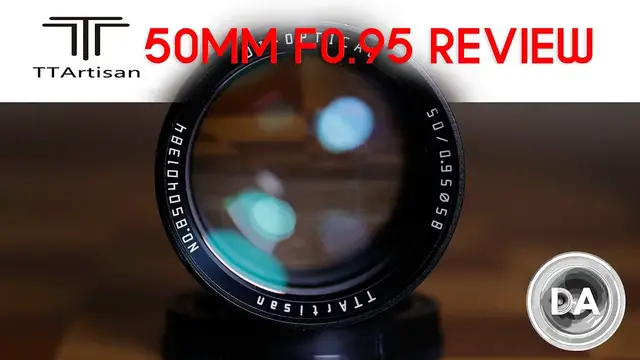
TTArtisan 50mm F0.95 Review (APS-C and Full Frame) | DA
Jul 16, 2023

Photographer Dustin Abbott shares a thorough, real world review of the surprising TTArtisan 50mm F0.95. It has some of the typical strengths and weaknesses of very large aperture lenses like this, but it's performance on full frame is most interesting. | This video is sponsored by Fantom Wallet. Visit https://store.fantomwallet.com and use code DUSTIN15 to get 15% off | Read the text review: https://bit.ly/TTA50da | Watch Craig's Video Review: https://bit.ly/TTA9550ltlintv | Purchase the TTArtisan 50mm F0.95 @ B&H Photo https://bhpho.to/3ziins9 | Amazon https://amzn.to/3uazp8z | Amazon Canada https://amzn.to/3xjobjL | Amazon UK https://amzn.to/3MiuKHF | Amazon Germany https://amzn.to/3x7k1KK | Pergear https://bit.ly/TTArt09550pergear | Fuji Mount: Amazon https://amzn.to/3zTMre6 | Amazon Canada https://amzn.to/3xKrhwe
Check out the DA Merch here: https://bit.ly/TWIMerch | Become a Patron: https://www.patreon.com/dustinabbott | On the Web: http://dustinabbott.net/ | Sign up for my Newsletter: http://bit.ly/1RHvUNp | Instagram: http://bit.ly/DLAinsta | Facebook: http://on.fb.me/1nuUUeH | Flickr: http://bit.ly/1UcnC0B | 500px: http://bit.ly/1Sy2Ngu Follow Craig @ https://www.instagram.com/craigstoffersen/
Want to support this channel? Use these affiliate links to shop at:
B&H Photo: http://bhpho.to/1TA0Xge
Camera Canada: http://bit.ly/DLACameraCan
Amazon: https://amzn.to/3HrY64d
Amazon Canada: https://amzn.to/3qG1p18
Ebay: http://bit.ly/DustineBay
Make a donation via Paypal: https://www.paypal.com/paypalme/dustinTWI
=============================
Table of Contents:
=============================
0:00 - Intro and Concept
3:00 - Build and Design
7:00 - Focus Action
8:00 - Image Quality Breakdown
19:00 - Conclusion and Pricing
Show More Show Less View Video Transcript
0:00
Hi, I'm Dustin Abbott and I'm here today to give you my review of the new TT Artisan 50mm F0.95
0:18
Now, this is an interesting lens in that right in the title, depending on the retailer you're
0:24
looking at, it says that it's a 50mm f1 0.95 APS-C. So of course, that leads you to believe this is a
0:32
APS-C lens, which of course it is. But interestingly, it actually functions quite well as a full frame
0:38
lens as well. Surprisingly well, all things considered. That's not to say that it flawlessly
0:43
covers the whole full frame image circle, but it does cover it without a mechanical vignette
0:50
a vignette that can't be corrected, though it doesn't quite resolve the very corners as we'll
0:54
see on our optical breakdown. As a byproduct of that, however, it is a very interesting lens to
0:59
me in that it has that dual personality that you might be able to enjoy on APS-C and full frame to
1:07
where while it does have some optical flaws, and by the way, I've still yet to review a lens with
1:13
a maximum aperture this large that doesn't have some optical flaws. You have to kind of recalibrate
1:18
your expectations and that they're going to be a little bit more dreamy in their rendering at
1:23
wide aperture. And that's certainly true here. But for a lens that retails for under 220 US dollars
1:29
the fact that this is one that can switch between both platforms with some success makes it a very
1:35
interesting lens. And while it is certainly not a technically perfect lens, it does produce images
1:41
that have some real charm and usability to them, as we'll explore as a part of this review
1:47
So this lens is going to be sold in a variety of different mounts. I'm testing it on Sony E-mount, which is why I can also use it on full frame
1:55
You can also get it as a Fuji X-mount lens. You can get it on Micro Four Thirds
1:59
And it will be coming, I believe, for Nikon Z-mount, also Canon RF in the new APS-C format
2:08
and also, I believe, Canon M-mount as well. So there are a variety of different lens mounts you can get this lens for
2:15
and at this price point, I do think it is an intriguing option, and I'll detail why as a part of this review
2:21
First, however, a word from our sponsor. Today's episode is brought to you by Phantom Wallet
2:26
the minimalist, modern wallet that is now even better with the new Phantom X
2:30
that is crafted from aluminum right here in Canada. It is 22% smaller and 35% lighter
2:37
while still making it easy to access your cards and money when you need them
2:41
thanks to their unique fanning mechanism. You could even customize your wallet due to its modular design with accessories like a money clip, cash holder, ID display, and even Chipolo and AirTag tracking integration
2:54
Visit store.phantomwallet.com to check out their unique sizes, styles, and finishes that span from aluminum to wood to carbon fiber
3:03
And use code DUSTIN15 for 15% off when you're ready to check out
3:07
so let's talk about the build and specifications of this lens as you can see for a lens with such
3:15
a large maximum aperture it really is a very compact lens it is a lens that definitely fits
3:21
in the palm of the hand 60 millimeters in diameter with a i believe 58 millimeter front filter thread
3:27
and it is 68 millimeters in length by my measurement but because it has so much glass
3:34
inside. And if you take a look inside, you see that it's just nothing but glass and metal. It
3:39
actually is fairly hefty. It weighs in at 411 grams. And in some ways it feels like a miniature
3:45
Zeiss lens and that feel of heft that comes from having an all metal construction and then lots and
3:51
lots of glass inside. And so definitely not super lightweight, but at the same time, neither is it
3:58
unrealistically heavy. It has, as noted, a 58mm front filter thread. It also has a 58mm thread-on
4:06
front lens cap. I don't love the thread-on front lens cap. For one thing, it's a little bit more
4:12
finicky to get started in the threads. And then, of course, every time you want to take it on and
4:16
off, if you do it all the way, it's several rotations to take it back off, several rotations
4:21
A pinch cap is just much faster in operation. It would be my preference here. What's not here is a
4:27
lens hood, which is somewhat surprising in a lens that does deal with some lens flare
4:31
as we'll see in just a moment. And so I'm kind of surprised that there's no lens hood
4:35
nor do I see any kind of capability of one being available for it
4:40
Inside, we see 10 rounded aperture blades. It's actually a really great looking aperture iris
4:47
And we do have a manual aperture ring. And that aperture ring is, it's okay. It has half-stop
4:54
click detents through F4. And then after F4, it is only full stop detents after that point. So a
5:02
little less finite control after you hit F4. And so it, however, it moves fine. It has, you know
5:09
well-defined clicks, no problem there. There is no de-click option for this. It also has an
5:15
interesting manual focus ring here in the middle And what interesting is the design and the texture here where you have all of these grooves that are carved into it kind of an inverted half type groove in there and it filled with a silver paint
5:31
It's a nice look. I think there's a vintage aesthetic to the lens that I find, you know, tasteful
5:36
Reminds me again of some old, you know, like Zeiss lens from way, way back
5:42
And so anyway, it's interesting in that regard. There is a minor amount of movement in and out
5:47
However, the extension is not at the front of the lens. It's actually in this middle portion
5:52
And so while the overall length of the lens does change, there's nothing that moves in and out
5:57
which may help to keep from any kind of dust intrusion getting into it
6:01
On that note, however, there is no weather sealing, which is not necessarily expected in a lens like this
6:07
and there's also no electronics. So that means that there are certain things that you are going to have to forego
6:13
certain XF information that's not transmitted that is lens specific. If you have a body that
6:18
has in-body image stabilization, you're going to have to manually input the focal length
6:22
You know, some things like that. However, I do get asked this question a lot. Things like focus
6:27
overlays do still work with lenses like this because that is a camera specific and not a
6:32
lens specific item. Things like metering also continue to work. And for the most part, it
6:37
functions fairly normally. Just you're manually focusing, you're manually changing the aperture
6:43
Minimum focus distance here is not really all that impressive. 50 centimeters, right under 20 inches, and the magnification is not specified
6:52
It looks in my test to be somewhere around between 0.12 and 0.13 times
6:58
So, you know, not exceptional, but because you have such a large maximum aperture
7:02
you still can really blow out backgrounds if you get fairly close to the subject as a byproduct of that
7:09
Manual focus itself works fairly good. It's about 120 degrees of focus throw and the action is smoothly damped
7:17
I did feel like if I went really fast that there is a little place where it almost felt like not slippage but something similar to that
7:25
But overall, I was able to do very nice focus pulls, nice and smooth and focus was good
7:33
Mirrorless bodies help so much for manual focus, be able to magnify the image and visually confirm
7:39
and the fact that this is a lens that I could use on my full frame bodies, I enjoy it much more there
7:45
than on this a6400. The viewfinder is so much better on my Alpha 1, for example, and even on
7:50
the a7 IV, and so as a byproduct, I prefer it there. I also get the in-body image stabilization
7:56
so I enjoyed it more on full frame than I did on APS-C for those reasons. So as I mentioned
8:03
it is a kind of an interesting lens because of being able to, you know, fairly successfully
8:08
manage both sensor sizes. We're going to dive in and see optically how it holds up in both of those
8:14
comparisons and its kind of unique optical properties. Let's dive in. Let's take a look
8:19
So as noted, the interesting thing about this lens is that typically APS-C lenses leave a lot
8:25
of mechanical vignette along the edges of the frame, places where you're not really covering
8:30
the full frame image circle and it's a byproduct. You just actually have parts of the image that are
8:34
clipped. You really can't effectively use them on full frame unless you're deeply cropping
8:38
That's not the case here. And so as you can see on my full frame A7 IV, there's definitely some heavy vignette in the area
8:45
But as you can also see here, it is not mechanical vignette in that it is correctable
8:50
There is still information there. Now, there's a little bit of caveat to that
8:55
And that is that if we zoom into these corners, we can see that while they're not blocked from vignette, they aren't really resolving properly into the corners
9:03
And so the actual optical formula doesn't really cover the last, say, 2-3% of the full-frame image circle
9:11
But as we're going to see, that maybe is a solvable problem. Now on full-frame, obviously you get the worst effect of the barrel distortion, so it's a plus 19 to correct
9:21
And vignette is very heavy. I'm not quite maxed out with the slider, but a plus 92
9:26
And now you can see, I often move that midpoint all the way over. But because the vignette is more concentrated in the corners, I'm keeping it at a more neutral position
9:35
But at the end of the day, that's a reasonable looking correction for an APS-C lens covering the full frame image circle
9:42
Now if we take a look at the APS-C image circle that this is actually designed for, we can see that there is much less distortion and vignette
9:50
In fact, really not a whole lot to even be concerned about. A surprisingly low amount of vignette in particular for an f0.95 lens at f095
10:00
So in this case, I've only had to do a plus 5 to correct for the barrel distortion and a plus 23 to correct for the vignette
10:06
And as you can see, I've done a more typical slide for the midpoint to move it all towards center
10:11
But 23 is less than one stop. That's a really minimal amount of vignette for such a large aperture lens
10:18
Now, I was also happily surprised to see that I didn't see a lot of traditional issue
10:23
with fringing when it comes to longitudinal chromatic aberrations. You can see that there's only minimal that is showing up there
10:31
Not a whole lot in this defocused transition area. What we are going to see is again minimal amount of fringing when it comes to these bouquet circles
10:40
You can see a little bit of green fringing around them. But really nothing pronounced or strong It doesn look too bad here But what you are going to see more of less you know so much just the fringing minimal there but you can see some basic fringing that just kind of blooming
10:56
around textures and it's due to the low contrast and this is on full frame here. So, you know
11:01
maybe a little bit more demanding, but as you can see, it's just not particular high contrast as we'll
11:06
see at wide apertures. And so you get a little bit of blooming of fringing that comes as a byproduct
11:12
of that. Now this image is interesting. It's shot on my full frame alpha one, so high resolution 50
11:19
megapixel sensor. It illustrates a couple of things. First of all, when stopped down, you can
11:24
see that, you know, where the image circle is properly covered. We have got actually really
11:29
nice detail at small apertures, you know, no problem. As we pan up, there's a couple of things
11:34
I wanted you to see. We're looking at this when it comes to lateral chromatic aberrations. So as we
11:39
get up near here, we're not seeing a tremendous amount of lateral chromatic aberrations. You know
11:44
everything is pretty well controlled here. But what we can see is that as you begin to transition
11:49
into those corners where the image circle is not quite covered, you can see that we completely
11:54
lose that resolution and it drops down into becoming almost like a watercolor towards the
11:59
edges of the frame. So obviously that's not a look that works well for landscapes. However
12:05
it's far less of a big deal if you're doing a traditional narrow focus and the corners not
12:11
really being in focus anyway. However, it's less of a big deal when you're shooting a shot like
12:16
this, for example, where you're focusing more in the center of the frame and more concerned about
12:23
that. And you're not really concerned about the corners being in focus. In fact, in this case
12:27
we get kind of a very unique patterning here towards the edges of the frame because they're
12:32
not really resolving, but the byproduct of that is an optical flaw that I suspect some people will
12:38
find to be desirable. So let's take a look at our chart test here, and at 200% magnification
12:43
this is on the 24 megapixel Sony a6400. So first of all, you can see at the 200% magnification
12:51
that contrast is low. There's actually some reasonable resolution there, but the contrast
12:56
is low. Mid-frame, it's the same kind of story. Again, there is some resolution there, but contrast
13:02
is kind of robbing, and you can see that kind of blooming that produces fringing around
13:06
these textures. As you get towards the corner, however, we have like almost no image quality
13:12
The contrast is so low that everything is basically a blur. It looks like you need a new
13:17
set of glasses. If we switch over to the Alpha 1, we see kind of a similar thing just at a higher
13:23
magnification level in that, you know, there is some resolution here. I mean, you can read the text
13:29
but the contrast is low. So, you know, it's just kind of like a little bit of a film of Vaseline
13:33
has been applied over everything. Same applies here, but I think what we're seeing is a faster
13:38
fade towards that loss of resolution. And here you can see a really dramatic to where this corner
13:44
there is still some resolution. By the time you get over here, you can see that, you know
13:48
we're not even resolving at all. It's just a smear. So if we compare F0.95 to F1.4, frankly
13:56
we don't see a radical difference. You know, there is a little bit more contrast here, but
14:02
you know, it's not like the textures are really popping yet. It's just marginally better. And down
14:06
here in the corner, you know, again, it's marginally brighter, but you're not really
14:12
getting any kind of true resolution yet. Stopping on down to F2, we see that we are starting to get
14:20
a mild improvement in the corner, still not very great yet. Stopping on down to F2.8, and you know
14:27
the picture is starting to emerge, but still not really all that clear. By F4, things are starting
14:34
to look pretty good, and by F5.6, they are looking generally pretty excellent. And so that's your
14:41
basic progression there and we can see now in the center of the frame it's sharp we can see in the
14:46
mid frame it is really sharp I would argue looks better in the mid frame than it does in the corner
14:50
and so in other places that we look across the frame at f5.6 resolution is really really good
14:57
now and that's kind of the trade-off with lenses like this they have a dual personality so at f0.95
15:04
low contrast but you can see that the scene is beautifully defocused as we stop down we're
15:10
starting to increase some you know some contrast on the subject so that's looking a little bit
15:15
crisper but the background is looking a little less you know diffused and here we stop down
15:21
further we can see the subject is starting to really sharpen up but at the cost of a busier
15:26
background and so on and so forth where we're getting really nice sharpness on our subject
15:31
and here going through another pattern we can see everything is kind of dreamy wide open but
15:36
beautifully defocused and as we stop down you know focus increases and detail increases but at the
15:44
cost of every you know kind of that loss of that kind of dreamy background and frankly if you want
15:50
to kind of get both of those things you know very high resolution and still a dreamy background let's
15:56
just say you're going to have to pay a lot more but I will point out that you know the quality of
16:01
the bokeh and the subject isolation is actually really lovely and that's where a lens like this
16:06
shines not in charting or testing perfection but in the ability to create images that have a certain look to them You can stop down for example and get a very credible landscape result out of this lens This is f5 or so
16:20
and you can see that detail all across the frame is excellent. But the truth of the matter is you could do that same shot
16:26
with a lot of lenses. I value it more for shots like this
16:30
This isn't as technically great as far as detail goes. You can see the contrast is not amazing here at f0.95
16:37
but looking at the image as a whole it has a just a beautiful aesthetic to it very soft blurred out
16:44
background so this is an image i think that kind of stands out more than the previous one even if
16:49
it's not technically as good again here for example we've got a really crisp looking you know
16:54
in result here that is is nice and uh and beautiful but you know an image like this is really more
17:01
where the lens is going to excel and even though again as you can see the you know the side is is
17:07
not even fully resolved this is on full frame here but you know there's sufficient amount of
17:11
detail there and then a really nicely blurred out background again here the ability to isolate a
17:17
subject you know and shoot through foreground objects i shot through the lilac leaves here
17:22
and you know and then isolated the blossoms here and again if you go into a pixel level it's not
17:27
technically perfect you know there's some fringing things contrast is low but if you take the image
17:32
at large, it's a really unique and beautiful looking image. I thought this was another interesting
17:37
example in that, again, if you take the image as a whole, it's a really great looking image
17:42
Lots of pop, lots of subject isolation. You know, you zoom in, it's not terrible
17:46
but you can see the contrast isn't amazingly low. The detail's there, but contrast holds it back a
17:51
bit. But again, if you just step back and appreciate the image, the image itself is a really cool one
17:57
Now, our minimum focus distance is only 50 centimeters, which is not all that close
18:03
And it's about a foot and eight inches, basically. But we can see also that up close, that low contrast on a chart test
18:13
Again, you can see the detail is there. The detail is not bad, but the contrast is so low that it is kind of lost
18:20
But again, if you go out into the real world and you actually get some value out of that dreamy look
18:24
Yeah, I mean, detail is there, but it's obscured a bit by the kind of the haze
18:29
But look at how creamy and soft the background is. It works better in the real world than what it does, certainly in chart testing
18:37
Now, when it comes to flare resistance, it really, really depends on where the sun is located
18:42
And so here, if we pan across wide open, you can see that there's a variety of different effects
18:48
But things get even wilder when you are stopped down. And you can see that there's these just sudden flashes of light
18:55
It's a really inconsistent performance depending upon how the sun is hitting those elements
19:00
And so, I mean, you can go from minimal effects to having just these weird blooms
19:07
And here, for example, I've captured one in a still photo. And you can just see it's just a weird effect
19:13
And so you have to really kind of be careful about your composition or desire some of these vintage looking effects and kind of use them artistically
19:21
But finally, you know, I can take something like this where I'm getting a little bit of veiling from the light coming through the window in my barrel sauna and get a shot of
19:30
the bucket here. And I really like the overall feel of the look. I love how blurred out, you know, the foreground is, the background, and it's a unique artistic
19:38
look that I actually enjoy. So as I mentioned at the beginning of the review, you do have to recalibrate your expectations
19:45
Lenses like this are rarely, if ever, technically perfect. You know, there's more aberrations, more flare-prone, contrast is usually lower
19:53
But the byproduct is that you can get some really unique images. And I think that that's where the strength of this lens is
19:58
Not so much for pixel peepers, but rather those that just appreciate the feel of images
20:03
and you like the kind of more dreamy look you can get at wide apertures with a lens like this
20:09
And of course, as we saw when stopped down, it does take on a different personality
20:13
and does tend to be a more conventional, sharper, higher contrast lens
20:18
And so you get a little bit of both in a very compact little package. At the end of the day, I think this lens is fun
20:23
And if you are someone that can appreciate what this lens brings
20:28
it's a fairly high reward for a fairly low risk when it comes to price
20:34
And it's the kind of lens that you might just take out when you're wanting to shoot for the fun of it
20:38
as opposed to shooting with a specific purpose in mind. And I enjoyed both the process of using the lens
20:45
and also a number of the images I was able to get with it. And so that to me is part of the joy of photography
20:52
And it's well worth considering if you're looking for a large aperture prime lens like this
20:57
I'm Dustin Abbott. And if you look in the description down below, you can find linkage to my full text review
21:02
There's also an included image gallery there. There are some buying links if you'd like to purchase one of these for yourself
21:07
Also, I'll throw a link to Craig's review that focuses more on the video aspects of this lens
21:12
and its low light performance. If you want to check out that beyond that
21:16
you can also find links to follow myself or Craig on social media to become a patron or to get channel merchandise
21:23
And of course, if you haven't already, please click that subscribe button right here on YouTube
21:27
Thanks for watching. Have a great day and let the light in