Up next in 10


Build and Handling: 02:33 | Manual Focus Observations 09:35 | Image Quality: 11:33 | Conclusion 24:39 | Read the text review: https://bit.ly/Voigt110MDA| Visit the Image Gallery: https://bit.ly/Voigt110ig | Purchase the Voigtländer 110mm F2.5 Macro @ B&H Photo https://bhpho.to/39cBu6m | Amazon https://amzn.to/2WzMfNE | Amazon Canada https://amzn.to/2UwRPOa | Ebay https://bit.ly/Voigt110Macro
Sony a9 Camera @ B&H Photo https://bhpho.to/2HyWIyt | Amazon https://amzn.to/2B4NAjh | Amazon Canada https://amzn.to/2peQkbn | Amazon UK https://amzn.to/2M7XPcY | Amazon Germany https://amzn.to/2VHbDOP | Ebay http://bit.ly/Sonyalpha9
Purchase the Sony a7RIV @ B&H Photo https://bhpho.to/2nUgnno | Amazon https://amzn.to/2oGpVD1 | Amazon Canada https://amzn.to/2mY8UDW | Amazon UK https://amzn.to/2n9GWF3 | Amazon Germany https://amzn.to/2nXhene | Ebay http://bit.ly/a7RIVda
Want to support this channel? Use these affiliate links to shop at:
B&H Photo: http://bhpho.to/1TA0Xge
Ebay: http://bit.ly/DustineBay
Make a donation via Paypal: paypal.me/dustinTWI
Get a discount off all Skylum Editing Software (Luminar, Aurora HDR, AirMagic) by using code DUSTINHDR at checkout: http://bit.ly/LuminarDLA
Become a Patron: https://www.patreon.com/dustinabbott | Check me out on: Personal Website: http://dustinabbott.net/ | Sign up for my Newsletter: http://bit.ly/1RHvUNp | Instagram: http://bit.ly/DLAinsta | Google+: http://bit.ly/24PjMzv | Facebook: http://on.fb.me/1nuUUeH | Twitter: http://bit.ly/1RyYxIH | Flickr: http://bit.ly/1UcnC0B | 500px: http://bit.ly/1Sy2Ngu
My filming setup: Sony a7R III: B&H Photo: https://bhpho.to/2D6ibNO or Amazon: http://amzn.to/2CNxOvH | or | Sony a9 @ B&H Photo: https://bhpho.to/2HyWIyt or Amazon: https://amzn.to/2s1vYE0
Tamron 28-75mm F2.8 RXD @B&H Photo: https://bhpho.to/2FA00la or Amazon https://amzn.to/2G2kaEr
Lights: Rotolight AEOS @B&H Photo https://bhpho.to/2IK7mqV | Genaray Contender @B&H Photo: https://bhpho.to/33HbGNM | and Aputure AL-MW: https://bhpho.to/2N3MtZV
Show More Show Less View Video Transcript
0:00
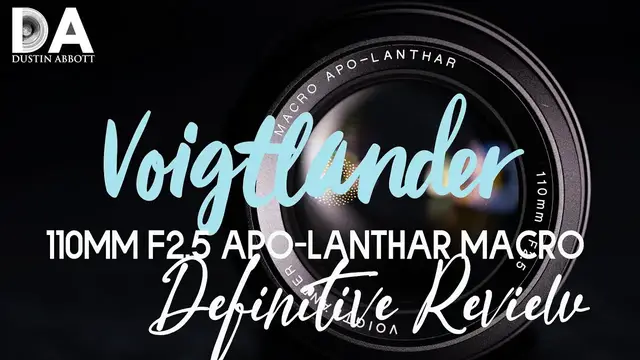
Hi, I'm Dustin Abbott, and I'm here to give you the definitive review of the Voightlander 110mm
0:11
millimeter F2.5 macro lens, and this is an APO-LANTHAR, is their designation, which means it's
0:18
an aprochromatic lens and uses their Lanthar optical design. And like Zeiss, they like to name
0:26
their optical formulas, and so this is the APO-Lanthar. design here. Now the 65 millimeter F2, Apolanthar macro lens, which is a one to two, not a one to one
0:39
like the 110 millimeter, which by the way I'm filming on at the moment. I'll show you it close up and
0:44
hands on in just a moment, but I thought you might be interesting to see in what footage looks
0:48
like, a shot out of it. But the 65 millimeter has been one of my favorite lenses on Sony
0:55
and I have used it for a lot of product type shot
0:59
when I don't need to go to a one-to-one magnification level. I've also used it at weddings and for portraits
1:06
and I have been very, very happy with the end results. I mean, it's just, it's an incredible lens
1:12
and in many ways it gives me some of the optical quality
1:16
that I love of, you know, Zice lenses on Sony platform in a more moderate size and a little bit more moderate price
1:25
Fortunately, the 110 millimeters when it was introduced, It also interested me because it's a great focal length
1:33
It went to a one-to-one magnification. But also they retained a really fairly moderate price for it
1:39
When you consider that this is essentially like a classic Zice lens
1:44
if you look at this ice macroplane R 100mm F2, that, you know, that ran you closer to $2,000
1:51
This is about half that. And you can get one right now for under $1,000 at BNH Photo and other outlets
1:58
And so anyway, I was very interested in the release of that
2:03
And in many ways, I continue to be very optimistic about it
2:07
I'm going to do my best to give you as balanced a review of this I can, as well as a comparison to the 65 millimeter
2:13
And by the way, if you are interested in the quicker review that just kind of gives you the highlights
2:18
into the end of the week I'll be releasing my kind of standard review that gives you everything in a more compact package
2:24
Today we're going to break things down in detail from the build to the focus
2:28
quality to the optical performance in detail. So if you want the details, you're in the right place
2:34
First of all, let's jump in and let's take a look at the build and handling of the lens and
2:39
give you a closer look at it. So taking a closer look at the 110 millimeters, what you see here is
2:44
that we have a beautifully crafted engineered design that is very reminiscent of these classic
2:50
Zice lenses. And so manual in that sense, however, what we do have here is we do have full
2:56
electronics and so everything is communicated. The active area will be magnified on the screen
3:02
to help with visually confirming focus. What we don't have back here, however, is any kind of
3:07
weather sealing. And so once again, like the classic Zeiss series, not like the newer Zeiss
3:11
Milvis series that does have weather sealed bodies. So in terms of the physical size, you're actually
3:18
very similar to the 65 millimeter F2. Functionally, they are identical in their kind of diameter
3:25
both around 78 millimeters. There's kind of a unique design here in that the 110 millimeters actually kind of comes back to a narrower point
3:35
And so at this point, it's only a 58 millimeter front filter thread
3:40
And that compares to a 67 millimeter front filter thread on the 65 millimeter
3:47
And so what is also interesting, however, is that the included lens hood, which is also all metal
3:53
Instead of bayonetting on, it actually screws into the filter threads. And so that does change things a little bit
3:59
You actually have a secondary included pinch cap at 67 millimeters. And so, you know, if you're going to use it in this fashion, you use this rather than this front cap
4:11
Also, the threading here is at 67 millimeters. And so you can use filters in that size for that
4:18
Now, the disadvantage of a threaded design is that you cannot reverse the lens hood for storage
4:23
And so it's a little bit more of a pain to bring along, because you're basically either going to need to bring it in your bag
4:28
or need to bring it attached. Now, as you can see, the physical length between these two lenses is quite similar
4:35
The 110 millimeters is a little bit longer. It is right under a hundred millimeters compared to 91.3 millimeters for the 65
4:46
And what does change the most, however, is that both of these lenses extend significantly
4:52
during focus and so the closer you get towards their macro level the longer the length becomes
4:59
In this case, because this only, the 65 millimeter is only a one to two macro, while the 110
5:06
millimeters is a full one to one. The byproduct of that, however, is that as you can see
5:11
there is a lot more barrel extension and a significant amount of extension from the, you know
5:17
the R1 to two level if we come to that. At that point, it's about equal in length, but there is
5:22
lot more extension from that. Now the actual action is really smooth. However, I will point out this
5:28
If you're going from macro and you want to move back into the normal range, there is a lot of focus
5:35
to do to get there. It's very, very smooth, very precise focus, but that extra amount of
5:41
magnification actually makes it a little bit clunkier to use for general purpose as opposed to
5:47
straight up macro use. I find that functionally the 65 millimeter is a little bit easier to
5:52
use for the simple reason that you don't have that as incredibly long a focused throw
5:59
One of the area where I find a functional difference is when it comes to the aperture ring
6:04
Now, unlike, you know, a lot of, say, like the GM lenses, they also have an aperture ring
6:10
However, it is a aperture by wire. This is a fully mechanical aperture, and so while it will show
6:17
on screen what your aperture change is, you are physically changing the aperture when you use
6:22
use the aperture ring. That functional difference, however, is when it comes to the actual
6:27
aperture ring position. On the 65 millimeter, it's up near the front, it's raised, it's quite
6:33
easy to find, just in a tactile sense. But in this case, if we attach the lens to a camera
6:41
what we find is particularly if you're looking through the viewfinder, there's not a natural
6:45
place where that aperture ring falls to hand. It's in a recessed position, and I just found
6:50
a little bit hard to find by feel. It's very fortunate that on screen you do see aperture changes
6:57
because the actual aperture ring position is hidden and it's not as clearly marked as what it is
7:04
on some lenses. And so I just find that to be a functional difference that I don't necessarily
7:09
love there Now because there is more glass due to the focal length here and of course the fact that you got a lot of extra barrel inside there there is more weight in the 110 compared to the 65 The 65 weighs in at 625 grams 1 pounds
7:26
110 millimeters is 771 grams or 1.7 pounds. And because it is fairly dense, when it's in the fully retracted position like this, you will feel being just a little bit front heavy because there is a fair
7:40
amount of weight that is located, you know, right there. At the end of the day, it's still a
7:45
moderate weight, but you definitely will feel that kind of sense of density that I associate with
7:51
a lot of Zeiss-type lenses, which this is very similar with. So three takeaways from this
7:57
particularly when you're kind of considering the 110 versus the 65 millimeter. And, you know
8:02
in some ways you could look at them as complementary lenses if you really love the look of those
8:06
lenses, and I certainly would understand that. But if you're looking at them as competing
8:10
options. A few things that I do prefer about the 65 millimeter, and that is in part the focus
8:17
row. Now, if you want one-to-one macro, 110 millimeter is the way to go. But if you're not and you're
8:22
wanting more of a general purpose, I do like the 65 millimeter a little bit better as a general
8:26
purpose lens. I would say both as a focal length, but also definitely in the handling of the
8:32
lens. You know, I continue to wish that they could find a way to implement some kind of
8:37
weather sealing into the design. That's becoming more and more standard. and these are premium lenses, and I certainly think that they deserve to have that next level apply to them
8:49
And so that's another thing I want to highlight. The other thing is I do find the whole lens hood situation suboptimal
8:56
I find that I think that if I own the lens, unfortunately, there would be a number of circumstances where the hood stayed home
9:01
And even storing like in my storage cabinet, it makes it too long to store it reasonably with the hood attached
9:09
If you have the hood separate, where do you put the hood when you're not using it
9:13
And so I don't love that design from a design and engineering standpoint
9:19
And so I'll offer that as a criticism. Beyond that, however, the other handling is beautifully, it's beautifully designed, beautifully built lens
9:25
and both the aperture ring and the focus ring, they really do handle in a premium fashion
9:32
That aperture ring design, again, that's another area where I like the 65 millimeter better
9:37
In terms of the overall focus, you know, and as a portrait-type lens, and we'll look at some portraits as a, you know, a portrait shots as a part of the image quality in just a second
9:48
But when it comes to portrait, the good news for portrait use is that you're not going to have to go deep into that long focus throw for portraits
9:57
And there's enough focus throw that remains there that I think it works fine as a portrait-type image
10:03
if you're wanting to shoot somewhere in that middle distance. And so let's say, you know, within a meter away and, you know, or, you know, a couple of feet
10:12
if you're looking at it that way, half a meter or so, I find in that range is where I don't love the long focus
10:18
So it feels like I do a lot of focusing to get from infinity to that point or from macro to that point
10:24
And so that's where I don't love the focus action as much. Furthermore, when it comes to video application, I'm actually in the process of testing a
10:33
motorized gumble right now, the Moza Aircross 2, and it comes with an actual cool drive
10:40
system that it can actually, you can actually set up the drive to optimize manual focus
10:46
to where you can do kind of focus pools from down here. So I tried the 65 millimeter and even that
10:51
it was not a great, a great story there. That focus throw is just too far for a lot of video work
10:59
And so as far as the footage, if you're doing static shots and you want to
11:03
a longer focal length. Obviously, it's capable of producing really beautiful footage. And so
11:08
you know, big plus from that because it's optically beautiful lens. However, for actual usage
11:13
it's a little bit more challenging to use. I would say a non-macro lens would be an easier
11:19
lens to use in that kind of application. And so it's not a top pick to me for video
11:25
for that simple reason. If you're wanting to do any kind of focus throws, if you just want
11:29
the focal length, go for it. It's going to provide really, really amazing
11:33
footage. So let's break down the image quality in detail here. And so let's jump in and let's take a
11:40
look at what you're getting in terms of performance. So first of all, let's take a look at vignette
11:44
and distortion. So distortion, we can see that there is a tiny bit of pincushion distortion
11:49
You can see a little bit of an downward curve here. You can see the corrected version on the right
11:54
is straight across. So it's not probably going to be enough to impact much of anything
11:59
however this is not a perfectly corrected lens in terms of distortion there's also some vignette with
12:06
you know some fairly significant vignette in the corners not as heavy as what i've seen on some lenses
12:11
and then kind of a linear progression towards the middle there'll be a number of situations where
12:17
that vignette is useful portrait situations however just know that it's there it corrects
12:22
clingly and easily through either the in-camera profile for jpeg and then here in lightroom
12:29
with the profile. So one of the huge strengths for upper chromatic lenses is the fact that
12:35
basically launch you know chromatic aberrations, either purple or green fringing before or after
12:40
the plane of focus are almost entirely eliminated. And you can see that to be the case here
12:45
I mean, you have a beautiful clarity of result there, very crisp. And then before the plane of focus
12:51
you can see that there is next to, well, there's, I don't really see any chromatic aberration there
12:56
at all. After the plane of focus, I don't see it either. So, in terms, intensely good result there. So in terms of our resolution, looking here at wide open F2.5
13:07
you can see a really crisp result. You know, that apochromatic design, it allows for really
13:12
really great clarity and microcontrast. It's not a coincidence that almost all of the
13:19
Zeus Otis lenses, actually all of them, I believe, are apochromatic design, because that allows
13:24
you to have just intensely good contrast and resolution. As we see here in the center of the frame
13:29
As we move towards the mid frame, we can see that the results are still very, very good with a little bit of loss towards the outer third of the frame
13:39
And what I mean by that is that on this side of the bill, it's a little bit better than it is on the bottom corner
13:44
And down into the corner, we still have very, very good results, very strong into the corner
13:49
But what I am seeing is a little bit of loss of contrast towards the corner
13:54
And so we'll see how that compares to the 65 millimeter. So what you see here is that we have the 110 on the left. We have the 65 on the right. And so
14:04
65 being at F2, wide open, F2.5 for the 110. So what we can see is if we look at the center of the
14:12
frame and at our bill here, I slightly favor the look from the 110. They're very, very close. I just
14:18
think there's a little bit more clarity there and maybe a tiny bit better, just kind of brightness
14:23
of image there If we move off to the midframe however my position reverses and I think that what you seeing is a little bit better micro contrast and a little bit more consistency from the left corner down to the right corner of the bill on the 65 millimeter
14:39
And into the corner, I definitely favor the 65 millimeter that is, I mean, it is very close to perfect in the corner
14:45
And when you put these side by side, you can see that there's definitely less contrast in the corner of the 110 millimeter than there is to the 65 millimeter
14:56
So if we stop down one-third to F2.8, we can see that there's definitely a center improvement
15:03
The microcontrast is already good. Now it becomes exceptional and really, really fantastic result and a noticeably improved result
15:12
If we look off here towards midframe, the result, I don't find it as significant
15:18
And even if we look at kind of the lines here, I think that there's a little bit better contrast
15:22
The darks are a little bit darker. Whites are a little bit brighter. It's not as noticeable as what it is in the center of the frame
15:29
and the same is true down into this corner. There's a mild improvement, but not
15:34
It's still not at the level of the 65 millimeter. Just to make that point, here's the 65 millimeter at F2.8
15:41
and you can see it is dramatically better in the corner, in both contrast and just the Christmas of the details
15:48
And so I would say it's the more consistent performer across the frame. You know, look at here and here
15:53
Definitely better on the 65. millimeter. Now where we see our big leap here is at F4. You can see how noticeably better contrast is here on F4. It almost seems like there's a light haze here at F2.8. Moving off into the corner, contrast is better here as well. It's looking really, really good right across the frame. At F5.6, you see a step forward to where it is better yet and looking really, really fantastic in the corner of the frame. So if you remember looking at the bill in the
16:26
center of the frame where we started off the German Deutsche Mark. Here you can see what one to one of
16:32
that bill looks like and if we jump into a pixel level, you can see that all of the weave of the
16:37
fabric and the bill and the ink is really clearly delineated. Very, very impressive. Now here's a look at
16:44
you know, kind of in a situation that would show off chromatic aberration and a loss of contrast
16:49
You can see that consistently across the frame we have got a nice clean result here, a metal
16:55
surface. We could see some chromatic aberration. We could also see a nice, you know, background there
17:01
good result there. This really stood out to me, just, you know, kind of an ordinary shot. I mean
17:06
I'm shooting in March. It's not the most beautiful time of year, pretty much anywhere. However
17:11
what you can see is that amazing microcontrast and really crisp delineation. And when I looked at
17:18
this at a pixel level, as we are right now, I thought, just wow. I mean, everything is so crisp
17:23
beautifully detailed. This is wide open, and so you can see the advantage of the
17:27
apricomatic design and that beautiful microcontrast there. And also, I would say the general
17:33
rendering in this shot is quite nice as well. I happen to be in Virginia during this review period
17:39
and so already some cherry blossoms are starting to come on. And so what we can see here is
17:44
with these blossoms, which are kind of high contrast because they're very, very bright
17:48
against a dark background. And what I noticed with the 40, millimeter F1.2 Voitlander, which does not have an apochromatic design. Definitely has lots of
17:59
chromatic aberration by comparison, is that it had a really rough go with this kind of scene. We can see
18:05
that the apochromatic design of the 110 does really, really great. Where the 40 millimeter might
18:11
win is that the background is a little bit softer by comparison, but overall, I think that's quite a
18:16
lovely image nonetheless. Now, if I go a little bit further back, we can make some observations here. First of all
18:23
I mean, our resolution, real world resolution, looks really, really fantastic. And that, you know, kind of great contrast in the image right across the frame, it looks really fantastic
18:34
You can see a mild drop off in the corner. But real world performance is beautiful here
18:39
Looking towards, you know, this area here, it's not as smooth as the best lens that I've seen around this focal length
18:47
At the same time, however, it's not bad either. It's positive. of often apochromatic designs, this is where they kind of let you down a little bit
18:56
in that there's still great contrast sometimes in the defocused area. I didn't see anything really that kind of deterred me
19:04
In this kind of situation looking, number one, we've got great detail on our subject in terms of
19:10
their faces. And here with a background further back, it's obliterated and it's just not an issue
19:15
Also here in kind of a more mundane scene, and so we've got, you know, objects that, you know
19:21
could be kind of attract the eye. We don't really see them. All the background kind of just blurs away
19:26
And here you can see beautiful detail rendered in these kind of faint details on the dog's face and
19:32
nose. Here's another kind of high contrast scene that shows you both some bouquet. You can see the
19:38
you know, there's kind of the typical cat eye deformation towards the edges. But also in the area of
19:43
high contrast, the snow, you know, this is where you definitely see lots of longitudinal chromatic
19:49
aberrations. You can see, however, it just isn't there. And that's the beauty of a lens design like
19:55
this. Another prime example is here. This is a high contrast kind of scene where if you have
20:01
you don't control chromatic aberration, images become really, really kind of unusable. In this case
20:07
however, that great control has allowed this to be an artful type image and not just an artful
20:12
type image in the global look, but also in the details. The details look really fantastic. And
20:19
So I really like what you're able to achieve with the lens. This is in the Luray Caverns in Virginia
20:26
and so just kind of a cool shot, but shows it even in these kind of lighting conditions
20:32
where I was having to go up a little bit higher ISO. But you can see wide open, I had no problem
20:38
and getting an image that is very credible and usable and good right up into the corners
20:44
And it allowed me to shoot in, you know, where I wanted to keep the ISO down
20:48
to shoot wide open and still get really good results. Of course, stop down. This becomes a beautiful
20:53
landscape lens, and so you can see, even though there's some of the layers of mist there
20:58
I really love the, you know, just kind of the composition of here and the bit of compression
21:02
that comes from a slightly longer focal length. If you own this lens, I'd really recommend
21:07
taking it out and using it in landscape type situations, you will be really, really pleased
21:14
with the end results. Now, looking a little bit closer up, it is possible, thanks to
21:18
to the ibis in cameras. This is a handheld macro shot, so it is doable, and you can see that it's
21:23
you know, rendered the ice crystal crystals kind of a frost crystal. Really, really cool
21:29
and I was able to do that handheld. Now, more traditional macro, this is shot on a tripod. You can
21:35
see it's able to deliver the fine details, good results there. Here's another example here. This is
21:42
wide open F2 And you can see there you know the detail is really good It definitely used definitely usable for a macro lens It does macro stuff as you would want it to Now in terms of flare resistance
21:55
it, as we've seen already, it does come with a lens hood that can be a little bit awkward to
22:00
use, but it does make a difference. Not so much in this kind of situation. The lens hood is not
22:06
going to help here because the sun is right in the frame. And so as you can see, what we see is a kind of a little
22:12
bit of loss of contrast here with the bright sun right in the frame. In this case, I also wanted to
22:17
show you the, you know, the aperture shape and the sun star shape, which is actually fairly nice for a
22:22
longer focal length. But you can see there are a little bit more ghosting artifacts. Now, if we look
22:27
at video panning, I'll show you first of all without the lens hood attached. And so you can see that
22:33
there's definitely some flaring, there's some veiling that will come and some a bit of ghosting
22:38
artifacts. It's more the veiling that we see. Putting the lens hood on doesn't make a huge
22:43
difference, you know, when you're more faced on. What it may help is when the sun is in the
22:48
corner of the frame and it helps to shade the frame there. Now stop down, contrast is better and there's
22:54
less veiling. However, you can see some more pronounced ghosting artifacts. And the same is true
23:00
with the hood attached rather than being unattached that, you know, it's going to more help from
23:05
corner shading, not direct pointing into it. the sun. So finally, I had some requests to compare the Voitlander to the Zeiss
23:14
Mildvis, 135 millimeter. So the Milvis is adapted here. And so, you know, obviously the
23:19
framing is different because of that. But if you want to get a sense of color and skin tones
23:24
so in both of these cases, I've actually profiled the lenses through my data color spider checker
23:32
And so there's custom profiles created for each one. So what you're seeing is very accurate
23:37
color here. And I wouldn't say that there's a huge difference in terms of the, you know, the coloration
23:43
here. One of them is a little bit cooler and the Zeiss looks a little bit warmer. That could be just the
23:49
color temperature of the image itself and the fact that they exposed a little bit differently
23:54
Also, the end result here is that both of them are really, really crisp in the details
23:59
Both of them render skin tones really nice. You know, I think they're both great. I would say that
24:05
the Zeiss has a little bit better microcontrast in some of these details
24:11
However, both of them, as you can see, looking globally, create a beautiful type result that I would say it's more a difference
24:18
in the compression of the focal length than it is in some kind of optical quality of the two
24:23
Both them have beautiful color. So once again, the aprochromatic design here really does the trick
24:29
in terms of the punch of images. One thing that I love about Voigtlander is the color
24:35
Voightlander lenses, and let's take a look at a few photos here together, because I really love their ability to produce just gorgeous colors in a variety of situations
24:45
And that comparison shot when we were looking at a portrait, I think that I, you know, ever so slightly favored the Voitlander in terms of just the way that it handled the gradations of color and the portrait
24:58
And so that was nice. But they are very much, they're the only company outside of Zeiss, I think, that really provides
25:05
kind of competitive color rendition to that. And so really, really beautiful colors
25:11
Also, that apricomatic design, you know, and the lack of any kind of haze on that
25:16
allows those textures to really pop and so great microcontrast. The bouquet is, I think, fairly good
25:22
It's not as exceptional as some lenses that aren't apricomatic and less contrasty
25:27
But I think that the tradeoff the end of the day is images that are really beautiful
25:31
One thing that I will note, we took a look at the aperture earlier on. Voigtlander does not do a great job because there's no curvature, much like Zeiss, to the aperture blades
25:41
And so you start to see the aperture shape early and often. It's maybe a minor criticism, but for those that are really into boca highlights, boca balls, as they're sometimes called
25:51
it's not as appealing for that with a lack of the rounded aperture blades
25:56
But overall, image quality is really, really stunningly good. However, surprisingly to me, at least in the copies I compare, I thought that the 65 millimeter would
26:05
the stronger of the two. And it's, of course, that's a high benchmark. That is a lens that is
26:11
right up there near the top of lenses I've tested in terms of its performance. And so the 110mm
26:17
is good or better in the center, not as good at mid-frame in corners as is what I saw. And so
26:25
you know, maybe a mild, mild regression in some of the areas of the frame there. At the end of the
26:30
day, however, I think as terms of a value lens, you have to be willing to commit to a manual
26:35
focus lens and near $1,000 is still a very significant investment, a very large investment
26:41
for some of you. Comparatively to a equivalent Zeiss-type lens, however, the Voitlander lenses
26:48
tend to come across as a relative bargain. This particular lens, I would say, falls into that
26:54
category in that I compare it to a lens to where it's performing at a near optical level to
27:00
the, like the macro planar lenses. And so when you're looking at, you're looking at a look at
27:05
it in that kind of light, it's almost a 50% reduction in price. So it's a pretty strong value when it
27:12
comes to that. Now, Sony shooters, this is a, you know, a Sony specific lens at this point. They also have a
27:18
you know, a 90mm macro to choose from from Sony. There are some other options out there. LaLWA has a
27:25
100 millimeter that is, you know, compelling as well. But I think that in terms of, if you can handle
27:31
that long focus throw, there's none of these lenses I don't think are provided
27:35
quite the color and overall pop as this, and you know, this particular lens
27:41
So it's really beautiful in that. If you're looking for one-to-one macro, it's tempting lens there
27:46
If you want more of a general purpose, you might consider the 65-millimeter F2
27:50
At the end of the day, and this is understand spoken because I own other macro lenses
27:55
and I don't need it for one-to-one macro. For many times I reach for it because it's macro enough for my purposes
28:02
product photography, for example, and it produces beautiful, I like the use of it. I like it better, I think, for a general purpose lens. But if you want a dedicated, you know, one-to-one macro, you like that 110 millimeter focal length. It's a really tempting lens. It's beautiful. And like other Voigtlander lenses, if you appreciate manual focus, this is macro, this is manual focus done beautifully. It's manual focus done right. I'm Dustin Abbott. And if you look in the description down below, you can find linkage to both my full written review, also to the image guide
28:35
So you can look at more photos from the lens. Beyond that, there are buying links there if you'd like to purchase one for yourself
28:41
along with linkage to, you know, to follow me on social media
28:45
sign up from my newsletter, support this channel by becoming a patron or becoming a subscriber
28:50
Thanks for watching. And have a great day
#Camera & Photo Equipment