Up next in 10


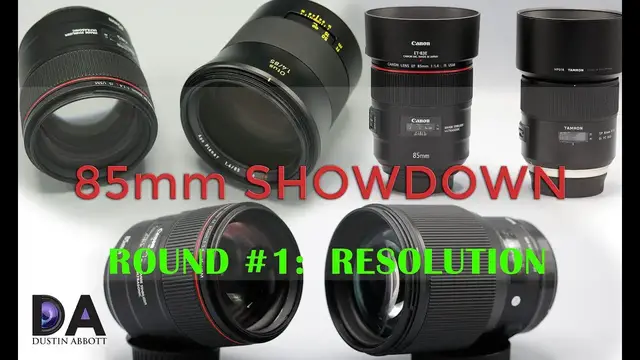
85mm Showdown: Canon 85mm f/1.4L IS vs Sigma 85mm f/1.4 ART vs Tamron 85mm f/1.8 VC vs Zeiss Otus 1.4 | Photographer Dustin Abbott gives a detailed breakdown of the resolving power of four of the top 85mm options. Find out which one packs the most punch! More images here: http://bit.ly/canon85LISig
Purchase the Canon 85mm f/1.4L IS: B&H Photo: https://bhpho.to/2kdkFUU Amazon: http://amzn.to/2i4ZtMU | Amazon Canada: http://amzn.to/2ng6LCH | Amazon UK: http://amzn.to/2Bxqpgu | Ebay: http://bit.ly/Canon85LIS
Purchase the Sigma 85mm f/1.4 ART: B&H Photo: https://bhpho.to/2D2zwpu | Amazon: http://amzn.to/2DFrxjo | Amazon Canada: http://amzn.to/2Br4QxL | Amazon UK: http://amzn.to/2BGNRvP
Purchase the Zeiss Otus 85mm f/1.4: B&H: https://bhpho.to/2BXTOA1 | Amazon: http://amzn.to/2BYrv4f
Purchase the Tamron 85mm f/1.8 VC: B&H:
https://bhpho.to/2fUnWXD | Amazon: http://amzn.to/2BoOgCw
Want to support this channel? Use these affiliate links to shop at:
B&H Photo: http://bhpho.to/1TA0Xge
Amazon: https://www.amazon.com/shop/dustinabbott
Ebay: http://bit.ly/DustineBay
Make a donation via Paypal: paypal.me/dustinTWI
Get a discount off all Skylum Editing Software (Luminar, Aurora HDR, AirMagic) by using code DUSTINHDR at checkout: http://bit.ly/LuminarDLA
Show More Show Less View Video Transcript
0:00
Hi, I'm Dustin Abbott and I'm here today to give you the first of a two-part series on my kind of final 85mm showdown
0:15
and I asked and I got permission to directly compare all of these lenses from the manufacturer
0:23
and so as a result I'm able to show you my results of how all four of these lenses that have been a part of my comparison series
0:31
how they shake out. Now in today's episode we're going to take a look at resolution
0:35
and if you've been following this series you may have a sense of how this is going to turn out
0:39
but I know that a lot of you have been interested in seeing how some of these others
0:43
I've been doing comparisons with the Canon and I know that you're also interested in how some of these lenses compare to the other lenses
0:50
For example, Tamron versus Sigma or the Zeiss versus the Sigma and the Tamron along with the Canon
0:57
And so today I'm going to show you those results when it comes to resolution
1:01
In our second episode, we're going to take a look and try to complete the picture because there's more to any of these images than just raw resolution
1:09
In fact, in a focal length that is most often used for portraiture, just pure resolution doesn't always equal the absolute best as a portrait lens
1:20
And case in point, of course, is the very popular Canon 85mm f1.2 L Mark II, which is not a part of this comparison
1:28
However, that lens has been treasured by some of the top portrait photographers for a long time because of the rendering that comes out of the lens
1:35
and also, of course, that unique subject isolation, very shallow depth of field you can achieve with an f1.2 lens
1:43
Now, none of these lenses that we're going to compare are f1.2. And all of them have, at best, an f1.4 maximum aperture
1:51
and in the case of the Tamron, a little bit smaller f1.8 maximum aperture
1:56
But taking a look at these lenses when it comes to raw resolution, let's jump in and let's see how they compare, looking at them compared each with the other
2:04
So, let's take a look. Okay, for the sake of brevity, we're going to limit our comparisons here to some basic aperture values here
2:14
And so just taking again a look wide open. Corner performance, the Tamron of course is strong as we've seen before
2:23
And so F1.8 versus F1.4. There's no question that the Tamron is the stronger performer in the corners versus the Canon
2:33
In the center of the frame, I think that the Canon is pretty much as good as what the Tamron is
2:41
I don't see really any kind of major difference there. And so center of the performance, or center of the frame performance is fairly good on the Canon
2:51
Now here wide open, I've got the Sigma and the Zeiss Otis here
2:56
And so you can see that the Zeiss is guilty of the heaviest vignette, but it also is going to give us our strongest performance
3:04
So center of the frame, the Zeiss looks really fantastic. You can see much more contrast than what the Sigma has in the center of the frame
3:13
Sigma is suffering a bit from chromatic aberrations. And so you can see just a general bit of veiling that's there
3:19
moving off to the edge however and I think that the the Sigma is a little bit more even across
3:29
the frame and so as a result it's you know depending on where you look like here seems to
3:35
me like the Zeiss is stronger than the Sigma so looking towards the bottom you know at the very
3:41
edge they're roughly equal up here I would say toward the edge the the Sigma looks a little bit
3:47
stronger, we move over towards the center, the Zeiss advantage starts to come back
3:54
Looking over at the other side, you know, at the very, very edge, I think the Sigma
3:58
looks a hair better. But then if we look towards the bottom half, the Zeiss looks a little bit better
4:04
again. So these two are close. The Zeiss is the best in the center And so just to give you an idea wide open if we compare the Tamron and the the Zeiss which are you know our strongest performers in terms of contrast we going
4:21
to find that the the Zeiss is still the winner in the center of the frame in terms of its contrast
4:27
moving off to the very edge of the frame where the Tamron is really strong we see that the
4:32
Tamron is delivering the stronger kind of edge edge performance and looking over at the other
4:39
side the same is true there now if we compare the Tamron and the Sigma just so you can kind of see
4:48
all of these comparisons here in the center of the frame I think that the the Sigma has the slightest
4:54
edge it's not really much but I think that the Sigma is a little bit stronger in the center of
5:00
frame. If we move off towards the edge of the frame, in this comparison, I would say that the
5:06
Sigma still looks a hair better. And of course that's at F1.4 versus F1.8. You know, and again
5:14
it's kind of a matter of where you look. And you know, in this area, the Tamron's a little bit
5:20
stronger than what the Sigma is. Looking at the other side, right side, the Tamron is stronger
5:26
than what the Sigma is. Now, if we compare at F2, we'll just do a quick comparison here. At F2
5:35
center of the frame, the performance of the Canon on the right, the Tamron on the left
5:42
is roughly, roughly equal at the center of the frame. Moving off to the edge of the frame
5:48
the Tamron is, or excuse me, the Canon is looking a little bit better than what it did, but the Tamron is definitely still the stronger. In many ways, I think the Tamron gives the most
5:56
consistent performance across the frame with the Sigma maybe a close second. Zeiss is unquestionably
6:05
the king in the center of the frame. And over here on the right side also the Tamron's looking a
6:10
little bit stronger. Now if we compare the Otis with the Sigma in the center of the frame we can
6:17
definitely see that now the Otis is like just stunningly sharp and this at F2 the Sigma is being
6:25
outclassed by the higher optical performance, at least in the center of the frame of the Otis
6:30
looking up in this area. You can still see some advantage for the Otis in terms of its contrast
6:36
and resolving power. However, if we move off to the very edge of the frame, just right at that last
6:42
tiny percentage, I would say that the Sigma is stronger. Even moving down towards the center of
6:50
frame the Zeiss looks stronger to me there. Right side it's basically the same story you know Zeiss
6:57
has the advantage right up until like the last you know two percent of the edge of the frame
7:02
So if we compare the Tamron with the Zeiss mostly kind of looking at comparisons that we haven't
7:08
previously made you see a similar story to that of the Sigma where the center contrast is definitely
7:15
stronger, no question about it, and thus resolving power is higher on the Zeiss lens. And that
7:22
micro contrast that we discussed in that episode, you can definitely see on display here. Looking
7:29
off to the edge of the frame, we can see that the Tamron and the Zeiss performance at f2 is close at
7:39
the edge of the frame. However, if we move down here towards the center of the frame, you can see
7:43
the superior micro contrast of the Zeiss lens moving off to the right side. It's kind of the
7:49
same story with the Tamron as it was with the Sigma. The Tamron is advantaged at the edge of
7:55
the frame, stretches maybe a little bit further out, but it's really at that last few percentage
8:01
points of the frame that the Tamron looks sharper in the corner than the Otis lens
8:08
Now one thing I do want you to note here that you going to find that does play a part in this comparison is that the Sigma is the shortest of all these lenses And so as a result like if you look down here you can see more of this area showing on the Sigma than you do on the Tamron But if we look at this other side also this square here
8:31
you're seeing less of it on the Tamron than you are on the Sigma. And so the Tamron is on the
8:37
long side. It's the longest of these focal lengths. And the Sigma is the shortest with the Otis and
8:43
the Canon being roughly equal. So in terms of our comparison here, center of the frame performance
8:49
you know, it might in the most slight degree favor the Sigma, but I think it's a splitting
8:57
hairs. I think they're basically equal center of the frame. Moving off to the very edge of the
9:01
frame, I'm going to give a very slight edge to the Sigma, which looks just a little bit better
9:07
right off towards the edge of the frame compared with the actual Tamron lens. Other side of the
9:13
frame, it's close. I think maybe the Tamron's a little bit better on the right side. And so
9:21
anyway, just note that the Sigma and the Tamron lenses, they are roughly equal in terms of
9:28
resolution at wide apertures. Now, one final comparison at f2.8, and this is as far as I'll
9:34
go for sake of time. We see that the Canon and the Tamron lenses are very, very similar here in the
9:41
center of the frame, and there's not really enough advantage there for me to call for either lens
9:48
Moving off to the edge of the frame, the Canon has improved considerably, and so now it's pretty
9:55
close to the performance of the Tamron f2.8. Both of these lenses are delivering a really strong
10:01
kind of across the frame performance here. And so I think that the Tamron, if anything
10:06
it has only an edge and maybe a little bit of contrast at the edges of the frame. And you can
10:12
see here, you know, a little bit of advantage there, but the difference is not significant
10:17
strong performance from both lenses. So comparing the Sigma and the Otis lens, we're going to find
10:25
here center of the frame that you know once again it's it's not a huge advantage but it's pretty easy
10:32
to call the win for the otis the otis just has superior contrast and so as a result the just the
10:39
textures they look more crisp while if you know comparing them side by side look a little bit
10:45
more veiled on the sigma in the center of the frame and moving off to the edge of the frame
10:51
and now both lenses at the very edge of the frame are roughly similar. If anything, maybe the Zeiss
10:57
its superior contrast shows up a little bit more here. At this point, the Otis is delivering
11:03
you know, well, best performance in the world basically. And so it's hard to compete with that
11:10
Sigma is doing a pretty credible job on a lot of levels. Comparing the Tamron with the Otis lens
11:15
here, we find that in the center of the frame, it's kind of the same stories with the Sigma
11:21
you know the superior micro contrast of the Zeiss is there again for a lens that costs so little
11:28
compared to the Zeiss this is a strong performance but at the same time the Zeiss is the winner
11:33
center of the frame and there's no no question about that and I would say at the very edge of
11:38
the frame other than that final maybe one percent where the Tamron is really consistent I would say
11:44
that the the Zeiss is the winner also in terms of contrast and resolution throughout a lot of the
11:51
frame. The Otis is the sharper lens of the two, which again is not particularly surprising
11:58
but what is surprising is how well the Tamron holds up. Now, if we compare the Sigma and the
12:04
Tamron lenses center of the frame, they're close. I mean, very close. I think there might be a hair
12:14
contrast edge for the Sigma compared to the Tamron. It's not highly distinguishable, let's just say
12:23
Edge performance, again, is very, very similar, but I'm going to give a fraction of an edge to
12:29
the Sigma To this on the left side on the right side the Tamron seems to be kind of the same thing It just slightly sharper than the Sigma but by that same kind of fraction of a percent
12:42
Now, looking at the Canon performance versus the Sigma, just for consistency, we'll look at this
12:49
The performance here on the center of the frame is, again, it's quite similar. And the biggest
12:55
difference here is that the Canon delivers a more brightly even image corner to corner
13:00
than what the Sigma does. Even with the Sigma having a little bit, you know, slower shutter
13:08
speed, thus a little bit more light to work with. And so the, definitely the light transmission
13:14
on the Canon is great. Very, very edge of the frame, just a slight edge for the Sigma
13:21
And so, you know, that gives you an idea in terms of the resolution department where all of these
13:25
lenses stand. And frankly, I mean, they're certainly the Otis is our absolute winner
13:31
And then kind of the Tamron and the Sigma vine there and Canon is behind them. But as you've
13:36
seen in this comparison, it's really not by any kind of significant margin. And these are the best
13:42
85 millimeter lenses, you know, in the class. And so, you know, that's nothing to hang your head over
13:49
So as we can see, the absolute winner when it comes to top resolution where it matters the most, which is in the center of the frame, is without a question the Zeiss Otis lens
14:01
and it is better than all the other lenses. They're all exceptional lenses, but in real-world
14:06
application, the Otis is going to deliver the sharpest center of the frame image, and of course
14:13
is very close, other than we saw that tiny fraction at the edge of the frame where some of the others
14:18
give a better performance. Now, we saw that the Tamron and the Sigma are extremely close at
14:25
equivalent apertures. But I'm going to give a very slight edge to the Sigma, simple because
14:30
it allows you to achieve incredible resolution there, even at a wider f1.4 aperture. And we saw
14:38
that there's some give and take between these two lenses. And to be fair, they're really more
14:42
similar than they are different. But just note that it's kind of a two-way tie for second between
14:47
the Tamron and the Sigma. We saw that the Canon is slightly behind the other three competitors
14:53
but frankly it's not by a huge margin. The Canon lens has a little bit less contrast than the other
15:01
three but again I do want to remind you that it actually has as much if not more contrast than
15:07
the 85mm f1.2L Mark II lens and so note that that high contrast in a portrait lens isn't always
15:17
necessarily what you're looking for. Now in our second part of the series we're going to look at
15:22
how the other pieces of the puzzle fit together and to help you to give a conclusion when it comes
15:29
to this. Today, I can declare a winner in terms of resolution. I'm just looking at the metrics here
15:34
And so, I mean, I can certainly declare safely the Zeiss Otis 85mm f1.2 or f1.4, I should say
15:42
as our tops here with the Tamron and the Sigma close behind that and then the Canon also close
15:50
buying that. All of these lenses, bottom line, are very, very sharp lenses that are going to deliver
15:54
pretty exceptional resolution performances, and so we can definitely see that from our comparison
16:00
today. Stay tuned for a part two of this series, and we're going to look a little bit closer
16:03
at some other metrics, flare resistance, chromatic aberration, even a little bit further look at the
16:10
focal length and then how all of that plays out at the bokeh quality, which is a huge thing. We'll
16:15
look at some facial rendering and see how it all each one of these lenses do does with that i'm
16:21
dustin abbott and if you'll look in my description down below you can find buying links to each one
16:26
of these lenses so you can make a choice from there if you would like and of course you can
16:29
follow me on social media become one of my patrons and if you haven't already please click that
16:34
subscribe button thanks for watching today have a great day
16:45
Thank you
#Photographic & Digital Arts
#Reference
#Documentary Films