Up next in 10


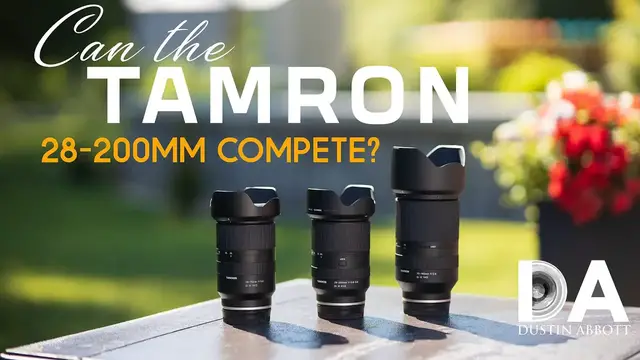
Photographer Dustin Abbott explores whether or not Tamron's new all-in-one zoom (the 28-200mm F2.8-5.6 RXD) can compete with their well-received 28-75mm F2.8 and 70-180mm F2.8 zoom lenses.
Tamron 28-200 Review: https://bit.ly/A071Review
Tamron 28-75 Review: http://bit.ly/TamA036da
Tamron 70-180 Review: https://bit.ly/A056Review
Purchase the Tamron 28-75mm f/2.8 RXD @ B&H Photo: https://bhpho.to/2xkmSUO | Amazon:
https://amzn.to/2L2DtyE | Amazon Canada: https://amzn.to/2H0VAT1 | Amazon UK: https://amzn.to/2soYBqX | Ebay: http://bit.ly/2875RXD
Purchase the Tamron 28-200mm RXD @ B&H Photo https://bhpho.to/2V1oooe | Amazon https://amzn.to/2zTeqy2 | Amazon Canada https://amzn.to/3dj79Fn | Amazon UK https://amzn.to/2Yh31S2 | Amazon Germany https://amzn.to/2V5JEJH | Ebay https://bit.ly/A071DA
Purchase the Tamron 70-180mm F2.8 VXD @ B&H Photo https://bhpho.to/2RsBIQV | Amazon https://amzn.to/2VlpeLQ | Amazon Canada https://amzn.to/2Rqy2PH | Amazon UK https://amzn.to/2Xm2pug | Amazon Germany https://amzn.to/3ebdX9N | Ebay https://bit.ly/F056VXD
Sony a9 Camera @ B&H Photo https://bhpho.to/2HyWIyt | Amazon https://amzn.to/2B4NAjh | Amazon Canada https://amzn.to/2peQkbn | Amazon UK https://amzn.to/2M7XPcY | Amazon Germany https://amzn.to/2VHbDOP | Ebay http://bit.ly/Sonyalpha9
Purchase the Sony a7RIV @ B&H Photo https://bhpho.to/2nUgnno | Amazon https://amzn.to/2oGpVD1 | Amazon Canada https://amzn.to/2mY8UDW | Amazon UK https://amzn.to/2n9GWF3 | Amazon Germany https://amzn.to/2nXhene | Ebay http://bit.ly/a7RIVda
Want to support this channel? Use these affiliate links to shop at:
B&H Photo: http://bhpho.to/1TA0Xge
Ebay: http://bit.ly/DustineBay
Show More Show Less View Video Transcript
0:00
Hi, I'm Dustin Abbott and I am here today to give you some direct comparisons among some of Tamron's newest lenses
0:18
Basically in light of the 28-200mm f2.8-5.6 coming out, I've gotten a lot of questions about whether or not it can
0:27
compete with the 28-75mm and the 70-180mm and whether or not it could potentially be a replacement for those
0:36
And I have to confess that first of all that really wasn't on my radar going into this review
0:41
for a couple of reasons. The first of those being that I don't really view an f2.8 zoom
0:47
in the same light that I view a variable aperture type zoom
0:51
for the simple reason that I look at them as two different tools for two different kinds of purposes
0:57
which I'll elaborate on more in just a moment. The second thing is that I've gotten these kinds of questions over the years many, many times
1:04
when it comes to all-in-one or super zoom lenses. I got a lot of those, you know, people asking me whether or not that they should choose the
1:12
you know, for example, the Tamron 18-400mm APS-C zoom, or if they should choose the Tamron 100 to 400 millimeter for a zoom because in their minds
1:25
they're just looking at the focal length and saying oh this one goes to 400 millimeters this
1:29
one goes to 400 millimeters they must be pretty much the same and of course to me I'm almost
1:33
taken back at that at first because I'm spending time with lenses all the time and I know how
1:38
preposterous that is but I have to remind myself not everyone has the opportunity that I have to
1:43
spend so much time with gear to you know review it so thoroughly and to understand how it works
1:48
so well. And so the truth of the matter is that the Tamron 18 to 400 millimeter is a very poor
1:55
replacement for the 100 to 400 millimeter from Tamron when it comes to a dedicated telephoto
2:00
option. As far as image quality, autofocus performance, all of those things, it's just
2:05
not in the same class. And so that is the attitude I would typically take into a lens like this
2:11
In some ways, however, Tamron has actually set up this comparison inadvertently perhaps by making
2:18
this lens so good. It is actually so optically sound that unlike any all-in-one that I've used
2:24
before, it actually is fairly competitive with more dedicated premium professional grade lenses
2:33
And that is a shock to me. And so kudos to Tamron. They really nailed it in delivering a surprisingly
2:39
a shockingly good image quality performance from this particular lens. And of course
2:43
it has a good autofocus system as well. And so in many ways it does, it is able to be a consideration
2:50
in some ways, whereas other type lenses in this class, I certainly would not say it is
2:57
At the same time, however, before we look at some direct comparisons, I'm actually going to give you
3:01
a summation up front. And if you want all of the details to see how I arrived at this conclusion
3:06
you're welcome to watch on. I encourage you to watch on and to get all of those details and to
3:11
see why I'm at the place that I'm at. So I maintain, number one, that for myself, I don't view an f2.8
3:19
zoom like the 28 to 75 millimeter or the 70 to 180 millimeter that I'm filming on at f2.8 at the
3:26
moment. I don't view those in the same light as I do a variable aperture zoom. I view them as two
3:33
different tools for two different purposes. Now, maybe for your application, that isn't true
3:38
I tend to use these lenses a lot for, for example, for event type work, either for religious work or for portraits or for weddings
3:48
All of those things I am engaged in on a regular basis. And so I tend to use them at their large maximum aperture a good portion of the time
3:57
So part of the reason why I'm able to or I'm willing to deal with the extra weight or cost is because of the advantage it gets of maximum aperture
4:06
And so I don't think that a lens like this is a replacement for shooting event type work
4:11
It's going to require much more light in similar conditions. You know, if I'm f5.6, for example, if I'm shooting on the telephoto end
4:20
f5.6 means that I have to have four times as much light compared to the 70 to 180 millimeter
4:28
If I'm shooting it at f2.8, shooting this at f5.6. So that makes a radical difference at the kind of ISO value that I can use in an event type setting how easy it going to be for me to keep the shutter speed up to avoid any kind of motion blur from moving subjects And also it means that
4:46
my backgrounds are going to be that much less distracting at f2.8 because depth of field is
4:51
going to be much more shallow. So in that application, I don't view this lens as a
4:54
replacement for the 70 to 180 millimeter, but your mileage may vary. Maybe you're not shooting event
5:00
work. Maybe your work is largely about just wanting to have good image quality. Maybe you're
5:06
shooting outdoors a lot. And so by the same token, I consider this to be a much better tool for
5:12
travel than what I would the 70 to 180 millimeter. It gives you the flexibility of an all-in-one
5:18
solution where you're not changing lenses. It means that you're getting very strong image quality
5:23
and so you're able to get good detailed images. And in those situations, it's often less about
5:29
creating a shallow depth of field or shooting in poor lighting conditions. And so I believe that
5:35
each tool, it's not like one is better than the other. It's just one is better suited for a certain
5:41
task than the other. Now, as far as what we're going to find when it comes to image quality
5:46
performance, this lens is actually able to compete very favorably at many aperture values with the
5:54
28 to 75 millimeter as we're going to discover. The 70 to 180 millimeter is a stronger lens
6:01
optically and so it isn't as competitive with that lens though still surprisingly decent. Now
6:10
when the f2.8 lenses are stopped down they tend to have a little bit more in the tank in terms of
6:15
absolute performance than what this lens does but it is surprisingly strong on just a pure
6:21
sharpness and resolution level. As we're going to see as we look at photos however where it
6:28
doesn't stand up nearly as well as when it comes to the softness of backgrounds of the bokeh
6:34
performance and even if you put the the zoom lenses f2.8 zooms at the same aperture value as
6:41
this lens they still deliver a softer more pleasing background as we're going to explore
6:46
So really it comes down to your set of priorities. If what I have described if you are
6:51
not necessarily shooting in challenging light conditions on a regular basis, and you're more concerned with just image sharpness, less about bokeh quality
6:59
and not so much concerned about shooting in higher ISO situations, indoors for events, etc.
7:05
this lens may be a reasonable alternative to those lenses. For me personally, because of the kind of work that I do
7:12
I view this as a complementary rather than a competitive lens to those others
7:18
So if you want a little bit more information, let's jump in and let's explore why I believe what I am saying right now. Let's take a look at some
7:25
photos together. So we'll start by looking at the 28 millimeter end and so throughout this series
7:31
I'm going to put the 28 to 200 on the left and the other lenses on the right. So a couple of things
7:37
I do want to point out here. First of all is that it does seem that there is a little bit better
7:42
light transmission on the f2.8 lenses. That's a general trend that I saw and frankly not a
7:47
surprising one, just considering the nature of the lens. We're going to pop all the way into 2 to 1
7:53
so you can really clearly see. So in the center of the frame at f2.8 28 millimeters, I think there
8:00
is a little bit of an edge for the f2.8 lens. And so it's got a little bit better contrast
8:06
a little bit better detail. If we pop over here, we can see that there is a little bit more
8:13
resolution but the advantage is not as clear as we move to mid-frame and if we pop down here in
8:19
the corner the situation has reversed and the 28 to 200 millimeter is actually the better of the two
8:26
by a fairly clear margin. So if we stop the lenses down to f8 at 28 millimeters as I said before I do
8:33
find that the f2.8 lenses in this case the AO36 has a little bit more in the tank and so just a
8:42
little bit more resolution, a little bit more contrast when stopped down. Here at mid frame
8:47
you can see there that there's just a little bit more detail, fine detail that's being rendered
8:52
And so that is a little stronger there. And if we pop down into the corner, you can see that again
8:58
the margin isn't as significant here, but a little tiny bit more detail there in the corner as well
9:04
So if we jump out to the 70 slash 75 millimeter range, first we'll compare the f2.8 lenses because
9:11
those you can look at at F2.8. So in the center of the frame F2 I think that it kind of a toss up not a significant difference between these two In the center of the frame F2 I think that it kind of a toss not a significant difference between these two In the center of the frame mid I think the 70 to 180 has a little bit
9:28
more detail, a little bit better contrast. And down in the corner, it is a clear winner in the actual
9:35
corner. So if we can compare the 28 to 200 millimeter in this zone, and we look at F4
9:42
where it's maximum after at 70 millimeters, we find that when stopped down the center of the frame
9:48
the AO36, the 28 to 75 millimeter, has a little bit more and a tiny bit more here
9:57
although in mid frame there's not a big significant difference. And down in the corner they are roughly the same with perhaps a little edge going to the 28 to 200 millimeter AO71
10:09
one. Now, if we switch over to the 70 to 180 millimeter AO5-6 instead at F4, you can see that
10:17
it's a different scenario here. I mean, this is a really strong lens and stop down to F4. It's just
10:23
fantastic. Great contrast, great detail. Mid-frame, you know, there's a clear edge there. It's resolving
10:29
really incredibly. And down here in the corner, it is a pretty clear advantage for the AO5-6 70
10:37
to 180 millimeter lens. And so it's the strongest of the three lenses at 70 millimeter range
10:44
Now, if we stop down the AO36 here, 28 to 75, and then the 28 to 200 at F8, we find that in the
10:53
center of the frame, a little advantage for the 28 to 75 millimeter, not by much though. Off in the
10:59
corner or in the mid frame here, they are more similar than different with a tiny edge to the
11:06
28 to 75 millimeter and in the corner I think that there's a bit of an advantage for the 28 to 200
11:12
millimeter. So between these two lenses there really isn't enough of a there's not really much
11:18
of an optical difference. Probably not enough that you would really see without them side by side
11:23
If we switch over to the 70 to 180 millimeter once again it is a it's a very very sharp lens and so
11:29
it does have a clear advantage though I mean it's not like the 28-200 is not even in the game
11:37
it's just this is definitely the stronger lens. So here is I think probably the biggest deciding
11:43
factor and that is on the long end 200 millimeters the 28-200 is at f5.6 while at 180 millimeters
11:50
the 70-180 is at f2.8 as a maximum aperture. So in the center of the frame they are roughly
11:57
equal in performance with both of them wide open, though that wide open is a big difference
12:03
I think mid-frame there's maybe even a tiny edge for the 28-200. In the corner, however
12:10
there's a clear advantage for the 70-180. If we stop the 70-180 down to f5.6, though
12:17
it has a clear superiority across the frame because now it's stopped down two full stops
12:24
and its advantage just grows here at this point. With them both stopped down to f8, what we're
12:31
going to find is that, as I noted in the introduction, the 70-180 just has more in the
12:36
tank, and so it sharpens up even more. And so even stopped down to f8, it still has a pretty clear
12:43
advantage all across the frame, wherever we look, just a little bit better contrast and better
12:50
performance detail resolution. It is a fantastic lens. At the same time, however, I have to give
12:55
the 28 to 200 millimeter credit. The fact that we're even having this conversation is evidence
13:00
of how sharp a lens it is. So in this case, what we are looking at is more the background. This is
13:06
a moving target. And so this is not really about resolution. These were blowing around. So what
13:10
we're looking at is the bokeh. And so what you can see here is that at 70 versus 75 millimeter here
13:16
that the 70-180 is the smoother of the two, and so you can see that it's better than the 28-75
13:24
However, even if we compare the 28-75, which is the lesser of the two, with the 28-200
13:31
you can see that the bokeh quality is much nicer on the 28-75 millimeter. And what's interesting
13:38
about this is that even if you stop the 28-75, again, the lesser of the two f2.8 zooms, you stop
13:44
it down to F4, the bokeh is still softer and smoother than what it is on the 28-200, as you
13:50
can see with them side by side I give you another example here This is at 75 versus 70 millimeters And so in a sense the 28 has an advantage five extra millimeters but you can see that the bokeh is still softer from the 70 to 180 millimeter lens it just a
14:06
little bit stronger a lens optically but once again even if you take the weaker of the those
14:11
two lenses and you stop it down to f4 equivalent aperture you can see that the bokeh is still
14:16
softer from the f2.8 lens as opposed to the 28 to 200 millimeter and if you switch the comparison
14:22
to the 70-180mm, it becomes even more obvious that the bokeh is just more soft. It's more pleasing
14:29
on the 70-180mm. Also, if we jump out into the real world, we compare even f2.8 on the 70-180mm
14:37
to f4 on the 28-200mm. If we look down here at the subject in the corner, you can just see
14:43
the, you know, there is an advantage, superior optics to these other lenses. And so you can see
14:50
that there is an advantage that's there. You can also see the advantage when it comes to the quality
14:54
of the bokeh here once again. And so if we look here, you know, there's actually a little bit of
15:00
an advantage in terms of compression because it's at 200 millimeters versus 180 millimeters and you
15:04
can see the difference in magnification on the subject. But if we look at this area, you can see
15:09
that these pine needles here, they're more clearly delineated where everything is just a little bit
15:15
softer and smoother on the 70-180mm. And once again, even if you stop down to f5.6, the 70-180mm
15:24
it still has a better quality of blur than what does the 28-200mm. So that maybe is the more
15:31
significant advantage for the f2.8 zooms, even more so than pure resolution or contrast
15:38
So as you can see, I think the ultimate takeaway is that, yeah, Tamron nailed this lens. It really
15:43
is surprisingly competitive with professional grade lenses that in themselves are highly
15:50
competitive with Sony G Master lenses that cost thousands of dollars. And so pretty amazing that
15:56
a lens like this can achieve that. At the same time, however, there are certainly a number of
16:01
areas where it's not nearly as good at those things. And depending on the lighting conditions
16:06
that you're working in, while it has a very good autofocus system, it's not going to be as good
16:11
obviously for indoor sports or for activities in lower light compared to say the 70 to 180 or even
16:18
the 28 to 75 millimeter. It actually does a good job and has a good focus system but the reality is
16:24
is that a lens with a maximum aperture at some part of the focal length of f5.6 is never going
16:30
to truly compete with a lens that can open up to f2.8. It's just that larger maximum aperture gives
16:36
you options. And so if you don't need those options, fantastic. Go for this lens. It is well
16:42
worth it. However, if you are someone that does need those options for either lighting conditions
16:48
or some of the other things that I've mentioned, I think that the 28 to 75 and a 70 to 180 millimeter
16:55
kit is still the way to go. And certainly if you are a portrait shooter, go with lenses that are
17:01
better suited for that. This is a jack of all trades and it is surprisingly masterful at a
17:08
number of them, but it's not truly a masterful lens when it comes to portraiture or event work
17:13
That's not really what it's designed for. And so I recommend that you use it according to your
17:17
purpose. But if your budget is tight, this lens is surprisingly competitive. I hope this has helped
17:23
you out today and maybe it helped to inform your buying decisions. I will throw a linkage to my
17:28
review of all three lenses in the description down below and I'll throw buying links to all three of them and so that you can take a look at that and
17:35
see if it might not be the lens for you. I haven't directly compared to the Sony
17:41
24 to 105 millimeter f4g lens however the Tamron does not give up a lot in
17:47
terms of aperture to that lens and of course has a longer focal length longer
17:51
zoom range and from what I understand it's very competitive all throughout in
17:56
the center of the frame. It's also very competitive when stopped down. At the around 105 millimeters
18:02
it's not always as good in the corners compared to the 24 to 105. But again, I think it's a really
18:09
really interesting alternative to that lens at pretty close to half the price. So a lot to think
18:15
about. So check out all of that information. Beyond that, there's links to follow me on social
18:20
media to become a patron. Sign up for my newsletter. And if you haven't already, please click that
18:25
subscribe button right here on YouTube. Thanks for watching today. Have a great day