live_tv
Livestream Starting Soon
00
Hours
:
00
Minutes
:
00
Seconds
Up next in 10


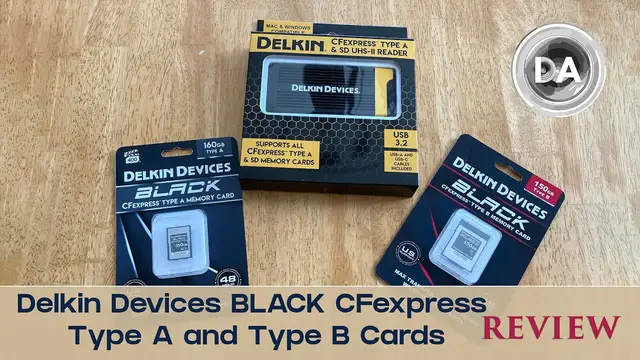
Photographer Dustin Abbott shares a review and demonstration of the Delkin Devices BLACK CFexpress Type A and Type B memory cards | Visit https://bit.ly/lethelightinTV for the new channel | Purchase the Delkin BLACK CFExpress cards @ B&H Photo https://bhpho.to/3Q6G3o9 | Amazon https://amzn.to/3eijVds | Camera Canada https://shrsl.com/3oolk | Amazon Canada https://amzn.to/3QbwrbK | Amazon UK https://amzn.to/3wSHMqB
Check out the DA Merch here: https://bit.ly/TWIMerch | Become a Patron: https://www.patreon.com/dustinabbott | On the Web: http://dustinabbott.net/ | Sign up for my Newsletter: http://bit.ly/1RHvUNp | Instagram: http://bit.ly/DLAinsta | Facebook: http://on.fb.me/1nuUUeH | Flickr: http://bit.ly/1UcnC0B | 500px: http://bit.ly/1Sy2Ngu Follow Craig @ https://www.instagram.com/craigstoffersen/
Want to support this channel? Use these affiliate links to shop at:
B&H Photo: http://bhpho.to/1TA0Xge
Camera Canada: http://bit.ly/DLACameraCan
Amazon: https://amzn.to/3HrY64d
Amazon Canada: https://amzn.to/3qG1p18
Ebay: http://bit.ly/DustineBay
Make a donation via Paypal: https://www.paypal.com/paypalme/dustinTWI
=============================
Table of Contents:
=============================
0:00 - Intro and Concept
2:16 - Specs and Features
6:00 - Performance Tests
9:25 - Conclusion and Pricing
---------------------------------------------------------
Show More Show Less View Video Transcript
0:00
Hi, I'm Dustin Abbott, and I am here today to give you a review of memory cards, specifically both Type A and Type B Compact Flash Express cards coming from Delkin devices
0:17
Now, these are the black label cards, and I've been really interested in reviewing their cards, mostly because Delkin has started to produce Type A cards
0:29
And while I've had the opportunity to review a variety of CF Express type B cards in the past
0:37
I've got four different ones on hand right now, starting from the Sony Tuff that I bought originally with my Canon EOS R5
0:45
and then I've reviewed a peer year before. I've reviewed a card from Manfredo before, and so now this Delkin is the fourth different one that I've had to look at
0:56
But I've continued to watch over the last several years since I bought my Sony Alpha 1
1:03
And to this point, I have only seen Sony branded cards. And so I'm really glad to see these along with, I think, Prograde, is starting to produce Type A cards as well, which is truly important for a variety of reasons
1:16
The biggest reason is when it comes to price. And one thing I've seen is that while both Type A and Type B, CF Express cards started off very expensive
1:26
As we're going to see here in just a moment, market forces have driven down the price of the type B card
1:31
simply because there are a variety of manufacturers. Whereas with Type A, because it has been almost a Sony exclusive format, we have not seen that price drop
1:40
And that's still reflected at this point, though I'm hopeful that new cards like these from Delkan are going to push that price point down
1:47
And so just to give you a quick idea of what those prices fall at, for the Type A cards, they have a couple of different sizes
1:54
there is an 80 gigabyte that runs at $196, roughly $200 from Delcun
2:01
And then the one that I reviewed is a 160 gigabyte capacity, and it retails at $365
2:08
When it comes to the type B card, they start at 75 gigabytes in terms of capacity for about $130
2:15
The 150 gig card, which is similar in size to the type A card I reviewed, is $175
2:22
and that will range all the way up to 650 gigabyte cards
2:26
It'll run you $725. They actually do have a lower level, a green series
2:32
where you can actually go all the way up to a 2 terabyte size for roughly about the size of the 7, or excuse me
2:38
the 650 gigabyte black level card. But the black label cards are, I would say
2:44
more comparable in their specs to the Sony tough cards, which have become my standard
2:51
and it's really what I've gone to for SD cards. I've obviously purchased CF Express Type B
2:57
And so that's really kind of the standard that I'm comparing against. Now, a few kind of general observations
3:03
I had zero problems on either Sony or Canon in running 8K
3:08
And so for example on the Canon EOS R5 I can run all the way up to a 8K raw And so obviously a very high bit rate I think somewhere around 500 megabits And so I ran that test until the card was filled
3:22
which in this case with 150 gigabyte card, look, took less than 10 minutes
3:27
And so it ran all the way to until it filled the card to capacity and only stopped at that point
3:32
So no problem in data transfer for 8K. In my Alpha 1, I ran 8K, which is at a lower 200 megabit bit rate at where I had it set up
3:43
And so I ran it until the Alpha 1 finally overheated. And that was at the 43 minute mark
3:49
And so it shut down at that point due to heat. But I had a 4259 in terms of limit
3:56
And so obviously no issue with file transfer there with the type A card
4:00
And so really good news in far as stability on that point, beyond that I've been really
4:05
real world using these cards now for about a month and they use them on trips. I've used them for
4:10
burst, you know, all the different things that you want that higher speed rating for. And I've had
4:16
zero problems with them, you know, whether we're shooting like, you know, 4K 120, for example
4:22
I've done some of that. And zero issues with that, very stable performance. And also I've noted
4:26
that I felt just, and this is not something that I've scientifically test, I'll get to a more
4:31
scientific test in just a moment. But as far as a non-scientific test, I have just felt that my
4:36
transfer of images has been faster coming with the type A card versus the Sony Tuff SDUHS2 card
4:46
and more on that in just a moment. But bottom line is when it comes to practical real world
4:51
performance, I've had zero issues thus far. And I will note that they are comparable to the Sony
4:56
tough cards in their specifications. And so breaking that down when it comes to
5:01
to the type A cards versus Sony Tough. The Delkin Black Series are rated at 880 megabytes per second in their transfer speed
5:12
And so that would be a read speed and 790 megabytes a second in terms of a right speed
5:20
And so 880, 790. The Sony card is rated comparatively at 800 and 700
5:27
And so the Delkan Black series is rated a little bit faster
5:31
It's also a little bit cheaper for this 160 gigabyte card to compare with a similar 160 gigabyte card in the type A from Sony
5:42
We're looking at $365 for the Delkin, about $400 for the Sony
5:47
So not a huge difference, not a night and day difference, but, you know, about $35, which is real money
5:55
And so, you know, at this stage, you probably would want to watch see if there's some kind of sale
5:58
It's a different range of attitude because, as we're going to see in real world spec performance, not a whole lot of difference
6:04
And so price may become your final evaluation. Type B cards are obviously, because those market forces, they are cheaper
6:11
And so as far as the Delcun Black Series rating, 1,125 as far as a read speed, 1530 as far as a right speed
6:20
So obviously the larger type B cards are faster which you probably already knew That compares to 1 for the Sony So you know roughly about 25 the Delkin card is about 25 megabytes per second faster in writing and it is
6:39
about 50 megabytes per second faster, excuse me, in writing, and 25 in reading. And so a little
6:47
bit of an advantage, and also a little bit of an advantage in price. So $175.00.000
6:52
versus $200 for the equivalent Sony card. And I will note when it comes to that
6:57
you also are getting a little bit more capacity versus the Sony. The Sony comes out 128
7:02
This is running at 150. So also for that same money, you're getting a little bit more capacity
7:07
So maybe a little bit more compelling on the price point when you're looking at the type B cards
7:13
I will also note that as I compared them, they have similar kind of tough specifications
7:19
The Sony cards have the tough brand, but I mean, really, there's kind of a standard that all of these professional cards are being built to, and so they claim
7:25
to be shockproof, waterproof, ready to handle extreme temperatures, you know, x-ray resistant, those types of
7:32
things. And so all of the basic specs are, you know, fairly comparable. I will also note that
7:38
they are producing a card reader for type A. This is a type A, and I'm also happy to see it also has an
7:46
SDAXC slot, which is always nice. I wish they, that it also had a type B slot
7:53
and so that you could get all of them in one card reader, which seems to be a little bit rare to find these days
7:59
But anyway, this card reader runs you about 80 bucks and certainly seems to be stable, works well
8:06
So let's talk about some, a little bit more scientific test. Now, when I say scientific, I'm not talking about
8:11
just running them through some kind of benchmark software. You can find that out there a lot
8:16
I'm more interested in the real world application. And so if I'm transferring files, do I see any kind of real world difference between these various cards
8:23
So for my test, I used a 5-gigabyte video file, and so I went in two different directions
8:29
I copied it from the card over to a solid-state hard drive
8:34
and so that way it kind of tests the read speed, and then in reverse, to write it back onto the card
8:39
And so when it came to the Delkan Type B card, it was able to transfer to the hard drive or read
8:46
and it took 13.09 seconds. to make that transfer to write back to the card
8:52
it took 19.27 seconds. And so a little bit slower, right speed
8:58
and also there was a few dips, whereas it stayed very consistent in terms of its throughput
9:04
when you were actually reading from it and writing to the hard drive
9:08
Now, for the Sony card, it took 13 seconds, and so 0.09 seconds less
9:15
for it to do the transfer to the hard drive. But in writing back to the card, it actually ran at 21.25 seconds versus 19.2 seconds
9:25
And so almost a full two seconds slower. And so that tells me that Delkin's doing a very good job with the right speed
9:31
And just in case you interested in these cards were all freshly formatted before doing this test to make sure that I had a consistent standard And it wasn some kind of slowdown versus to other files or any kind of file corruptions that were taking place Now when it comes to the type A transfer unfortunately I don have the Sony card on hand
9:50
And so what I am actually replacing this, I'm replacing in my cameras is actually a Sony
9:56
tough, a UHS2 SD card, which is a very, very good, the best that I've tested as far as SD cards
10:03
But obviously, you're getting faster transfer speeds. going to see here. So when I did the same kind of transfer on the Delkin type A, it took me 14.16
10:14
seconds to do the read transfer, and it took me 21 seconds in terms of the right transfer. So
10:21
interestingly, this card actually wrote a little bit faster than what the Sony Tough Type B card did
10:28
And so that's certainly good news for the Delkin card. As far as the SD transfer, it was 18.16. So
10:36
four seconds slower to do the read, and it took 23.06 to do the right, so only about two seconds
10:43
slower to do the right, which again shows how very good in real world use these Sony tough
10:49
SD cards are, and which is why I've been able to access most of the functionality, even on a
10:53
camera like the Alpha One, using very good SD cards. This is just a little bit better, obviously
10:59
and gives you just a little bit more stability and, you know, possibly more storage. And so
11:03
the conclusion of the matter is, is that these Delcan cards are great additions. They come with a very quality warranty to them. They talk about having
11:13
a 48-hour exchange if there ever is any kind of, they will replace it. Then 48 hours
11:19
if ever you did actually have an issue on the cards. These cards are made in Taiwan
11:24
just if that matters to you. And so anyway, a very good experience so far with them. Not as huge
11:30
of a price improvement as I hope for. And so that's going to be less the selling point. They are a
11:35
better value and that they're giving you a tiny bit more performance. And in the case of the
11:40
type B card, they're also giving you a little bit more storage space at a better price point. So
11:45
well worth consideration. But I think what's most important when it comes to the type A card is
11:49
its very existence means that all of a sudden there is some market force and some competition
11:54
And as we see other manufacturers start to produce these cards. The good news for us as consumers
11:58
is that I think you will see the price of this media come down. And I'm really happy about that because
12:04
I'm seeing it pop up in more and more of Sony's cameras. I now have two Sony cameras that can use
12:09
these cards. And so their price coming down is great news for me as a consumer because it means
12:14
that I can make more of a transfer of this card to, you know, away from the older format of the
12:21
SD card. If you would like to purchase any of these cards, you can look in the description down
12:26
below and you'll find a linkage there to various places where you can purchase. Beyond that
12:31
of course, you can follow myself or Craig on social media, become a patron. Get channel merchandise
12:36
And of course, if you haven't already, please click that subscribe button right here on YouTube
12:40
Thanks for watching. Have a great day and let the light in
#Camera & Photo Equipment
#Greeting Cards