0:00
In the perfect world, all of us that do YouTube videos or vlog, we would have a nice camera
0:17
crew to follow us around and get professional footage of us as we do what we do. But unfortunately
0:23
we don't live in a perfect world. And if you're anything like me, you probably are more of
0:28
a one-man or one-woman show. And I am both my on-screen talent and also my camera crew most
0:36
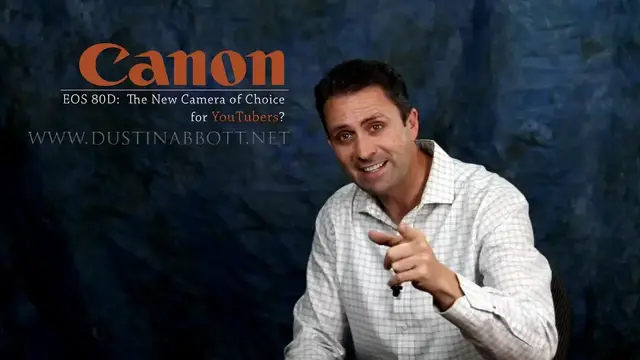
of the time. I'm Dustin Abbott and I'm here today to talk to you about the new Canon 80D
0:41
and why it may be the camera you've been looking for for your YouTube channel or vlogging
0:47
Out of the various things that Canon has touted, and I will have a lot of new segments that are
0:51
coming as I look at some of the various aspects of this camera. Already I've started to look at
0:56
the high ISO performance as well as the dynamic range and its new focus system, its ability
1:03
to use a 1.4x teleconverter at different focus points, all of these things and others I am
1:09
considering as a part of my review. But today I want to focus specifically on the one element here that I think may be an
1:17
underrated feature for those of you that are doing regular video use
1:26
And it has an upgraded new version of Canon's DPAF focus system that is upgraded and enhanced
1:34
And I wanted to see just how much better it was in the previous generation Canon 70D
1:40
And then along with that, the Canon EOS M3. And so I set up a test this morning where I put the cameras down at the level of a piano
1:52
and had my son rip out a classical piece. And so the point was to see how well the cameras could do
2:00
in trying to track the movements of his hand as it went up and down the keyboard And of course the nature of the piano keyboard gives us a very clear indicator of what in focus and what not in focus And so as a part of that
2:13
I also shot footage looking at the tracking system on the back of the camera
2:18
and so we can compare and contrast. And so in that sequence of events
2:23
I certainly found out that the new Canon EOS 80D is the best of the bunch for tracking
2:29
I tried them in both situations, where I first tried to track the easier hand
2:34
which would be, in this case, the left hand was the one that was closer to the camera
2:38
And so it was always in view, and thus it was easier to track. But then I also tried to do a sequence
2:44
where I would track the far or the right hand, and there would be times
2:49
that it would be obscured by the left hand and to see whether or not the camera could keep up
2:53
with its original focus point. And in starting off the sequence by selecting the right hand
2:59
to see how well it could follow it. And so as we look at each one of these scenarios as it plays out, we quickly come to some conclusions about which of these three cameras is the best for tracking on-screen activity
3:13
We're going to use the EFS 24mm f2.8 lens on the 70D and the 80D, and then I'm also going to throw the Canon EOS M3 into the mix using the 22mm f2 STM lens on that body, also set at f2.8
3:31
We see as we watch the tracking from the 70D that the adjustments are not made in a kind
3:39
of linear way but rather there is a periodic adjustment and if we see what's happening
3:44
with the actual tracking we find that at some point the tracking has given up and is simply
3:50
just focusing on a specific point which is reflected in the fact that there isn't really
3:55
a whole lot of movement in the actual focus taking place here
4:00
In fact, in one occasion, we discovered that the 70D has just given up trying to track
4:08
particularly when we move to the far right hand and trying to track that And it given up with the actual tracking and it just now kind of focusing across the whole frame And so now we going to try and I going to set the focus point on the forehand
4:23
which is the easier one to track and let's see how he does. Go ahead Sam
4:27
The EOS M3 delivered a mixed performance
4:38
It tracked fairly well when tracking the easier, the front hand. But when we shifted to trying to focus following the back hand, the rear hand
4:48
which does disappear from sight sometimes behind the right, the left hand
4:53
We found that at some point the tracking shifted off from the right hand that it started with and eventually switched to the forehand and focus stayed with that after that
5:05
And so we find that even when the right hand continued to move away from the left hand that the focus was staying on the left hand rather than even trying to track the right hand any further
5:16
Okay, one more time we're going to try the 80D on the most difficult setting
5:20
We found with the other cameras that either they stopped tracking altogether like the 70D and just stayed fixed on one point
5:27
or in the case of the M3, at some point they switched hands and did not continue to track the far hand
5:34
So I'm going to have Sam lift up his right hand here, and we're going to select that
5:39
and we're going to see now once again if the 80D can keep up with this right hand, even when it begins to disappear behind the left
5:46
Go ahead. So in conclusion, you can see with me that the Canon 80D is clearly superior to both its predecessor and then the mirrorless M3 bodies and their ability to track movement
6:58
And while it is still not perfect, and I don't know that any DSLR focus system is perfect, it was able to accurately not only keep tracking but also retain which was the hand that it should be focused on
7:11
So what that means for you is that if you are moving around and wanting the camera to follow you
7:17
as far as being on screen and trying to track your activity
7:21
the Canon 80D is clearly superior in this ability and in fact has one of the best focus follow systems for what we call servo AF during video capture
7:33
And so as a result, I think it probably should be at the very top of your list
7:37
if you're considering a new camera for doing either a YouTube channel or vlogging and you
7:43
don't have somebody else to run the camera for you. It is going to be able to keep up with your face
7:48
and keep focusing where it needs to without ruining your videos by focusing back and forth
7:55
or losing focus altogether. So I hope that this helps those of you that are considering
7:59
using a DSLR for your actual video performances. I'm Dustin Abbott, and if you haven't already, please subscribe below
8:09
There's also information on how you can follow me on social media and even sign up for my newsletter
8:15
which has all of my new reviews and photography tips, as well as some giveaways
8:21
Thanks for watching. Have a great day