Up next in 10

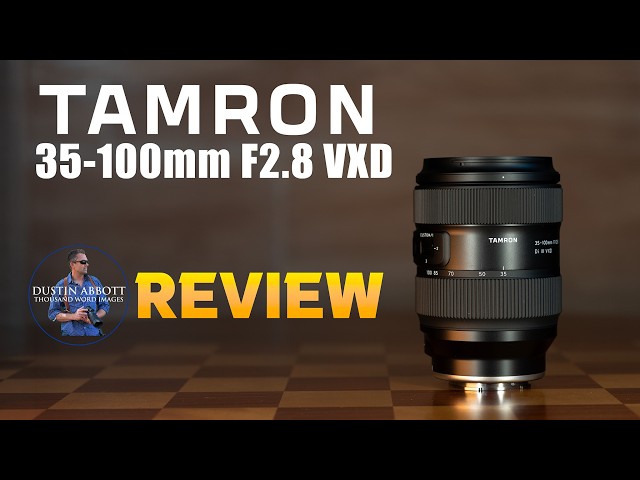
Tamron 35-100mm F2.8 VXD Review | Does the Oddball Zoom Excel?
Mar 8, 2026

Photographer Dustin Abbott shares a deep dive review of Tamron's interesting new 35-100mm F2.8 VXD zoom. An unconventional zoom range...does it work? | This episode is sponsored by Fantom Tracker. Visit store.fantomwallet.com and use code DUSTIN20 for 20% off. | Read the Text Review: | Purchase the Tamron 35-100mm F2.8 VXD @ B&H Photo https://bhpho.to/4r2jIdY | Adorama https://prf.hn/l/y8M8LGe/ | Amazon https://amzn.to/4rENsi4 | Camera Canada https://tidd.ly/4kXqqAo | Amazon Canada https://amzn.to/4qY6oHy | Amazon UK https://amzn.to/4r3kEyS | Amazon Germany https://amzn.to/4rXZUdf
Check out the DA Merch here: https://bit.ly/TWIMerch | Become a Patron: https://www.patreon.com/dustinabbott | On the Web: http://dustinabbott.net/ | Sign up for my Newsletter: http://bit.ly/1RHvUNp | Instagram: http://bit.ly/DLAinsta | Facebook: http://on.fb.me/1nuUUeH | Flickr: http://bit.ly/1UcnC0B | 500px: http://bit.ly/1Sy2Ngu Follow Craig @ https://www.instagram.com/craigstoffersen/
Want to support this channel? Use these affiliate links to shop at:
B&H Photo: http://bhpho.to/1TA0Xge
Adorama: https://tinyurl.com/AdoramaDA
Camera Canada: http://bit.ly/DLACameraCan
Sony Canada: https://www.thesonyshop.ca/?ref=abbott
Amazon: https://amzn.to/3HrY64d
Amazon Canada: https://amzn.to/3qG1p18
Ebay: http://bit.ly/DustineBay
Into the AM Clothing: https://bit.ly/intotheAMda and use code DUSTIN10 for 10% off
Fioboc Clothing: https://tinyurl.com/FiobocDA20 and us code DUSTIN20 for 20% off
Make a donation via Paypal: https://www.paypal.com/paypalme/dustinTWI
=============================
Table of Contents:
=============================
0:00 - Intro and Concept
Show More Show Less View Video Transcript
0:10
Hi, I'm Dustin Abbott and I'm here today
0:12
to give you my review of the new Tamron
0:14
35 to 100 millimeter f2.8 DI3 VXD lens.
0:20
A lot of you have been requesting that I
0:22
review this lens ever since it was
0:23
announced and so your wish is granted
0:26
today. This is an interesting lens in
0:29
that it is going after a focal length
0:31
that really we haven't seen before or I
0:34
should say a focal range. And while
0:36
Tamron has released the 35 to 150 mm
0:39
previously, this is obviously a more
0:42
constrained zoom range in a lens that is
0:44
roughly the size of a lens like Tamron's
0:46
own 28 to 75mm f2.8. And obviously that
0:51
while it's still a little bit
0:52
unconventional is much closer to the
0:53
conventional 24 to 70 millimeter focal
0:56
length. And this like the 35 to 150 is
0:59
kind of borrowing a bit from both the
1:01
standard zoom 24 to 70 and then a
1:04
telephoto zoom in the 70 to 200
1:06
millimeter though in this case a much
1:08
more constrained uh zoom range on both
1:11
ends. But while it's an unconventional
1:13
zoom range, you are getting a lens that
1:16
is lightweight, relatively inexpensive,
1:18
has a constant maximum aperture of
1:20
f/2.8, and as we're going to see, is an
1:23
extremely high-erforming lens. And so,
1:26
while the lens is unique on paper and
1:28
maybe doesn't make sense for everyone on
1:30
paper, as we're going to see, the actual
1:33
performance of the lens is really pretty
1:35
fantastic. Tamron, maybe more than any
1:38
other company, is dedicated to the idea
1:40
of making zoom lenses, and they tend to
1:42
do it really, really well, as we're
1:44
going to see today. Before we dive in, I
1:46
do want to say thanks to Tamron USA for
1:49
sending me a loaner of this lens. It
1:51
will be going back to them at the end of
1:52
this review period, and they have had no
1:54
input on this review, nor will they see
1:57
it before you do. All the caveats aside,
2:00
let's jump in and take a look at the
2:01
build and handling today. Today's
2:03
episode is sponsored by the all-new
2:05
Phantom Tracker 2.0. Phantom has not
2:08
only seriously upgraded the visual look
2:10
of the card, but now we have a superior
2:12
build quality. Made with tempered glass
2:14
and metal alloys. This credit card size
2:16
tracker can be locally tracked via a 90
2:19
decel beeping noise, but also on a
2:21
global level via Apple's Find My Network
2:23
and its map. The addition of NFC means
2:26
you can also use the card to trigger an
2:28
automation. Just tap it. The tracker
2:30
fits perfectly in any wallet or bag and
2:32
assures you won't lose your valuables.
2:35
It has a built-in rechargeable battery
2:36
that can be easily charged via any
2:38
wireless charger, and a single charge
2:40
can last up to 6 months. The Phantom
2:43
Tracker 2.0 makes for a seriously cool
2:45
gift. So, visit store.fanomwallet.com
2:48
and use code dustin20 at checkout for
2:51
20% off. That's store.fanomwallet.com
2:54
and use code dustin20 for 20% off. All
2:58
right, let's take a closer look at the
3:00
build and the handling, the overall
3:02
design here. Price point at $899,
3:05
there isn't really hardly any comps for
3:08
this lens. Um, it obviously that feels
3:11
like a good value for the lens and it is
3:12
similar to their 28 to 75mm f/2.8 G2
3:16
lens. If we look at the 35 to 150
3:19
millimeter lens, which is at a whole
3:20
another level if we're being honest,
3:22
it's about $1,700. Sigma's 28 to 105
3:26
millimeter is $1,650.
3:29
I think that we can probably all agree
3:30
that that's a very fair value for this
3:32
particular lens as far as the price. It
3:35
also gets a win for being very nice and
3:38
lightweight for a lens in this class.
3:41
565 g that is light enough when you
3:44
compare to a lens like the 35 to 150.
3:47
That lens is 1,165
3:50
g. The Sigma 28 to 105 is 990 grams or
3:53
basically a kilo. And so this lens is
3:56
very lightweight. It's less than half
3:58
the weight of the 35 to 150. Overall
4:01
dimensions here, the lens is 80.6 mm in
4:05
diameter or 3.38 in. That makes it just
4:08
a a little bit wider in diameter than
4:09
the 28 to75. And at 119.2 millimeters or
4:14
4.7 in, that makes it about two
4:17
millimeters longer than the 28 to75. So
4:19
again, very moderate size. Now, it is
4:22
not internally zooming. You can see
4:24
there is a very mild barrel extension
4:26
here, but it's just about 19 mm. And I
4:30
would say that it is a small enough
4:32
extension that it probably isn't going
4:33
to change the balance when you're
4:35
working on a gimbal. While this is an
4:37
externally zooming lens, the zoom action
4:39
is actually nice and smooth. Uh it's
4:41
very, very nicely damp. I could do some
4:44
successful zooming while shooting video,
4:46
even handheld. And so that tells me that
4:49
there's a nice smooth zoom action going
4:51
on here. What we don't have is a zoom
4:54
lock. And I think that Tamara must have
4:56
assumed that the small amount of barrel
4:58
extension and the good damping of the
5:01
overall zoom mechanism made them feel
5:03
like it was unnecessary.
5:05
This is an interesting uh zoom range.
5:08
Obviously, we've never seen anything
5:10
quite like it before. So 35 mm on the
5:13
wide end and then zooming into 100
5:14
millimeters. a lot of very useful focal
5:16
lengths there, but I think that there
5:18
are some people they're going to look
5:19
and say that's not wide enough or it's
5:20
not long enough to actually meet their
5:23
needs. I think that's going to be the
5:24
area where Tamron is going to have to
5:26
sell people on an a non-conventional
5:29
zoom ratio here. Now, the feature set of
5:31
the lens is largely built around this
5:34
USBC port. It is weather sealed here,
5:37
but that is going to give you access
5:39
either through an OS app or Android or
5:43
Windows or Mac to their lens utility
5:45
software that really allows you to tweak
5:47
the behavior of the lens. You'll note
5:49
here that there is a custom switch on
5:50
the side and then we have a function
5:52
button. Basically, these c this custom
5:55
switch is going to determine what not
5:57
only the button does, but also what this
5:59
control ring does. And so it's typical
6:01
function is going to be manual focus,
6:03
but you can set it up to be an aperture
6:05
ring, for example. Um, and there's
6:07
different things that you can do with
6:08
that. And in this case, rather than just
6:10
having one custom function, whatever the
6:12
function from within the camera, which
6:14
would typically be for the function
6:15
button, you can set a total of three
6:17
different custom functions in that lens
6:19
utility software. Put a lot of different
6:21
options in there. You can uh set again,
6:24
as I've mentioned, set up for an
6:25
aperture ring. You can set up this as an
6:26
AFMF switch. You can set it up for
6:29
infinity control. If you're wanting to
6:32
uh shoot astro, for example, you can do
6:34
AB focus. There's a lot of variety
6:36
there. Also, in that lens utility, you
6:38
can not only control the behavior of the
6:40
manual focus, whether it's linear or
6:42
nonlinear, how far the throw is going to
6:44
be, what direction it goes in, but you
6:46
can also do the same now in the most
6:48
recent update to the app. You can now do
6:50
the same thing when it comes to the
6:53
control of the aperture. The nice thing
6:55
for this being both E-mount and Zmount
6:58
is that, you know, Nikon and Sony, they
7:01
actually zoom and focus in opposite
7:04
directions. You can set it up to where
7:06
it is going to match what you're
7:07
accustomed to doing in Nikon, for
7:09
example. And so, I find that to be
7:10
really, really useful. There's one other
7:13
option here that is now available
7:15
through the USBC port. There is a new um
7:18
utility uh kind of dongle that you can
7:20
add on there that's called the Tamron
7:22
Link. It costs about 50 bucks. I don't
7:24
have one unfortunately to demonstrate
7:25
here, but it what it does is it gives
7:27
you wireless control over the lens. And
7:29
so you can access it via the app via
7:32
Bluetooth and you can control lens
7:34
function. You can control certain camera
7:36
function through it and just gives you
7:38
some remote control of the lens.
7:39
Obviously, you can't it's not a power
7:41
zoom. You're not going to be able to do
7:42
something like zooming, but as far as
7:44
focusing and making some other tweaks,
7:46
you know, aperture uh value, for
7:48
example, taking photos or videos, you'll
7:50
be able to do all of that remotely. So
7:52
an interesting addition to the setup
7:54
here. This is a weather sealed lens and
7:57
that starts with a gasket here at the
7:59
rear. There are different seal points,
8:02
you know, at the switches, the button,
8:04
the rings, and then a flooring coating
8:06
on the front element. A nice thorough
8:08
degree of weather sealing there. Inside
8:11
we do have nine aperture blades. And by
8:14
the way, if you're setting this up to
8:15
where you have aperture control enabled
8:17
here, you can do aperture racking as you
8:20
can see here. And so that just gives
8:22
you, you know, an extra option of what
8:24
you can do as far as control. The hood
8:27
is included. And the hood itself, it
8:30
locks into place with really good
8:31
precision. It stays locked there. No
8:33
problems that there is no actual locking
8:35
switch if you're looking for something
8:37
like that. Minimum focus distance on the
8:40
wide end. It's a variable minimum focus.
8:42
So on the wide end, you can focus as
8:44
closely as 22 mm or right under 9 in.
8:48
And that will give you a very high 0.30
8:50
30 degree of magnification. However, it
8:54
leaves you with very little working
8:55
distance, about 8 centimeters or roughly
8:57
3 in. So, you're going to have to be
8:59
pretty close to your subject. You're
9:00
probably going to want to remove the
9:01
lens hood if you're right up close to
9:03
your subject like that. And also, as you
9:05
can see here, the plane of focus isn't
9:07
particularly flat. Now, that's worse
9:08
with the two-dimensional thing like my
9:10
test chart. If you move out to
9:11
three-dimensional objects, it works a
9:13
little bit better.
9:15
The telephoto wind, the minimum focus
9:18
distance is 65 millimeters. Obviously,
9:21
you don't get as high a magnification,
9:23
only 0.17 times, though the plane of
9:25
focus is much flatter. I would say that
9:28
sometimes with these variable minimum
9:30
focus distance lenses, you can find a
9:32
sweet spot. In this case, maybe around
9:34
50 millimeters or so, where you get a
9:36
little bit more working distance, maybe
9:38
slightly less magnification than on the
9:40
wide end, but maybe a little bit more
9:42
useful if you're willing to compromise a
9:44
bit of magnification. Overall, this is a
9:47
really nice package for the money, and
9:50
uh there's really not a lot to complain
9:52
about here. Tamron's kind of control
9:53
system is it's non-conventional, but it
9:57
also gives you a deeper degree of
9:59
customization than what most other lens
10:01
brands offer. And so that is
10:03
interesting. So let's talk autofocus.
10:06
Tamron has utilized their VXD which
10:09
stands for voice coil extreme drive
10:12
focus motor here. VXD is a voice coil
10:15
motor. And as such I'm I'm actually a
10:17
big fan of voice coil motors. They tend
10:20
to have good amounts of thrust. They're
10:22
very quiet. They're very smooth in
10:23
operation. And Tamron has now had a
10:26
number of years to basically perfect
10:28
their craft when it comes to their VXD
10:30
folks motors. And so in this case, what
10:32
we have got is a focus motor that is in
10:35
fact very very fast in operation. As you
10:37
can see here, you can zip from a close
10:39
to a distant subject, whether indoors or
10:41
outdoors with near instantaneous speed.
10:44
And what I did find is that focus speed
10:46
is good throughout the zoom range. Some
10:48
zoom lenses are great on the wide end
10:50
and then slow down on the telephoto, but
10:52
I didn't find that to be the case here.
10:54
And uh and so you could see there's good
10:56
focus speed. In fact, we could see that
10:58
here as Nala is approaching the camera.
11:00
Just, you know, sometimes I get poor
11:02
results in this kind of setting. No
11:04
problems here. Focus was keeping up with
11:05
her. I don't always look to third-party
11:07
lenses for sport lenses on Sony E-mount
11:11
or Nikon Zmount, uh, because of some
11:13
limitations, particularly on the Sony
11:15
side of things, but I think that this is
11:17
a lens that will work just fine for
11:19
sporting applications. It's a unique
11:21
zoom range that might just work for
11:22
certain, you know, short court type
11:25
sports. And so I think that the focus
11:26
motor is fast enough to keep up with
11:28
that action. Furthermore, it is very,
11:30
very quiet in operation. You're not
11:33
going to hear any kind of focus noise
11:34
basically ever. And so all of that is
11:36
great. Precision is good. I found good
11:38
precision during a portrait session with
11:42
all of our least favorite portrait
11:44
subject, but he tends to be available.
11:46
And you can see here that we got good
11:48
focus accuracy um without any kind of
11:50
issues u whether I was looking at the
11:52
camera looking away from the camera
11:54
didn't really matter shots of uh of Nala
11:57
for example great precision um and you
12:00
can see the results are just
12:01
fantastically sharp fantastically well
12:04
focused and so autofocus generally for
12:06
stills was pretty fantastic. Likewise,
12:09
on the video side of things, the big
12:11
kind of takeaway here on the video side
12:13
of things is that we do have quite low
12:15
focus breathing in this lens, which
12:17
makes it more useful for video
12:19
applications. You can see that focus
12:21
pulls likewise are smooth and confident,
12:24
no visible steps, no stuttering, but it
12:27
just moves back and forth with good
12:29
damping and good precision. Likewise,
12:31
when I did my hand test, the only thing
12:33
that I would say is that there was
12:35
several occasions where it didn't
12:37
transition to my uh to my hand when my
12:40
hand was out. And it's because it could
12:42
my, you know, Alpha 1 Mark II could see
12:44
a little too much of my face. And so, I
12:46
mean, I don't think that's really a lens
12:48
problem so much as just the test
12:49
problem. When I approached the camera
12:52
and I stepped in and out of frame, I
12:54
would say that uh acquisition was a
12:57
little bit slower than what I would
12:58
like. they've gone towards damping.
13:00
Obviously, I could turn up the
13:01
sensitivity if I wanted a little bit
13:03
quicker response there, but it tracked
13:05
me with good confidence. And as you can
13:07
see with these outdoor segments, all of
13:08
which I am filming with the lens on my
13:10
Alpha 1 Mark II, you can see that I am
13:13
getting good precise results. One final
13:15
thing that I will note is that unlike
13:17
many of the competing lenses, this lens
13:20
is small and light enough to go on a
13:21
gimbal. And while it is an externally
13:23
zooming lens, the actual zoom extension
13:26
is smaller than basically all of the
13:29
other externally zooming options. And I
13:31
don't feel like the the balance point
13:33
really changes much. So I think you
13:35
could zoom throughout and any kind of
13:37
very minor variance in the actual uh the
13:41
balance I think would be easily
13:42
compensated for with the motors on your
13:44
motorized gimbal. So all of that adds up
13:46
to a lens with low focus breathing that
13:48
I think is going to be a very
13:50
interesting and useful lens for video
13:53
work. All right, let's start by taking a
13:54
look at the optical design. Here we have
13:56
15 elements in 13 groups. As you can see
13:59
that included includes some molded glass
14:02
aspherical elements. We also have uh low
14:06
dispersion elements and then extra low
14:08
dispersion element in there as well.
14:10
Now, if we look at the MTF chart on the
14:12
wide 35mm end, you can see an extremely
14:15
sharp center of the frame that stays
14:18
relatively flat out to about here, then
14:20
begins to drop. Although, you know, that
14:23
is on the sagittal axis. The meridian
14:26
axis drops a little bit sooner. Um, but
14:28
overall a good strong consistent
14:30
performance there. On the 100 millimeter
14:33
end, we can see that the center is every
14:35
bit as sharp, but it just kind of falls
14:37
in a more linear way. and so it's weaker
14:40
in the corner and just kind of falls off
14:42
more consistently across the the frame.
14:45
You'll see in both cases if you're
14:46
cutting off at APS-C for this lens, it's
14:48
going to be really really sharp across
14:50
the APS-C um image circle. Now, one of
14:53
the advantages of not going super wide
14:56
at 35 mm is that we see very, very
14:58
little distortion. Now, obviously,
15:00
there's lots of 35 millimeter lenses
15:02
with massive amounts of distortion, so I
15:03
don't want to downplay what Tamron has
15:06
done here. We basically have a neutral
15:07
performance. I dialed in a plus one to
15:10
correct the tiniest amount of barrel
15:11
distortion here, but you could easily
15:13
leave that uncorrected. Vignette is more
15:15
obvious and I needed a plus 64 to
15:18
achieve the manual result. Again,
15:20
profile corrections will take care of
15:21
this in camera or in editing software.
15:23
Typically, after a bit here at the
15:25
middle of the range, 62 mm, you can see
15:27
that it inverts to a pin cushion style
15:29
distortion. By the way, it stays this
15:31
way almost exactly through 100 millm.
15:34
The vignette is a little less um obvious
15:36
here. I needed about a plus 50 to
15:38
correct here. At 90 millimeters or
15:41
excuse me 100 millimeters, the pin
15:42
cushion distort distortion still
15:44
required a minus 9 to correct for
15:46
consistent from what I saw in the mid
15:48
mid level. And then we see here that the
15:50
vignette is just a little bit heavier
15:52
again about equal to 35 mm around a plus
15:54
60 plus 62 to correct like this. Nothing
15:57
too extreme there. Now when it comes to
16:00
fringing we see that it's not perfectly
16:02
corrected here. There is a bit of a
16:04
green fringing after the plane of focus.
16:06
A tiny bit of magenta beforehand. If I
16:09
zoom in here at a very high level of
16:12
magnification, about 200% magnification,
16:14
you can see that there is some fringing
16:17
bits on the shiny areas here of the
16:20
image. Um, and so that is going to show
16:23
up. It's not particularly pronounced
16:24
enough to where you're going to see it
16:26
really strongly here, but you you will
16:28
see it there. You can also see a little
16:29
bit of fringing around the specular
16:31
highlights. On the note of the specular
16:33
highlights, you can see there's
16:34
definitely some pretty strongly squeezed
16:37
uh lemon shapes there in the corner at
16:38
f2.8. At f4, it's more circular, but
16:42
we're getting a bit of an odd shape
16:45
here. And then by f5.6, it's mostly
16:48
resolved, though there's a little bit of
16:49
clipping that we still see there. If we
16:52
pop back in here for a moment, we can
16:54
see that by F56, almost all of that
16:56
fringing is cleared up. Lateral style
16:59
chromatic aberrations are not a problem.
17:01
You can see no evidence of fringing as
17:03
you transition from black to white here
17:05
near the edge of the frame. Let's take a
17:07
look at resolution and contrast. I'm
17:09
testing on Sony, so I'm using a 61
17:11
megapixel A7R Mark 5 and showing you the
17:15
results here at 200% magnification.
17:17
Center of the frame looks fantastic.
17:19
high contrast, high detail, all thing
17:22
looks great. Likewise, the mid-frame. It
17:24
suggested that it would be really strong
17:26
in the mid-frame, and that is a
17:27
fantastic mid-frame result. And really,
17:30
I think that the corner performance is
17:32
actually impressively good as well. I'm
17:34
seeing that detail all the way down into
17:36
here. I've got no complaints about that.
17:39
Likewise, up in this corner, also
17:41
looking quite good. For real world
17:43
perspective here, this is f2.8 at 35
17:46
millimeters. We can see all throughout
17:48
the kind of plane of focus area that it
17:51
is really, really crisp. Nice detail,
17:54
nice contrast. Nothing to complain about
17:56
there. What I found throughout the zoom
17:58
range is stopping down to f4, it makes a
18:01
minor, but not a radical improvement. As
18:04
you can see, it's just a little bit
18:05
higher contrast, a little bit better
18:07
detail. But there's a bit more of a bump
18:10
at f5.6. And this is where you can
18:13
really start to see an improvement in
18:15
the corners where the corners are
18:17
looking really, really nice and crisp,
18:19
very high detail. So shooting at f5.6 is
18:22
going to give you great performance all
18:24
across the frame. Here's a real world
18:25
case in point. And so you can see
18:27
looking in the center of the frame,
18:29
there's great fine detail all throughout
18:32
the image. And as we pan off right off
18:34
here to the very edge, you can see that
18:35
that detail is pushing right out towards
18:38
the corners. Very, very sharp. That's
18:40
going to stay that sharp through f8. By
18:42
f11, defraction is starting to soften
18:44
the image a bit. And then by the minimum
18:45
aperture of f-22, you can see that it's
18:48
getting much much softer due to
18:50
defraction. Moving on to 50 mm, we see
18:53
again a fantastic result. The center and
18:56
mid-frame result, if anything, is a bit
18:59
sharper. And moving right off to the
19:00
corners, they're really quite strong
19:02
here. There's plenty of detail there,
19:04
even at f2.8. And as before, by f5.6,
19:07
six, it is to fantastic levels.
19:10
Likewise, at 70 mm, you can see very
19:13
sharp and detailed in the center of the
19:14
frame. F5.6, it's looking better, but
19:17
not radically so because it's already so
19:19
good. Mid-frame looks good and better
19:21
still at f5.6. And then once again, in
19:24
the corners, corners don't sharpen up as
19:26
much as we saw at 70 mm, but still in
19:29
real world sharpness, this is very good.
19:31
And finally at 100 millimeters as
19:34
suggested by the MTF center of the frame
19:36
looks fantastic even at f2.8
19:39
more even more contrast and detail by
19:41
f5.6.
19:42
We move towards the midframe also
19:44
looking very good and exceptionally good
19:46
by f5.6. The corner performance is a
19:51
little bit softer and you can see it
19:52
doesn't sharpen up to the same degree at
19:55
100 millm. However, for real world
19:57
context, once again, depth of field is
19:59
going to uh be more affected at 100
20:02
millm. And so, you can definitely see
20:03
where we're focused at. But you can see
20:06
that detail looks really crisp here even
20:08
at f2.8. And again, we've got a very
20:10
credible image even at f2.8. Then, if
20:13
you're looking, you know, at this shot
20:16
for example, that is amazingly sharp
20:19
even at f2.8 and at 100 millimeters.
20:21
Another one here. And you can just see
20:23
that, you know, that consistency of
20:26
great focus, great detail. All of the
20:29
textures just look fantastic. That's a
20:32
really, really sharp performance.
20:34
Returning to the minimum focus distance
20:36
for a moment at 100 millimeters, even
20:38
though the magnification isn't as high,
20:40
you can see it's delivering a nice
20:42
looking result at 100 millimeters. And
20:44
then at 35 mm, the result looks good in
20:48
the plane of focus obviously, but it's
20:50
not nearly as flat a plane of focus.
20:52
However, you know, here at about 40 mm
20:56
in a real world type shot, there's a
20:58
little bit of fringing there, but the
21:00
detail looks really, really crisp in
21:02
this area of focus here. And so I'm
21:04
quite happy with the uplose results I
21:07
can get. Even if sometimes, as I
21:09
mentioned, backing off a little bit just
21:10
to compromise to give you a little bit,
21:13
you know, maybe more working distance
21:15
and a little bit more control. As far as
21:17
the bouquet goes, this is probably the
21:20
busiest example I could find. You can
21:21
see there's a little bit of harder
21:23
edges, a little bit more than what I
21:25
would like, but I would still say that
21:26
the image looks good. This shot here,
21:29
you can see that um again, it's a little
21:31
bit more of a favorable favorable ratio.
21:33
So the background is defocused very
21:35
nicely. This shot I feel like falls off
21:38
really nice towards defocus. Maybe a
21:41
little bit more edging here than what I
21:42
would like. But for a zoom lens, that's
21:45
not bad at all. And here with a portrait
21:47
type shot, this is in the middle of the
21:49
range. I think about 68 mm. Number one,
21:52
the detail is fabulous as you can see.
21:55
But as we look towards defocused things
21:57
in the background, um, again, there's a
22:00
little bit more edging there than what I
22:01
would like, but that's really my own
22:03
only complaint. Outside of that, I feel
22:05
like the bokeh quality is really quite
22:07
decent. These shots, a couple of shots
22:10
here, either really, really close or
22:11
just a little bit further away at those
22:13
distances, the background is really
22:15
softly blurred. When it comes to the
22:17
coma performance, you can see shooting
22:19
the night sky, star points are really
22:21
crisp. No real fringing issues around
22:23
them. That's good. And really there's
22:26
minimal coma. It's actually quite well
22:28
controlled right out to the corners of
22:30
the frame. And so while f2.8 isn't the
22:33
brightest aperture for shooting the
22:34
night sky, it does a very credible
22:36
looking result of capturing celestial
22:39
bodies. Finally, when it comes to flare
22:41
resistance, we've got the barbar mark
22:43
coatings here. You can see wide open um
22:47
that we're getting minimal ghosting and
22:49
flare artifacts a little bit here.
22:51
Stopped down to f11. And then you can
22:53
see as we pan back and forth, you're
22:55
seeing a little bit of ghosting, but
22:58
overall the contrast is holding up. It's
23:00
really a pretty strong performance in
23:03
terms of flare resistance as well. A
23:05
good optical performance.
23:07
So in conclusion, the Tamron 35 to 100
23:10
millimeter f2.8 VXD is, I think, a very
23:14
interesting addition to both Sony
23:16
E-mount and Nikon Zmount platforms. It
23:20
gives you a different option. If you're
23:22
maybe looking at a 24 to 70 or 28 to 75
23:26
millimeter zoom range and you just say,
23:28
I I'd like a little bit more reach.
23:30
Well, basically the trade-off is is that
23:32
you get a little bit less on the wide
23:34
end and you pick up some very useful
23:36
reach on the telephoto end. Now, for
23:38
many people, that is not a compromise.
23:39
It's going to be worth it. And they're
23:41
going to prefer a wider uh zoom range
23:44
than what they want on the longer end.
23:46
looking at the ability to crop, for
23:48
example, as a way of compensating for
23:50
that. However, I think that there are
23:52
certain applications that will really
23:54
work with this particular zoom r range.
23:56
I think that one example might be street
23:59
photography where you don't necessarily
24:00
need as wide and that extra bit of
24:02
reach, particularly in a discrete
24:04
package like this could be very useful.
24:07
Likewise, for portrait photography, it's
24:09
going to be a rare situation, for
24:11
example, in a studio that you're going
24:12
to go want to go as wide as 24, maybe
24:15
even as 28 millimeters, whereas 35 mm is
24:18
going to be quite common. And the
24:20
ability to go in much tighter for head
24:22
and shoulders type shots, I think, is
24:24
going to be quite useful. So, I
24:25
definitely think that there are
24:26
applications for that. And then of
24:28
course, those of you that like the idea
24:30
of the 35 to 150, but don't want to
24:32
spend either the price or lug around
24:34
that weight may find this to be an
24:36
acceptable compromise that gives you at
24:38
least part of that zoom range and maybe
24:41
get the rest of the way through
24:42
cropping. And if that, you know, suits
24:44
the bill, you're also getting a
24:46
relatively inexpensive lens uh as a part
24:49
of the bargain. And so I do think that
24:51
there's going to be an audience for this
24:53
lens, but because it is an
24:55
unconventional zoom range, we're going
24:56
to have to just find out whether how big
24:58
that audience actually is. But if the
25:02
zoom range works for you, I think you're
25:04
going to be pretty delighted with the
25:05
overall performance of this lens. It has
25:08
great autofocus. It has an interesting
25:10
feature set to it. It has a really,
25:12
really strong uh optical performance
25:15
that delivers repeatedly impressive
25:18
results. In my test, I was just again
25:20
and again looking and saying, "Wow,
25:22
that's that's really sharp and impressed
25:25
in that." And I felt overall the the
25:26
rendering from the lens was also nice as
25:28
well. So, I think that this is a lens
25:30
that definitely has the optical chops to
25:32
deliver. I don't think that there's
25:33
anyone that's going to buy it that's
25:35
going to say, "Oh, I wish it was a
25:36
better performing optically." That's not
25:38
going to be the problem. The bigger
25:39
question is whether or not this zoom
25:41
range actually works for you. And if it
25:42
does, well, this is going to be a
25:45
really, really interesting addition to
25:46
your kit. it might end up being a lens
25:48
that you end up using a lot. I'm Dustin
25:51
Abbott and if you want more information,
25:53
please check out the full text review
25:55
that's linked in the description down
25:56
below. And if you haven't checked out
25:57
dustinbott.net, take a look around
26:00
there. At this stage is something like
26:02
13 or 14 years worth of accumulated uh
26:05
reviews there. A lot of information. So,
26:07
check that out. As always, thanks for
26:09
watching. Have a great day and let the
26:11
light in.
#Science