Up next in 10


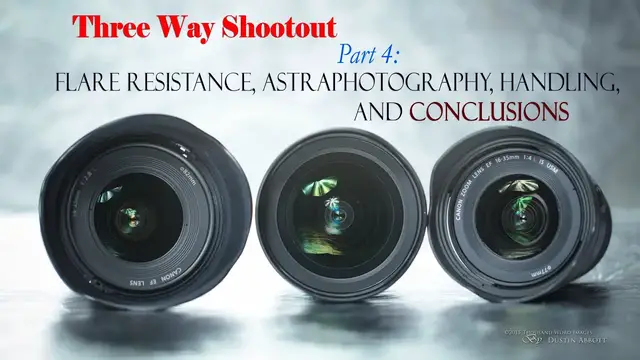
Photographer and Reviewer Dustin Abbott shares the comparison you have all been looking for - a direct head to head shootout between the Canon EF 16-35mm f/4L IS, Tamron SP 15-30mm f/2.8 VC, and the EF 16-35mm f/2.8L II. This final segment focuses on flare resistance, astraphotography and coma, as well as an overall summation and recommendation of which lens would be best for you.. Still have questions? You can find even more details about the lenses here: http://bit.ly/1Fsekay, including photos and crops and far more information.
Buy the lenses:
Canon EF 16-35mm f/4L IS: http://bhpho.to/1caytWU
Tamron 15-30mm f/2.8 Di VC USD: http://bhpho.to/1zjpg3x
Canon 16-35mm f/2.8L II: http://bhpho.to/1aWVKeE
Want to support this channel? Use these affiliate links to shop at:
B&H Photo: http://bhpho.to/1TA0Xge
Amazon: https://www.amazon.com/shop/dustinabbott
Ebay: http://bit.ly/DustineBay
Make a donation via Paypal: paypal.me/dustinTWI
Get a discount off all Skylum Editing Software (Luminar, Aurora HDR, AirMagic) by using code DUSTINHDR at checkout: http://bit.ly/LuminarDLA
Become a Patron: https://www.patreon.com/dustinabbott | Check me out on: Personal Website: http://dustinabbott.net/ | Sign up for my Newsletter: http://bit.ly/1RHvUNp | Instagram: http://bit.ly/DLAinsta | Google+: http://bit.ly/24PjMzv | Facebook: http://on.fb.me/1nuUUeH | Twitter: http://bit.ly/1RyYxIH | Flickr: http://bit.ly/1UcnC0B | 500px: http://bit.ly/1Sy2Ngu
My filming setup: Sony a7R III: B&H Photo: https://bhpho.to/2D6ibNO or Amazon: http://amzn.to/2CNxOvH | or | Sony a9 @ B&H Photo: https://bhpho.to/2HyWIyt or Amazon: https://amzn.to/2s1vYE0
Tamron 28-75mm F2.8 RXD @B&H Photo: https://bhpho.to/2FA00la or Amazon https://amzn.to/2G2kaEr
Show More Show Less View Video Transcript
0:00
It's really important in a lens that's going to be used for landscape purposes to see how it's
0:11
going to react when the sun is put into the frame. And so here we're just going to examine these
0:16
We're going to start by looking at the Tamron here. And so we're going to look at three different
0:21
apertures. You'll see that we're going to go from f2.8 with each one to f5.6 and then finally to
0:27
f11. So that will give us both a way to look at these images and how they hold up to flare at
0:33
different aperture settings, but also will allow us at the f11 to show off how the sun star is going
0:40
to develop or a sunburst is going to develop. So we've got the sun here at the frame. I focused in
0:46
on this little dried stalk that's sticking up, and so we have a kind of a foreground focus that
0:52
It really makes it a little bit more of a torture test for flare resistance
0:56
And so here wide open with the Tamron, first of all, we have a great looking image and you'll
1:01
see how that our sharpness, there's no sharpening that's been added to this
1:05
That's really great wide open. And here I believe that there is a little bit of a flare pattern there
1:11
It's almost indistinguishable, but it is there, but no other kind of flare artifacts
1:16
that I can see in the image. Now at F5.6, exposure value is a little different from these as it goes, they just react differently
1:26
And so anyway, we see our sharpens course is still very good
1:31
I see just a little dot right there for a flare pattern
1:36
Our ghosting pattern over here is basically gone now at this point
1:40
And so now at f11, we see that there is a little bit more now of a ghosting pattern coming down here at the center
1:49
It's certainly not very pronounced or noticeable. And there is a little bit also right up here
1:55
One nice thing about this lens, it produces a really nice sun star there, as you can see
2:01
Nice, nicely defined blades and looks good. And so next we are going to jump on to look at the, and we'll just verify this
2:10
we are looking at the Canon at f2.8. And so this is the 16-35mm f2.8
2:18
And so wide open, also a pretty decent result. Obviously, the sharpness is not as good because the lens is not as sharp
2:25
And we have, right off the bat, we do have an extra bit of flare here at f2.8
2:30
kind of a pattern from that. And then also over on this side, that area is a little bit more pronounced
2:35
and a little bit larger than it was with the Tamron. Now at f5.6 we see that we're beginning to add on a larger flare pattern and from another torture
2:46
test that I've done, this lens is the worst of the bunch when it comes to its flare resistance
2:53
Then finally at f11 we see both the main negatives and the main positives. There is definitely more
3:00
of a pattern and that will show up more in another series that I'll take you to next
3:04
but one positive for this is that that is a really cool sun star really really long blades
3:12
and and so that is a plus for this if you're into that and so now the 16 to 35 f4 l is now
3:23
i have to confess that i can tell from looking at this that i did not nail sharp or focus as well
3:28
as what I did with the other two lenses. And so this is not because the 16-35mm f4L is not as sharp
3:35
We all know better than that. But we're looking more at the flare resistance here
3:39
This is f4, obviously, because it doesn't open as wide. And right now, other than this kind of traditional spot
3:45
that seems to, for whatever reason, seems to get just a little bit of coloration
3:50
which is there and has been on all three of them but there no pattern forming here yet And so now at f5 we can see that there is a little bit of that flare pattern that is forming here And this area is still there a bit a little
4:06
bit of discoloration, but a great performance here so far. And then finally at F11. And at F11
4:14
this is probably the best performance of the bunch in that there isn't really any kind of
4:20
flare pattern showing here. The Sunstar or Sunburst isn't quite as interesting as the other
4:27
two lenses, but it's also quite nice. Okay, we have one final kind of torture test here that I did
4:33
before I had the Tamron in place, and so there's not a direct comparison with the Tamron, but
4:38
this is the worst case scenario for the Canon 16-35mm f2.8, and you can tell in this situation
4:45
that's a nightmare for that particular lens. And by comparison, let's see if we can get an f11 example
4:54
Here we go. Here's from the 16-35mm f4. And you can see that while there is obviously these ghosting artifacts
5:01
from the various elements, it is far less messy looking than what the 16-35mm f2.8 was
5:10
I tried to shoot something similar for the Tamron. And while the conditions weren't identical
5:15
This is similarly FF11 with a very close foreground subject and the light coming through a window
5:21
This performance is better, but I suspect the conditions were probably a little more accommodating than the torture test for the two cannons
5:29
While I would not hesitate to shoot any of these lenses directly into the sun
5:34
Certainly the two newer lenses, the 16-35mm F4L IS and the Tamron 15-30mm, do have a stronger performance when it comes to flare resistance
5:45
Another area where I compared these lenses is for shooting the stars or nightscapes, something that a number of landscape photographers like to do
5:55
And so let's take a look at the performance of each one of these lenses, starting with the Canon 16mm F4 LIS
6:06
Now, obviously, the F4 LIS is at a bit of a disadvantage because it has an aperture that only goes half as wide at maximum aperture
6:16
It's a full stop behind the F2.8 variance. And so as a result, it doesn't have as much light gathering, which means your disadvantage in shooting with this lens is that you either have to jack up your ISO setting higher, or you have to have the shutter open for longer
6:33
And that's a bit of a challenge with astrophotography because you can only keep your shutter open for so long before you start getting some movement of the stars
6:41
And even here at 25 seconds, we'll see that there is a little bit of movement that is beginning in some of these stars
6:52
But a couple of things to look at here is, number one, this is actually a better result than what I've previously gotten with this lens
6:58
and it is because I had to find the right point for infinity focus
7:04
which is not near the hard stop. It's quite a bit short of that
7:08
And so just a kind of a word to the wise that if you're going to shoot the night sky
7:13
it might be wise to determine where infinity focus actually is on your lens in advance
7:18
Sometimes it can be a bit of a challenge of determining that out in the field. Let's look at some of these bright points here
7:23
because coma is one of the key things for shooting night images
7:27
and so you want stars to remain as close to points of light as possible and not to do too much of this
7:37
And so overall, this isn't a terrible performance, but we do get some of these kind of artifacts
7:42
particularly towards the edges where they become more like flying ducks than actual circles of light
7:50
Okay so next up we have the Tamron and so you can see it frames a little bit wider and you can also see that there is a little bit more definition in our
7:59
star points if we go back and forth, and also you can see a little bit more of
8:04
kind of the galaxy haze that's showing up there because of increased light
8:10
sensitivity here. Color balance is not the same between these two, but the Tamron
8:14
is giving us a bit better of a performance in terms of points of light
8:18
Now towards the edge, it's more like there's some elongating of some of these, a little bit of a tail on them
8:25
Not the kind of flying duck or flying saucer look, just a bit of an elongating towards the center
8:33
Nice performance here. And so overall, this is a pretty good performance here
8:40
Now the other Canon 16-35, this is the F2.8L. And so you can tell from this, kind of the main thing is that it doesn't have quite the resolution of the other two
8:52
It has a good light sensitivity. But if we look at here, we see kind of some more of that flying duck and some of those bright areas
9:01
And then if we look towards the extreme edge, there's definitely more distortion along the extreme edge of this one
9:07
Let's switch back to the Tamron for a moment. You see the difference here compared to what the Tamron is producing near the edges
9:14
and then going back to the F4LIS, you can see definitely more of the distortion, that coma
9:20
effect in the corners of the Canon. Here's the Tamron, and then there is the F2.8L, and so that's
9:30
where things kind of fall apart, and here you see some really bad distorted ones out towards the end
9:35
of the frame. Again, let's compare with the Tamron before, and then going back to the F4L, and so
9:43
So F4L has less distortion towards the edges than what the F2.8L is, but our best performance
9:51
here is coming from the Tamron. Now we have one final contender to look at, and that is the Rokinon
9:59
And the Rokinon has been my kind of lens of choice for shooting the night sky
10:04
It does a great job. It opens to F2.8 and has quite good resolution
10:10
And as we look towards the edges here, nice shooting star there
10:17
And so we see just a little bit of kind of that, a more minor variation of that kind of flying duck look there
10:25
That not nearly as bad as what the F2.8L is. And of course the Tamron, really in these corners, I would say the Tamron is probably producing the best result
10:36
There's a little more distortion along the edges of the Rokinon here
10:42
And so overall, I would give our top performance here in shooting the night sky to the Tamron
10:49
That has good light sensitivity, has great sharpness here, and it has less coma along the edges of the image as compared to the others
11:01
So why should you pick the 16-35mm F4 LIS? There are a number of advantages to this lens
11:07
Number one, it is the most compact in terms of its weight and overall size of our Trio
11:13
It also has tremendous image quality with sharpness extending right out to the edges
11:18
along with a great image stabilizer, and it brings a lot of optical goodness to the table
11:24
Its negatives include a bit more vignetting than some of the other options
11:29
particularly compared to the Tamron. and also of course it has the smallest maximum aperture of the three
11:36
And so for those of you that need a larger aperture you may need to look at one of the other two
11:40
But I would say that if your priority is shooting landscapes this is probably your logical choice and that it has a great build as we already mentioned great image quality but it also has a relatively modest 77 millimeter front filter thread which means that it a natural to use with traditional filters
11:58
and it's going to be the most easy one to pack along and to use for a variety of landscape options
12:05
Now, who is the older 16 to 35 F2.L for? I would say it is for those who feel like they need the
12:13
larger aperture of an f2.8 but at the same time some of you are not really comfortable in using
12:19
third-party lenses like this Tamron and so if you are a Canon loyalist who wants the kind of the
12:25
tried improved track record of the build of the f2.8 L along with its wide aperture and great
12:33
focal length just understand that you're going to lose some sharpness and contrast compared to the
12:39
others and its optical defects are definitely more noticeable than the other two. But again
12:44
this is a proven performer that has taken a number of great pictures. And finally, why should you
12:50
choose the new Tamron 15-30VC? Well, you are a person that is looking for the best kind of
12:56
versatility and image quality along with the larger aperture. This lens, it definitely tops
13:01
the list in terms of its feature list and optically it is an amazing performer. It is just about as
13:07
good, perhaps just a fraction of a hair behind the F4L IS, but certainly at large apertures
13:14
it is better than anything else that I have compared it to so far at F2.8, and that includes
13:20
head-to-head with the Tamron 24-70mm F2.8 VC, and compared to the older F2.8 L 16-35mm
13:29
from Canon, the Rokinon 14mm F2.8. This lens is definitely producing the best image quality wide open of those
13:37
It has low distortion, it has very well controlled chromatic aberrations, it also has minimal
13:44
vignetting and very little to correct in post. So for those of you that want to shoot and have images with very little processing to
13:52
do, this is a great choice for that. Its biggest downside of course is the fact that it does not use traditional filters
13:59
Of course, that hasn't stopped a horde of people from effectively using Nikon's 14-24mm f2.8G lens very successfully around the world
14:09
And I do believe that there will be aftermarket solutions for that filter problem
14:14
But recognize that even when those filter systems exist, it will not be as convenient as a traditional screw-on filter thread
14:21
The other downside, of course, is it is significantly larger and heavier than either of these other two options
14:27
but at the same time it is not astronomically large and it's an easy lens to use in field
14:34
This has been my choice mostly because of the things that I value and I need as an event
14:39
photographer, wedding photographer, along with shooting landscapes. I've learned techniques while using the Rokinon over the last several years of getting by without having traditional
14:49
screw-on filters. Would I prefer this to have that traditional filter thread? Absolutely
14:53
But I recognize that the trade-offs of having a large aperture lens like this that has as great an optical performance as it does
15:01
means that you have to cut corners somewhere to achieve that. And at this case, it came at the cost of losing that more manageable front filter thread
15:11
All three of these lenses, they all have something to offer. and I think that for many of you the choice comes down to between the 16-35mm f4L and the Tamron 15-30mm
15:24
VC and so if you're weighing these two options know that it really comes down to what you need
15:30
There is no loser between these lenses. It really comes down to what feature set is more important
15:35
to you. I'm Dustin Abbott. If you haven't already please subscribe. Thanks for watching and have a great day