Up next in 10

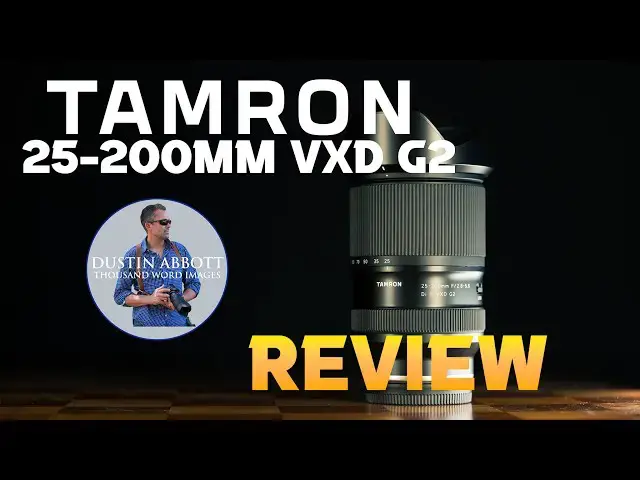
Tamron 25-200mm F2.8-5.6 VXD Review: The Superzoom to Buy!
Oct 28, 2025

Photographer Dustin Abbott shares a deep dive review of the Tamron 25-200mm F2.8-5.6 VXD G2 all-in-one/travel zoom. Is this now the one-lens solution to buy? | This episode is sponsored by Fantom Tracker. Visit store.fantomwallet.com and use code DUSTIN20 for 20% off. | Read the text review on dustinabbott.net: https://tinyurl.com/Tamron25-200DA | Purchase the Tamron 25-200mm F2.8-5.6 VXD G2 @ B&H Photo https://bhpho.to/48MfXUA | Adorama https://howl.link/7y6xvy0fzxug6 | Amazon https://amzn.to/4nabqyF | Camera Canada https://tidd.ly/3WMYiVL | Amazon Canada https://amzn.to/4oeZYTW | Amazon UK https://amzn.to/4oFALBL | Amazon Germany https://amzn.to/4noqKb1
Check out the DA Merch here: https://bit.ly/TWIMerch | Become a Patron: https://www.patreon.com/dustinabbott | On the Web: http://dustinabbott.net/ | Sign up for my Newsletter: http://bit.ly/1RHvUNp | Instagram: http://bit.ly/DLAinsta | Facebook: http://on.fb.me/1nuUUeH | Flickr: http://bit.ly/1UcnC0B | 500px: http://bit.ly/1Sy2Ngu Follow Craig @ https://www.instagram.com/craigstoffersen/
Want to support this channel? Use these affiliate links to shop at:
B&H Photo: http://bhpho.to/1TA0Xge
Adorama: https://howl.link/nt4zdz1goa7ql
Camera Canada: http://bit.ly/DLACameraCan
Sony Canada: https://www.thesonyshop.ca/?ref=abbott
Amazon: https://amzn.to/3HrY64d
Amazon Canada: https://amzn.to/3qG1p18
Ebay: http://bit.ly/DustineBay
Into the AM Clothing: https://bit.ly/intotheAMda and use code DUSTIN10 for 10% off
Fioboc Clothing: https://tinyurl.com/FiobocDA20 and us code DUSTIN20 for 20% off
Make a donation via Paypal: https://www.paypal.com/paypalme/dustinTWI
=============================
Table of Contents:
=============================
0:00 - Intro
01:53 - Disclosure
2:07 - Fantom Tracker
03:01 – Build and Handling
11:28 – Autofocus
13:38 – Video AF
15:30 – IQ Breakdown
22:06 – Conclusion
---------------------------------------------------------
Oben Tabletop Tripod shown in video: https://bhpho.to/3vL8YWy
My Cameras:
Purchase the Sony a7RV @ B&H Photo https://bhpho.to/3ZivNyZ | Adorama https://howl.me/cjNY1LU3gFH | Amazon https://amzn.to/3CRCDlq | Camera Canada https://shrsl.com/3vulf | Sony Canada https://bit.ly/BuyA7R5 | Amazon Canada https://amzn.to/3H8yeNH | Amazon UK https://amzn.to/3kbg5FM
Purchase the Sony Alpha 1 @ Camera Canada https://shrsl.com/2wdk2 | B&H Photo https://bhpho.to/3upRFZd | Adorama https://howl.me/cj2nQpjLBKW | Amazon https://amzn.to/3t1m8MD | Sony Canada https://bit.ly/BuySonyA1 |Amazon Canada https://amzn.to/3cVFrBB | Amazon UK https://amzn.to/2OtrjGe | Amazon Germany https://amzn.to/3d0GtMO | Ebay https://ebay.us/i371Vs
Canon EOS R5: B&H Photo https://bhpho.to/3iMH18x | Amazon https://amzn.to/33L3D53 | Camera Canada https://shrsl.com/2jqth
Purchase the Fujifilm X-H2 @ B&H Photo https://bhpho.to/3KAInTC | Adorama https://howl.me/cjyzbiO5lVp | Amazon https://amzn.to/41zMzKl | Camera Canada https://shrsl.com/4128o | Amazon Canada https://amzn.to/40gY4W7 | Amazon UK https://amzn.to/43Grn7a | Amazon Germany https://amzn.to/3L6hwjR
Get a discount off all Skylum Editing Software (Luminar, Aurora HDR, AirMagic) by using code DUSTINHDR at checkout: http://bit.ly/LuminarDLA
DISCLAIMER: This video and description contains affiliate links, which means that if you click on one of the product links, I’ll receive a small commission. As an Amazon Associate I earn from qualifying purchases.
Keywords: Tamron 25-200mm, 25-200mm, F2.8-5.6, f/2.8-5.6, Di III, VXD, G2, Tamron 25-200mm G2 Review, Travel, All-in-One, Sigma 20-200mm, 28-200mm, Full Frame, Review, Sony A1 II, Sony a7RV, Review, Hands On, Dustin Abbott, Real World, Comparison, Sharpness, Bokeh, Flare Resistance, Autofocus, Image Quality, Sample Images, Video, Photography, let the light in, weathersealing, #letthelightin, DA
Show More Show Less View Video Transcript
0:11
Hi, I'm Dustin Abbott and I'm here today
0:12
to give you my review of the new Tamron
0:15
25 to 200 millimeter. This is an f2.8 to
0:19
5.6
0:21
DI3 which means it's designed for
0:23
mirrorless VXD which is the voice coil
0:27
autofocus motor that's in it. And this
0:29
is a G2 or a second generation lens.
0:32
That's a lot of uh different initials in
0:35
the name there. But what we have here is
0:37
an evolution of Tamron's very popular 28
0:40
to 200 millimeter RXD lens that was
0:43
released back in 2020. I have found that
0:46
lens to be a very valuable one. And so I
0:49
was intrigued when Tamron announced not
0:51
only a G2 version but also and they that
0:54
they have increased the zoom range to
0:57
what is now an eight time zoom zoom
0:59
ratio. Now of course that doesn't quite
1:01
match Sigma's 20 to 200 millimeter
1:04
contemporary lens that was released a
1:07
about a month and a half ago. However,
1:10
that lens did have some severe
1:11
compromises to reach 20 millimeters. And
1:14
so I was very intrigued to see if Tamron
1:17
was able to mitigate some of those
1:19
compromises to produce a lens that had
1:22
some improvements relative to their
1:24
first generation lens while also pushing
1:26
the boundary on the wide end a little
1:28
bit as they have done here. And so in
1:31
today's review, we're going to explore
1:33
whether or not Tamron has been
1:34
successful in pulling that off and
1:36
whether or not this new 25 to 200
1:38
millimeter VXD is the lens in the class
1:42
to buy. Now, I'm going to be filming all
1:45
of these outdoor segments on the lens
1:47
itself to give you a sense of how it
1:48
renders, how it tracks me in these
1:50
situations. And so, we'll dive in and
1:52
take a look. I do want to say thank you
1:54
to Tamron for sending me a loaner of
1:57
this lens as always. However, they have
1:59
had no input in my review, and in fact,
2:02
they will not see it before you do. This
2:04
is completely independent. My findings
2:06
are my own. Today's episode is sponsored
2:08
by the all-new Phantom Tracker 2.0.
2:11
Phantom has not only seriously upgraded
2:13
the visual look of the card, but now we
2:15
have a superior build quality. Made with
2:17
tempered glass and metal alloys, this
2:19
credit card size tracker can be locally
2:22
tracked via a 90de beeping noise, but
2:24
also on a global level via Apple's Find
2:26
My Network and its map. The addition of
2:29
NFC means that you can also use the card
2:31
to trigger an automation. Just tap it.
2:34
The tracker fits perfectly in any wallet
2:36
or bag and assures you won't lose your
2:38
valuables. It has a built-in
2:39
rechargeable battery that can be easily
2:41
charged via any wireless charger, and a
2:44
single charge can last up to 6 months.
2:46
The Phantom Tracker 2.0 makes for a
2:48
seriously cool gift. So, visit
2:50
store.fanomwallet.com
2:52
and use code dustin20 at checkout for
2:55
20% off. That's store.fanomwallet.com
2:58
and use code dustin20 for 20% off. All
3:02
right, let's jump in and take a look at
3:03
some of the build and design features
3:05
here. And so obviously we do have a
3:08
wider focal length which now scales us
3:10
up to an eight times zoom range because
3:12
we are going all the way to the 25 mm.
3:15
And so you can see how that compares
3:17
relative to the 28 to 200 millimeter. If
3:20
I put them both on a tripod and I
3:22
compare it's a you know a very
3:24
noticeable difference between the amount
3:26
of extra framing that you can get at 25
3:28
millimeters. Now, to give you while I
3:31
don't have the Sigma side by side here,
3:33
I did do a similar comparison with the
3:35
Sigma 20 to 200 millimeter and the
3:37
Tamron. You can see it's an even more
3:39
radical difference. 20 mm is
3:41
considerably wider than what 25 mm is.
3:44
However, as I pointed out in that Sigma
3:47
review, there was a pretty severe
3:49
penalty that came, compromises that had
3:52
to be made to get all the way to 20 mm.
3:55
You can see I'm putting it up here. I've
3:56
got a chart that I've made up that takes
3:58
a look at the light gathering potential
4:00
of all three of these lenses. Now, I
4:02
will say the best remains the 28 to 200
4:05
millimeter. Tamron was a little bit more
4:07
conservative in their design at that
4:08
point, but the trade-off was is that
4:10
this lens is remarkable at how long it
4:14
holds the various uh apertures. And it's
4:17
not until you hit 147 mm that you
4:20
actually achieve the smallest minimum a
4:22
or smallest maximum aperture of the 28
4:25
to 200 mm. Things aren't nearly as rosy
4:28
on the 25 to 200 mm where you hit f5.6
4:32
at 96 mm instead. So you've got pretty
4:36
much 50 mm less before you're hitting
4:39
that smallest maximum aperture. The
4:41
Sigma, however, of course, is far worse.
4:44
And the Sigma actually hits f5.6. 6 at
4:47
51 mm and uh and then by by 85 mm it's
4:52
at f6.3 which is a smaller maximum
4:54
aperture than what either of these
4:55
lenses reaches at all. And there is of
4:58
course no f2.8 as all. And so as you
5:00
look at that chart you can see that the
5:02
sigma is just an incredibly uh dark lens
5:06
in terms of light gathering potential
5:08
particularly rel relative to the 28 to
5:10
200 but even relative to the 25 to 200
5:13
millimeter lens. And so I was afraid
5:16
that things that this would happen with
5:18
the Tamron when it moved to 25
5:20
millimeters. And while it is somewhat
5:22
disappointing, Frank, at least it's not
5:24
nearly as bad as what we saw on the
5:25
Sigma. So that is going to be your
5:28
primary negative trade-off if you're
5:30
looking at upgrading from this lens to
5:32
the new Tamron is you do lose some light
5:34
gathering potential. However, you do
5:36
gain in pretty much every other area.
5:40
Now, none of these lenses have
5:41
lens-based stabilization, and so you're
5:43
going to have to rely on in camera
5:45
corrections stabilization if your camera
5:48
is so equipped, but there really isn't
5:50
an option that's going to give you that
5:52
stabilization at the moment. We have an
5:55
expanded feature set here with the new
5:58
G2 lens. And so, it the one feature that
6:01
was shared is that both lenses had a
6:03
zoom lock on the side. And that only
6:05
locks at the wide end. But what we do
6:07
have the addition of is that we have a
6:09
customf function button and we have a
6:11
USBC port. It's weather sealed on the
6:14
outside. Now there's a little bit more
6:16
than what meets the eye. A lot of times
6:18
you see that and you think well that's
6:20
just for firmware updates. In this case
6:21
you actually have access to Tamron's
6:23
lens utility software and it allows you
6:25
to do quite a lot with this and then the
6:28
button itself. You can set that button
6:30
to a variety of different functions than
6:33
what you can within camera. And the
6:35
thing is you can assign a lens specific.
6:37
So for example, there's no AFMF switch
6:39
here, but you can make the function
6:40
button an AFMF switch if you want
6:42
something like that. What's more, you
6:44
have the ability to control the behavior
6:47
of the focus ring and a variety of ways,
6:50
whether it's going to be linear,
6:51
nonlinear, how far the focus throw is.
6:53
So you do have some customization that
6:56
you can do to this lens that you can't
6:57
do to any of the other lenses. So that
7:00
is appreciated. Now the lens has grown
7:03
very slightly relative to the 28 to 200
7:05
but not much as you can see here. Uh the
7:08
new lens is 76.2 millimeters in diameter
7:11
and so slimmer than what the Sigma lens
7:13
is. Um that's 3 in in diameter and it's
7:17
121.5 mm or 4.8 in in length and so that
7:21
is a little bit longer than the Sigma
7:23
which is 115 and change millime.
7:26
However, the Sigma does inner barrel
7:29
does extend further. it. This extends
7:31
out 70 millimeters, whereas the Sigma
7:34
extends out 75 millimeters. And so when
7:37
they're extended, it is the shorter of
7:39
the two lenses, but just be aware that
7:40
it is a little bit longer. It is the
7:42
longest of these three by a small margin
7:46
there. It weighs in at 573 g or 1.3 lbs.
7:50
And so again, a moderate, very
7:52
manageable weight. Tamron has been very
7:56
very intentional about retaining a 67
7:59
millimeter front filter thread on all
8:01
lenses possible and that is the vast
8:04
vast majority of the lenses they
8:05
produced for mirrorless at this point.
8:07
So the fact that you can share filters
8:09
with a wide variety of other Tamron
8:10
lenses is certainly an advantage. The
8:12
Sigma has a 72mm uh filter thread which
8:15
is obviously is going to be shared with
8:17
fewer lenses.
8:19
This lens also has a really thorough
8:21
degree of weather sealing for this type
8:23
of lens. There's 12 different seal
8:25
points as you can see in this diagram.
8:27
So that's five more seal points than
8:29
what you're going to find on the Sigma
8:31
and and so it's just a little bit more
8:32
robust of a weather sealing there.
8:35
Inside we have nine rounded aperture
8:38
blades. No aperture ring here. However,
8:41
um you are going to find that the zoom
8:44
ring, the two rings that are here, the
8:46
zoom ring actually works a lot smoother,
8:48
at least on the copies that I tested, I
8:50
found that the Sigma zoom ring was kind
8:52
of tight and it didn't move with
8:55
consistent pressure and so there was
8:57
just sticky points, whereas this moves
8:59
in a much smoother fashion. The manual
9:02
focus ring, it does move smoothly.
9:04
However, it doesn't have a lot of weight
9:06
to it. So, I don't find it to be the
9:08
best manual focus simulation, but it's
9:10
pretty comparable to everything else
9:12
that I've seen on this class. Now, the
9:14
new lens design, it feels more upscale
9:16
than the generation one lens, which is a
9:18
pretty bland looking lens. This one is a
9:20
little bit glossier. It's got some
9:22
sculpts to it. Um, the actual rings,
9:25
they stick out a little bit more.
9:26
They're more deeply ribbed. The whole
9:28
thing just feels more premium, which is
9:30
obviously the point. Now, interestingly
9:33
here, the included lens hood is just a
9:35
little bit more shallow, as you can see,
9:37
than what was on the original lens. Uh,
9:39
for whatever reason, they've determined
9:41
that it it doesn't need to be quite as
9:43
deep there. Unfortunately, as we're
9:44
going to see later on, flare resistance
9:46
is great. Now, it has become a trend
9:49
with a lot of zoom lenses, but certainly
9:51
with these type lenses that there are
9:53
there's a variable minimum focus
9:56
distance. Now, both the Tamron and the
9:59
Sigma claim a maximum magnification of
10:02
0.50 times. The Sigma's magnification
10:06
can be accessed anywhere between 28 and
10:08
85 millimeters. So, it's actually quite
10:11
versatile and easy to get that
10:12
magnification. Not so with the Tamron.
10:15
The Tamron here has a minimum focus
10:17
distance on the wide end of 16 cmters.
10:21
One problem. When I measured from the
10:22
sensor to the end of the lens with the
10:24
lens hood off, it was 14 cm, which means
10:27
there's no way for even the lens hood to
10:29
fit there. And as you can see here, I'm
10:31
basically right on top of my test chart
10:34
to test for that, making it almost
10:36
impossible to get proper light in there.
10:39
The end result is is garbage, frankly.
10:41
Whereas with the Sigma, I had a lot more
10:42
versatility in getting that. I found
10:44
that with the Tamron that somewhere
10:46
between 45 and 50 mm was a better way to
10:50
work with. I didn't quit quite as high
10:51
of magnification, but I got a nice even
10:54
performance, a nice flat plane of focus,
10:56
and so that's far more usable. And so,
10:58
yes, it it can achieve a maximum
11:01
magnification of 0.50 times, but that is
11:04
basically just marketing. There's not
11:06
really a lot of practical ways to
11:07
achieve that. So, that's one area where
11:09
I do like the Sigma better. Price here
11:12
is $899.
11:14
So that makes it 100 more than the 28 to
11:16
200, but 100 less than the Sigma 20 to
11:19
200 millimeter. Feels like pretty fair
11:21
value for what you're getting here.
11:23
Overall, it's a nice package. Not a
11:25
perfect package, but well executed and
11:27
does a lot of things really quite well.
11:29
So let's talk autofocus. One of the key
11:31
upgrades here is we have moved from the
11:33
RXD, which is a stepping motor from the
11:35
first generation to a VXD, which is a
11:39
voice coil style motor in this new
11:41
generation of lens. VXD stands for voice
11:43
coil extreme torque drive. And what
11:46
you've got is a more sophisticated
11:48
autofocus motor that is smoother. It's
11:51
quieter and also faster in operation.
11:53
Where that's particularly needed is on
11:55
the telephoto end. With lenses like
11:57
this, it needs far less thrust on the
11:59
wide end than what it does on the
12:01
telephoto end. And getting a higher
12:03
powered motor like this does enable it
12:05
to have a more equal performance
12:08
throughout the zoom range. What I found
12:10
in my formal test is that it's
12:11
essentially instant on the wide end, but
12:14
as you go towards the telephoto and in
12:16
indoor conditions, I found autofocus did
12:18
slow a little bit. You can see that
12:20
outdoors, it's sped back up and it's
12:23
pretty close to instantaneous back and
12:25
forth. Lens like this with variable
12:27
aperture, it's going to prefer better
12:29
light for obvious reasons. It's only
12:31
f5.6 on the telephoto.
12:34
I was really pleasantly surprised,
12:36
however, to see that when I went out, I
12:38
could not only easily acquire birds in
12:40
flight, but I could track them very
12:42
successfully. In fact, one of these
12:44
burst, uh, it was 105 frames in the
12:46
shot. And it seemed like basically every
12:48
frame was perfectly focused along the
12:51
way. Now, some people will mistake a
12:53
lens like this for because it goes to
12:55
200 millimeters that it's a dedicated
12:56
telephoto lens. It's not really. This is
12:58
a do-it-all type lens, so it's not going
13:01
to be as good as, for example, their 70
13:03
to 180 mm f/2.8 VXD lens. That is a
13:07
constant f/2.8 maximum aperture. And of
13:10
course, it has a more constrained zoom
13:12
range. And so, it's going to do better
13:14
when it comes to actual sports or
13:16
wildlife type conditions. But if you're
13:19
in decent lighting conditions, this lens
13:21
has enough thrust to get the job done.
13:23
And I think that most people are going
13:24
to be pretty pleasantly surprised with
13:26
what you get. In all of the different
13:28
situations that I used this lens, I
13:30
found that autofocus was perfectly
13:32
sufficient to the task. I have zero
13:34
reservations about it. Great job on this
13:36
Tamron. This is a nice area of
13:38
improvement. So, how about autofocus for
13:41
video work? Once again, the VXD motor
13:44
proves its worth here because you can
13:46
see in doing focus pools that they are
13:49
nicely damped. They're quick. They're
13:50
confident. no visible steps along the
13:52
way. Another thing that really stands
13:54
out to me is how low the focus breathing
13:57
is. And that allows you to really
13:59
achieve nice results because it's
14:02
there's not some obvious difference
14:04
between close and focus subjects in
14:06
terms of their size on frame. And so it
14:08
just allows those focus transitions to
14:10
be smoother and more cinematic. When I
14:12
did my hand test, I felt like it went
14:15
reasonably well, though focused uh did
14:17
on some occasions want to just kind of
14:19
predictively stay locked on my face and
14:21
not be distracted by my hand. It's more
14:23
of a camera related thing than a lens
14:25
related thing necessarily. What I also
14:27
found is that when I approached the
14:29
camera that I had no problems with the
14:32
lens quickly reacquiring if I ducked or
14:34
stepped out of frame. And so you can see
14:37
that it's doing a great job on that
14:39
front as well. One other area that I
14:41
will point out before I move on from
14:42
this subject is that I did prefer this
14:45
lens relative to the Sigma 20 to 200
14:47
when it came to the zoom action. I found
14:49
that the zoom action was a little bit
14:50
tight on the Sigma and I wasn't able to
14:53
get smooth zooms while videoing. I also
14:56
felt like the Tamron was maybe a little
14:57
bit better. It's not like a par focal
14:59
lens, but it fel felt like there wasn't
15:01
any kind of focus readjusting that was
15:03
necessarily taking place along the way.
15:06
And so I was able to zoom in and out in
15:08
a variety of situations. And I didn't
15:09
really notice like a lag with autofocus
15:12
where it kind of arriving there and then
15:13
focus arrives just a little bit later.
15:16
And so in general, I would say that I
15:18
was pleased with autofocus. And as
15:20
you've seen in these outdoor settings,
15:22
lighting is really kind of harsh today.
15:24
But um at the same time, you can see
15:26
it's having no problem in tracking me
15:28
and staying focused on me in these
15:30
various settings. All right, let's talk
15:32
image quality. Optical design is 18
15:34
elements in 14 groups, which by the way,
15:36
that's the exact same number of elements
15:38
and groups that we find on the Sigma,
15:40
but obviously a very different optical
15:42
design. Here, this design includes some
15:44
GM or glass molded aspherical elements,
15:47
LD, low dispersion, and XLD or extra low
15:50
dispersion elements as a part of it. We
15:52
can see looking at the MTF charts that
15:54
on both the wide and on the telephoto
15:56
end, it's really really strong for this
15:58
type of lens. carrying on the tradition
16:00
that we saw with the 28 to 200
16:02
millimeter. There is some astigmatism.
16:04
The in this this case it's the sagittal
16:07
axis that is really really strong at
16:09
both 25 and uh 200 mm and the meridian
16:13
axis is just a little bit weaker trails
16:14
off a little bit more. But what we see
16:17
and when I compare to the Sigma is that
16:20
you can see that at both the wide and
16:22
the telephoto end the MTFs favor the
16:25
Tamron lens. In my real world test on my
16:28
test chart, I found that the Tamron was
16:31
definitely sharper at the wide end. Not
16:34
by a huge margin, but particularly in
16:36
the corners, it is sharper there. And
16:40
then on the telephoto end, it's a little
16:42
bit of give and take. The Tamron is ever
16:44
so slightly sharper, but not really in a
16:47
meaningful kind of way. Likewise, I
16:49
found about the same thing with the 28
16:52
to 200 millimeter that on at 28 versus
16:55
25 millimeters, the 25 millimeter on the
16:58
new lens is sharper on the wide end. On
17:00
the telephoto end, pretty much a wash
17:02
there. Now, one area where the Tamron is
17:06
still has a serious advantage over the
17:08
Sigma is that the Sigma exhibits on the
17:10
wide end a pretty terrible amount of
17:14
complex distortion. And so I needed a
17:16
plus 39 to try to correct for it. But
17:19
you can see that even after correction,
17:20
it's a mess. It's just a a very complex
17:23
distortion pattern. The Tamron has far
17:26
less distortion. I only needed a plus 19
17:29
to correct. But it's also a very linear
17:31
correction. And so it just corrects in a
17:33
much cleaner fashion. And and so it
17:35
means even with the profile corrections,
17:37
it's going to look cleaner. Uh even with
17:40
that attached to it, it still has a lot
17:42
of vignette on the wide end. I needed a
17:44
plus 96 to correct, but I was able to
17:46
perfectly correct at 96. Whereas with
17:48
the Sigma, I maxed out the slider at 100
17:51
and I still could have gone further
17:52
because there was still more vignette to
17:54
correct. And so, uh, definitely an
17:56
advantage there. As you begin to zoom
17:58
in, you will find that the barrel
18:00
distortion inverts to a pin cushion
18:02
distortion. It stays throughout a lot of
18:03
the range in the place where I tested at
18:05
about a minus 7, a mild amount to
18:08
correct. It corrects in a nice linear
18:09
fashion. No problem there. and vignette
18:12
drops way down. I only needed a plus 42
18:15
to correct either at 100 millimeter or
18:18
200 millimeter. So good there. When I
18:21
tested for fringing, I got really well
18:24
controlled fringing results both on my
18:25
test chart and out in real world
18:27
situations. No issues there. I also saw
18:30
no lateral style chromatic aberrations.
18:32
When I tested for sharpness, I found
18:35
that that I got an excellent center,
18:38
really, really sharp for this kind of
18:40
lens on the wide end. I got a very
18:42
strong mid-frame, and I got good
18:44
corners. And what's more, one of my
18:46
chief complaints about the Sigma is that
18:48
even as I stopped the lens down, the
18:49
corners never really sharpened up much.
18:51
And so, I never could get great
18:53
landscape results because the corners
18:55
never really got sharp. That's not true
18:57
here with the Tamron. You can see that
18:59
it holds an advantage relative to the
19:01
Sigma. both of them at f8. And what's
19:03
more, in real world results, I liked the
19:05
corner performance a lot better. Better
19:08
detail, better contrast there in those
19:09
corners. Now, you're going to hit
19:12
defraction starting at f11. This is a
19:14
variable aperture lens, and so that
19:16
means also the minimum aperture is
19:18
variable. On the wide end, it's only
19:20
f16. By the time you get to the
19:22
telephoto end, it's f-32. So, particular
19:25
on the telephoto end, when you get all
19:26
the way to f-32, there's a vast
19:28
difference between f11 and f32. And so,
19:32
I typically say in most situations, f11
19:35
is kind of my upper limit that I
19:36
personally use for photography because
19:38
you pay a price, particularly on high
19:40
resolution bodies like I'm using um
19:42
after f11 when it comes to defraction.
19:46
Moving on through the zoom range, 50
19:47
millimeters is awesome. It looks great
19:50
all across the frame. very strong
19:52
results, very great con contrast. Uh
19:54
that's probably the area where this lens
19:56
has the biggest advantage over the
19:58
Sigma. Uh the Sigma was not great at 50
20:00
millimeters. This lens is fantastic at
20:02
50 mm. And so really, really good
20:05
results there. By the time I get to 100
20:07
millimeters, I'm less impressed. Um it's
20:10
a little less contrasty. It doesn't
20:11
sharpen up as much. And then at 200
20:15
millimeters, it's slightly better than
20:16
what it is at 100 millimeters. Kind of
20:18
the same pattern as what I saw on the
20:19
Sigma. They obviously engineered for the
20:21
you know the telephoto end and that
20:24
beginning of the telephoto range gets a
20:26
little less love in the optical design
20:28
but in this case um I found real world
20:31
200 millimeter results actually I that's
20:33
where I saw a bigger difference relative
20:35
to the Sigma my real world results were
20:37
pretty punchy really all things
20:39
considered and not as sharp in the
20:41
corners but in the rule of third zone
20:44
you know the middle two/3s looks really
20:46
really fantastic there what's more I
20:49
found that the bokeh quality was better
20:52
relative to the Sigma. In most
20:54
situations, these are variable. You
20:56
know, they're allin-one zoom with a
20:58
variable aperture. They're not going to
21:00
replace a nice prime for the overall
21:02
rendering, but I did find that I got
21:04
plenty of shots where I felt like the
21:05
bokeh looked good. And if I'm looking at
21:08
bright specular highlights, yes, there
21:10
is a little bit of busyiness inside of
21:11
them, but there's not the really hard
21:13
outlining that I saw with the Sigma. And
21:16
so, it's a nicer result. And I felt like
21:18
real world results were nicer generally.
21:21
There's some occasions where you can get
21:23
busier results because it's a smaller
21:24
maximum aperture, but in general they
21:27
looked pretty good and so I'm not
21:28
concerned about that. Colors look
21:30
excellent. Tamron has good optical glass
21:33
as does Sigma and you know these major
21:35
lens brands. So all of that looks fine.
21:37
No problems there. Flare resistance is
21:39
really strong. Impressively strong
21:42
actually. uh Tamron's BB bar two uh two
21:45
two coatings seem to be doing a great
21:46
job. The lens is very flare resistant
21:49
particularly on the wide end where it
21:50
matters the most and so in general I was
21:53
pleased with what I saw on that.
21:55
Optically my you know biggest negatives
21:57
is the fact that we've lost some light
21:59
gathering potential relative to the
22:00
older lens but outside of that it's
22:02
basically better in almost every metric
22:05
and so great job Tamron there. So my
22:09
conclusion is that I think that Tamron
22:11
has done a good job of mitigating some
22:13
of the compromises that come with
22:15
building a lens like this. The thing
22:17
that really made endeared the 28 to 200
22:20
millimeter to me back in 2020, I
22:23
actually ended up subsequently buying
22:24
one and I've used it extensively while
22:26
traveling over the last 5 years. But
22:29
what endeared it uh it to me is the fact
22:31
that it was surprisingly strong
22:33
optically for a lens like that.
22:36
typically, well, always, you're going to
22:38
be having to endure some compromises to
22:41
get that broad zoom range because it
22:43
means that the engineers, they can't
22:45
really design for a wide angle or a
22:47
telephoto or a standard lens. They've
22:49
got to engineer for all of those things.
22:51
So, there are corners that are going to
22:52
be cut. And while I love the fact on
22:55
paper that the Sigma goes all the way to
22:58
20 mm and all the extra composition
23:02
options that that brings, there is a lot
23:04
of compromises that went into that lens.
23:06
And so the more that I used it, the less
23:08
enthusiastic I became about it for that
23:11
reason. Now I recognize your mileage may
23:13
vary and maybe some of the priorities
23:14
for me are not necessarily priorities
23:16
for you. And if you're have bought that
23:18
lens or are planning to buy that lens,
23:20
absolutely go for it and enjoy it. To
23:22
me, this Tamron lens, while it isn't
23:24
nearly as dramatically wide, it also
23:27
preserves some of the integrity of what
23:29
I loved about the 28 to 200 millimeter.
23:32
Namely, that this is still a very, very
23:33
good lens optically. I felt like not
23:36
only was the sharpness better on the 25
23:38
to 200, but also the bokeh and the
23:40
general rendering is nicer. There's less
23:43
compromises when it comes to distortion
23:45
and even vignette to some degree. And
23:48
so, all of those things add up to a lens
23:49
that to me is a little bit more usable.
23:52
Now, my conclusion for those of you that
23:54
already own the 28 to 200 millimeter if
23:57
you're looking for just pure optical
23:58
improvements, I'm not sure that it's
23:59
worth buying the 25 to 200 millimeter.
24:02
It is very slightly better in some
24:04
situations, but as we've seen, it also
24:06
comes with the loss of some light
24:08
gathering uh due to just expanding the
24:11
formula from 28 to 25 mm. At the same
24:14
time, if you're more interested in
24:17
getting that wider zoom range, getting
24:20
better autofocus, getting some more
24:22
features, I certainly think that there
24:24
are compelling reasons to upgrade. I
24:26
just don't think that they solely
24:28
include an optical performance. If you
24:30
are new in the market and you're looking
24:32
for an all-in-one/travelt
24:35
type zoom, this is my pick at this
24:38
point. I feel like the 25 to 200
24:39
millimeter, it just does a lot of things
24:41
right. It gives you so much versatility.
24:44
And while you can't really access that
24:47
050 times magnification as well as you
24:51
can on the Sigma, it still has a high
24:53
degree of magnification and you can do a
24:55
lot with this lens. It really does
24:57
provide a lot of versatility. It's got
24:59
good weather sealing, great autofocus,
25:01
and so if you're thinking about a lens
25:02
and you just want to travel with one
25:04
lens, this lens is pretty sweet for
25:06
everything that it does and doing it in
25:08
a pretty compelling package. As always,
25:10
thanks for watching. Have a great day
25:12
and let the light in.
Science