Up next in 10

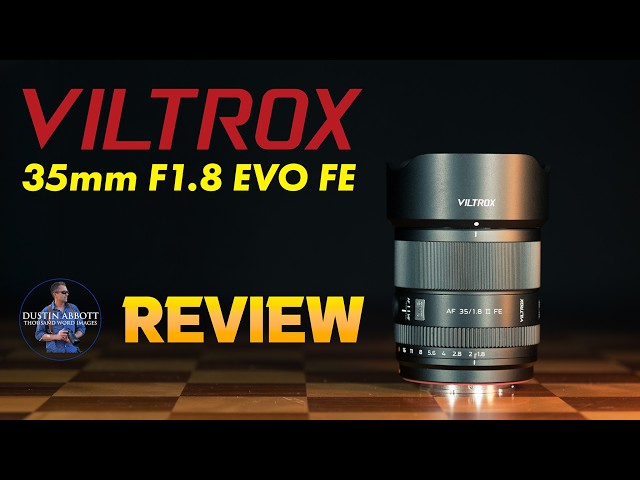
Viltrox EVO 35mm F1.8 II APO Review | A Compact Dream Lens?
Apr 13, 2026

Photographer Dustin Abbott takes a deep dive look at the Viltrox EVO 35mm F1.8 APO lens - maybe the best 35mm F1.8 lens we've seen...and for just $390 USD! | This episode is sponsored by Fantom Tracker. Visit store.fantomwallet.com and use code DUSTIN20 for 20% off. | Read the Text Review: | Purchase the Viltrox EVO 35mm F1.8 @ Viltrox (use code DUSTINABBOTT for 5% off) | B&H | Adorama | Amazon | Amazon Canada | Amazon UK | Amazon Germany
Check out the DA Merch here: https://bit.ly/TWIMerch | Become a Patron: https://www.patreon.com/dustinabbott | On the Web: http://dustinabbott.net/ | Sign up for my Newsletter: http://bit.ly/1RHvUNp | Instagram: http://bit.ly/DLAinsta | Facebook: http://on.fb.me/1nuUUeH | Flickr: http://bit.ly/1UcnC0B | 500px: http://bit.ly/1Sy2Ngu Follow Craig @ https://www.instagram.com/craigstoffersen/
Want to support this channel? Use these affiliate links to shop at:
B&H Photo: http://bhpho.to/1TA0Xge
Adorama: https://howl.link/nt4zdz1goa7ql
Camera Canada: http://bit.ly/DLACameraCan
Sony Canada: https://www.thesonyshop.ca/?ref=abbott
Amazon: https://amzn.to/3HrY64d
Amazon Canada: https://amzn.to/3qG1p18
Ebay: http://bit.ly/DustineBay
Into the AM Clothing: https://bit.ly/intotheAMda and use code DUSTIN10 for 10% off
Fioboc Clothing: https://tinyurl.com/FiobocDA20 and us code DUSTIN20 for 20% off
Make a donation via Paypal: https://www.paypal.com/paypalme/dustinTWI
=============================
Table of Contents:
=============================
0:00 - Intro
1:22 - Disclosure
1:33 - Magnification Update
3:02 - Fantom Tracker
4:02 - Build and Features
8:17 - Autofocus for Stills
10:42 - Video AF
12:36 - Image Quality
23:45 - Conclusion and Pricing
---------------------------------------------------------
Oben Tabletop Tripod shown in video: https://bhpho.to/3vL8YWy
My Cameras:
Purchase the Sony a7RV @ B&H Photo https://bhpho.to/3ZivNyZ | Adorama https://howl.me/cjNY1LU3gFH | Amazon https://amzn.to/3CRCDlq | Camera Canada https://shrsl.com/3vulf | Sony Canada https://bit.ly/BuyA7R5 | Amazon Canada https://amzn.to/3H8yeNH | Amazon UK https://amzn.to/3kbg5FM
Purchase the Sony Alpha 1 @ Camera Canada https://shrsl.com/2wdk2 | B&H Photo https://bhpho.to/3upRFZd | Adorama https://howl.me/cj2nQpjLBKW | Amazon https://amzn.to/3t1m8MD | Sony Canada https://bit.ly/BuySonyA1 |Amazon Canada https://amzn.to/3cVFrBB | Amazon UK https://amzn.to/2OtrjGe | Amazon Germany https://amzn.to/3d0GtMO | Ebay https://ebay.us/i371Vs
Canon EOS R5: B&H Photo https://bhpho.to/3iMH18x | Amazon https://amzn.to/33L3D53 | Camera Canada https://shrsl.com/2jqth
Purchase the Fujifilm X-H2 @ B&H Photo https://bhpho.to/3KAInTC | Adorama https://howl.me/cjyzbiO5lVp | Amazon https://amzn.to/41zMzKl | Camera Canada https://shrsl.com/4128o | Amazon Canada https://amzn.to/40gY4W7 | Amazon UK https://amzn.to/43Grn7a | Amazon Germany https://amzn.to/3L6hwjR
Get a discount off all Skylum Editing Software (Luminar, Aurora HDR, AirMagic) by using code DUSTINHDR at checkout: http://bit.ly/LuminarDLA
DISCLAIMER: This video and description contains affiliate links, which means that if you click on one of the product links, I’ll receive a small commission. As an Amazon Associate I earn from qualifying purchases.
Keywords: Viltrox AF 35mm FE EVO FE, Viltrox AF, EVO, Viltrox EVO, #EVO, #EVO35, #explorebeyond, Viltrox 35mm, Telephoto, Full Frame, F1.8 f/1.8, STM, Viltrox EVO 35mm F1.8 II FE, Viltrox EVO 35mm Review,, Sony a7V, Sony A1 II, α1 II, Sony a7RV, Review, Hands On, Dustin Abbott, Real World, Comparison, Sharpness, Bokeh, Flare Resistance, Autofocus, Image Quality, Sample Images, Video, Photography, let the light in, weathersealing, #letthelightin, DA
Show More Show Less View Video Transcript
0:10
Hi, I'm Dustin Abbott and I'm here today
0:12
to give you a review of a lens that when
0:15
I reviewed the Evo 85mm F2 lens from
0:19
Viltrox last fall in the comments, the
0:21
number one lens that you all wished
0:23
would come in the Evo series was a 35mm
0:26
F2. Well, Viltrox has done one better
0:29
for you all and we have the new Evo 35mm
0:32
f1.8.
0:34
What's more, it is an apo or
0:36
apochromatic design. And so, we are
0:39
moving up into a whole other level of
0:41
optical performance, but in that beloved
0:43
package that really straddles between
0:45
the air series and the pro series.
0:48
Taking a lot of the feature set of the
0:49
pro series and bringing it down into a
0:51
more compact, lightweight package, just
0:54
a little bit larger than the air series.
0:56
I think this is a true winning formula
0:58
for Viltrox. And today we're going to
1:00
explore whether the new 35mm f1.8. By
1:03
the way, I'm also reviewing a 55mm f1.8
1:06
or I'm going to do that one on Nikon
1:07
Zmount. They're being released at the
1:10
same time. These are really exciting
1:12
additions to this new um lineup of
1:15
lenses and I suspect this is going to be
1:17
a lens that a lot of you are really
1:19
going to want to add to your kit. Before
1:21
I dive into that, however, I do want to
1:23
say that this lens was sent to me by
1:25
Viltrox for evaluation. They have had
1:27
zero input in my review and will not see
1:30
this video before you do. This is a
1:32
completely independent review. Now,
1:34
before we jump into the review today, I
1:36
wanted to give you a quick update, a
1:38
caveat on some of the information
1:39
contained in the review itself. That is
1:41
incorrect because it's based on
1:43
information that Viltrox sent out
1:44
initially where they showed that the
1:46
along with the minimum focus distance
1:48
that the maximum magnification on both
1:50
the 35mm and the 55mm was just 0.10
1:54
times. Not a very competitive figure at
1:56
all. I discovered subsequently when I
1:58
was doing a comparison review with the
2:00
55mm and the Nicor's own 50mm f1.8s 8s
2:05
that the Nicor rated at 0.15 times had
2:08
the same level of magnification as what
2:10
the Viltrox 55mm did. And so I took that
2:13
data back to Viltrox. They went to their
2:16
engineers and they came back with
2:17
revised figures on both of these lenses.
2:20
Now the 35mm has same minimum focus
2:23
distance but is rated at 0.15 times
2:26
level of magnification. Whereas the uh
2:29
the 55 millimeter, same minimum focus
2:31
distance, but now it is rated at 0.16
2:35
times level of magnification. Now on
2:37
that ladder figure, I think it's
2:38
actually a little bit high. I think that
2:40
it's probably 0.15 times is the accurate
2:43
figure. And either way, however, it
2:45
makes these lenses more competitive. And
2:47
I wanted to share that updated
2:49
information with you and let you know
2:51
that what you're going to see
2:52
subsequently in the video, both the
2:54
numbers that I give and the way that it
2:56
kind of influences my opinion on the
2:58
lens, we need to revise that a little
3:00
bit based on that updated information.
3:02
Today's episode is sponsored by the
3:04
all-new Phantom Tracker 2.0. Phantom has
3:07
not only seriously upgraded the visual
3:09
look of the card, but now we have a
3:11
superior build quality. Made with
3:13
tempered glass and metal alloys, this
3:15
credit card size tracker can be locally
3:17
tracked via a 90de beeping noise, but
3:20
also on a global level via Apple's Find
3:22
My Network and its map. The addition of
3:25
NFC means you can also use the card to
3:27
trigger an automation. Just tap it. The
3:29
tracker fits perfectly in any wallet or
3:31
bag and assures you won't lose your
3:33
valuables. It has a built-in
3:35
rechargeable battery that can be easily
3:37
charged via any wireless charger, and a
3:39
single charge can last up to 6 months.
3:42
The Phantom Tracker 2.0 makes for a
3:44
seriously cool gift. So visit
3:46
store.fanomwallet.com
3:48
and use code dustin20 at checkout for
3:50
20% off. That's store.fanomwallet.com
3:54
and use code dustin20 for 20% off. That
3:57
aside, let's dive in. Let's take a look
3:59
at the build and handling. All right,
4:01
let's take a closer look here. A few
4:02
things I want to point out from the
4:04
branding on the lens. This is a 35
4:06
millimeter. They have two on here
4:08
because there was a previous 35
4:09
millimeter f1.8 8 from Viltrox. And so
4:12
they don't want you to confuse the two
4:13
that lens has already been discontinued
4:15
and will be replaced by this EVO lens
4:18
from their EVO series. One other
4:20
interesting thing here looking at the
4:22
front is we see on this lens, we didn't
4:24
see this on the 85mimeter, but we do see
4:27
it on the new 55mimeter and that is that
4:30
it is apo or apochromatic. That is huge
4:34
as we're going to see when it comes to
4:35
the optical design. Apochromatic lenses
4:38
tend to be rather exceptional optically.
4:40
Spoiler alert, this lens is.
4:43
So, this comes in Sony E-mount, which
4:45
I'm testing here. It will also be
4:47
available in Nikon Zmount. I actually
4:49
have the 55mm and the Zmount. I got one
4:52
of each and so I can test for both
4:54
platforms. The price point is $370.
4:58
That compares to on Sony, the first
5:01
party Sony 35mm F1.8 is about $850.
5:05
The first party Nickore 35mimeter f1.8s
5:08
is going to run you more like $900. So
5:10
very strong value and particularly if
5:12
we're getting APO type performance.
5:14
Build quality here is actually really
5:16
beautiful. I like the look of these
5:18
lenses. I liked it starting with the
5:20
formula of the 85mm f2. I think it's a
5:24
great balance between having featurerich
5:27
nice build quality but also being
5:29
compact and lightweight which this lens
5:31
is. What's more, it has a thorough
5:34
weather sealing. We got a nice thick
5:36
gasket here at the lens mount. And I
5:38
asked Viltrox if there was internal
5:40
seals because I assumed that there
5:41
wasn't. And I was very surprised to get
5:43
a diagram like this that showed that
5:45
there's about seven seal points in the
5:47
lens. So that is fantastic. It does come
5:50
with a hood and a pouch. And what we've
5:53
got is a lens that is actually more
5:54
featurerich than opposing lenses. And
5:57
that includes the first party. We have a
5:59
traditional aperture ring. You can have
6:01
clicked and 1/3 stop uh detents with a
6:04
nice firm detent in between f-16 and
6:07
automatic, but you have the option of
6:09
declicking that aperture and moving
6:11
smoothly throughout all of the aperture
6:13
values. That'll allow you to do things
6:15
like an aperture rack, for example. I
6:17
will note that neither the Sony nor
6:19
Samyang 35mm f1.8 have an aperture ring.
6:24
There is a control ring, customizable
6:25
control ring on the Nicor lens, but
6:28
obviously it doesn't have quite as much
6:29
features as this. You don't have the
6:31
option of having it clicked, for
6:32
example, on the Nicor. So, this is the
6:35
winner in that regard. We have a
6:37
customer function button. We have an
6:38
AFMF switch. We also have a USB C port
6:42
that will allow us to do easy firmware
6:44
updates and uh to keep the lens current
6:47
and ready to go. The lens is very
6:49
compact. It is 69 mm in diameter or 2.71
6:54
in and just 76 mm or 2.99 in in length.
6:59
It is identical in size to all of the
7:01
other um lenses from the EVO series so
7:05
far. And so once again, they are kind of
7:07
standardizing their design. And so I'm
7:09
sure that helps to keep cost down as
7:11
they manufacture these lenses, which is
7:13
great for us. I also love the fact that
7:15
we've got a 58 millimeter filter thread
7:17
up front that is shared across all three
7:20
of these lenses and so you can buy one
7:22
set of filters and use them on all of
7:24
them. That's great. It's a little bit
7:26
lighter than the 85mm 330 g or 11.64 oz.
7:32
And so again, nice and lightweight. Has
7:35
a nice uh manual focus ring that's
7:38
nicely damped. It moves smoothly. No
7:40
problems there. The only fly in the
7:42
ointment for this optical design is the
7:45
fact that it can only uh has a minimum
7:47
focus distance of 34 cmters which is not
7:50
particularly close and the resulting
7:51
magnification is just 0.10 times. It
7:55
does do a good job up close but I am a
7:58
little bit disappointed by that low
7:59
magnification figure because personally
8:01
I love using 35mm lenses for getting
8:04
some of those uplose shots and just you
8:06
know an interesting different way to do
8:08
some storytelling with it. But outside
8:10
of that one misstep, this is a really
8:12
amazing little package that has a
8:15
fantastic price tag. So, let's talk
8:17
autofocus. As you can see from my
8:19
shooting environment, we have had a bit
8:20
of a setback when it comes to spring
8:22
around here with wintering winter
8:25
continuing on. However, I did have the
8:27
opportunity to travel with this lens and
8:28
shot with it exclusively in Arizona and
8:31
so I got much nicer weather and a whole
8:33
lot of unique environments to allow me
8:35
to show off the unique optical
8:37
capabilities of this lens. autofocus
8:39
comes via an STM focus motor here. Now
8:42
in their pro and lab series higherend
8:45
lenses, we have seen them move to uh
8:47
hyper VCM focus motors there and but
8:50
here because the glass elements are
8:52
smaller and lighter, they are clearly
8:54
feeling that an STM focus motor has
8:56
enough thrust to get the job done. And I
8:58
think I would agree with them in this
9:00
case there. I wouldn't say that the
9:02
autofocus is at kind of that instant
9:05
level I see with some of the best VCM
9:07
equipped focus motors, but it is very,
9:09
very quick, as you can see, going back
9:10
and forth with little lag at all. In
9:13
fact, out in real world shooting, I
9:14
never noticed any kind of focus lag at
9:16
all. Focus was, you know, for all intent
9:18
and purposes, pretty close to
9:19
instantaneous. What's more, I found that
9:23
I was able to get good focus accuracy in
9:26
a wide variety of of situations. Now,
9:28
when it comes to actually trying to
9:30
track things like action, I found I, you
9:32
know, I got kind of mixed results when,
9:34
you know, shooting Nala moving around
9:36
that persistent movement towards the
9:38
camera can be a bit of a challenging
9:39
subject to keep up with. And I did find
9:41
that there was some, in some cases a
9:43
little bit of back focus, though, in
9:44
most cases, I was able to get accurately
9:46
focused results. As always, I would say
9:49
that if you're wanting to shoot action
9:51
that you probably should stick with a
9:52
first-party Sony or Nicor lens, but I
9:56
would say that everyone else in almost
9:58
every other kind of situation, you're
9:59
going to be just perfectly delighted
10:01
with autofocus here. It is not
10:03
completely silent, but focus is quiet
10:06
enough that I didn't really notice in
10:07
real world shooting. I did notice in a
10:09
quiet environment when I was
10:10
intentionally uh doing my focus test
10:12
back and forth, I could hear just a
10:14
little bit of worrying as it went back
10:15
and forth. you know, kind of doing that
10:17
all with great rapidity. But in normal
10:20
shooting situations, you're going to
10:21
find folks to be nice and quiet. And as
10:22
we'll talk about just a moment, for
10:24
video, there wasn't any kind of noise
10:26
for video to be concerned about as at
10:28
all. And so, in general, I would say
10:30
that autofocus was excellent. Whether I
10:32
was you shooting uh human subjects or
10:36
animal subjects, I got good detail.
10:38
Everything worked as it should. And so,
10:40
when on the still side of things, I
10:42
think autofocus is really pretty
10:44
fantastic. Now, on the video side of
10:47
things, you can see that Viltrox has
10:49
made some intentional choices about how
10:51
that autofocus is handled. They've
10:53
slowed that down, damped it down a
10:55
little bit, and so to allow us to have
10:57
these smooth transitions back and forth.
10:59
And so, there is, I think, a decent
11:01
cinematic quality. The focus pulls feel
11:04
nicely enough damp to where they're not
11:06
abrupt or jarring. And I don't see any
11:08
kind of visible steps or any kind of
11:10
pulsing here. And so, all of that is
11:13
fine. There is a bit of focus breathing
11:15
there, however. And of course, as a
11:16
third-party lens, you are not going to
11:18
benefit from focus breathing
11:20
compensation on either Sony or Nikon
11:23
platforms. When I did my hand test, I
11:25
had no problems with the transitions
11:27
back and forth. And in that more mild
11:29
kind of focus pull situation, I found
11:32
that I didn't really notice any kind of
11:34
obvious focus breathing there. And so,
11:35
in many situations, the focus breathing
11:37
is light enough that it probably won't
11:39
be a factor for you. When I approached
11:41
the camera, it had no problem tracking
11:43
me. I've been filming all of these
11:45
outdoor segments on the lens, and you
11:47
can see that it has no problem tracking
11:49
me in these situations. If I ducked out
11:51
of the frame, it was picked me up uh
11:53
without any kind of of problems there
11:55
and, you know, focus back accurately on
11:57
my eye. So, all of that is good.
11:59
Likewise, when I did just kind of more
12:01
ordinary, you know, focus pulls, whether
12:04
I was here on this organ where I was
12:05
intentionally causing the focus pulls,
12:08
it moves back and forth nicely. I think
12:10
I I like the damping there. And then
12:12
then this final shot when I started with
12:14
a close subject and I stood up and
12:16
allowed focus to move towards a distant
12:18
subject, it did so again with a nice
12:20
smooth pull. It's not abrupt and so all
12:23
of that I think is fine. Autofocus in
12:25
general I think is really pretty
12:28
excellent here on Sony and I think
12:30
you're going to be satisfied with what
12:31
you get out of it outside of again maybe
12:34
if you're shooting action and you need
12:35
just a little bit more thrust in the
12:37
focus motor. So we'll start by taking a
12:39
look at the optical design. Here we have
12:41
13 elements in 10 groups. And you can
12:43
see that this includes three re high
12:46
refractive index lenses. We also have
12:49
two extra low dispersion lenses here and
12:53
here. And then we have an aspherical
12:54
lens at the front of the optical design
12:58
that leads to an MTF chart that as you
13:00
can see is really quite excellent. And
13:02
so here, if we're looking at the 30
13:04
lines pair, which is this part of the
13:06
diagram, you can see that it starts off
13:09
at f1.8 in just absolutely super sharp
13:13
territory all the way through most of
13:15
the midframe out towards the corners. We
13:18
are still up above the 80% threshold and
13:20
we're only dropping down to this level,
13:23
averaging out at about 65%
13:26
by the time that we get to our all the
13:28
way out at the very edges. You can see
13:30
if we look instead at the f8, we can see
13:33
that it's not quite as sharp in the
13:35
center, but it's a very flat all across
13:37
the frame. If we look in by comparison
13:39
towards the earlier 35mm f1.8, we can
13:42
see that it started like 23 points
13:45
lower. In the mid-frame, that gap has
13:48
grown to more like 30 plus points. And
13:50
then in the corners, obviously much much
13:52
weaker there, averaging out to about 45%
13:55
rather than the 65% up here. And so all
13:58
across the frame, it's basically at
14:00
least 20 points higher, if not greater.
14:02
That's fantastic. Now, as far as other
14:04
metrics, we see on the plus side when it
14:06
comes to vignette and distortion, there
14:08
is a so small amount of uh barrel
14:11
distortion there that it's basically not
14:12
even worth correcting. Very, very mild.
14:15
But what we can see is there is a
14:17
significant amount of vignette. And so I
14:19
had to max out the slider for my chart
14:21
to get the result here. Now, what's
14:23
curious is that I didn't actually really
14:25
notice that vignette out in real world
14:27
shots very much. And so, here, for
14:29
example, this is at f1.8 indoor scene.
14:32
You know, corners that should be bright
14:33
and zero correction. And what you can
14:35
see is that the corners actually look
14:37
fine. And so, it's it seems like maybe
14:39
that effect is exaggerated up close or
14:42
on my test chart, but I don't know that
14:43
it's much of a real world factor. Now,
14:46
this is an app chromatic design, which
14:47
means that in many cases, a lot of the
14:49
fringing is going to be just optically
14:51
corrected as a part of the design. And
14:53
we can see here on my actual test chart,
14:55
there's basically almost no fringing to
14:57
see. However, I did see in a few very
15:00
high contrast situations like here that
15:03
while the contrast is still exceptional,
15:05
there is a bit of fringing on some of
15:07
these very bright surfaces. Likewise, if
15:10
I look at my dad's old SLR up here, very
15:13
high contrast. All the lettering is
15:15
really clean, but there is a little bit
15:17
of fringing on some of those shiny bits.
15:20
F1.8, F2, F2.8.
15:23
You can see it keeping a nice circular
15:25
shape. And obviously that fringing is
15:27
going to reduce as you stop the lens
15:29
down. What I found, again, just going
15:32
out into real world shooting away from
15:34
testing, I actually felt like it did
15:36
quite a good job here. You can see that
15:38
we have really high contrast and detail
15:40
at f1.8. There's lots of shiny bits
15:42
here. And you can see tiny bits of
15:44
fringing, but they're so minimal that
15:46
you're probably not going to see that
15:47
out in the real world. This shot here, I
15:49
was expecting to see a fair bit of
15:51
fringing. Everything here is really kind
15:53
of shiny and there's lots of layers of
15:56
defocus here. Lots of opportunity for,
15:59
you know, the boke bokeh to have
16:00
fringing around it. But what we see is
16:02
actually quite a neutral shot here. And
16:06
you know, there's a tiny bit of
16:07
fringing, a few points here and there,
16:09
but in general, I would say that the
16:11
apocromatic design is really doing a
16:13
fantastic job helping that contrast to
16:16
hold up and also reducing fringing. The
16:19
lateral style chromatic aberrations near
16:20
the edge of the frame are just not a
16:22
problem at all. I just don't see them
16:24
period. Now, a chromatic designs tend to
16:26
be very sharp, but of course, this is
16:28
more of a budget lens. But here on a 61
16:31
megapixel sensor um and shooting showing
16:34
you results at 200% magnification. We
16:36
can see in the center of the frame it
16:38
looks fantastic. I mean it is pin sharp
16:40
even at 200% magnification. Great
16:43
contrast. Moving to the mid-frame it
16:45
looks exceptional. Really really strong.
16:48
And as we pan down this direction we can
16:51
see that here and here it's keeping a
16:54
very good level of consistency. And even
16:56
right off into the corners, there's
16:57
still lots of detail following us all
16:59
the way out there. It's really quite a
17:02
strong performance. So, I thought I
17:04
would set a high bar to compare it to. I
17:06
recently reviewed the Sigma 35mm F1.4
17:11
uh Art M2 lens. And so, I stopped that
17:13
down to f1.8. The Sigma is one of the
17:16
sharpest 35mm lenses I've seen, period.
17:19
So, let's see how the EVO holds up. in
17:22
the center of the frame. I would say
17:23
that there is a little bit more contrast
17:26
from the Sigma with it stopped down, but
17:28
I mean they are very very close in the
17:31
mid-frame. You can see that I would say
17:34
that the EVO is holding up really really
17:36
well there in the midframe. A really
17:38
strong result and it down into the
17:40
corners. I think the Sigma is a little
17:42
bit more precise, a little bit better
17:44
detail, but you can see that it's it's
17:46
quite close. And so this inexpensive
17:49
lens is really impressive optically. If
17:51
we go to a more ordinary 100%
17:53
magnification, you can see that the
17:55
detail and contrast is just brilliantly
17:58
good. Uh this shot it obviously shot in
18:01
lower light, but I just saw the light
18:03
hitting my wife's face in a otherwise
18:05
dark room and I wanted to take the shot
18:08
again. F1.8 that is super super sharp.
18:11
Really great contrast and again that
18:13
vignette issue doesn't hardly show up
18:15
even in this quite dim scene. This
18:18
showed me that micro contrast from that
18:20
app apricatic design at f1.8 and you can
18:22
see it's really really gorgeous. I mean
18:25
all of these little details very very
18:28
finely resolved. I love it. This image
18:30
is actually my kind of home screen um
18:33
you know wallpaper at the moment because
18:35
I really like the way that it turned
18:36
out. But again you can see that as we
18:39
look here on that very narrow plane of
18:41
focus that all of that detail is holding
18:43
up really nicely. And as we can see,
18:46
there's a pretty nice transition from
18:47
focus to defocus across the image. So,
18:50
does the lens get sharper as we stop it
18:52
down? Well, from f1.8 to f2, you can see
18:54
there's a bit more contrast, but I
18:57
wouldn't say there's any kind of major
18:59
improvement. However, you can see
19:01
stopping down from f2 to f2.8 that there
19:03
is a noticeable improvement in the
19:05
center of the frame, which is now
19:07
fantastically sharp. And if we look here
19:09
in the mid-frame result, it looks just
19:12
super sharp. I mean, look at how crisp
19:14
all that detail is. And now we can also
19:16
see we're starting to really improve
19:18
there into the corners. They are really
19:20
starting to get sharper. And if we stop
19:22
on down to f4, now you can see that
19:25
those corners are basically pin sharp.
19:27
They're really exceptionally good.
19:29
Again, if we drop down to uh, you know,
19:31
more normal 100% level of magnification,
19:34
you can see that the amount of detail
19:35
here right off into the corners is just
19:38
super crisp. Uh really fantastic detail
19:41
all throughout the image here at f5.6.
19:44
I'm just really really impressed. I mean
19:46
all the detail here in the foreground as
19:49
we look towards the housing development.
19:51
You can look through this image and you
19:53
can you know you can count cacti over
19:55
here. Really impressive. And then as we
19:56
look at the draw distance toward the,
19:58
you know, the the far horizon, you can
20:01
see that as you magnify the image,
20:03
there's just more and more of these
20:05
really fantastic detail. Really unique
20:08
and beautiful contrast holding up. This
20:10
is looking out over Fountain Hills,
20:12
Arizona. And this is the Adero Canyon
20:14
development here. So with every lens,
20:16
you'll start to see the effects of
20:17
defraction. Um, and that's due to
20:19
particularly on these high resolution
20:20
bodies. So on 61 megapixels by f11,
20:23
you'll see the image start to start sh
20:25
soften up. And then at f-16, we hit the
20:27
minimum aperture and you can see it's
20:29
quite soft. Then as noted, the
20:31
magnification level doesn't blow my
20:33
mind, but this lens is super sharp up
20:35
close. You can see it even at f1.8.
20:38
There's tons of detail being resolved
20:40
there. And so I mean, if you actually
20:42
want higher magnification and you want
20:44
to mess with extension tubes, you could
20:46
actually get really nice detail out of
20:48
this lens. Here's another shot just to
20:50
show you that minimum focus distance. So
20:52
again, no no problem with contrast and
20:53
detail up close. It's just not a super
20:56
high level of magnification.
20:58
That contrast and detail does hold up
21:00
really nicely though. And as we look
21:02
towards defocus, a lot of times with app
21:05
chromatic lenses, they aren't as soft
21:07
because in the defocus because they're
21:09
so crisp, you know, I feel like this is
21:11
worst case scenario and it's a, you
21:14
know, it's a it's a very busy type
21:16
scene. And so I shoot this particular
21:18
shot intentionally because it's got so
21:20
much stuff in the transition zone. I
21:22
mean, the image is still busy, but it it
21:24
isn't showing me a lot of hard edges,
21:26
which I like. And so that means if I
21:28
move out into more optimal situation
21:30
where there's more, you know,
21:31
separation, obviously the detail and
21:34
contrast on the subject is awesome. And
21:36
then moving towards the defocus, it
21:38
looks quite nice. Here again, we can see
21:41
in the transition towards defocus that
21:44
frankly, I think it looks pretty good.
21:45
Another similar on a Hammond Oregon
21:47
here. And you can see that, you know,
21:50
before and after the plane of focus. I
21:52
think all the defocus looks pretty nice
21:55
here. This image where I'm at the
21:57
basically the minimum focus distance and
21:59
the background is further back. You can
22:01
see it, you know, it bleeds away really
22:02
nicely.
22:04
This shot I liked a lot. I mean, there's
22:06
good again shooting at f1.8, very, very
22:09
good subject isolation. And so for this
22:11
kind of environmental portrait shot,
22:13
this is the Kieran Commons in
22:14
Scottsdale, Arizona. Um you can see that
22:17
everything looks just really beautiful.
22:19
The colors are fantastic. All of that
22:21
looks good. And as we look towards the
22:23
background, the background is not going
22:24
to be strongly defocused, but what is
22:27
there is is pretty nice. We can see a
22:29
little bit of a soap bubble effect at
22:31
this distance, but some of you like
22:33
that. I don't necessarily love it, but
22:35
in general, because it's small here, I'm
22:37
not bothered by it either. Uh this image
22:39
again, some layers of defocus, but I
22:42
like it. Uh and I love this part of the
22:45
image right here, how crisp it is even
22:48
with super bright Arizona sunlight
22:50
coming through that. This image here has
22:52
the ability to kind of have a softer
22:54
transition towards defocus. The lighting
22:56
is a little less harsh. And so you can
22:58
see I think it looks fairly soft there
23:00
overall. Now flare resistance is
23:02
actually quite good here. Um you can see
23:04
in this shot at f1.8 looks good.
23:07
stopping down to f11. Again, we're not
23:09
getting any kind of weird flare
23:11
artifacts. Again, at a different angle.
23:13
It's looking good. If I pan back and
23:16
forth here, you can see there's a little
23:17
bit of a flashing at a certain point at
23:19
f1 f1.8. Stopping down to f11. We've got
23:23
no problems here. Um, no issues with
23:25
flare. We go back and forth. I shot lots
23:28
of images into the Arizona sun, like
23:29
landscape images, no problem. And this
23:32
where I was, you know, shooting for
23:33
these layers of defocus here. I got that
23:36
one shaft of sunlight coming into it.
23:39
That is about the worst that I saw uh
23:42
with my time during the lens review. So
23:44
again, that's pretty great. So what's my
23:47
conclusion? This, I think, is the lens
23:49
that we all were looking for, a 35mm uh
23:53
lens that is compact, easy to bring
23:54
along, but delivers very high-end image
23:57
quality. I have only one real regret
23:59
here and that is that rather poor
24:01
maximum magnification figure. That does,
24:04
you know, unfortunately take away one of
24:06
the things that I love to do with a 35mm
24:08
lens. At the same time, however, I will
24:10
note that the uplose performance is
24:12
good. And so, at least when I'm shooting
24:14
at those close focus distances, I am
24:16
going to get decent results. Outside of
24:18
that, you know, minor error there, I
24:21
think that this is a lens that Viltrox
24:23
deserves to sell a lot of. I know that
24:25
there's a lot of 35 millimeter lenses on
24:27
the market, but this really gives you a
24:30
a lot of the best of both worlds. And if
24:31
you compare it to what's being offered
24:33
up by the first party lenses from either
24:36
Sony or Nikon, I think that this really
24:38
really stands up not only just, you
24:41
know, on its own, standing on its own
24:43
two feet, all other qualifications taken
24:45
aside, but when you add in the fact that
24:47
it retails for $370 and you can get it
24:50
for less if you use the discount code in
24:52
the description down below. just use my
24:54
name, Dustin Abbott, and it'll get you
24:55
5% more off. But I mean, the fact that
24:59
you can get this lens for 370 versus
25:01
$850 or $900, it really makes this kind
25:05
of the lens to buy if you're looking for
25:07
a 35mm f1.8.
25:09
And here on Sony, there is another
25:11
alternative in the Samyang 35mm f1.8,
25:14
but this lens is superior in basically
25:17
every way. It's better optically, it has
25:19
better build, better features, uh has
25:21
weather sealing more thoroughly. It has
25:23
just all of those things going on for
25:24
it. And so I think that it is the lens
25:27
to buy. And the fact is is that it it's
25:30
no more than what the Samyang lens is in
25:33
terms of price. I've been excited about
25:35
the Evo series from the moment I saw
25:37
Viltrox begin to develop it. And this
25:39
35mm and by the way, the 55mm f1.8, they
25:43
they show me the reasons why. I think
25:45
this is a truly winning formula for
25:47
Viltrox. And I look forward to what else
25:49
they're going to bring in this series in
25:51
the future. If you want more
25:52
information, you can check out my full
25:54
text review which is linked in the
25:55
description down below. There are some
25:57
buying links there in the description as
25:58
well. As always, thanks for watching.
26:00
Have a great day and let the light in.
Science