0:10
Hi, I'm Dustin Abbott. For the most
0:12
part, for me, I have stuck with 1.4
0:15
times teleconverters because while the
0:17
advantage that they bring in terms of
0:19
reach isn't quite as extreme as what you
0:22
get with a two times teleconverter, the
0:24
downsides are also smaller as well.
0:27
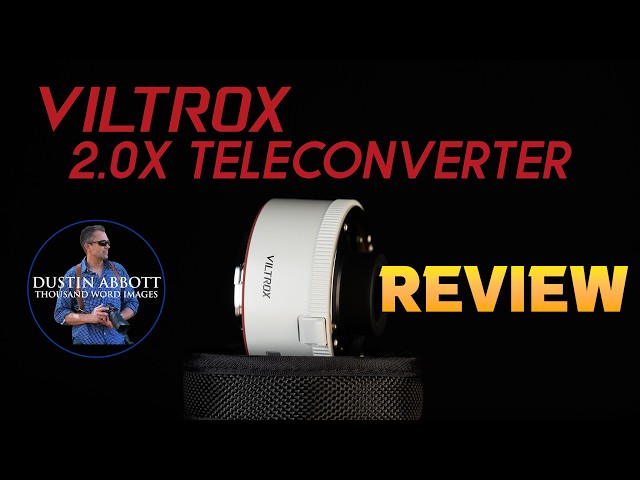
However, Viltrox's new TC 2.0 might just
0:32
change that equation a little bit for at
0:34
least some users. The pros of a two
0:37
times teleconverter is that obviously it
0:39
doubles your effective reach of a lens.
0:42
So, for example, I tested it with the
0:44
new Sony 100 to 400 millimeter f4.5, an
0:48
amazing lens, and you add that on there
0:50
and you get an effective focal length of
0:53
200 to 800 millime out of that same
0:56
lens. Well, obviously that radically
0:58
changes what you can do with a lens like
1:00
that. What's more, adding a two times
1:02
teleconverter because it doesn't
1:04
increase the minimum focus distance on a
1:06
given lens, it means that you're also
1:08
doubling the amount of magnification
1:10
available to you. So, for example, if
1:12
you put it on Viltrox's own lab 135mm
1:16
f1.8, which has a maximum magnification
1:18
of 0.25 25 times. You double that and
1:21
all of a sudden you have an effective
1:26
times or a one to two macro capability.
1:28
Throw it on to a lens like this which is
1:30
Sony 70 to 200 millimeter uh f4 goss
1:35
mark I which has a magnification of 050
1:40
times already and you get a full one to
1:42
one macro configuration. Now that's
1:44
obviously going to really extend the
1:46
usefulness of any given lens. However,
1:49
there are some cons that come with that.
1:51
You are adding a number of optical
1:53
elements into the design. And so that
1:55
means that you are uh having the amount
1:58
of light that reaches the sensor. And
2:00
so, for example, this F4 lens here
2:02
becomes an F8 lens when I've got that
2:05
teleconverter attached. And of course,
2:06
things get worse if you're working with
2:08
a lens with a smaller maximum aperture.
2:10
That 100 to 400 millimeter with a
2:12
constant aperture of f4.5, well, it's
2:14
going to become an F9 lens with that
2:16
attached. And if I throw it on to a lens
2:19
like Sony's 200 to 600 millimeter f5.6
2:23
to 6.3 which I own that means that on
2:26
the telephoto end you're working with a
2:28
maximum aperture of f13. So obviously
2:31
that's going to radically limit the kind
2:33
of situations that you can shoot in and
2:35
how much light that you need. There's
2:37
also the reality that you add a bunch of
2:40
additional optical elements means that
2:41
you are introducing some extra optical
2:44
liabilities and so you're going to get a
2:46
little bit less lens sharpness, get a
2:48
little bit more aberrations and
2:49
distortion and we'll examine those
2:51
things as a part of the review. So, as I
2:54
mentioned, I have stuck with 1.4 times
2:56
teleconverters because the trade-offs
2:58
aren't nearly as much. It's only one
3:00
stop of light loss. And what's more, the
3:04
optical I would say limitations that are
3:06
introduced by a like Sony's own 1.4 time
3:09
teleconverter, they tend to be fairly
3:11
minimal in my experience. But the other
3:13
factor there, of course, is going to be
3:15
price. And so with Sony's own two times
3:18
teleconverter, you're paying about $600.
3:20
This Vtrox comes to market at $280,
3:23
which means that even if you don't use
3:25
it all the time, it's a much lower type
3:29
What's more, the Viltrox adds a little
3:32
extra compatibility, its own Lab 135mm.
3:36
And though I haven't tested it
3:37
personally, I've heard that some Sigma
3:39
lenses, including the new 135, F1.8R,
3:42
the 300 to 600 millimeter, F4, they're
3:45
also compatible with this Viltrox
3:47
teleconverter. So, it just adds a little
3:49
extra flexibility on there. So, we're
3:51
going to dive in today and look at a few
3:53
of these aspects to see if this holds up
3:56
and is worthy of consideration. As you
3:59
can see, the new Viltrox follows the
4:01
Sony format pretty much to AT similar
4:04
type cases. And when it comes to the
4:06
build quality of the teleconverters,
4:08
they're really quite similar. Now, the
4:10
one exception I found is that when I was
4:12
testing with the new 100 to 400
4:14
millimeter lens, I found that the
4:16
Viltrox's finish is not quite a perfect
4:19
match to the Sony's. And so, the Sony
4:21
perfectly matched the new lens. The
4:23
Viltrox is a little bit brighter. And
4:25
so, just something to be aware of there.
4:27
Terms of the overall build, however, it
4:30
is, you know, it's the same. It's got a
4:32
weather sealing gasket. It's got the one
4:34
addition here is you've got the ability
4:36
with the USBC port to do the firmware
4:38
updates very easily and simply there.
4:40
This is actually a little bit shorter
4:42
than what Sony's own uh two times
4:44
teleconverter is. It's 29 mm or 1.1 in
4:47
in length versus 42.7 mm for the Sony or
4:51
1.68 in. It is a little bit wider in
4:54
diameter, however. It's 66.3 millimeters
4:57
or 2.6 inches versus 63.5 millimeters or
5:01
2.5 in for the Sony. And it does weigh
5:05
in just a little bit heavier at 225 g
5:08
versus 207 g. That's 7.9 O. Outside of
5:13
that though, it's pretty simplistic. We
5:14
just have the release port for here. Um,
5:17
I do like the little bit of stylistic of
5:19
the orange weather sealing gasket on
5:21
there, but it feels quality. It feels
5:23
wellmade. Frankly, it feels just like
5:25
the Sony in terms of the quality. So,
5:28
let's talk autofocus for a moment
5:29
because this is one of the critical
5:31
issues. If you're going to add a
5:32
teleconverter on like this, the question
5:34
is is are you going to get effective
5:36
auto autofocus left over? Well, the good
5:38
news is that in most situations, the
5:40
answer is yes. And here, as I'm shooting
5:42
with the 70 to 200 with it attached,
5:45
autofocus is very snappy. It's still
5:48
looking on accurately. When I tested
5:50
using the 100 to 400 millimeter, I had
5:52
an opportunity to shoot uh burst with
5:54
it. And you can see in this sequence
5:56
that for the most part, autofocus is
5:58
excellent. There is a transition period
6:00
where the camera switches between one of
6:03
two subjects. And there's a bit of a dip
6:06
and some loss frames there in between.
6:09
But as I look back through the focus of
6:11
most of these uh images, they're
6:12
actually really quite good. And that's
6:14
under, you know, obviously extreme
6:15
circumstances where I've got a very
6:17
fastmoving subject. I'm shooting at 30
6:19
frames per second and you know I'm also
6:21
shooting with a maximum aperture of f9
6:23
because it's an f4.5 lens. Obviously if
6:26
you're throwing this onto a lens with a
6:28
faster maximum aperture gives you just a
6:30
little bit more effectiveness. And of
6:32
course if it's on a lens with a slower
6:34
maximum aperture like my 200 to 600
6:36
millimeter that becomes a little bit
6:38
more challenging. Remember always that
6:40
it's not so much the autofocus speed
6:42
here because that seems to be just fine.
6:44
It's the fact that the sensor is working
6:47
with less and less light depending upon
6:49
what lens you have attached to it. It's
6:51
always losing those two stops of light.
6:53
And while modern cameras are quite good
6:55
at overcoming that, you know, there are
6:57
practical limits. Now, one thing
6:59
interesting I did notice is that even
7:00
though I'm introducing a third-party
7:02
ingredient into the equation, it's as if
7:05
my Sony cameras don't really register it
7:07
as that. It's still seeing that there's
7:09
a Sony lens attached so long as it is a
7:11
Sony lens attached, which means that the
7:13
uh limitation on 15 frames per second is
7:16
not there. So, I could shoot no problem
7:18
at 30 frames per second in the sequences
7:20
as long as I have a Sony lens attached
7:22
to it. Now, obviously, if I throw on the
7:24
Viltrox Lab, one of those aforementioned
7:26
Sigma lenses, th that third party
7:28
limitation is still going to apply. So,
7:30
overall, autofocus was fine. When it
7:32
comes to the video side of things,
7:34
obviously, again, you're introducing
7:36
less light and a much longer focal
7:39
length. So, that's going to come with
7:40
some challenges. Just the nature of
7:42
having a much longer focal length. For
7:44
example, here, you know, it's it's nice
7:45
and quick, but I'm I'm shooting at it's
7:48
still 400 millimeters even on the long
7:50
end. I throw on that 100 to 400
7:52
millimeters. All of a sudden on the long
7:53
end, I'm shooting at 800 millimeters.
7:55
Well, there's just extra challenges that
7:57
come at 800 millimeters. I throw on the
7:59
200 to 600 millimeter. I'm shooting at
8:01
f13 and 1,200 millimeters on the long
8:05
end. Well, that's going to introduce
8:06
some challenges for stills or video. And
8:09
so, I think that it does work, but
8:10
obviously the situations applications
8:13
for video are going to be a little bit
8:15
less practical. And a lot of the things
8:17
I typically, you know, test like a touch
8:19
to focus, it's a little less relevant in
8:21
this kind of situation. Okay. So, we
8:24
have an optical design of nine elements
8:26
in five groups here. Obviously, we have
8:29
three high refractive index elements as
8:31
a part of the design. Now, all the
8:33
various optical properties are going to
8:35
be really dependent on the lens that
8:37
it's attached to. So, for example, here
8:39
I'll primarily use Vtrox's lab 135mm.
8:42
It's a good sharp lens. You know, it
8:44
works well for this. You can see that
8:46
adding on the teleconverter doesn't
8:48
really add much in terms of distortion
8:50
or vignette. There's a tiny bit tiny bit
8:52
of barrel distortion that is introduced
8:54
but not enough to make a meaningful
8:56
difference and doesn't seem to be much
8:58
in terms of vignette. Now there's one
9:00
big caveat that comes with using it with
9:05
Uh usually when you put you know
9:07
multiply that aperture by two times
9:09
you're in the you know 3.5 to to f4
9:13
range. And so you can see instead we
9:15
have f5.6. And the reason for this is
9:17
that teleconverters are designed for to
9:19
be used with lenses typically with a
9:21
maximum aperture of f2.8.
9:24
And so correspondingly you can see that
9:27
f5.6 is the resulting maximum aperture.
9:31
And that's because it's basically
9:32
calculated with what should be a basis
9:34
of an f/2.8 lens. I wish that they'd
9:37
actually solve that for use with their
9:39
own lens, but it is what it is. So our
9:41
maximum aperture is f5.6 6 here. You can
9:44
see that the result is not as sharp that
9:48
this is 200% magnification and it's on a
9:51
61 megapixel sensor. And so you can see
9:53
that while it's not as sharp as the bare
9:56
lens, which you know the bear lens is
9:57
exceptionally sharp, it's still very
9:59
very sharp. If we jump into other places
10:02
like the mid-frame, you know, it's again
10:03
it's a little bit softer, but that's
10:05
still an amazing result. That's still
10:06
better than most lenses I test. And we
10:09
can look into the corners and again it's
10:10
still quite a strong performance. Not a
10:12
whole lot being lost there. So for a few
10:14
real world results here again with the
10:16
Viltrox Lab, we can see that, you know,
10:20
depth of field is obviously really tiny,
10:21
but you can see that that resolution
10:23
contrast at 270 mm f5.6, it still looks
10:26
really fantastic. Here we have a 400
10:29
millm f8 result from the 70 to 200 in
10:31
the two times teleconverter. And while
10:33
depth of field is really tiny, you can
10:35
see that the resolution and contrast is
10:37
still quite good in the area of focus.
10:40
Up close for macro style work, you can
10:42
see that there's still lots of, you
10:44
know, resolution and contrast that is
10:46
here. A tiny bit of fringing that's been
10:49
introduced, but really not much. Here's
10:51
a shot at 800 mm fine with the new Sony
10:55
100 to 500 millimeter. You can see that
10:57
it's softer than what the bare lens is,
10:59
but it's still quite usable. contrast
11:01
has suffered a bit, but still looks
11:03
quite good. This shot, for example, I
11:05
shot more in the middle of the zoom, so
11:07
it's 486 mm. And you can see that the
11:10
detail and the contrast still looks
11:12
really quite amazing. And so, I mean, in
11:15
bokeh quality still looks good. So, I
11:16
mean, bottom line is that optically it's
11:19
not going to be as good as a bare lens,
11:21
but if you're starting with a a sharp
11:22
lens, you're still going to get really
11:24
nice results. So, what's my conclusion?
11:26
Well, functionally, this really works
11:28
quite well. I would say that the build
11:30
quality is similar equivalent to my Sony
11:34
1.4 times teleconverter. I would say
11:36
that the overall performance is there in
11:39
terms of autofocus in terms of the
11:41
optical performance. Viltrox has gotten
11:43
very very good with optical design and
11:45
it shows up here. And certainly when it
11:48
comes to the price at $280 that's less
11:50
than half the price of the first party
11:52
Sony teleconverter. So I think that that
11:54
is going to be appealing to certain
11:55
people as is you know having some extra
11:58
flexibility with the lenses that you can
11:59
use. It's that latter point that really
12:01
raises my only true area of concern.
12:05
Teleconverters are an area where Sony
12:07
has been very very protectionist when it
12:10
comes to the E-mount. And to this point
12:13
it is only them that has produced
12:14
teleconverters. It's only their lenses
12:16
that have been compatible with
12:17
teleconverters. And the fact that
12:19
Viltrox is kind of messing with that
12:21
formula does give me a little bit of
12:23
concern. You know, there's already been
12:25
some issues with between Nikon and
12:27
Viltrox when it comes to licensing, and
12:29
I would hate to see them embroiled with
12:31
yet another firstparty company over
12:34
that. At the same time, the fact that we
12:36
live in this era of easy firmware
12:39
updates and the ability to get those on
12:42
the fly means that it's pretty easy for
12:44
Viltrox to maintain compatibility with
12:46
this and to add new lenses as they
12:48
become available through simple firmware
12:51
updates to it. And so I think that from
12:53
my opinion, I think it's worth whatever
12:55
risk is there. Viltrox is seems to be
12:57
really thriving on E-mount. I just hope
12:59
that this isn't a bridge too far for
13:01
them. Obviously, that's not your and I
13:03
concern. that's for them to deal with.
13:05
However, at less than $300 to pick one
13:08
of these up and the kind of flexibility
13:10
that it can add to your lenses, it
13:12
certainly is a solid investment if you
13:14
happen to own a lens or two that is on
13:17
the list of current compatible lenses.
13:19
So, at the end of the day, I think that
13:21
makes the new Viltrox TC 2.0 a very,
13:24
very interesting addition to the Sony
13:27
E-mount market. If you want more
13:29
information, you can check out my full
13:30
text review which is linked in the
13:32
description down below. Also, there's
13:33
some buying links there if you'd like to
13:35
pick one up for yourself. As always,
13:36
thanks for watching. Have a great day
13:38
and let the light in.