Up next in 10

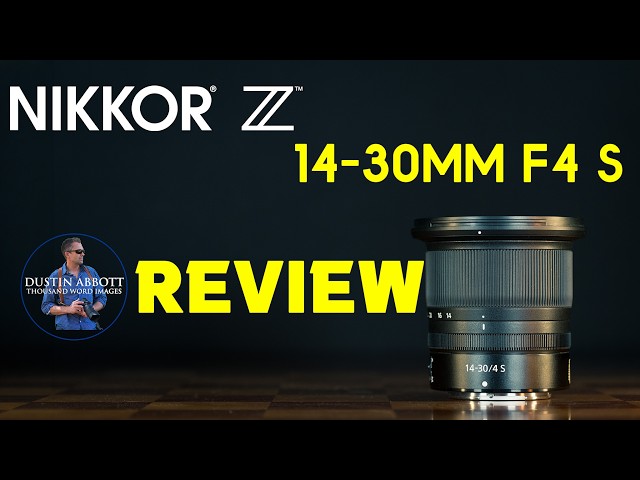
Nikkor Z 14-30mm F4 S Review (2026) | Still the Best Nikon UWA Zoom?
Apr 19, 2026

Photographer Dustin Abbott shares a deep dive review of the most popular wide angle zoom for Nikon Z-mount - the Nikkor Z 14-30mm F4 S. Is it the best option in 2026? | Read the Text Review: | Purchase the Nikkor Z 14-30mm F4 S @ B&H Photo https://bhpho.to/4mr9Nhg | Adorama https://prf.hn/l/nPJnnmb/ | Amazon https://amzn.to/4cnKhF1 | Camera Canada https://tidd.ly/4cloKwL | Amazon Canada https://amzn.to/4cunnft | Amazon UK https://amzn.to/47WYeIT | Amazon Germany https://amzn.to/482eMiD
Check out the DA Merch here: https://bit.ly/TWIMerch | Become a Patron: https://www.patreon.com/dustinabbott | On the Web: http://dustinabbott.net/ | Sign up for my Newsletter: http://bit.ly/1RHvUNp | Instagram: http://bit.ly/DLAinsta | Facebook: http://on.fb.me/1nuUUeH | Flickr: http://bit.ly/1UcnC0B | 500px: http://bit.ly/1Sy2Ngu Follow Craig @ https://www.instagram.com/craigstoffersen/
Want to support this channel? Use these affiliate links to shop at:
B&H Photo: http://bhpho.to/1TA0Xge
Adorama: https://tinyurl.com/AdoramaDA
Camera Canada: http://bit.ly/DLACameraCan
Sony Canada: https://www.thesonyshop.ca/?ref=abbott
Amazon: https://amzn.to/3HrY64d
Amazon Canada: https://amzn.to/3qG1p18
Ebay: http://bit.ly/DustineBay
Into the AM Clothing: https://bit.ly/intotheAMda and use code DUSTIN10 for 10% off
Fioboc Clothing: https://tinyurl.com/FiobocDA20 and us code DUSTIN20 for 20% off
Make a donation via Paypal: https://www.paypal.com/paypalme/dustinTWI
=============================
Table of Contents:
=============================
Show More Show Less View Video Transcript
0:00
[music]
0:10
>> Hi, I'm Dustin Abbott, and I'm [music]
0:11
here today to give you a review of yet
0:13
another one of the
0:15
Nikon Z mount classics. Today, I'm
0:18
covering the 14 to 30 mm f4 S line lens.
0:22
And since 2019 when it was announced and
0:25
released, this has been, I think, for
0:27
many people the go-to wide-angle option
0:30
here on Z mount. There is, of course,
0:33
Nikkor's own 14 to 24 mm f2.8 along with
0:37
the re-badged Tamron in the form of the
0:39
17 to 20 uh 28 mm f2.8. But, I would say
0:44
that probably this lens is the one that
0:46
has ended up on more Z mount cameras
0:48
than any other because it combines a lot
0:51
of great things. It's got a compact form
0:53
factor, it's lightweight, it has good
0:55
image quality, good autofocus, and a
0:58
reasonable price. And that reasonable
1:00
price has gotten more so uh this year
1:03
with some discounts bringing it down
1:04
more into the $1,100 range where I think
1:07
it's an attractive value at that point.
1:10
I'm working my way through uh Nikon's
1:13
back catalog of lenses because I came to
1:15
Z mount later, only a couple of years
1:17
ago, and so it gives me an opportunity
1:19
to not only evaluate them with new
1:21
competition, new standards here in 2026.
1:24
For example, Tamron's 16 to 30 mm f2.8
1:27
G2 didn't exist uh along with some other
1:30
lenses at the time that this one was
1:31
released, but it also helps to
1:33
familiarize me with what's available on
1:35
Nikon, and so I can draw better
1:37
comparisons to the new lenses that are
1:39
released on the platform. I do want to
1:41
say a big thank you to Nikon Canada for
1:43
sending me a loaner of this lens.
1:46
However, they have had no input on the
1:47
review, and this is, as always, a fully
1:51
and completely independent review. That
1:53
caveat aside, let's jump in. Let's take
1:55
a look. All right, let's take a closer
1:57
look at the build and design of the 14
1:59
to 30 f4s. So, first of all, quick
2:02
discussion of price. This lens has an
2:04
MSRP of $1,396 or basically $1,400. It's
2:08
currently on sale, however, for $1,100.
2:11
That compares to the least expensive
2:13
kind of wide-angle zoom being the Tamron
2:15
16 to 30 mm
2:17
uh f2.8 G2. You can get that for $929.
2:21
There's the older Nikkor 17 to 28 mm
2:25
f2.8. That's essentially a re-brand
2:27
branded Tamron lens, and it has an MSRP
2:31
of $1,296.95
2:34
or, again, basically $1,300. It's
2:36
currently also available for around
2:37
$1,100. And then at the top of the heap
2:40
is the 14 to 24 mm f2.8s,
2:43
and you're going that's going to set you
2:44
back MSRP of around $2,700, though it's
2:47
currently discounted down to about
2:49
$2,000. So, at current pricing as of
2:52
today, it's a $900 difference between
2:54
the 14 to 30 and the 14 to 24 mm f2.8.
2:59
However, as you can see, this lens is
3:01
much, much smaller than the 14 to 24 mm
3:04
f2.8s.
3:05
It is a whopping 40 mm shorter and
3:09
weighs 165
3:11
g less. So, that's a significant
3:13
difference. And as you can see, this is
3:16
a compact lens. Now, even the diameter
3:18
figure, which is actually the same as
3:20
the much bigger lens, it is skewed a bit
3:23
by the fact that we really have this
3:25
flare right here out towards the front
3:27
element. And so, the diameter is 89 mm
3:30
or 3.5 in. The lens itself is only 85 mm
3:35
or 3.35 in. However, there's a caveat
3:38
attached to that, and that is the fact
3:40
that this is a retractable zoom. And so,
3:43
right now, if I, you know, it's fully
3:45
retracted at the moment, I turn the
3:47
camera on, I'm going to get this message
3:50
right here. It's not actually usable as
3:52
it is. I first have to extend the lens
3:55
out a significant amount as you can see,
3:57
it's about 28 mm to get to the actual
4:00
shooting position at 14 mm. Once I'm
4:02
there, it actually is the shortest at 30
4:05
mm, although actually it's around 24 mm.
4:08
It extends just a little bit. It's a
4:10
little bit of a rocking zoom design. And
4:12
so, I mean, yes, it is very compact, but
4:15
it does cheat just a little bit with
4:17
that retractable design. So, just
4:19
something to bear in mind. I don't love
4:21
that design. However, it does allow you
4:23
to, at least as far as transport, to get
4:26
a nice compact package.
4:28
The lens weighs in at 485 g or right
4:31
over 1 lb. Up front, we have standard
4:34
filters in that 82 mm size, which is
4:36
great to be able to use those filters.
4:39
The lens does have weather sealing here,
4:41
and so up front, we have a fluorine
4:44
coating. At the back, we have a gasket
4:47
here, and I'm assuming some internal
4:49
seals, though I have not actually seen a
4:51
diagram. I couldn't find one for the
4:53
lens itself.
4:55
As far as the actual build here, the
4:57
lens
4:59
frankly feels a little bit plasticky to
5:01
me. I mean, there are metals here. It
5:03
doesn't necessarily come across visually
5:05
as being a high-end S S line lens. But
5:08
then again, you know, the S line lenses
5:11
are fairly discreet as premium lenses
5:13
go. But, I will say this. This is
5:15
obviously a lens that has held up really
5:17
well. Um at this point, it's got a
5:19
proven track record. It's been on the
5:21
market for about 7 years and has a
5:23
positive reputation.
5:25
The feature set is brief. We have the uh
5:29
AF/MF switch here, and outside of that,
5:32
we have a manual focus ring that can be
5:35
used as a customizable control ring, but
5:37
we have no dedicated customizable
5:39
control ring. So, if you're wanting to
5:41
use this for aperture control, for
5:43
example, it's always going to be
5:44
clickless, and on top of that, you're
5:47
going to lose full-time manual override.
5:49
May not be a big deal here because maybe
5:51
you won't have to override much with a
5:54
wide-angle zoom like this. But anyway,
5:56
just be aware of that. Inside, we have
5:58
seven aperture blades. Keeps a pretty
6:01
reasonable circular shape as you stop
6:04
the lens down, though the truth of the
6:05
matter is is that specular highlights
6:08
producing bokeh balls are not going to
6:10
be all that common.
6:12
The minimum focus distance here is 30
6:15
or, excuse me, 28 cm.
6:17
And that will give you a maximum
6:18
magnification of 0.16 times. That's not
6:21
super high for a wide-angle zoom like
6:24
this, but I mean, it's it's usable. It's
6:26
fine. Nothing exceptional. There is no
6:28
lens-based VR here, and clearly Nikon is
6:31
banking on the fact that all of its uh
6:34
cameras, uh at least full-frame cameras,
6:36
do have camera-based VR or vibration
6:39
reduction.
6:41
One final thing to be aware of with
6:43
that, however, is that I did note a
6:45
little bit of warping or wobble when it
6:47
comes to shooting video on the wide end
6:50
of the zoom lens. So, that VR it isn't
6:53
always flawless in its execution. All
6:56
things considered, this is a pretty
6:58
simple, straightforward design. The big
7:00
deal being here that it's compact, it's
7:02
lightweight for a quality wide-angle
7:05
full-frame zoom. So, let's talk
7:07
autofocus. Autofocus, as with basically
7:09
all of the Nikkor Z lenses from this
7:12
particular era, it comes from a stepping
7:15
or STM type focus motor. Now, while I
7:18
don't always love STM focus motors
7:21
because there are more high-powered,
7:23
smoother options that are available in
7:25
today's market, the reality is is that
7:28
the STM does a perfectly good uh job of
7:31
performing both in terms of focus speed
7:33
and focus accuracy here on the 14 to
7:36
30s. The truth of the matter is is that
7:39
wide-angle lenses don't put a lot of
7:42
stress on focus systems, particularly
7:44
when the maximum aperture is only f4,
7:46
because a lot is in focus all the time.
7:49
And so, it's easy to focus quick because
7:51
you don't have to make significant focus
7:53
changes. That focusing element or
7:55
focusing group only has to move a little
7:57
bit. And so, as you can see here, focus
7:59
moves very snappy back and forth between
8:01
close and distant subjects, whether
8:03
indoors or outdoors. And so, no problems
8:11
looking for like an album album cover.
8:13
And so, we're doing some kind of air
8:15
walk style where I was very, very low
8:17
shooting, and he was coming above. You
8:18
can see from these shots that I had no
8:20
problem freezing motion as he moved, and
8:23
autofocus was accurate in those
8:25
situations. There probably isn't a lot
8:27
of situations where you would have any
8:28
kind of focus issues, in fact, because
8:31
focus is snappy here. And what's more,
8:33
as I've already said, probably
8:35
everything's going to be in focus
8:37
throughout your frame with very, very
8:38
minor focus adjustments along the way.
8:40
Focus is also quiet. I didn't really
8:42
hear any focus noise, whether in stills
8:44
or video, and so no concerns on that
8:46
front. Speaking of video,
8:49
in this case, I actually really liked
8:51
what I saw from the lens when it comes
8:53
to video AF, though there's one caveat
8:55
that I'll get to in just a moment. Uh
8:57
you can see here in my focus pull test
8:59
that not only is focus smooth quickly
9:01
and smoothly back between subjects, I
9:04
didn't see any of the racking I
9:05
sometimes see in the wrong direction, no
9:07
visible steps or anything like that.
9:09
Also, you can see even shooting on the
9:11
30 mm end, which I'm doing on that test,
9:13
that the focus breathing is very, very
9:15
low. Also positive is that while the
9:18
lens may not be perfectly parfocal,
9:21
practically, that's about the way that
9:23
it plays out. And so, you have no
9:25
problem if zooming in or out that
9:27
everything pretty much stays in focus as
9:30
you zoom. Likewise, when I did my hand
9:32
test, I had no problem with focus
9:34
snapping accurately from my hand to my
9:37
eye and back and forth. No issues there.
9:39
When I approached the camera, no issues
9:41
on that front as well. It approached me
9:43
accurately as I came towards the camera.
9:45
When I stepped out of frame, it picked
9:47
me back up quickly. So, no problems, no
9:50
concerns there. The one caveat that I
9:52
mentioned is that I did notice some
9:54
wobble or warping sometimes when
9:57
shooting just handheld video shots or
9:59
clips with the lens on my Nikon Z8 or on
10:03
the Z6 Mark III body I was reviewing at
10:05
the same time. I think that that
10:06
probably comes down to maybe a little
10:09
overzealousness on the part of the
10:11
in-camera VR or vibration reduction. And
10:14
then so it maybe is a little
10:16
overcompensating a little too much and
10:17
so in the particularly at the beginning
10:19
of shot there's a little bit of warping
10:21
or wobbling there as it you know is a
10:23
little too aggressive in its
10:25
corrections. Maybe it's something else
10:26
altogether. But it is something to be
10:29
aware of. I did get my best most stable
10:31
results when shooting off of a tripod.
10:33
I'm filming all of these outdoor
10:35
sequences on the lens itself and you'll
10:37
notice that for these no problem and
10:38
most of my other video clips were
10:40
actually handheld and I didn't see the
10:43
warping necessarily in every situation.
10:45
But particularly when shooting on the 14
10:46
mm end that's when I noticed it the
10:48
most. Just something to bear in mind.
10:50
But as far as the autofocus goes no
10:52
concerns at all. All right, let's take a
10:54
closer look at the optical design. Here
10:56
we have an optical design of 14 elements
10:59
in 12 groups. And so you can see as a
11:02
part of that that we have 1 2 3 4
11:04
aspherical lenses along with 1 2 3 4
11:08
extra-low dispersion glass elements. If
11:10
we look at the MTF chart on the wide end
11:13
we see that in the center of the frame
11:14
super sharp very very sharp at 14 mm. Uh
11:18
here in the mid-frame still looking very
11:20
strong. We see that after this point
11:22
while we do have we have this dip and
11:24
then it comes back up on at least one
11:26
axis the sagittal axis. We can see that
11:29
it kind of does a continual slide on the
11:31
meridional axis and giving us a little
11:34
bit more astigmatism in this zone here.
11:36
But interestingly at least on one axis
11:38
this lens is definitely stronger closer
11:40
to the edge than what it is in the
11:42
mid-frame and we'll see that that does
11:44
pop up in our own test. Now on the
11:46
telephoto end at 30 mm we see that
11:48
there's less astigmatism. The two axes
11:51
stick closer together. But we see a
11:52
little bit more of a typical slide still
11:54
very sharp in the center of the frame
11:56
but just a steeper drop into those
11:59
corners and so in the very you know far
12:01
corners we're definitely weaker um than
12:04
what we are on the wide end. Now
12:06
initially this is what I came up with my
12:08
raw files and I thought oh this lens
12:10
doesn't have a whole lot of distortion.
12:13
However, what we're going to find is
12:14
that they're actually baking into some
12:16
corrections as it arrives at least into
12:19
Adobe products. And so in this case it
12:21
actually looked like a tiny bit of
12:22
pincushion distortion but some
12:23
definitely left over vignette. Well,
12:25
that is because those baked in
12:27
corrections were covering up this and
12:30
this is what I found if I went to
12:31
Luminar Neo which doesn't have that
12:33
automatically baked in. And so we see a
12:35
significant amount of barrel distortion
12:37
and some very heavy vignette. So to
12:39
achieve this manual correction I
12:41
actually had to dial in a whopping plus
12:44
32 to correct the barrel distortion and
12:46
even maxing out the vignette slider I
12:49
still as you can see had some
12:51
uncorrected vignette in the corner. We
12:53
see that even after the correction
12:54
profile previously that that's still
12:56
showing up in the that there's a little
12:59
bit more
13:00
vignette in the edge that even the that
13:02
the correction profile is not
13:03
eliminating. Likewise if we go to the
13:05
telephoto end we find that that you know
13:09
the uncorrected image has some pretty
13:11
strong pincushion distortion. In the
13:13
middle of the frame it's basically
13:14
neutral. We go from the barrel
13:15
distortion to the pincushion distortion
13:17
and in the middle of the zoom range it's
13:19
basically neutral. But here on the
13:21
telephoto end we can see that there is a
13:23
you know significant amount of
13:25
pincushion distortion. It does correct
13:27
in a very linear fashion taking about a
13:30
a minus 11 to correct for that. Vignette
13:32
is still heavy though not quite as heavy
13:35
requiring in the minus 60s to correct as
13:39
you see here. Now as far as fringing
13:42
when it comes to the longitudinal style
13:44
we see that there is some potential for
13:46
fringing after the plane of focus some
13:49
green fringing
13:50
>> [snorts]
13:50
>> though it doesn't often show up in real
13:52
world work. The simple reason for that
13:54
is most of the time you're not going to
13:56
have enough out of focus to actually
13:59
achieve that. Here at the minimum focus
14:01
30 mm F4 is you know is ultimate
14:05
situation. I can get a little bit of
14:07
defocus and we do see some of that green
14:09
fringing on these shiny bits. Likewise
14:12
if I look in at my dad's SLR you can see
14:16
again some you know bit of fringing in
14:18
those shiny bits. Taking a look here at
14:20
the specular highlights there's a little
14:22
bit of fringing around the edges of
14:24
those a little bit of business inside.
14:26
Geometry's pretty good. It's still
14:28
pretty circular all across the frame at
14:30
F5.6. You know again it's more
14:33
consistently round though you are
14:34
starting to see those seven blades just
14:36
a little bit. And then by F8 it's a
14:38
little bit more pronounced a little bit
14:39
more pronounced inner lining. But you
14:41
know what? It's going to be very rare
14:43
that you're going to see specular
14:44
highlights like this anyway
14:46
because you have to be really on top of
14:48
your subject to get the background
14:50
defocused enough to achieve that effect.
14:53
Now with wide-angle lenses the bigger
14:54
concern is going to be lateral style
14:56
chromatic aberrations cuz they can mess
14:58
up some of your landscape images.
15:00
Fortunately this lens is very well
15:01
corrected for that and I don't see any
15:03
evidence of fringing near the edges of
15:06
the frame. All right, so let's take a
15:07
look at resolution and contrast. And so
15:10
here starting on the 14 mm end I am
15:12
shooting on a 45 MP Z8 showing you
15:15
results at 200% magnification. So you
15:18
can see as the MTF suggests center of
15:20
the frame super sharp super high
15:22
contrast. We've got that moire because
15:24
there is so much contrast there.
15:26
However, as the MTF also suggested the
15:29
mid-frame at least the near mid-frame
15:31
actually takes a pretty significant dip
15:34
by comparison. It's not bad but it's not
15:37
exceptional either. And surprisingly we
15:41
see a bit of a rebound into the corners.
15:43
Again the MTF does suggest that a bit
15:45
that the corners are a bit better
15:47
actually than what that you know
15:48
mid-zone actually is where it looks a
15:51
little bit shaky there and a little bit
15:53
better here towards the edge. Now one
15:55
interesting comparison that we didn't
15:57
have back when this lens was released is
15:59
the new 14 mm F4 from Viltrox which
16:03
gives us kind of a perfect match in
16:04
terms of focal length and maximum
16:06
aperture.
16:07
If we compare these two lenses we see in
16:08
the middle of the frame they are close.
16:11
I would maybe give a tiny edge to the
16:13
Nikkor lens.
16:14
Where the Viltrox excels is in this
16:17
mid-frame. It doesn't have that same
16:18
kind of dip here. And so you can see it
16:20
is stronger in this zone. However, if we
16:22
look towards the corners
16:25
um it's actually the Nikkor lens that is
16:26
stronger out towards the corners. And so
16:30
um look at a couple of other spots here
16:31
just as comparison. Here and again in
16:33
this mid-frame Viltrox looks better down
16:35
here. Viltrox looks better. But if we
16:37
look over to this edge for example
16:40
uh in this case I would say the Viltrox
16:43
is holding its own better down into this
16:44
corner. However, you can see that the
16:46
Nikkor is definitely the better of the
16:48
two. Now what I did find is that when I
16:50
stopped down the 14 to 30 mm it always
16:53
does improve at least to some degree.
16:56
And so in this case we can see that the
16:57
center there wasn't much room for
16:58
improvement there. But you can
16:59
definitely see an improvement here in
17:01
the mid-frame. Everything just looks a
17:03
little bit more stable. The corners are
17:05
now looking quite crisp uh nice detail
17:09
you know right off towards the edge of
17:10
the frame. So looking good there.
17:12
Stopping down to F8 isn't going to
17:14
improve the center any further but the
17:16
mid-frame is just very slightly better
17:19
now. And then of course the corners are
17:21
looking fantastic. As far as a real
17:24
world result here at 14 mm F4 you can
17:27
see that you know in our area focus
17:30
detail looks really really good. Um we
17:32
can see moving out here towards the edge
17:34
that really the detail is holding up
17:36
nicely towards the edge. Uh in general I
17:39
would say that it looks good. I was
17:40
actually happy with all of my landscape
17:42
style images shot at 14 mm. Here's
17:45
another image that I shot with it I
17:47
actually really love. And so this again
17:49
is shot at 14 mm. This is F6.3. And so
17:53
we can see detail is really strong right
17:55
out to the corner. And if we kind of pan
17:56
out we can just see throughout the image
17:59
the detail looks really good. Obviously
18:01
I'm shooting into some heavy mist and
18:02
fog here. But you can see that in those
18:05
spots where the the mist kind of lifts
18:07
you can see there's great detail out
18:08
there into the distance. So starting at
18:11
F11 you'll start to see a bit of
18:12
softening due to diffraction. If you
18:14
carry on though by F22 which is minimum
18:17
aperture you can see that the image has
18:18
really softened due to the effects of
18:20
diffraction. And so you know just be
18:22
careful about that know that if you
18:24
continue to stop a lens on down you may
18:25
get some diminished returns in terms of
18:27
sharpness and contrast. Now moving on
18:29
throughout the zoom range at 16 mm on
18:32
the left and 20 mm on the right you can
18:34
see that the mid-frame looks excellent
18:36
on both maybe a hair sharper at 16 mm
18:39
but you can see that the mid-frame is
18:41
stronger at 20 mm. And we're getting a
18:43
little bit more of a consistent uh
18:45
performance. And we move up here into
18:48
the corners the corners actually look
18:49
fantastic at 20 mm even at F4. And so I
18:53
would say at 20 mm you're getting a
18:54
really really even performance in terms
18:56
of sharpness all across the frame. We
18:58
stop both of those down to F5.6 center
19:01
continues to be be excellent as
19:03
expected. Mid-frame is looking good on
19:05
both of them a little bit better still
19:07
at 20 mm and then off into the corners
19:09
both look really good out to the
19:11
corners. Again 20 mm looking better than
19:13
what 16 mm did. Now when we compare 24
19:17
mm and 30 mm the next two or final two
19:20
mark spots we can see that 24 mm looks
19:23
sharper in the center of the frame a
19:24
little less contrast at 30 mm in the
19:27
center of the frame than what we've
19:29
seen. Um again we can see that in this
19:31
mid-frame to where it's it's consistent
19:34
from what we're seeing but just a little
19:35
bit less contrast. Actually 24 mm in the
19:38
mid-frame looks a little bit soft. If we
19:40
move off into the corners however, we
19:42
can see that it holds that kind of wider
19:44
pattern to where it looks a little bit
19:45
better in the corners than what it does
19:46
in the mid-frame. Whereas as the MTF
19:49
suggested the 30 mm corners are just a
19:52
little bit softer and lower contrast by
19:54
comparison. One thing I did note at
19:57
30-mm, however, is if you stop down to
19:59
F5.6, it is a it's it's the most
20:01
noticeable improvement of contrast of
20:03
anywhere in the range. So, now just
20:05
staying here for a moment, we can see
20:07
that contrast is every bit as good as
20:09
what it is at 24-mm, and actually I
20:11
would say a little bit better. In the
20:13
mid-frame, we can see again it's made
20:15
very good progress to where it's
20:17
actually a little bit sharper in the
20:18
writing than what it is at 24-mm. And
20:21
off into the corners, we can see that
20:23
while the corners aren't 100% there,
20:26
they aren't quite caught up to what we
20:27
see at 24-mm. They're not far off. And
20:29
so, definitely at 30-mm, stop it down a
20:32
bit and you'll restore that contrast
20:34
that isn't there wide open. Now, going
20:36
back to the minimum focus distance at
20:37
30-mm, we can see that the detail and
20:40
contrast actually I think are quite
20:42
good. Magnification isn't super high,
20:44
but there's a good level of
20:45
magnification or actually a performance
20:47
there. What we do see is that the plane
20:49
of focus isn't completely flat. This
20:51
ship kind of looks like it's a little
20:53
bit three-dimensional coming off the
20:54
page cuz it's softer here and softer out
20:57
towards the corners. That doesn't matter
20:59
as much with three-dimensional objects,
21:01
as we can see here. We can see that the
21:04
detail, while it doesn't look
21:05
exceptional, it looks fine. I mean, the
21:08
image works. And if we look towards the
21:10
defocus, you know, it's it's not like
21:12
radically defocused, but it works. And
21:15
so, I think that this is another
21:16
application for the lens, even if it's
21:18
not exceptional in that regard. Finally,
21:20
a quick look at flare resistance, which
21:22
I saw no problems with. It uses Nikon's
21:25
nano coatings. You can see I was
21:27
shooting this series into very, very
21:29
bright sun, kind of catching, you know,
21:31
this look that we were going for for the
21:33
album cover. And in all of these images,
21:35
you can see that contrast is holding up
21:38
just fine. Going back to this info for a
21:39
moment, there's a couple of little tiny
21:41
ghosting artifacts there, but that's
21:43
with the lens way stopped down to try to
21:45
get the sun burst effect. All in all, I
21:47
would say that it really works. Again,
21:49
there you see those two little minor
21:51
things. I don't consider that to be an
21:52
issue at all. And so, the coatings work.
21:55
It works really well for getting some
21:56
beautiful images. On most platforms, I
21:59
think the F4 wide-angle lenses tend to
22:02
be those that are the most popular for a
22:05
good reason. Not everyone needs F2.8 or
22:09
brighter on the as a maximum aperture on
22:12
a wide-angle lens, particularly if the
22:14
primary purpose is going to be something
22:16
like shooting landscapes, shooting
22:18
architecture, things like that. Often,
22:21
what you're looking for is more depth of
22:22
field and not necessarily a great need
22:25
for more light gathering potential.
22:28
And there typically is quite a cost to
22:29
pay for moving up to that brighter
22:32
maximum aperture. In the case of Nikon,
22:35
the 14-24-mm F2.8S
22:38
costs twice as much. It's
22:41
40-mm longer. It's nearly 170 g heavier.
22:45
And so, you're paying for it in multiple
22:47
ways. And not to mention even just the
22:50
impracticality of carrying a lens, you
22:52
know, your storage reality is much
22:54
different when you have a lens that's an
22:55
additional 40-mm long. And so, I think
22:58
that for many people, the sweet spot is
23:01
hit by a lens like the 14-30-mm F4S. And
23:05
the fact that there are twice as many
23:06
user reviews on B&H Photo for the
23:09
14-30-mm as opposed to the 14-20 to
23:12
24-mm F2.8 lens
23:15
maybe tells the story there that this
23:17
lens is the one being chosen maybe in a
23:20
two-to-one ratio or something similar to
23:23
it. And I think that that is with good
23:25
reason. This is a solid lens. I don't
23:27
love retractable zoom designs. To me,
23:29
they feel kind of kit lensy, but at the
23:32
same time, I do recognize the
23:34
practicality of a lens that is more
23:36
compact for for storage. I just don't
23:38
love having to retract that or, you
23:41
know, to zoom it out before I can
23:42
actually start to take shots. And I
23:44
think that there are moments that
23:45
there's the potential to miss a shot
23:47
based on that. It's just something
23:49
you're going to have to bear in mind if
23:50
you purchase this lens. I also wish that
23:52
it didn't rely quite as much on
23:53
electronic corrections when it comes to
23:56
some optical qualities like vignette and
23:59
distortion, particularly on the wide
24:00
end. But that's kind of par for the
24:03
course in modern lens design. And so, I
24:06
won't knock it too hard for that. The
24:08
truth of the matter is I found it a very
24:10
easy lens to live with. I love the
24:11
ability to get the nicely dynamic type
24:15
images that you can get at 14-mm, and
24:17
the fact that it does everything pretty
24:19
competently makes it a lens that's a lot
24:22
of fun to bring along and really
24:23
delivered the kind of images I'm happy
24:26
to take. We're now into spring, and as
24:27
you can see with some of my images,
24:29
there's a lot of that mist and mood that
24:31
I actually find quite enjoyable. And
24:33
then so, anyway, I wish I had a little
24:35
bit more time with it, but I've enjoyed
24:36
my time with the 14-30-mm.
24:38
If you want more information about the
24:40
lens itself, you can check out my full
24:42
text review that is linked in the
24:43
description down below.
24:45
And there is also some buying links
24:47
there in the description as well. As
24:49
always, thanks for watching. Have a
24:50
great day, and let the light in.
#Science