0:10
Hi, I'm Dustin Abbott and I'm here today
0:12
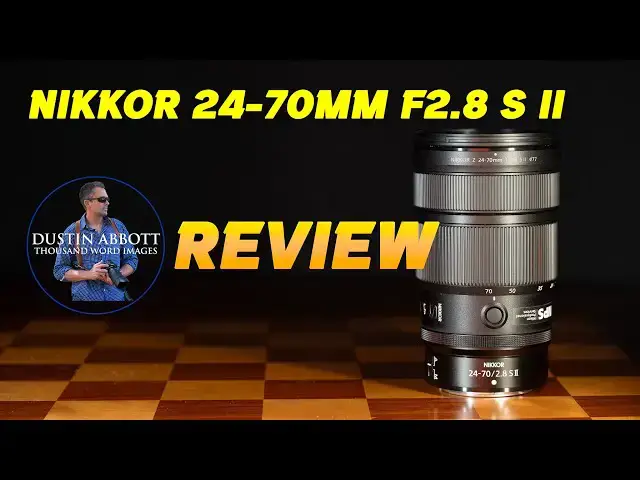
to give you my review of the newest
0:15
Nicord zoom and that is the 24 to 70
0:20
This is the Mark I. It is rare in what
0:24
is maybe the most popular zoom ratio for
0:27
professional-grade zooms, 24 to 70
0:29
millimeters, to see any kind of real
0:32
innovation. Probably the only thing that
0:34
we've seen really in the past is not so
0:36
necessarily in the 24 to 70, but seeing
0:38
things like 28 to 70mm f2 lenses, but in
0:41
this case, nicor has really helped to
0:44
change the formula around. And in many
0:46
ways, I think it's mostly all for the
0:48
better. We have the first internally
0:50
zooming 24 to 70 millimeter zoom. We
0:53
have a lens that is lighter than its
0:55
predecessor. A lens that has a new
0:58
autofocus system, at least one that
0:59
we've never seen in anything outside of
1:01
a couple of super telly's before. And
1:04
then we have a few new features for for
1:06
Nikon. Just a lot of things where in my
1:08
opinion they're moving in the right
1:10
direction. And particularly that
1:11
autofocus system, the SS VCM is a huge
1:15
step in the right direction for their
1:16
premium lineup. And so today I am here
1:18
to explore whether or not this new 24 to
1:21
70 mm is worth its pretty lofty price
1:24
tag. We're talking $2,800
1:27
which is higher than the competing
1:28
lenses from other firstparty brands. So
1:31
this is definitely going to compete in a
1:33
very premium class and we're here to
1:35
explore today whether or not it earns
1:38
that big price tag. As you can see,
1:40
winter has fully arrived in my neck of
1:42
the woods. And so I will be shooting a
1:45
few outdoor segments here with the lens
1:47
mounted on my Nikon Z8 body, and we'll
1:50
get a sense of its performance in terms
1:52
of its rendering and autofocus in these
1:54
settings along with breaking down all
1:56
the details for you. This lens was loan
1:58
to me by Nikon Canada, which I
2:01
appreciate very much. However, they have
2:03
had no input in this actual review
2:06
process and they will not see this video
2:08
before you do. Let's jump in and take a
2:09
look. Today's episode is sponsored by
2:11
the all-new Phantom Tracker 2.0. Phantom
2:14
has not only seriously upgraded the
2:16
visual look of the card, but now we have
2:18
a superior build quality. Made with
2:20
tempered glass and metal alloys, this
2:22
credit card size tracker can be locally
2:24
tracked via a 90 decel beeping noise,
2:27
but also on a global level via Apple's
2:29
Find My Network and its map. The
2:31
addition of NFC means that you can also
2:33
use the card to trigger an automation.
2:35
Just tap it. The tracker fits perfectly
2:38
in any wallet or bag and assures you
2:40
won't lose your valuables. It has a
2:42
built-in rechargeable battery that can
2:43
be easily charged via any wireless
2:45
charger, and a single charge can last up
2:48
to 6 months. The Phantom Tracker 2.0
2:50
makes for a seriously cool gift. So,
2:52
visit store.fanomwallet.com
2:55
and use code dustin20 at checkout for
2:57
20% off. That's store.fanomwallet.com.
2:59
phantomwallet.com and use code dustin20
3:03
for 20% off. All right, let's take a
3:05
closer look at the build and the design
3:07
of the lens itself. First of all, a
3:08
quick note on price. Price $2,800 is
3:12
definitely the most expensive of its
3:14
competitors. The Canon RF lens is 2599
3:19
or 2600. The Sony is 2450. And so
3:24
definitely there is a price premium
3:26
here. However, the upside is that while
3:28
this is not a small lens, it is a
3:31
relatively lightweight one for this type
3:33
of lens. It weighs in at 675 g or 1 1/2
3:37
lb, which compares to a whopping 900 g
3:40
for the Canon version. Then the Sony is
3:43
695 g. The Mark1 version of this lens
3:47
was 805 g. And so we have dropped a
3:50
significant amount of weight uh from
3:52
that first generation to the second
3:53
generation lens. The overall physical
3:56
dimensions of the lens itself is that it
3:59
is 84 millimeters or 3.4 inches in
4:02
diameter. We've got a 77 millimeter
4:04
filter thread up front, which is down
4:05
from 82 mm. By the way, uh the overall
4:08
length is 142 mm or 5.6 in. Now, while
4:14
this is an internally zooming lens, and
4:16
so the length doesn't change as you
4:18
zoom, this lens is while it's longer
4:21
than the previous generation lens in its
4:23
kind of like attracted form. When that
4:25
other lens is zoomed out to 70 mm like
4:27
this, it's actually the longer lens by a
4:30
fair margin. Now, those of you that are
4:32
accustomed with the first generation
4:34
lens will note something is missing that
4:36
was there on the first generation lens,
4:38
and that is that there is no OLED screen
4:40
here at the top. Instead, we have got a
4:43
second um function button, custom button
4:46
here at the top. And so, again, as
4:47
always, any of these additional buttons,
4:49
they are it's not like a secondary
4:51
function. It's the same function, but
4:52
it's so that if you're shooting in
4:54
vertical or portrait mode, one is still
4:56
easily accessible there. Now, in a first
4:58
for uh any of these Nikon lenses, we do
5:01
have a click or dclick option here for
5:05
the control ring. And so, when the click
5:07
is on, you will have click stops. when
5:10
it is off, it'll operate smoothly. And
5:12
so that means that if you're using it
5:13
for an aperture ring in stills mode, you
5:16
can actually have a little bit of
5:18
resistance. It will help you to select
5:19
that aperture. And if you're wanting to
5:21
do aperture racks, you can declick and
5:23
do that. Or if you just prefer a
5:25
smoothly turning control ring, you now
5:27
have the option to do that. That's a
5:28
great step forward. I'm really happy
5:30
about that. A little bit odder is a
5:33
focus limiter here, which you don't
5:35
typically see on a lens like this. And
5:36
its operation is is a bit strange.
5:38
There's just two positions, full or
5:40
limit. So, what's being limited? Well,
5:42
you have to dive pretty deep to figure
5:43
that out. But basically, what it is is
5:45
that rather than having a variable
5:47
minimal minimum focus distance, for
5:50
example, at 24 mm, you can focus down
5:52
closer than what you can at 70 mm.
5:55
Instead, it's just kind of standardizing
5:57
to where it only will focus closely as
5:59
the 70 mm position, which is 33 cm. And
6:02
I think that the other is 24 cm. And so
6:05
what that does is when you have that
6:08
limiter on, it means that you can't
6:09
focus as closely at 24 mm. Maybe that
6:13
will be helpful for some people. I
6:14
didn't really see a lot of value to it,
6:16
so I just kept it in the full basically
6:18
all the time. We've also got the AFMF
6:20
switch. Inside, we have got 11 rounded
6:23
aperture blades. And you can see here as
6:25
I go back through that rack that it does
6:27
a very nice job of keeping a circular
6:28
shape as the lens is stopped down.
6:31
Now, this is the world's first
6:34
internally zooming lens for this class.
6:36
And ordinarily, one of the things that I
6:38
really love about internally zooming is
6:40
that they sm they they zoom so much
6:42
easier. I did find that I was not able
6:45
to zoom as smoothly as what I expected
6:48
when I was shooting during video. Again,
6:50
that might loosen up as the lens gets
6:53
more use, but it was a little bit
6:54
tighter and a little bit less consistent
6:56
than what I would have preferred as far
6:58
as the resistance throughout. It's a
7:00
little bit tighter right before 70 mm.
7:03
And so it does I feel like it feels a
7:05
little bit better in the time that I've
7:06
been using it. But anyway, just
7:07
something to watch out for there. But
7:09
being able to have that internal zooming
7:11
is great because it means if you're
7:13
using it on a gimbal, the length is not
7:15
changing as you zoom back and forth.
7:16
It's great. The manual focus ring,
7:18
however, I love. Um, it it it's got good
7:21
damping, but also because of this
7:24
upgraded autofocus motor means that it's
7:26
more responsive, less laggy, less kind
7:28
of feeling of steps and so that I can
7:31
get a smoother manual focus simulation.
7:33
So, I definitely prefer that. A bit of a
7:36
tweak here to the actual lens hood as
7:38
well. Another kind of video focused
7:40
feature in that we now have a window
7:42
that'll allow you access to rotating,
7:44
for example, a variable ND filter or a
7:47
circular polarizer. And so, um, both of
7:49
those things are welcome additions to
7:52
this. So, you have a little bit extra
7:53
control there. One final thing to note,
7:56
minimum focus distance, as noted is 33
7:58
cm at 70 mm. And that's where you're
8:01
going to get your highest level of
8:02
magnification all the way up to 0.32
8:05
times or almost a 1 to three level of
8:07
magnification. Very, very useful
8:09
obviously in a lot of applications. This
8:11
lens does not have VR and so that's
8:14
lensbased stabilization. And so if
8:16
you're if you don't have a camera with
8:18
VR, that is something you should be
8:20
aware of. Most lenses in this class do
8:22
not, though there are a few exceptions
8:23
to that rule. But anyway, that's
8:26
something to watch out for that if you
8:27
have a camera with VR, as I did with my
8:29
Z8, no problem. But you may not, your
8:32
mileage may vary. If you don't have a
8:34
camera with actual camerabased
8:36
stabilization. So let's talk autofocus.
8:39
This is the first time outside of, as
8:41
mentioned, a couple of those super
8:42
telephotos that we have seen their SSVCM
8:46
focus motor used in any of these, you
8:49
know, more ordinary focal length zooms
8:51
here or prime lenses. SSVCM is somewhat
8:54
unfortunately named, but fortunately,
8:57
that is the only downside here. SSVCM
8:59
stands for silky swift voice coil motor.
9:04
Now, voice coil motors are kind of all
9:06
the rage right now. And aside from the
9:08
kind of odd naming convention, this is a
9:11
fantastic implementation of a VCM focus
9:13
motor. It is fast, it is quiet, it is
9:16
smooth in operation. And I've kind of
9:18
lamented in times past that these
9:20
premium lenses from Nikon are coming
9:22
with an STM focus motor because in many
9:24
ways STM focus motor, stepping motors,
9:26
I've associated with less premium
9:29
lenses. And so I'm really happy for them
9:31
to get a premium autofocus upgrade. And
9:33
it is a genuine upgrade. When it comes
9:36
to the marketing side of things, Nikon
9:38
would tell you that focus is five times
9:39
faster than the previous generation lens
9:42
that it is 50% smoother and uh with less
9:45
vibration and sound. And while I don't
9:48
know about those particular figures,
9:50
which I suspect would be kind of hard to
9:53
replicate in any kind of real world
9:54
conditions, I can tell you this.
9:56
Autofocus is essentially instantaneous
9:58
and essentially silent. It goes from
10:01
close to distant subjects with great
10:03
rapidity. You could even call it almost
10:06
like silky swift in the way that it
10:08
moves from one subject to another.
10:10
Autofocus accuracy is good and I saw
10:13
good uh focus confidence in all of these
10:15
stills type situations in a portrait
10:18
session. I had no problem shooting in
10:20
various focal lengths and also shooting
10:22
in the middle of a snowstorm, which
10:24
unfortunately that's seems like all
10:25
that's been happening around here. And
10:27
so it can be tough shooting in snow
10:29
because there are a lot of distracting
10:32
layers. But autofocus didn't seem to
10:33
have any problem with that. It was
10:35
always locked onto the eye and delivered
10:37
really good focus results in that
10:38
session. Likewise, when I used it in a
10:40
church event type setting or, you know,
10:42
just all the other different ways that I
10:45
shoot, I had no problems with that. On
10:48
the video side of things, this is also a
10:50
really noticeable improvement. I didn't
10:53
see any of one of the issues I've seen
10:54
with a lot of uh Nikon stepping motors
10:57
is that I have seen a an occasional kind
10:59
of kind of like back focus rack um as a
11:03
part of sometimes moving from one focus
11:04
subject to another. But in this case, I
11:06
actually didn't see any of that. I saw
11:09
much more smoothness even in doing my
11:11
touch to focus pulls which have not
11:13
necessarily gone well in times past on
11:15
Nikon, but I feel like they're improved
11:17
here. And then on things like be it my
11:20
hand test or block the view of the
11:22
camera's view of my face with my hand
11:23
and then remove that. It transition back
11:25
and forth really nicely. And you'll
11:26
notice that focus breathing is basically
11:29
non-existent here. Really, really well
11:31
controlled. And so that helps a lot as
11:33
well to get more cinematic looking
11:35
results. On top of that, I found that
11:37
when approaching the camera and then
11:38
stepping out of frame and back in that I
11:41
saw really good confidence in picking
11:43
myself back up, that kind of
11:45
responsiveness in once I stepped back in
11:48
frame, properly acquiring focus happened
11:51
nice and quickly. So, no issues with
11:53
that. All of that is good. And so,
11:55
overall, I would say that autofocus for
11:58
both stills and video is really quite
12:00
excellent. And I love this new focus
12:02
system. And I hope that this becomes the
12:04
standard for Nikon, at least with their
12:06
better lenses moving ahead. All right,
12:08
let's take a look at the optics here.
12:10
The previous optical design was actually
12:12
more complex than the second generation
12:13
lens, which now has just 14 elements in
12:16
10 groups. So, hooray for simpler
12:18
optical designs. You can see here that
12:20
that includes two extra low dispersion
12:23
elements and then three aspherical
12:25
lenses as a part of the design. The MTF
12:27
chart looks very good here. In the
12:30
center of the frame at 24 millimeters on
12:32
the wide end, it is impressively sharp
12:35
all the way through about this zone,
12:37
which is still very, very high. And it's
12:39
only in maybe that last 20% that it
12:42
starts to fade off, but not to any kind
12:44
of really poor level here. Interesting
12:48
uh MTF curve at the 70mm end. You can
12:51
see that it's actually a fair bit
12:53
sharper in the mid-frame than what it is
12:55
in the center of the frame. And then we
12:57
have a fairly standard drop off there
13:00
into the corner. So overall, pretty
13:01
impressive. Now, as far as that focal
13:04
length, this is 24 mm and then zoomed
13:06
into 70 mm. Obviously, a lot of
13:09
different framing options contained
13:10
there. The result for vignette and
13:13
distortion at the wide 24mm end is
13:15
definitely better than typical. You can
13:18
see here that I did need to use about a
13:21
plus 10 to correct for the barrel
13:22
distortion, but the actual barrel
13:24
distortion is fairly mild. And what's
13:26
more, it is very linear. Most of these
13:28
lenses have a kind of complex mustache
13:31
pattern. And you know, for example, the
13:32
Sigma 24 to 70 Mark II on the 24mm, it
13:36
needed like a plus 30 to correct for
13:38
distortion. It was very wavy. So, this
13:40
is a much much better end result. Here
13:43
you can see that I dialed in a plus 67
13:46
or a fair bit less than three stops to
13:49
correct for the vignette in the corners.
13:51
Now, as you go on into the zoom range,
13:53
it'll start to flip to a pin cushion
13:54
style distortion. At 70 mm, that is
13:57
somewhat pronounced, but not terrible.
13:59
Here, I needed to use any around a minus
14:02
6 minus 7 to correct. But again, you can
14:03
see it's very, very linear. A little bit
14:06
less vignette here, about a plus 55 to
14:08
correct for it. Again, nothing bad there
14:11
at all. I see very, very good control of
14:14
chromatic aberrations. Longitudinal
14:16
style are basically nothing showing up
14:18
on my test chart. As I look here, I
14:21
don't see any in this zone. I don't see
14:23
any on the shiny bits and no frring
14:26
around the bokeh balls or the specular
14:29
highlights there. So, that's good.
14:30
Likewise with lateral style chromatic
14:32
aberrations. Very nice and clean in the
14:34
corners. No issue with that either. So,
14:37
all good so far. Or how about the
14:39
resolution and contrast? This is a Z8
14:42
with 45 megapixels of resolution. And
14:44
I'm showing you results at 200% level of
14:46
magnification. You can see in the center
14:48
of the frame, it is basically perfect.
14:50
Very, very sharp, very crisp. Mid-frame
14:53
looks fantastic as well. Very crisp edge
14:56
to edge. As I pan down this way, you can
14:58
see that we have very little fall-off
15:00
from the upper left to the lower right.
15:01
There is a little bit, but it's still at
15:03
a very high level. And right down here
15:05
into the corner, we can see that it
15:07
actually is holding quite a good
15:08
resolution standard right off to the
15:10
corner. Just a little bit less contrast
15:12
here at the edge. But overall, I'm
15:14
impressed. What's more, if we look over
15:16
on the left side at the lower end up
15:19
upper left and then into the upper
15:21
right, we can see a good centering
15:23
performance throughout. Here's a real
15:25
world 24mm portrait. And you can see if
15:28
I zoom in to 100% detail looks really,
15:31
really good. Contrast looks great. It's
15:33
doing a fantastic job in this scene.
15:36
Now, if we stop down to f4, you can see
15:38
just a little bit more detail and
15:40
contrast there that is in the center of
15:42
the frame. Mid-frame, you can also see a
15:45
bit of a gain there. And if we pop down
15:47
to the corner, you see the corner just
15:49
feels brighter and thus higher contrast.
15:52
And so, definitely an improvement there.
15:57
the further gains are pretty minimal.
15:59
And so you're going to see basically
16:01
this kind of performance through about
16:04
f8. At f11, defraction will soften
16:07
things just a little bit, but still at a
16:09
very high level. By f-22, which is the
16:11
minimum aperture, you can see the image
16:13
is a fair bit softer due to defraction,
16:16
but I would still argue usable when
16:18
looking at it at 100%. If we move on to
16:21
28 millimeters, we can see again sharp
16:23
in the center, maybe just a hair less
16:25
sharp. stopping down makes a little bit
16:27
of improvement in the center mid-frame.
16:30
It's it doesn't gain a lot of
16:32
resolution. It doesn't sharpen up maybe
16:34
as much as 24 millimeters, but still at
16:36
very very high levels. Does gain a bit
16:39
of contrast there for real world
16:41
perspective. This is at f4.5. You can
16:44
see detail is very crisp here in this
16:46
center area. It's crisp off to this
16:49
side, crisp over here in the tree line.
16:52
real world results. Even on the highest
16:54
resolution, 45 megapixels available on
16:56
Nikon, this lens is holding up just
16:59
fine. Likewise, at 35 millimeters, a
17:01
pretty similar story, maybe just ever so
17:03
slightly sharper and higher contrast. At
17:06
35 mm, you know, great result that gets
17:09
a little bit greater when stopped down
17:11
to f4. Here's a real world portrait shot
17:14
and you can see, you know, plenty of
17:15
detail and contrast in it and, you know,
17:18
a fairly nice defocus of the background
17:20
as well. At 50 mm, I feel like the
17:23
results were very slightly softer, just
17:25
not quite as detailed as what I saw
17:28
earlier on in the zoom range. Um, the
17:30
center of the frame, mid-frame, you can
17:32
see it's just not quite hitting that
17:34
same level and not sharpening up quite
17:36
as much as you stop it down. However,
17:38
the corners still look pretty good. But
17:40
again for real world perspective here's
17:42
a 50 millimeter portrait and you can see
17:45
again being 45 megapixels I think
17:47
anybody would be happy with that result
17:49
wide open f2.8 eight. And finally, at
17:51
the extremely important 70 mm end, it
17:54
looks a little bit better. It's
17:55
regaining some of that contrast. So,
17:57
it's better than what it was at uh 50
17:59
mm. And what's more, you can see there
18:01
is a much more noticeable improvement
18:03
when stopping down to f4 where contrast
18:05
levels reach fantastic levels. This
18:08
mid-frame area is looking really
18:10
fantastic. Remember, the MTF showed that
18:12
it's sharper here than the center of the
18:13
frame. And you can definitely see that.
18:15
And that's true if we look on either
18:17
side of the image. It's just really
18:19
crisp. If we look up into the corners,
18:21
the corners are looking quite good.
18:23
Really nice and strong, particularly at
18:24
f4. They're brighter, have better
18:26
contrast. It's a pretty impressive
18:28
result there. Finally, take a look at a
18:30
portrait at 70 mm. And you can see
18:33
again, even at f2.8, lots of detail.
18:35
Looks really crisp. Great results. Now,
18:38
here is our maximum magnification at 70
18:41
mm. And so, you can see you're getting a
18:42
very high level of magnification.
18:44
Contrast, however, drops a fair bit. And
18:48
so you may need to stop down a bit to
18:49
get kind of supreme contrast out of it.
18:52
And I found that to be true shooting in
18:54
real world results at a looking at it at
18:57
a full magnification level looks great.
18:59
No problem. But if I zoom in there,
19:01
contrast is only okay. And so I do think
19:05
that, you know, you're going to get a
19:06
better result if you stop down a little
19:08
bit. Now, as far as the bokeh quality
19:12
with zooms like this or zooms generally,
19:15
a lot of times, particularly if they're
19:16
not telephoto zooms, it's hard to get
19:19
the similar level of bokeh out of them
19:22
as what you could out of an equivalent
19:23
prime. Mostly because the prime is going
19:25
to have very likely a much brighter
19:27
aperture. And so here, this is a fable
19:30
ratio, so the background's blurred out,
19:32
and you can see some different layers
19:33
due to the snowflakes falling. So, we
19:36
got good detail and contrast on this
19:37
background looks nice. In this, the
19:40
ratio has a little bit more of a mix.
19:42
So, we've got some in the mid-frame zone
19:44
here. And so, that is, you know, kind of
19:46
in the transition area. Doesn't look too
19:49
bad, though. Out of focus area looks
19:50
good. In this image, you've got a lot
19:53
more in that transition area, but it's
19:55
it doesn't look bad. I mean, there's not
19:56
really any hard edges that are grabbing
19:58
my attention. And so, generally, I would
20:00
say it looks pretty good. And as you've
20:02
seen a lot of portrait shots through
20:04
here, again, I think that this this shot
20:06
looks beautiful. Background is nicely
20:08
defocused. It's not like prime level
20:10
magical, but if you are a portrait or
20:13
wedding photographer, I think you're
20:14
going to deliver results. Your client
20:16
will be really happy with this shot
20:18
here. You know, there's a little bit of
20:20
busyiness here in this background scene,
20:22
but you can see that the shot looks
20:24
fine. It's uh I I don't have any issues
20:27
with it holding up quite well. When it
20:29
comes to the specular highlights here,
20:31
you can see there is a bit of that cat
20:32
eye effect when they're near the edge of
20:35
the frame. There's obviously a couple of
20:38
dust moes in this lens that shows up
20:40
there. But as we stop down, you can see
20:43
that we get, you know, increasingly
20:45
circular specular highlights as we go.
20:48
Stopped all the way down to f 5.6. You
20:50
can see it's very circular all across
20:52
the frame. Now, when it comes to flare,
20:54
you can see shooting first at f2.8 eight
20:56
that as I pan back and forth, these
20:59
high-end coatings in this lens are doing
21:01
a great job. Very, very little flare
21:02
showing up there. If I stop down to f11,
21:05
it's still doing a great job and there
21:07
are very few flare artifacts. Overall,
21:09
that's a very impressive result. This is
21:11
a very impressive lens optically. So,
21:13
what's my conclusion? Well, as far as
21:16
the actual performance of the Nicor Z 24
21:22
Mark II, this is a really fantastic
21:24
lens. It's got some new features as we
21:27
have seen which do help to expand the
21:30
kind of hybrid nature of the lens.
21:32
Having the ability to control whether
21:34
that control ring is clicked or
21:35
decllicked is great. I'm a little less
21:38
kind of pumped over the focus limiter. I
21:40
think that that has limited uh benefit.
21:43
But maybe for some people it will be a a
21:45
legitimate benefit. But as far as the
21:47
handling, I like what's happening. I
21:48
like the internal zooming. I wish it
21:50
zoomed a little bit smoother, but in
21:52
general, I think that it is great to uh
21:55
to move to that kind of design,
21:56
particularly for those that want to do
21:57
gimbal work. And I think I can see this
22:00
being used a lot for wedding
22:01
videographers, things like that. So, I
22:04
like all of those handling improvements.
22:05
The autofocus improvement is a home run
22:08
all across the board. I'm really
22:09
impressed with the improvement there,
22:11
and I really hope that this becomes the
22:13
standard for Nikon lenses moving ahead.
22:16
And of course, the optical performance
22:18
is right up there with the very best 24
22:20
to 70 that I've ever seen. So, there's
22:22
no question that performance-wise, it is
22:24
it's fantastic. But it it is expensive.
22:27
There's no question about that. $2,800
22:30
puts it out of reach of some maybe a lot
22:33
of photographers outside of those that
22:35
actually earn their living with their
22:36
cameras. And so, I think that that is
22:38
going to be consideration. And so, it
22:40
does mean that lenses like Tamron's 28
22:43
to 75mm f2.8 8 G2 and maybe even their
22:47
35 to 150mm f2 to f/2.8 are going to be
22:51
attractive options for those that don't
22:53
have as deep a pockets but still need to
22:55
effectively cover a similar at least
22:58
similar focal length focal range. And so
23:01
I think that those may be
23:02
considerations. For those of you that
23:03
want a first-party lens um and are are
23:07
either going to make money with this
23:09
lens or you feel like this could be your
23:11
one lens, there's no reason to not buy
23:13
it if you can afford it. It really is an
23:16
excellent lens and so I'm I'm really
23:18
glad to see some actual innovation from
23:20
Nikon on this front and I hope that that
23:23
uh you know kind of points towards more
23:25
of that in the future. Now, if you want
23:27
more information, feel free to check out
23:28
my full text review that's on the newly
23:31
revised dustabbott.net. That's found in
23:33
the description down below. There are
23:34
some buying links there as well. And as
23:36
always, thanks for watching. Have a
23:38
great day and let the light in.