Up next in 10

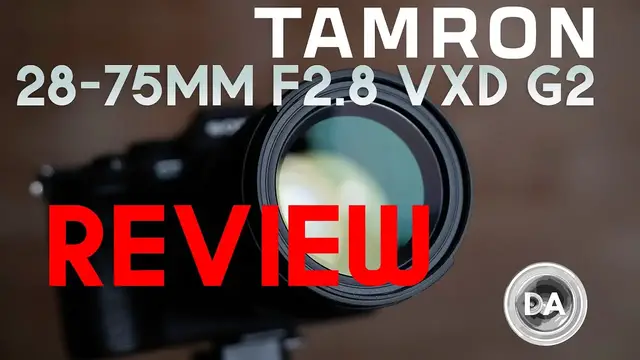
Tamron 28-75mm F2.8 VXD G2 (A063) Review | DA
Jul 17, 2023

Photographer Dustin Abbott shares a thorough, real world review of the second generation Tamron 28-75mm F2.8 VXD G2 wide aperture telephoto zoom. Visit https://bit.ly/lethelightinTV for the new channel | | Read the Text Review: https://bit.ly/A063review | Visit the Image Gallery https://bit.ly/A063pics | Purchase the Tamron 28-75mm F2.8 VXD G2 @ B&H Photo https://bhpho.to/2U3uozJ | Amazon https://amzn.to/3o0FqAz | Amplis Foto https://bit.ly/AmplisA063 (use code AMPLIS52018DA for 5% off) | Camera Canada https://shrsl.com/38lkx | Amazon Canada https://amzn.to/3qaweMQ | Amazon UK https://amzn.to/3BNfpK6 | Amazon Germany https://amzn.to/3nTRLXi
Purchase the Tamron 35-150mm F2-2.8 VXD @ B&H Photo https://bhpho.to/2Y5bXwA | Amazon https://amzn.to/316ycTM | Camera Canada https://shrsl.com/3892h | Amplis Foto (Canada) https://bit.ly/AmplisA058 (use code AMPLIS52018DA for 5% off) | Amazon Canada https://amzn.to/3nKoTAx | Amazon UK https://amzn.to/31gHixv | Amazon Germany https://amzn.to/3mtDl0D
Check out the DA Merch here: https://bit.ly/TWIMerch | Become a Patron: https://www.patreon.com/dustinabbott | On the Web: http://dustinabbott.net/ | Sign up for my Newsletter: http://bit.ly/1RHvUNp | Instagram: http://bit.ly/DLAinsta | Facebook: http://on.fb.me/1nuUUeH | Flickr: http://bit.ly/1UcnC0B | 500px: http://bit.ly/1Sy2Ngu Follow Craig @ https://www.instagram.com/craigstoffersen/
Want to support this channel? Use these affiliate links to shop at:
B&H Photo: http://bhpho.to/1TA0Xge
Camera Canada: http://bit.ly/DLACameraCan
Ebay: http://bit.ly/DustineBay
Make a donation via Paypal: https://www.paypal.com/paypalme/dustinTWI
=============================
Table of Contents:
=============================
0:00 - Intro
2:13 - Build and Handling
6:41 - Focus Action
8:08 - Image Quality Breakdown
25:01 - Conclusion and Pricing
Show More Show Less View Video Transcript
0:00
Hi, I'm Dustin Abbott and I'm here today to give you my standard review of the new Tamron 2875
0:16
millimeter f2.8 di3 which means it's made for mirrorless in this case it is designed for sony
0:22
fe and it has their vxd focus motor and it's called g2 which stands for second generation
0:29
because this is a follow-up to the wildly successful first-generation copy of this lens
0:35
that was the best-selling lens in the world after its release in 2018
0:40
and for a lot of good reasons. This was kind of a breakthrough lens in the sense that it gave a much, much cheaper alternative
0:48
to the expensive Sony G Master lens, and a lens that was smaller and lighter
0:54
also very good optically, good autofocus, And it was kind of one of the very first true big third-party lenses on the Sony platform
1:04
And after that point, of course, there's been a whole wave of development from Tamron and Sigma, Samyang, that have been fantastic
1:12
But this was kind of the granddaddy of those. And so we have a follow-up to that, to where Sony has pretty much improved everything
1:20
And if you want more detail as to all of those things, I recommend that, first of all, you check out my definitive review
1:26
that will dive into everything in greater detail. I'm also going to be following this up next week
1:31
with another episode that just really kind of details in specifics the areas of improvement
1:36
to help you to know whether or not you should make that upgrade for yourself
1:40
if you happen to already own the original 28-75mm RXD. So a few things that have been improved
1:48
First of all, let's talk about build and specifications. The initial lens was fairly plain
1:54
It did have weather sealing. It had good optics and autofocus, as I mentioned, but it had a pretty plain exterior, no switches
2:02
The feel of the rings were just okay. It's a fairly kind of flush lens, particularly when the manual focus ring, it doesn't really stand out hardly at all
2:12
And so not a whole lot going on there. The new lens here, however, though, is really improved in that regard
2:18
It's got a new finish to it that looks much more upscale. It's also more resistant to fingerprints and scratching
2:23
It's got kind of a sculpted design that ergonomically feels really good in the hand
2:28
and also gives it an extra element of style, I think. But on a more practical level, all of the rings are radically improved
2:36
This manual focus ring is worlds better, both in the feel and even in the damping of it
2:42
The zoom ring just has, again, a more premium feel. And one thing that I did note that was kind of interesting
2:48
is that you can see that the amount of zoom extension is, for whatever reason, considerably
2:52
less on the new lens. On that note, even though we've got an improved finish and handling to the
2:59
lens, the lens actually dropped 10 grams in weight, which is frankly kind of surprising
3:04
It's 540 versus 550 grams. This new lens is a little bit bigger in diameter with that new sculpt
3:11
design and kind of the raised ring sections for that, but not significantly. It is 70
3:18
75.8 millimeters in diameter versus 73 millimeter for the original. However, it is just a little bit
3:24
shorter at the same time It is 117 versus 117 millimeters in length So probably not going to notice that too much in the real world They look a little bit different in height here standing here but that has to do more with a redesigned rear cap that is lower profile and to me a better design fit for the Sony platform
3:45
The older cap was thicker and kind of inherited from their DSLR days
3:49
And so anyway, I think that that is also an improvement. Also improved is some of the technology here
3:55
And so you have the focus hold button that in this case has a lot more significance
4:00
because there's also a USB-C port. That is weather sealed, by the way
4:04
You don't have to worry about moisture getting in there. But this allows you to connect the lens to a computer
4:09
and you can download Tamron's lens utility software that allows you to do just a lot of things
4:15
in conjunction with that port and this button. So first of all, firmware updates
4:19
can be directly installed through that, which is nice. But beyond that, you can add a lot of different functionality
4:25
And so included in it through that, you can change the behavior of the manual focus ring
4:29
You can choose which direction you want it to operate in, depending on what you're most familiar with
4:34
You can choose how long the focus throw is. You can choose whether it operates in a linear or nonlinear fashion
4:40
A lot of great things there. Also, you can program this button to do a lot of things
4:45
You can click it and switch between autofocus and manual focus, for example
4:49
Or you can program it to switch for the ring here between an aperture ring and manual focus
4:55
You know, all useful things. You can even program some kind of video specific functionality like, you know, the speed of focus throws or you can even program an A to B focus throw if you want a predefined focus throw for certain applications
5:10
A lot of different functionality there and obviously that's a really, really useful addition to the lens
5:15
Also steadily improved is the weather sealing. We've got a thicker gasket here at the lens mount
5:20
About eight seal points on the interior. There is a flooring coating up front that helps with fingerprints and moisture there, makes it easier to clean
5:29
All of this very welcome because it adds up to a lens that, as we noted, it didn't get bigger and heavier
5:34
but it did get more premium in terms of both the feel of the lens, the handling of the lens
5:40
but also some of the technical options on the lens when it comes to using it
5:46
So that's welcome there. Another thing that's also improved here is the minimum focus distance
5:52
And so on both ends, you're basically able to get about a centimeter closer
5:56
And so here on the wide end, you can get as close as 18 centimeters versus 19 centimeters
6:02
38 centimeters on the telephoto end versus 39. So what that does is it gives you a little bit higher degree of magnification
6:10
The highest magnification is on the wide end. it's up to about 0.37 times, which is obviously a very high, very useful figure. On the wide end
6:19
it's more like 0.25 times. And so in that case, it's not really improved in magnification over
6:25
the previous generation lens, but it is improved in the performance up close where you get
6:29
noticeably better contrast and detail rendering. So another useful application for that. Like the
6:35
previous, they both have nine rounded aperture blades and most of the other functionality is
6:40
pretty much the same. What is improved though over the first generation lens is it's gone from
6:45
the RXD focus motor to the VXD focus motor. That VXD stands for voice coil extreme torque drive
6:54
And so it is a linear focus motor system that according to Tamron is about a hundred percent
7:00
faster and a full focus rack from minimum focus to infinity. The way it plays out is you have
7:06
Lots of torque in all kinds of focus situations, whether I was shooting in low light like you can see from this shot I got accurately focused results If I approach the camera it very strong and smooth and tracking my face If I do my focus pulls you see minimal focus breathing
7:23
you also see smooth transitions from subject to subject, and no kind of visible stepping or pulsing
7:29
or anything like that. I found that I had good focus speed
7:33
in every situation that I used the lens in. I also found that I had very accurately focused results
7:39
for portraits at a variety of different distances and using different focal lengths in the zoom range
7:45
And so a great autofocus system here that I would say is, from what I can tell
7:50
in real world use, is pretty much on par with anything like the G Master type series
7:56
You've got all the torque, the speed, the quietness, and the consistency
8:00
Consistency if I'm using it for a video segment, for tracking my face, you know, all of those things
8:05
So a great autofocus system here. I was really intrigued when I saw the announcement from Tamron and saw the MTF charts for this lens
8:12
because, as noted, this was a lens that held up really well. I actually compared it originally to the G Master, the 24-70mm f2.8 G Master lens
8:22
and while I concluded that in the end the G Master was better, it was not demonstrably better
8:28
and in fact there was some give and take across the frame in terms of performance
8:32
So when I saw that this lens was fairly dramatically improved over this lens
8:37
I thought, wow, this is going to be a pretty fantastic lens optically
8:41
And it certainly is. Quickly looking at distortion, starting at 28 millimeters
8:46
we've got a bit of barrel distortion. It's linear. It's easily correctable
8:50
It's much kinder than the distortion you see on, say, the Sigma 24-70mm f2.8
8:57
That's one of the advantages of only going as wide as 28 millimeters is that it's an easier lens to design for
9:04
And so, you know, that is a trade-off in that, you know, I think pretty much everybody would
9:08
prefer that you could go as wide as 24 millimeters, but your upside is you get less distortion there
9:13
And again, vignette is just at a moderate level. This switches in the middle of the range to pin
9:18
cushion distortion, which is where it stays through 75 millimeters. And again, a linear
9:24
not too bad to correct about a minus eight is what I needed to use to correct for it. If I did
9:28
a manual correction, there are correction profiles out there and it will receive automatic corrections
9:33
in camera for JPEGs and video right off the bat. And so again, nothing extreme there. As far as
9:40
aberrations, I saw only in the most difficult situations, a tiny bit of fringing. And that's
9:47
only viewed at a hundred percent level, not enough to really be a factor. In most situations, I saw
9:52
no lateral chromatic operations along the edges of the frame either. I did have this one shot where
9:57
there's some bare branches and you can see some purple fringing along some of that. But again
10:02
only in the most difficult of situations. So overall, good control of aberrations
10:07
That adds up to a lens that has a lot of contrast and a lot of resolution. At 28 millimeters
10:12
it is extremely sharp all the way across the frame with very little drop off at any point
10:18
The sharpness profile goes right out to the edge of the frame. In the middle of the zoom range
10:23
it's about equal in the center and towards the mid frame and just a tiny bit worse in the corners
10:30
but you can stop down to F4, F5.6 and improve those corners. So typically around F5.6 is kind
10:38
of your optimal kind of aperture value for getting sharpness across the frame for like landscapes
10:46
Then at 75 millimeters you see an uptick again and that really probably the single greatest improvement in that you just have great sharpness again all across the frame and so it really great that at both the extreme ends you get top optical performance and so I found that you know byproduct
11:02
that say this this shot of just this chain link you can see that even in a simple thing like this
11:06
if you zoom into a pixel level the contrast and the delineation of you know just of textures and
11:12
information is really, really fantastic. I also found that the lens had a great combination of
11:18
contrast and color pop, and so images just have this special kind of quality to them, I think
11:24
that is at another level. One other kind of subtle but important detail I noticed when shooting
11:29
portraits side by side is that I felt like color accuracy was a little bit better with the G2 lens
11:35
and so skin tones have a little bit, there's none of that, very, very, it was slight, but there was
11:39
a slight kind of yellowish tinge in the original AO36, as Tamron calls it, and in the AO63
11:46
the new lens color is just more accurate. Bokeh quality is also improved, particularly at 75
11:52
millimeters, where it doesn't have, this one had a little bit of a nervous quality at 75 millimeters
11:58
It's smoother here, and so again, a really nice byproduct from all of that. It also did a good
12:04
job when shooting the night sky. Very low instances of coma. That held up well. And I felt
12:10
that overall flare resistance was also quite good in most situations. It was only in the most extreme
12:15
of circumstances that I could introduce some flare artifacts. But for most real world shooting
12:21
flare resistance is going to be fantastic. At the end of the day, I almost look at this lens
12:26
as being fan service because they have given us a lens that has improved really across the board
12:31
and have basically left the price unchanged. Right now, this lens sells for $879 US dollars
12:38
the new lens for $899 US dollars. Now, I know from some feedback
12:42
that that may not be exactly true in your home market, and I suspect that this lens will probably get
12:47
either heavily discounted or phased out in probably some combination of the two
12:52
to where it will be discounted for a season as they clear off stock, and this will be the one that is stocked in the future
12:59
At the end of the day, however, this is a lot of lens for the money and represents, you know
13:03
probably one of the best values that I've seen in a standard zoom. Some of you have asked me about
13:08
how this compares to the 28 to 70 millimeter from Sigma. The only real advantage I would say for the
13:13
Sigma is that it's smaller and lighter. And basically every other facet, I think that this
13:18
lens is the better of the two. And it is an easy recommendation for me if you're looking for a lens
13:23
and you don't mind that it starts at 28 millimeters. And some of you, you really want to go to 24 millimeters
13:30
And so that's the deal breaker. Consider the Sigma. And then of course there is the G Master lens
13:35
though I have to think that there's probably a Mark II of the 24 to 70 millimeter G Master
13:40
somewhere on the horizon. Anyway, I hope that this helps you to make an informed decision
13:45
If you want more information, you can look in the description down below and you can find linkage to my full text review
13:51
which has lots of information there. You can also find linkage to an image gallery if you want to look at photos
13:56
Beyond that, there are some buying links there if you want to purchase one for yourself. You can find linkage to check out our new channel, Let the Light In TV, where Craig and I collaborate over there
14:05
You can also find linkage to follow Craig and I on social media, to become a patron, to sign up for my newsletter, and buy merchandise
14:13
And, of course, if you haven't already, please click that subscribe button right here on YouTube. Thanks for watching. Have a great day
14:19
And Let the Light In